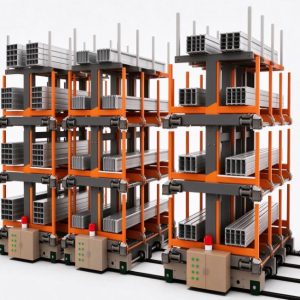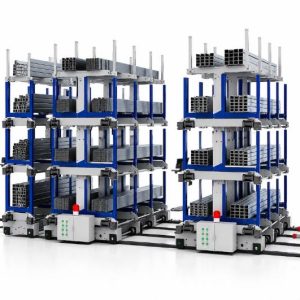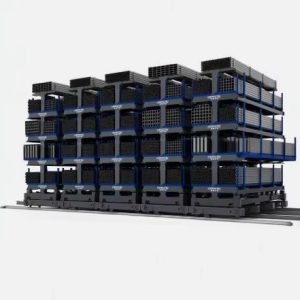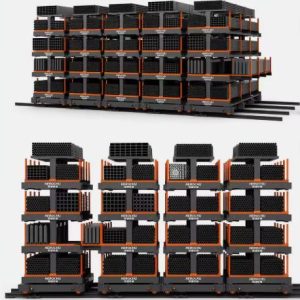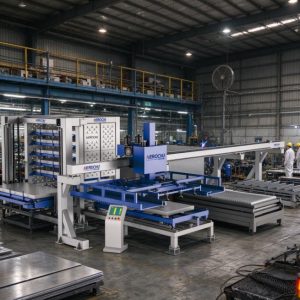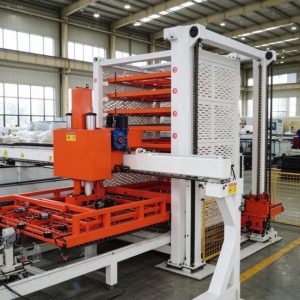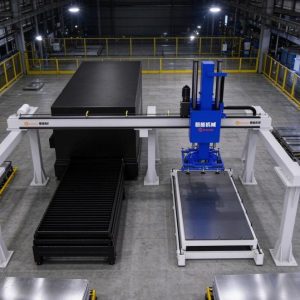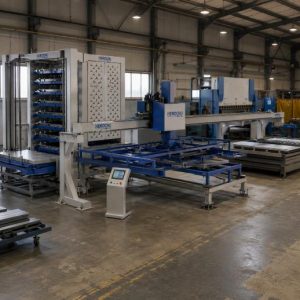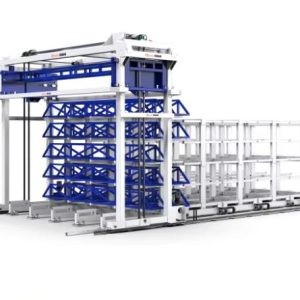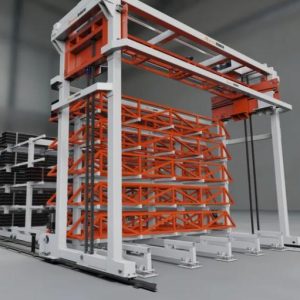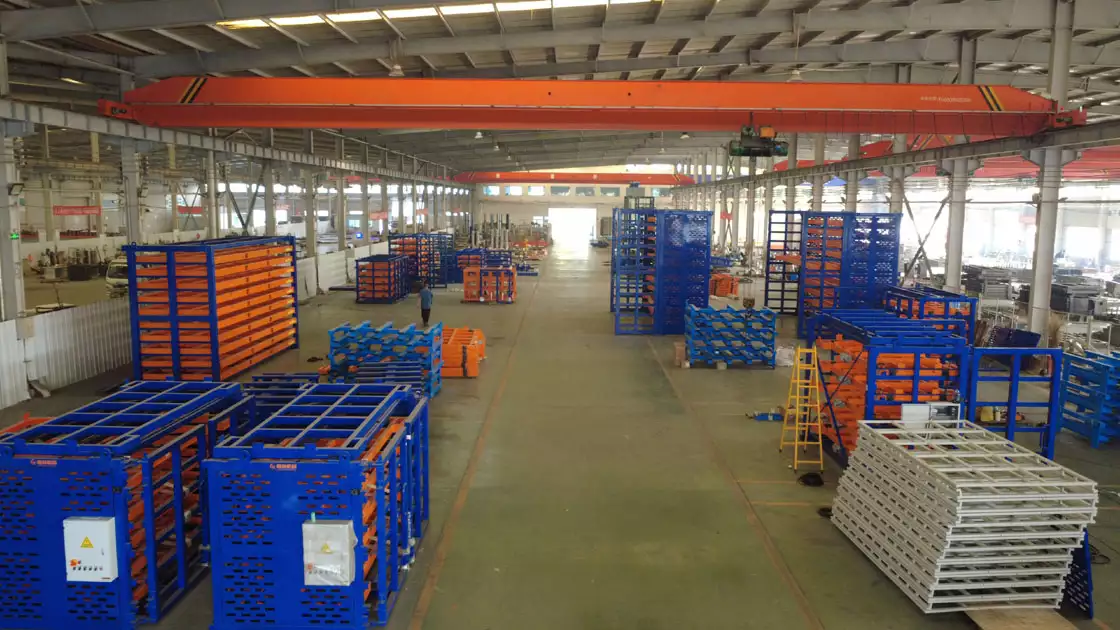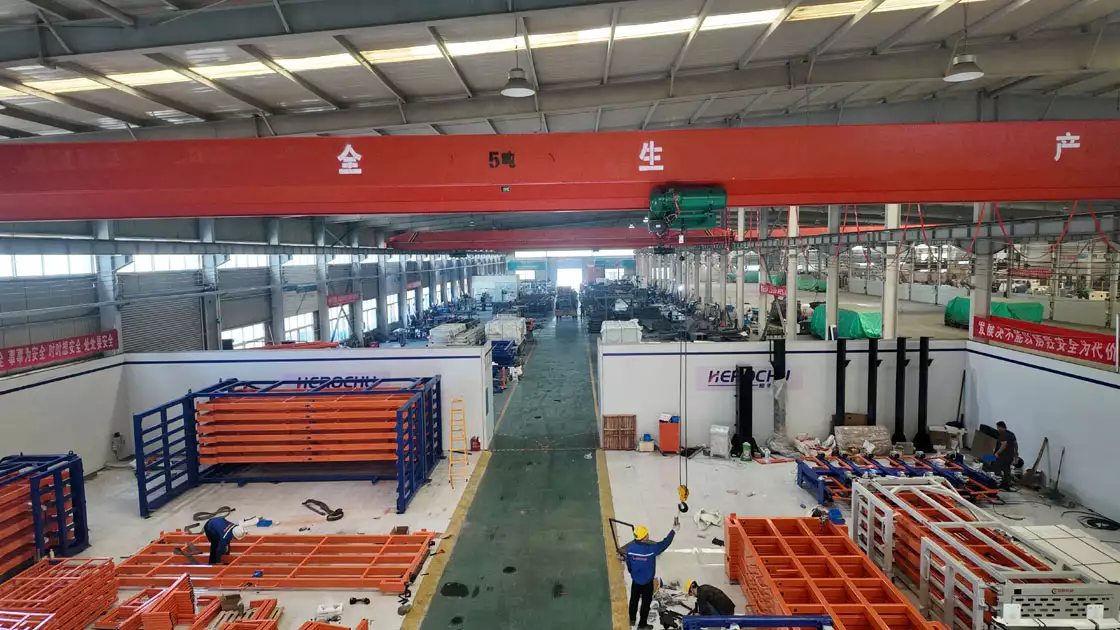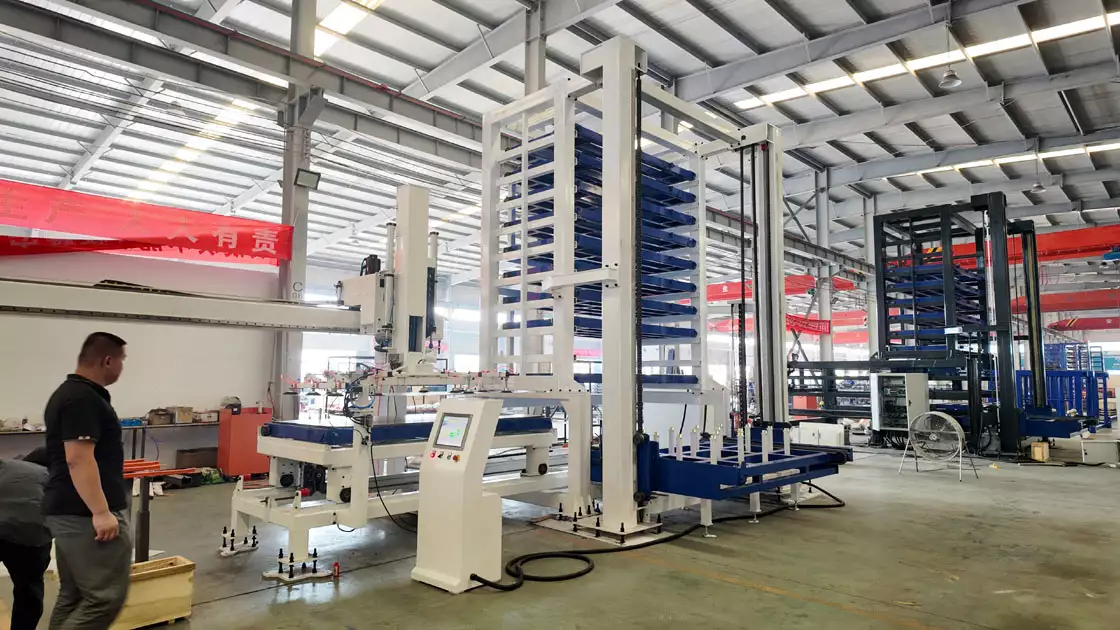
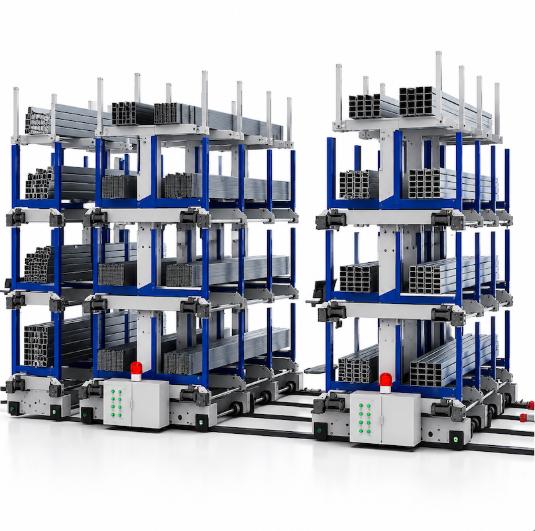
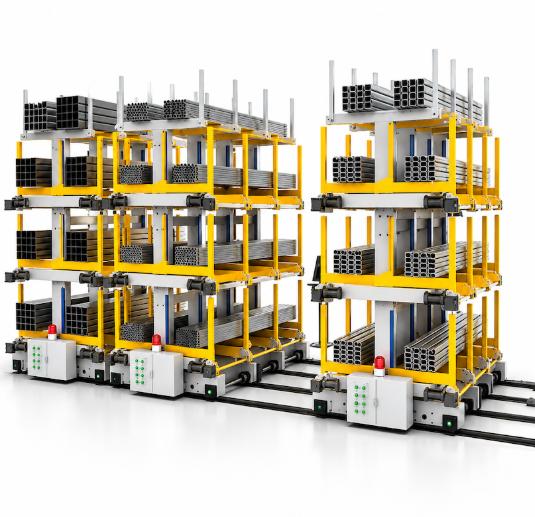
A mobile pipe storage rack places several cantilever towers on floor-mounted rails that share one picking aisle. Each tower moves independently on a motorized carriage, so the aisle opens only in front of the tower being loaded. Herochu builds this format for 6,000–12,000 mm steel pipe, tube and profile stock, with up to 5,000 kg per level on a single side.
Why long stock eats floor space
A 12-metre bundle of tube does not fit anywhere convenient. Lay it on the floor and it blocks traffic. Put it on a fixed cantilever rack and every rack needs its own aisle, because a forklift or an overhead crane has to reach the full length of the load. Five fixed racks mean five aisles. In a 40-metre-wide bay, that is more than half the floor given over to air.
Fixed cantilever racking is not a bad product. It is simply generous with space. The aisle stores nothing, and it exists for every rack, all day, even when only one rack is being worked.
A mobile pipe storage rack attacks that specific waste. Towers stand side by side with a few centimetres between them. When an operator needs a bundle, the selected tower travels out of the block and opens one aisle. The other towers stay closed. Storage density rises because the aisle is shared instead of duplicated.
What the rail system looks like in practice
Herochu builds the S-series on floor-mounted rails. Two rails run the length of the storage block, set into or on top of the slab, and every tower undercarriage rides on them. The rail carries the vertical load; a chain drive moves the tower.
Two speeds matter. Carriage speed during positioning is 27 mm/s, deliberately slow because a loaded tower carrying several tonnes per level should not accelerate. Travel speed between positions is 1–5 m/min. Both are handled by Siemens PLC logic, so the tower stops at fixed positions instead of wherever an operator releases a button.
The picking aisle is the only open floor inside the block. Because every tower uses the same aisle, the layout works in buildings where a high-bay automated store would never fit: low truss heights, mezzanine edges, older factory bays with services running overhead.
Sizing around the material, not the catalogue
Long-goods storage fails when the rack is chosen before the stock list is written. Three numbers drive everything: the longest piece, the heaviest bundle per level, and the number of levels the ceiling allows.
Herochu’s standard models cover the common ranges:
| Model | Pipe length | Levels | Load per level | Towers |
|---|---|---|---|---|
| HC-G6053EM-5 | 6,000 mm | 5 (customisable) | 3,000 kg | 5 (customisable) |
| HC-G9055EM-7 | 9,000 mm | 5 (customisable) | 5,000 kg | 7 (customisable) |
| HC-G12065EM-7 | 12,000 mm | 6 (customisable) | 5,000 kg | 7 (customisable) |
Anything outside those bands is a layout question, not a product gap. Tower count, layer count and arm pitch are set by the material mix. A fabricator cutting 6-metre tube all day needs different arm spacing from a distributor holding mixed bundles of angle, channel and bar.
Space arithmetic for a low-bay warehouse
Take a bay 36 m long and 18 m wide with 6 m clear height. Five fixed cantilever racks at 12 m long, each with a 3.5 m operating aisle, need roughly 5 × (1.2 m rack depth + 3.5 m aisle) across the width — about 23 m of the 18 m available, which is why most bays like this end up with three racks and floor stacking for everything else.
The same block built as five mobile towers on shared rails uses 1.2 m × 5 towers plus one 3.5 m aisle: about 9.5 m of width. The remaining floor stays clear for cutting stations, dispatch or a second block. That is a layout gain, not a warehouse extension.
Vertical lift on the retrieval carriage runs at 9 m/min and in-and-out travel at 12 m/min, so a level change costs seconds rather than minutes.
Where it fits, and where it does not
Mobile rail systems suit steady, mixed-SKU long stock: tube, pipe, profiles, bar, wire and irregular sections that do not palletise well. They suit buildings with height limits. They suit operations where a forklift currently threads between racks all shift instead of moving material.
They are a poor fit where throughput is extremely high and several operators need simultaneous access to different towers, because one aisle serves one pick at a time. They also need a sound slab, since the rails transfer point loads from a moving, loaded tower.
FAQ
How much floor space does a mobile pipe storage rack save? Typically 35–50% of the storage footprint compared with fixed cantilever racking in the same bay, because one shared aisle replaces one aisle per rack. The real figure depends on tower count and aisle width.
Can it handle 12-metre pipe? Yes. The HC-G12065EM-7 is built for 12,000 mm material with six levels and 5,000 kg per level on a single side. Shorter or longer lengths are fixed at order stage.
Does the system need a special foundation? It needs a level, load-rated concrete slab. Floor-mounted rails are anchored to the slab and carry the travelling load, so slab condition is checked during the site survey.
How are loads taken from upper levels? Through electric assistance and a PLC-controlled carriage. Each tower moves independently so adjacent stock stays undisturbed.
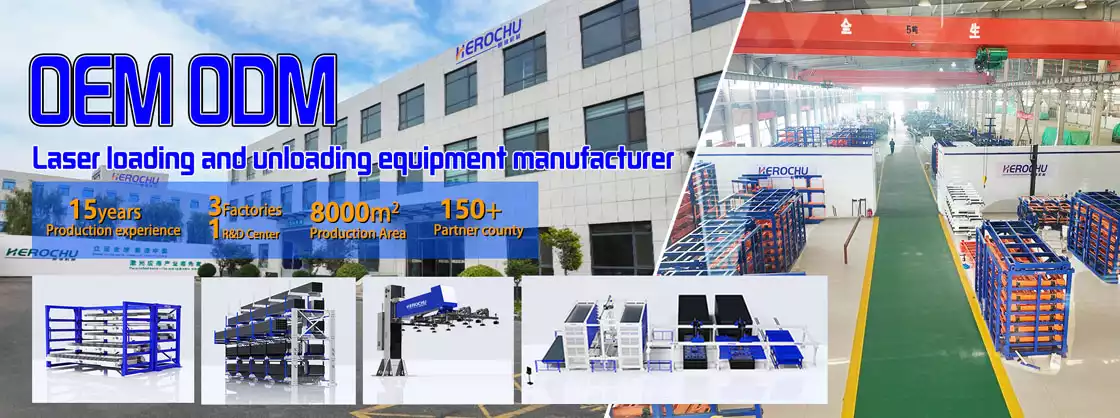
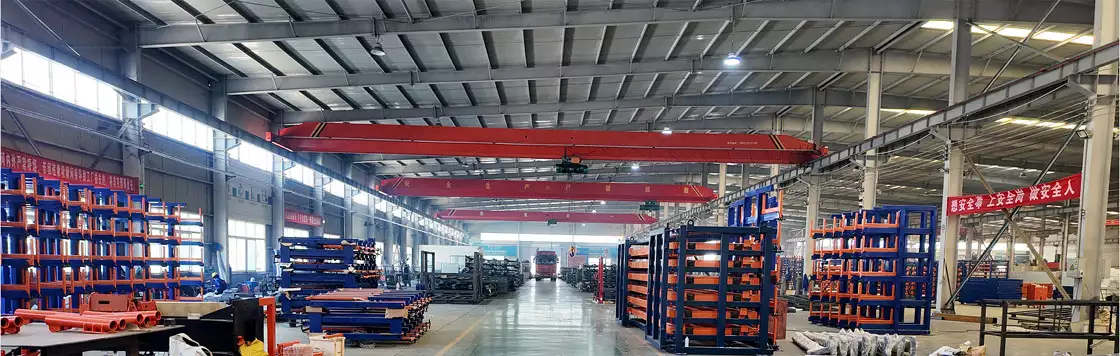
Who builds the system? Herochu designs, manufactures and commissions it, including rail layout, tower structure and control logic.
Choosing between fixed and mobile
If your long stock already has a home and the aisle count is manageable, fixed cantilever racking is the simpler purchase. If floor space is the constraint, if the ceiling is low, and if the same forklift spends its day driving around racks instead of moving steel, a shared-aisle mobile system pays back in square metres. Herochu will size a layout against your actual stock list before anything is quoted.