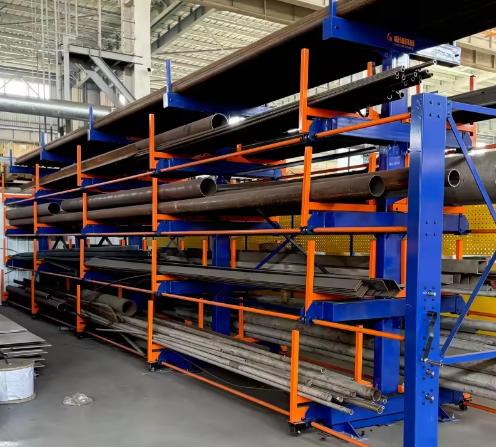
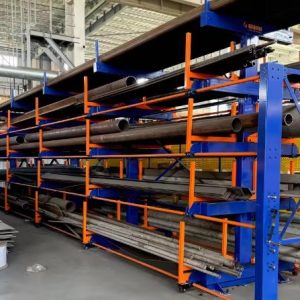
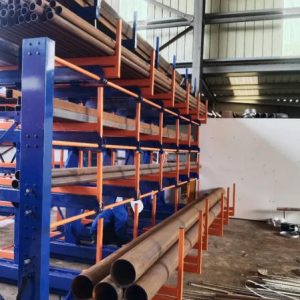
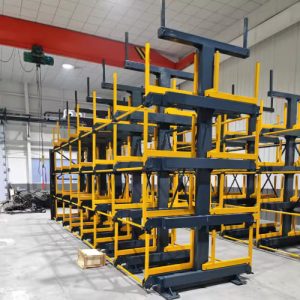
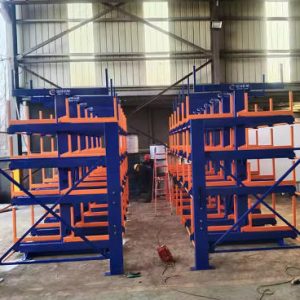
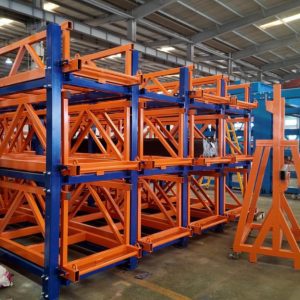
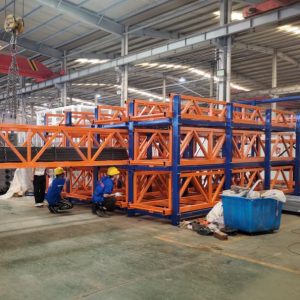
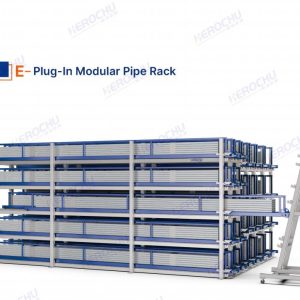
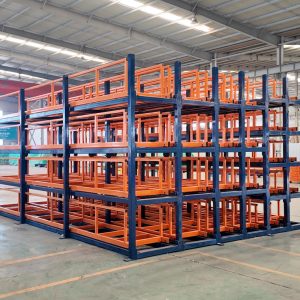
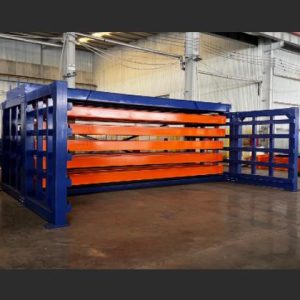
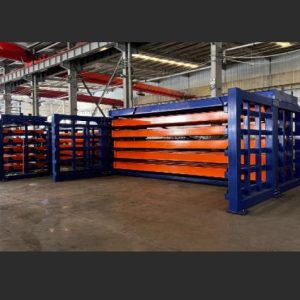
Herochu heavy-duty crank-out cantilever racks store 6 m to 12 m steel bar and tubing without digging. Q235B frame, 3,000–5,000 kg per level, CE and ISO tested.
Steel bar arrives in bundles. That one fact shapes the whole warehouse layout. A bundle of 6 m rebar cannot be split by hand at the receiving dock, and it does not fit a pallet rack opening without wasting half the depth. The rack has to take the load as delivered, hold it level, and return it without disturbing anything stacked above. That is the design brief behind the Herochu heavy-duty crank-out cantilever rack.
Quick answer: A crank-out cantilever rack stores steel bar and tubing on arms that extend on a manual crank, so a crane lifts each bundle vertically instead of dragging it past the tier above.
Why a cantilever beats a pallet rack for bar stock
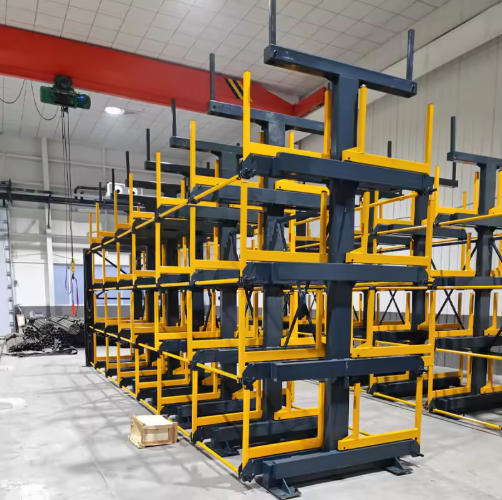
A pallet rack places a front column in the loading path. For cartons that is harmless. For a 9 m pipe pushed in from the end, the column limits usable depth and forces the operator to angle the load. Cantilever arms project forward from a single line of columns at the rear, so the bay stays open from floor slab to top level and nothing obstructs a crane hook.
Herochu builds the upright from fabricated I-section stock in Q235B steel, with Q355B available for the heavier tiers. The I-section matters once you pass roughly three tonnes per level; a rolled channel starts to deflect at the arm root and that deflection never recovers.
What “crank-out” changes in practice
On a fixed-arm cantilever rack, reaching the third bundle in a bay means lifting the two in front of it first. That is the digging cycle, and in a steel service centre it consumes more labour than any other warehouse task.
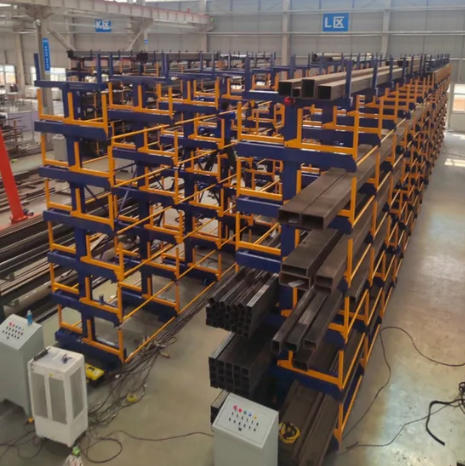
A crank-out arm carries its load on a travelling carriage inside the arm body. Turning the manual crank drives a gear pair that extends the carriage forward until it clears the arm above. Travel is full extension, so the bundle sits outside the rack envelope and can be lifted vertically with no side clearance at all.
Three consequences show up on the floor:
- Crane access to every tier. The hook descends directly onto the bundle instead of dragging it sideways past an arm tip.
- No electrical service on the rack. No motor, no festoon cable, no control cabinet to protect from grinding dust, no hydraulic oil in a workshop already fighting contamination.
- Narrower aisles. Loads are retrieved from above rather than pulled out by forklift, so the aisle only serves transport. Most installations recover 1.5 m to 2.5 m of width per aisle, which is usually where the payback starts.
Matching the model to the material
Herochu publishes four standard configurations, each adjustable at the order stage:
| Model | Pipe length | Max load per level | Layers |
|---|---|---|---|
| HC-G6053S | 6,000 mm | 3,000 kg | 5 |
| HC-G6053 | 6,000 mm | 3,000 kg | 5 |
| HC-G9065 | 9,000 mm | 5,000 kg | 6 |
| HC-G12065 | 12,000 mm | 5,000 kg | 6 |
Layer count and clear space are built to order; the 600 mm clear space in the standard sheet is a starting point, not a ceiling. Arm spacing adjusts on the column at fixed pitch, so one bay can hold 80 mm flat bar below and 400 mm pipe bundles above without a frame change. The load figures are working loads verified on the assembled structure, not paper calculations, and every rack ships with CE and ISO 9001 documentation.
Structural details that surface in daily use
Dual-beam crossbar. Arms are tied by a double-beam crossbar rather than a single tube. Under an eccentric bundle — one sitting toward the arm tip — a single crossbar twists, and that twist is what eventually cracks welds at the column junction. Two beams share the torsion.
Independent compartments per tier. Each level is closed on both sides, so a bundle cannot migrate sideways into the neighbouring slot during a lift. Loose bar and bundled stock can share a bay without mixing.
Arm stoppers. Removable end stops keep round bar from rolling off during extension. They are sized to the load and can be left off on tiers reserved for flat plate.
Powder coating. Electrostatic powder coat over phosphated Q235 steel wipes clean of coolant mist and cutting oil, where bare mill scale holds an oil film that traps swarf.
Where the configuration pays back
Steel service centres with mixed order profiles gain the most. A centre carrying 400 stock lines cannot dedicate a bay to each one, so adjustable arms and crank extension let the same frame serve 12 m tube on Monday and 6 m flats on Friday. Fabricators with one high-turnover section gain less from flexibility and more from speed: their calculation is pick time per bundle, and the crank-out arm removes double handling entirely.
Choosing the supplier
Two racks can both claim five tonnes per level and still differ in weld quality, steel certification and whether the load test is genuine. Herochu supplies mill certificates with every order and builds the crank as a serviceable assembly rather than a sealed unit.