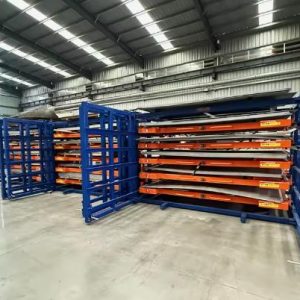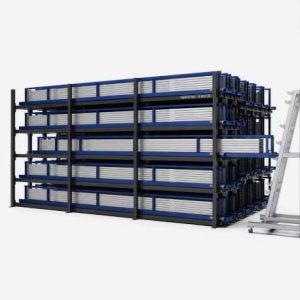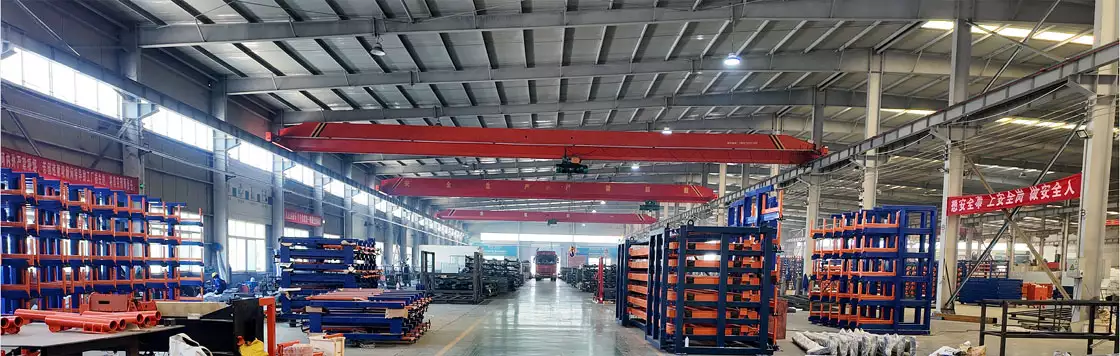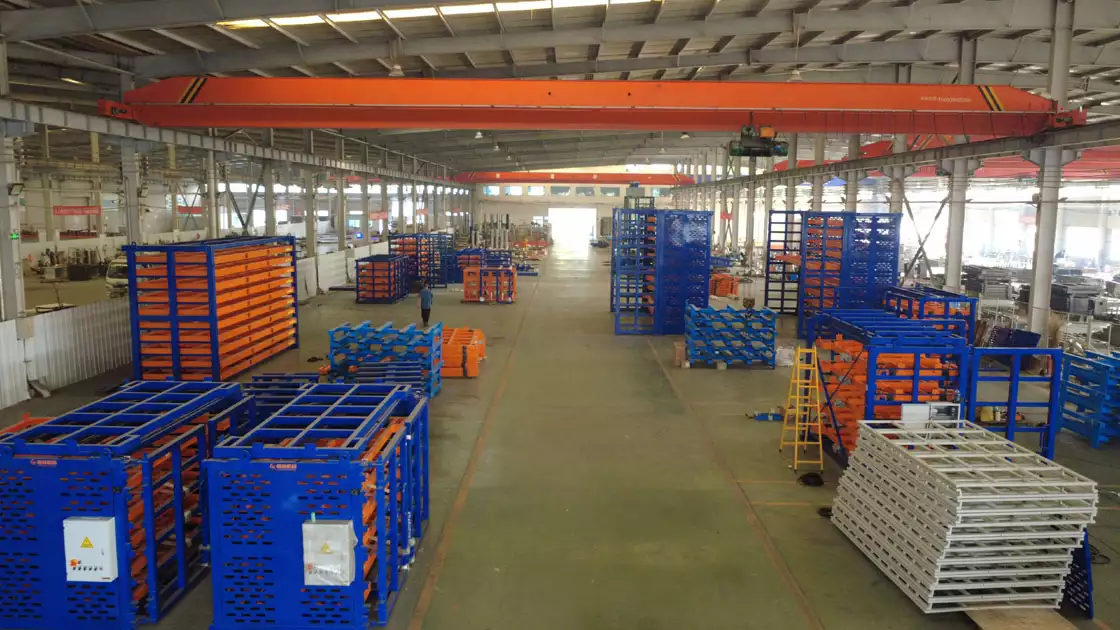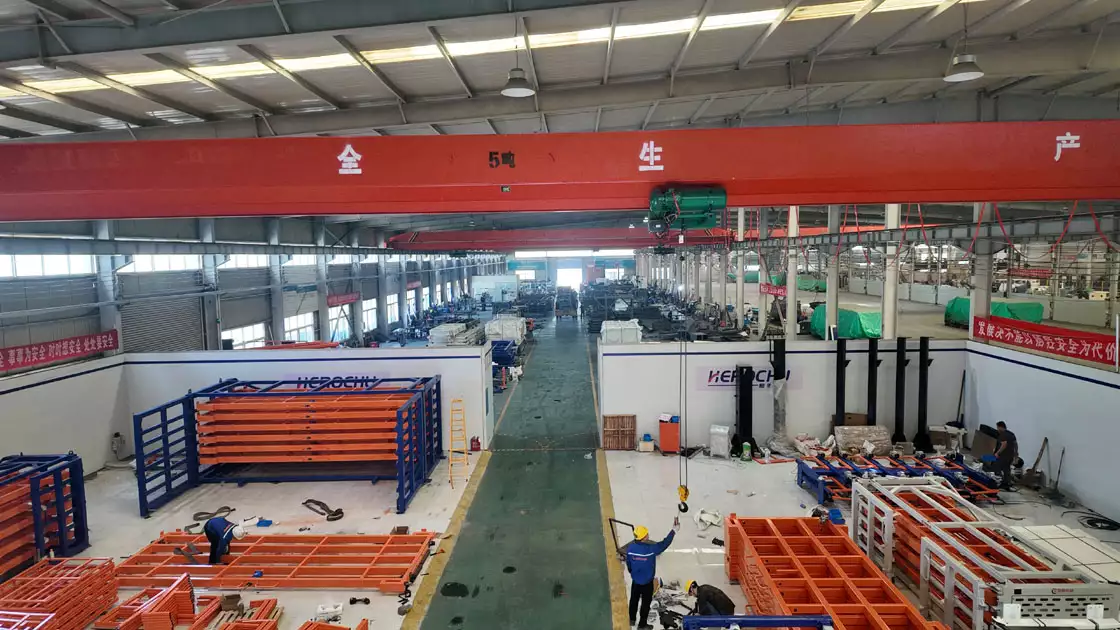
A hand-cranked roll-out sheet metal storage racking system is only as reliable as the frame that carries its load. The crank mechanism, the gear rack drive, the guided rollers — all of these components depend on a frame that holds its geometry under five tons per tier and does not deflect, twist, or settle over years of cyclic loading. The Herochu HC-B series is engineered around this premise: the frame is built first, and the motion components are integrated into a structure that is already proven to carry the load.
The frame material is Q235B high-strength steel, selected for its yield strength, weldability, and consistency across structural sections. Q235B is the backbone of heavy industrial racking in Chinese fabrication, and its mechanical properties — minimum yield strength of 235 MPa, tensile strength in the 375–500 MPa range — align with the load demands of multi-tier sheet storage. Herochu uses Q235B throughout the main frame, the drawer carriages, and the load-bearing connection points, creating a homogeneous structure that responds to stress uniformly rather than concentrating it at material transitions.
Dual-Beam Design and Load Path
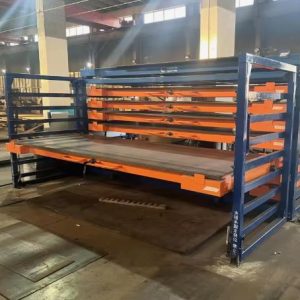
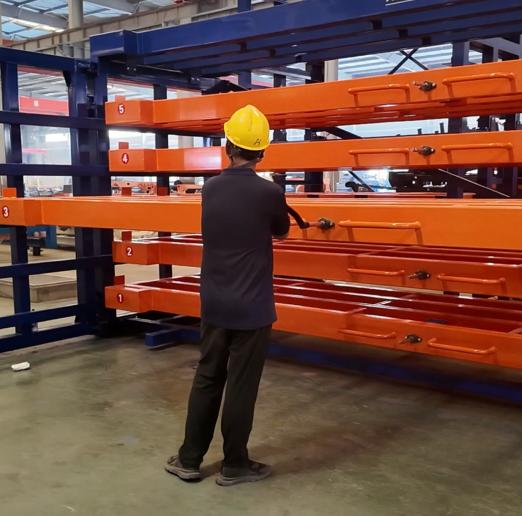
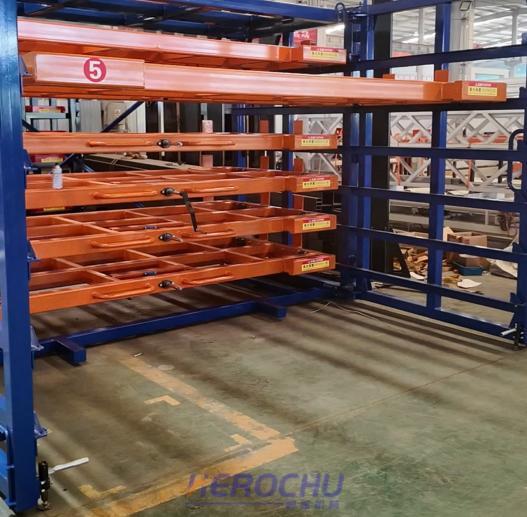
The dual-beam design is the structural signature of the Herochu HC-B series. Each tier rests on two longitudinal beams that span the frame width, and each drawer carriage rides on rollers that track along both beams. This configuration splits the drawer load between two parallel paths instead of forcing a single beam to carry the entire weight at midspan. The benefit is measurable: beam deflection under full load drops roughly by half compared to a single-beam arrangement, and the gear rack drive maintains its engagement geometry because the mounting surface stays stable.
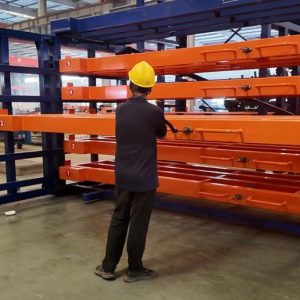
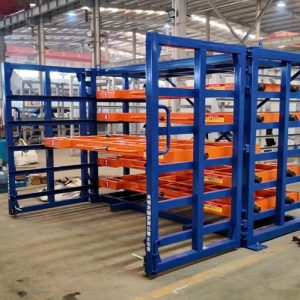
When a drawer extends outward, the load center shifts from inside the frame to a cantilevered position in the aisle. The dual-beam structure manages this transition by keeping the roller track supported at the front and rear of the frame, so the drawer is never fully unsupported even at full extension. The solid steel load roller under the drawer carriage bears the weight, and the lateral guide wheel prevents the drawer from skewing as the load center moves outward. Together, these components keep the extension smooth and the drawer trajectory straight, even when the drawer is loaded asymmetrically with sheets of different sizes on the same tier.
Cyclic Loading and Fatigue Consideration
Static load capacity tells part of the story. A rack that holds five tons per tier for a month is one thing; a rack that holds five tons per tier through thousands of open-close cycles is another. The Herochu frame is designed for cyclic loading. The dual-beam geometry, the Q235B material, and the connection detailing at the column-to-beam joints all contribute to a structure that resists the fatigue effects of repeated drawer extension.
The connection points use bolted and welded joints in combination — welding for structural rigidity and bolted connections for field assembly and future reconfiguration. This hybrid approach means the rack can be disassembled, moved, and re-erected without cutting welds, which matters for facilities that reconfigure their shop layout as production volumes change. The frame geometry is consistent across all five HC-B models, so the structural logic scales from the 2,500 × 1,300 mm sheet size up to the 6,000 × 2,000 mm sheet size without requiring a fundamentally different load path.
Gear Rack Drive Under Cyclic Load
The gear rack drive is the motion element most directly affected by cyclic loading. Each time the operator cranks a drawer open and closed, the gear teeth engage, carry the drawer mass through the extension stroke, and disengage at the closed position. Over thousands of cycles, the tooth engagement surface must maintain its geometry or the motion quality degrades — backlash increases, the crank develops play, and the operator starts to feel chatter in the handle.
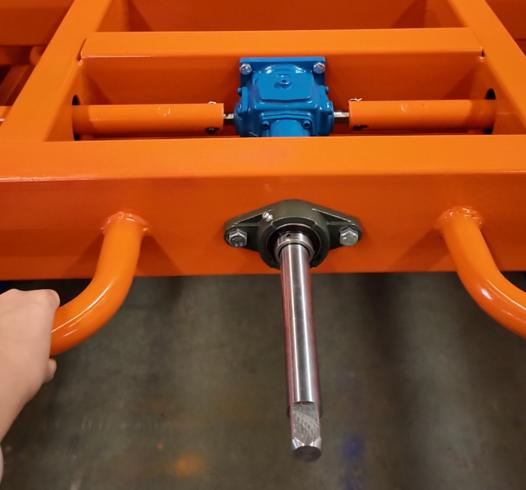
Herochu mitigates this with the pillow block bearing that stabilizes the crank shaft and prevents lateral deflection at the gear interface. The bearing holds the shaft concentric with the gear rack under the side thrust generated during cranking, which keeps the tooth engagement surface consistent and distributes wear evenly across the gear face. The 1:1.5 reduction ratio means the gear teeth see lower per-cycle force than a direct-drive arrangement would produce, extending the service life of the drive components under the same load.
Model Selection by Load Class
The HC-B series divides into two load classes based on per-tier capacity:
- 3,000 kg per tier: HC-B2513-63, HC-B3015-63, HC-B4015-63 — suited for standard plate stock up to 4,000 × 1,500 mm
- 5,000 kg per tier: HC-B4020-65, HC-B6020-65 — suited for heavy plate up to 6,000 × 2,000 mm
Both load classes share the same dual-beam Q235B frame architecture. The difference lies in the beam section dimensions, the roller capacity, and the connection detailing — all scaled to the target load. A buyer specifying the rack confirms the maximum sheet weight per tier, selects the matching model, and adjusts the number of layers and clear space to match the inventory. The clear space per tier is 120 mm as standard and can be customized for shops storing thicker plate or stacked sheet bundles.
Anchoring and Floor Preparation
The frame stability under cyclic load depends partly on the floor it stands on. Herochu provides adjustable foot plates at each column base, allowing the rack to be leveled on floors with minor irregularities. Once leveled, the frame is anchored to the floor to resist the overturning moment generated when a fully loaded drawer is extended into the aisle. The anchoring specification is part of the installation package — the rack is not designed to operate unanchored, and the anchor points are sized for the overturning loads calculated at full per-tier capacity.
For shops with overhead cranes, the rack can also be tied to ceiling-mounted lateral restraint brackets at the top of the frame, which adds stability against the lateral forces generated during crane-assisted loading of the top tier. The frame is compatible with both floor-anchored and ceiling-restrained installations, giving the facility flexibility in how it integrates the rack into its existing material handling infrastructure.
Engineering as the Product
The Herochu hand-cranked roll-out sheet metal storage racking system is, at its core, a structural engineering product. The crank makes it ergonomic. The rollers make it smooth. The per-drawer independence makes it selective. But the frame — the Q235B dual-beam structure that holds everything in alignment under five tons of cyclic load — is what makes it durable. That is the specification a buyer should evaluate first, because every other feature depends on it.