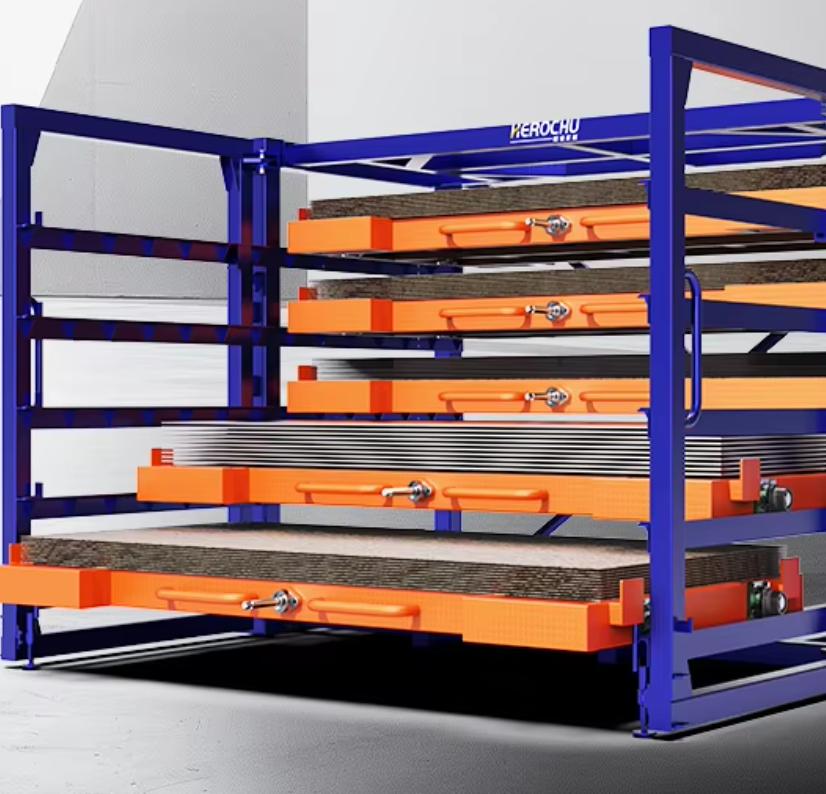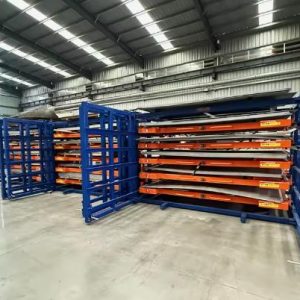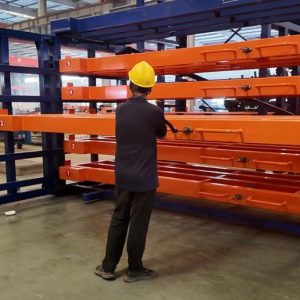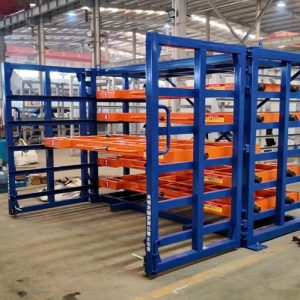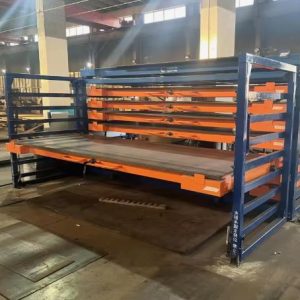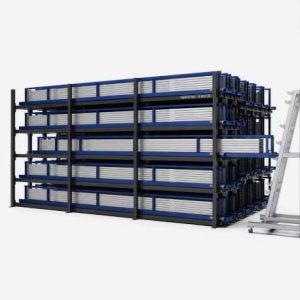
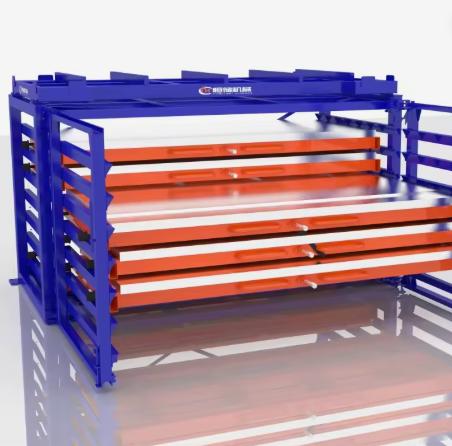
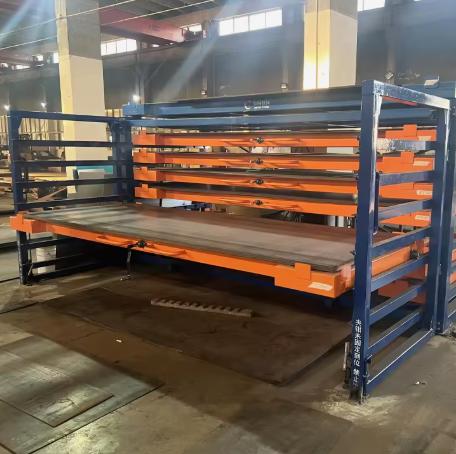
The defining feature of a manual crank-out sheet rack is not the crank itself — it is the independence of each shelf. When every drawer carries its own hand crank, the rack stops being a storage container and becomes a selective retrieval system. One operator opens one drawer, retrieves one sheet, and closes it. The rest of the inventory stays in place, supported and sealed behind closed steel panels. That selective access is the mechanical foundation of the Herochu HC-B series, and it reshapes how a fabrication shop sequences its material flow.
Consider the alternative. Static shelving forces the operator to reach past front sheets to access the ones behind them. Flat storage on the floor or on pallets exposes every sheet to damage and requires a crane or forklift for every retrieval. A powered roll-out system automates the motion but adds a control layer, electrical maintenance, and a single point of failure. The Herochu manual crank-out sheet rack with roll-out shelves sits between these extremes: it gives the operator mechanical assistance where it is needed and keeps the system mechanically simple where automation would add cost without proportional benefit.
The Geometry of Selective Access
Each roll-out shelf in the Herochu rack extends outward on guided rollers and lateral guide wheels. The undercarriage carries a solid steel load roller that bears the weight of the drawer and its contents, plus a lateral guide wheel that keeps the drawer tracking straight along its rails. When the operator cranks a drawer open, these components engage immediately — the load roller carries the mass and the guide wheel prevents sideways drift. The result is drawer motion that starts smoothly, tracks straight, and stops cleanly at full extension without the binding or ratcheting that would force the operator to improvise with extra force.
This guided motion matters for more than convenience. When drawer travel is controlled, the operator does not need to jerk the handle, lean into the pull, or recruit a second person to stabilize the load. The physical demand drops to a level that one person can manage across a full shift, even when the drawer holds three to five tons of plate stock. The ergonomic argument and the mechanical argument point in the same direction: smooth motion protects both the operator and the equipment.
Classified Storage and Material Integrity
Sheet metal inventories are rarely uniform. A single rack may hold mild steel plate, stainless sheet, aluminum, and specialty alloys in different thicknesses and heat-treat conditions. Mixing these materials in open storage invites contamination, picking errors, and damage from contact between dissimilar metals. The Herochu manual crank-out sheet rack addresses this by giving each drawer its own crank and its own enclosed storage compartment. The operator accesses only what is needed, and the rest remains classified, separated, and protected.
For shops serving aerospace, automotive, or structural fabrication contracts, material traceability is not optional. Each sheet must be identifiable and retrievable without disturbing adjacent stock. The per-drawer crank system supports this requirement mechanically — the operator does not need to open, shift, or re-stack material to reach a specific sheet. The drawer that contains the needed material is the only drawer that moves.
Dual-Beam Frame and Load Distribution
The main frame of the Herochu HC-B series is built from Q235B high-strength steel using a dual-beam design. Two longitudinal beams carry the drawer load at each tier, distributing the weight across the frame structure rather than concentrating it at a single point. This distribution keeps the frame geometry stable under full load — up to 5,000 kg per tier on the HC-B4020 and HC-B6020 models — and maintains the alignment of the gear rack drive over thousands of extension cycles.
The dual-beam approach also simplifies installation and leveling. The frame stands on adjustable foot plates that accommodate minor floor irregularities, and the beam spacing is set to match the roller track geometry of the drawers. Once the frame is level and anchored, the drawers extend and retract within their designed tolerances without lateral drift. The clear space between tiers — 120 mm as standard, customizable for thicker material — keeps the sheet edges clear of the beam above and below during extension.
Model Range and Configuration Logic
Herochu offers five standard configurations in the HC-B series, scaling with sheet dimensions and per-tier load capacity:
- HC-B2513-63: 2,500 × 1,300 mm sheets, 3,000 kg per tier, six layers
- HC-B3015-63: 3,000 × 1,500 mm sheets, 3,000 kg per tier, six layers
- HC-B4015-63: 4,000 × 1,500 mm sheets, 3,000 kg per tier, six layers
- HC-B4020-65: 4,000 × 2,000 mm sheets, 5,000 kg per tier, six layers
- HC-B6020-65: 6,000 × 2,000 mm sheets, 5,000 kg per tier, six layers
The number of layers is customizable. The clear space per tier is customizable. The material discharge method — mechanical assistance via hand crank — is consistent across the range. A buyer specifying the rack begins with sheet dimensions, confirms per-tier load, and adjusts layer count and clear space to match the inventory profile. Herochu tailors the configuration to the material types the shop actually stores, rather than forcing the shop to adapt its inventory to a fixed rack geometry.
Where the Manual Crank-Out Rack Fits
The Herochu manual crank-out sheet rack with roll-out shelves occupies a specific niche in the storage equipment field. It is not a replacement for automated storage and retrieval systems in facilities that need lights-out operation or high-frequency random access. It is the right choice for shops that need heavy-capacity, selective, ergonomically sound sheet storage without the capital and maintenance cost of powered automation. The hand crank multiplies the operator’s input torque, the guided rollers keep the motion controlled, and the per-drawer independence preserves selective access. For those requirements, no other storage architecture delivers the same balance of capacity, control, and mechanical simplicity.