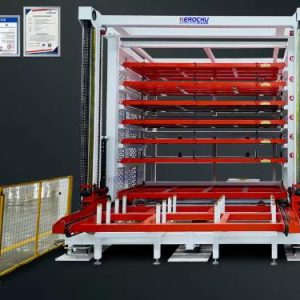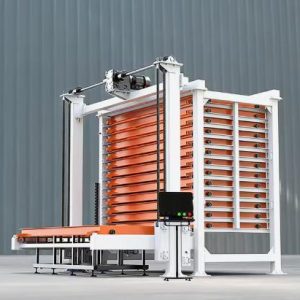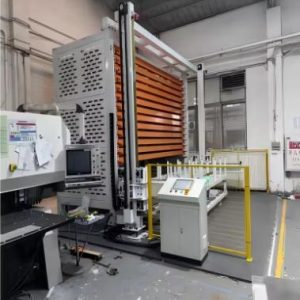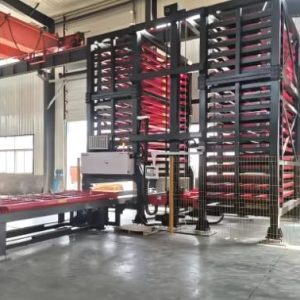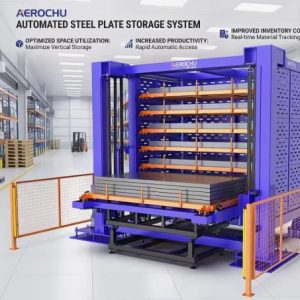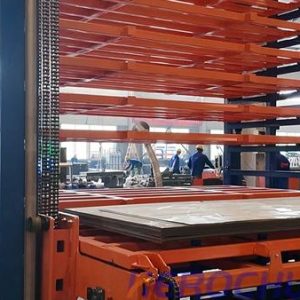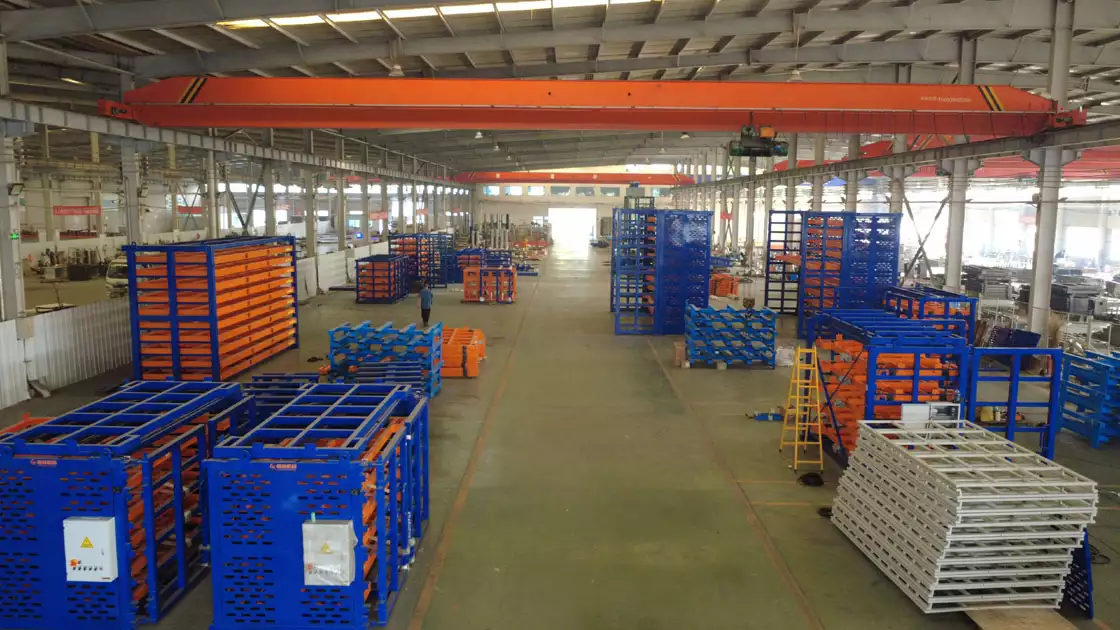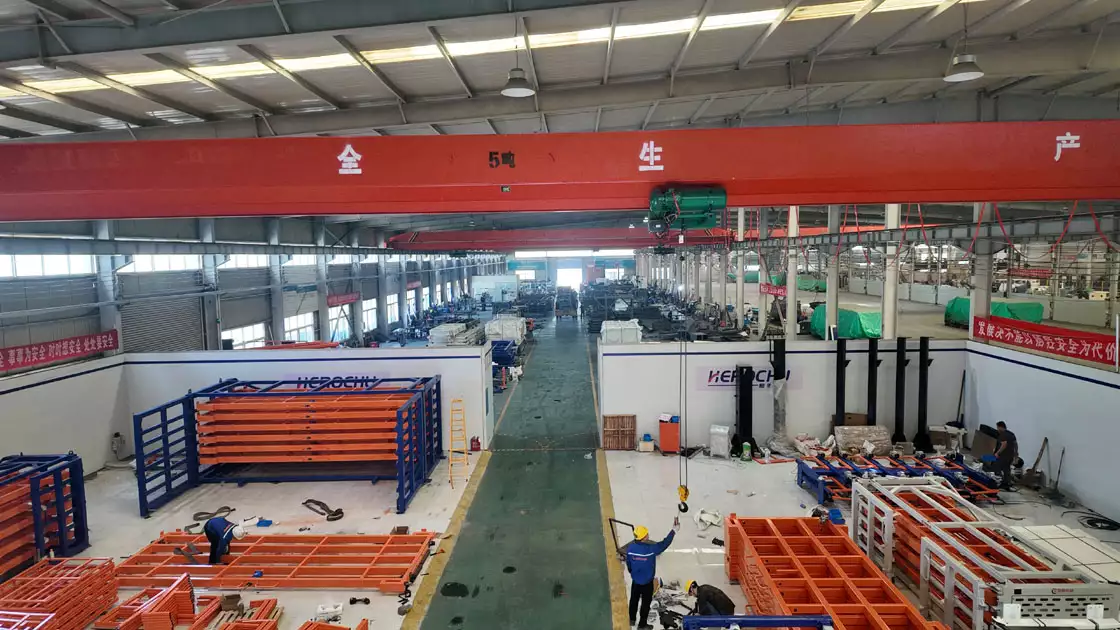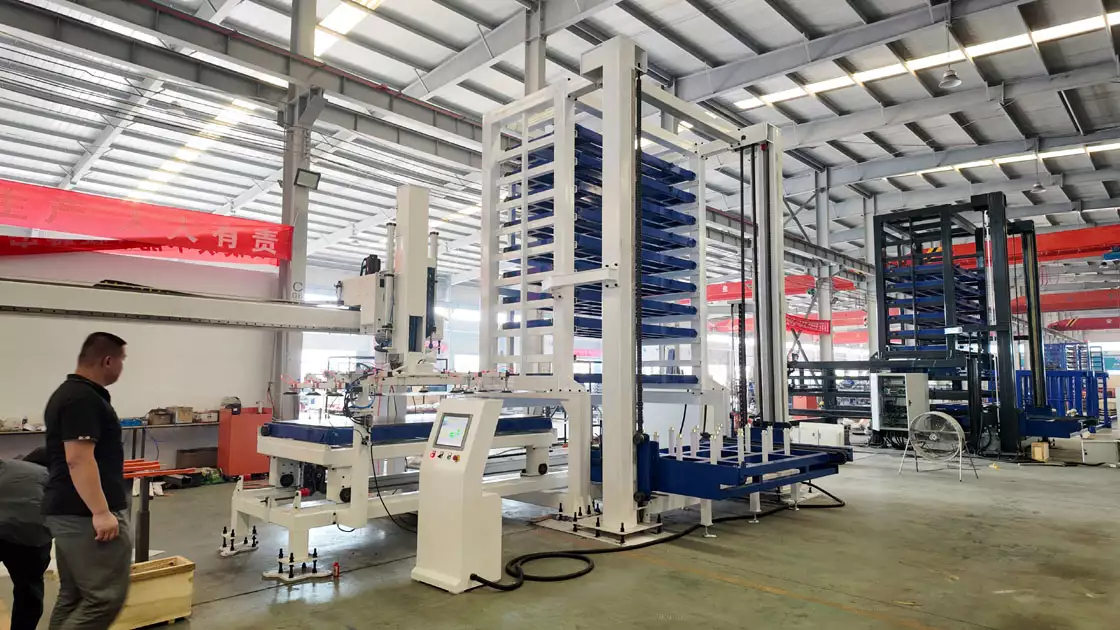
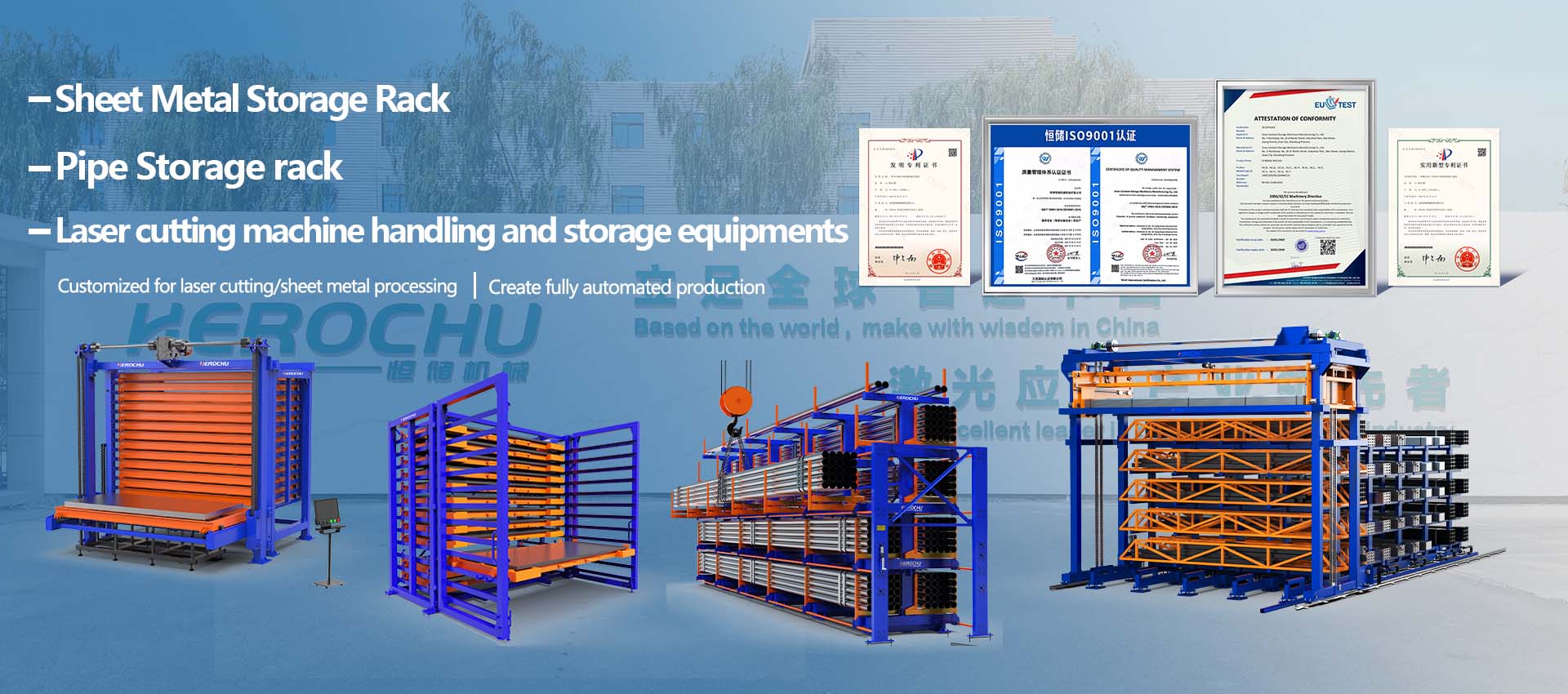
Wood panel products—plywood, MDF, particleboard, OSB, and veneered composite panels—represent one of the largest material cost categories in furniture manufacturing and cabinetry production. The way these materials are stored between delivery and processing directly affects both yield and product quality. A Fully Automated Vertical Storage System for Wooden Boards by Herochu provides flat, climate-stable storage within a retrieval-automated tower, replacing the leaning racks and floor stacks that introduce warp, edge damage, and handling inefficiency into the production workflow.
The Flat Storage Imperative for Wood Panels
Wood-based panels are hygroscopic by nature: they absorb and release moisture in response to changes in ambient humidity. When a full sheet of 18-millimeter plywood is stored leaning against a vertical rack, gravity acts on the sheet’s own weight to produce a bending moment that, over time, can set the panel into a permanent bow. The effect is most pronounced in thinner panels and in MDF, which has lower bending stiffness than plywood of equivalent thickness.
Once a panel develops a bow exceeding a few millimeters across its span, it becomes problematic for CNC processing. The vacuum hold-down system on a nested-based router may fail to secure the panel flat against the spoilboard, causing the sheet to lift during cutting. The resulting part dimensions can deviate from the programmed toolpath, generating scrap or requiring rework. For edgebanding and through-feed processing, a bowed panel can jam in the machine infeed, stopping production and potentially damaging guide components.
Herochu’s flat-drawer storage eliminates the gravitational bending that causes seasoning bow. Each panel rests on a continuous flat surface—the drawer tray deck—distributing its weight evenly across its full area. The stacked layers within each drawer apply additional downward pressure on the bottom sheets, actively counteracting any tendency toward upward curl at the sheet edges. Panels stored in this orientation for extended periods maintain the flatness specification they held when placed into inventory.
Moisture Management in Enclosed Storage
The relative humidity of a typical woodworking shop fluctuates with weather, season, and the operation of dust collection systems that exhaust conditioned air to the exterior. A panel stored near an open bay door in summer may experience humidity swings of 30 percentage points between morning and afternoon, driving moisture content changes that produce dimensional movement—primarily across the sheet width, perpendicular to the grain orientation of the face veneers.
The enclosed drawer bays of the Herochu tower moderate these fluctuations by reducing the air exchange rate around stored panels. While the drawers are not hermetically sealed, the close-fitting drawer faces limit convective airflow into the storage cavity, so the microenvironment within each bay responds more slowly to ambient humidity changes than the open workshop air. This buffering effect reduces the peak-to-peak moisture content swing experienced by stored panels, which in turn reduces the dimensional change that can cause panels to bind in tight-tolerance fixture locations during assembly.
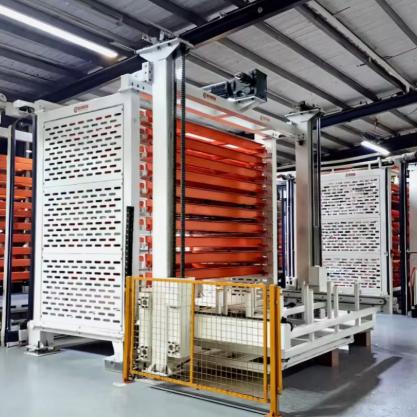
For facilities producing high-end furniture or architectural millwork where panel dimensional stability is critical to joinery fit, Herochu can equip the tower with drawer-level humidity monitoring sensors that trend conditions over time and provide data for process capability analysis. If the data indicates that ambient workshop humidity exceeds acceptable limits for a given product line, the information supports a business case for climate-controlled storage or process-area conditioning.
Panel Surface Protection in the Production Environment
Wood panel surfaces—particularly pre-finished veneers, high-pressure laminates, and melamine-faced boards—are susceptible to scratching, gouging, and abrasion during handling and storage. A single dragged sheet corner across a finished panel face can render that panel unusable for exposed-surface applications, converting a full sheet into drop material at a significant cost penalty.
The drawer-based retrieval method in the Herochu system eliminates sheet-to-sheet sliding contact during access. Rather than pulling a sheet from the top of a stack—which requires dragging it across the sheet below—the operator retrieves material by having the entire drawer presented at the load/unload station, where vacuum lifters or fork-mounted handling attachments can engage the top sheet and lift it vertically clear of the stack. The remaining sheets in that drawer are undisturbed, and the next sheet down is never subjected to frictional contact with the sheet above during retrieval.
For panel products that ship from the manufacturer with protective film, the reduced handling translates to fewer incidents of film damage that would require reapplication before processing. For panels without protective film—the common case for commodity plywood and MDF used in interior cabinet construction—the elimination of sliding contact during retrieval preserves the surface quality that directly affects finishing labor and material consumption.
Inventory Organization by Species, Grade, and Thickness
A furniture factory or cabinet shop typically carries panels in multiple core materials (plywood, MDF, particleboard), multiple face species (oak, maple, cherry, birch, walnut), multiple thicknesses (6, 12, 18, 25 millimeters), and, for plywood, multiple grades (A1, B2, C2, shop grade). The combinatorial expansion of these variables can produce over a hundred distinct inventory line items, each of which must be locatable and retrievable on demand.
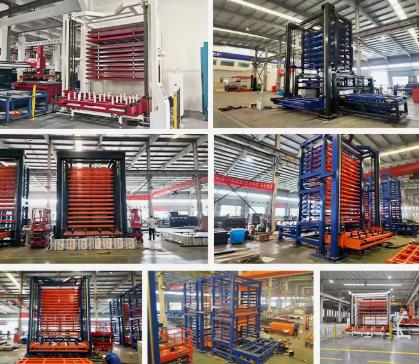
The Herochu ASRS addresses this complexity through drawer-level material assignment managed by the PLC controller. Each drawer position in the tower is mapped to a specific material code—species, grade, thickness, and sheet dimensions—and the operator selects material by code rather than by physical location. The system retrieves the correct drawer regardless of its position in the tower, so inventory organization does not depend on operator memory or visual identification of panel markings.
This code-based retrieval is particularly valuable in shops where multiple panel types are visually similar. A sheet of rotary-cut birch plywood looks nearly identical to a sheet of rotary-cut maple plywood under shop lighting conditions, and a thickness difference of 3 millimeters is difficult to distinguish by eye when sheets are stacked. Retrieval errors that result in birch being cut for a maple job—or 12-millimeter stock being run through toolpaths programmed for 18-millimeter material—generate rework costs and schedule disruption. The tower’s material-mapped drawer system prevents these errors at their source.
Integration with Panel Processing Lines
Modern panel processing lines—comprising a panel saw or nested-base router, an edgebander, and a CNC drilling center—operate at throughput rates that demand consistent material supply. The time required for an operator to locate and retrieve the next panel from conventional storage can create gaps in the processing flow, reducing overall equipment effectiveness.
When the Herochu tower is positioned adjacent to the processing line’s infeed, the retrieval cycle overlaps with the machine’s processing cycle. As the saw or router completes its cut program on the current sheet, the operator calls up the next sheet at the HMI. By the time the finished parts are cleared from the machine bed and the program for the next sheet is loaded, the drawer is presented at the load/unload station with the next panel ready for transfer. This parallel operation converts what would otherwise be waiting time into productive machine time.
For automated panel processing cells that use a gantry or articulated-arm robot for sheet loading, the tower can communicate directly with the cell controller via the same industrial protocol interface used for WMS integration. The cell controller requests the next sheet by material code, the tower retrieves and presents it, and the robot executes the pick-and-place sequence without human intervention. This level of integration supports lights-out operation for the processing cell, extending productive hours beyond the limits of manual staffing.
Capacity Configuration for Woodworking Operations
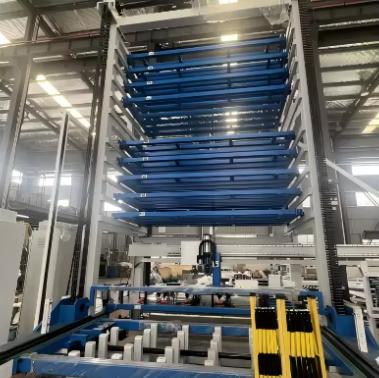
The standard Herochu tower configurations accommodate the panel dimensions common to the woodworking industry. The 3015 format (3000 by 1500 millimeters) handles full-size plywood and MDF sheets at their standard European and Asian dimensions. The 4015 and 4020 formats extend to 4000 by 1500 or 2000 millimeters for oversized panels used in store fixture and exhibition stand construction. The 6020 format accommodates jumbo-format panels up to 6000 by 2000 millimeters, suitable for continuous-run wall paneling and large-format architectural applications.
Drawer count can be specified between 8 and 13 levels, each drawer rated for 3 metric tons. For a furniture factory carrying 40 distinct panel items at average bundle heights of 200 millimeters, 8 to 10 drawers provide sufficient capacity with room for inventory fluctuation. The 3-ton per-drawer rating accommodates roughly 75 to 85 sheets of 18-millimeter MDF per drawer, depending on the panel density specification.
The weight of wood panel inventory is substantially lower than that of equivalent steel or aluminum sheet volumes, so the 3-ton rating is typically more than adequate for woodworking applications. This lighter loading reduces wear on the drive train components and allows faster acceleration ramps during retrieval, shaving several seconds from the cycle time compared with heavily loaded steel configurations.
Fire Safety Considerations
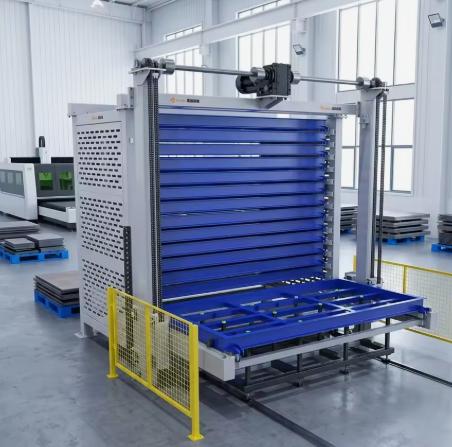
Wood panel storage presents fire load considerations that differ from metal storage. MDF and particleboard, in particular, contain resin binders that contribute to combustion, and vertically stacked panels can create chimney effects that accelerate fire spread if ignition occurs. The Herochu tower’s enclosed drawer bays compartmentalize the stored panel inventory into isolated vertical cells, each separated from adjacent bays by the structural steel tray construction and the intervening air gap. This compartmentalization limits the potential for fire to propagate vertically through the stored material and provides defined access points for sprinkler system coverage.
The tower’s steel construction does not contribute fuel to a fire event, and the enclosed bay geometry tends to limit the availability of combustion air to stored panels. While the tower is not a fire suppression system in itself, its design characteristics are compatible with the fire protection strategies typically employed in woodworking facilities, including overhead sprinkler coverage and compartmentalized storage areas.
Return on Investment for Furniture and Cabinetry Production
The economic justification for a Herochu ASRS in a woodworking context centers on four measurable impacts: reduced panel damage and associated material write-off, increased machine utilization through parallel material staging, recovered floor space that can accommodate additional production equipment, and reduced fork truck traffic and associated energy and maintenance costs.
Panel damage reduction alone often justifies a significant portion of the investment. Shops that track material yield typically find that 2 to 5 percent of panel material is lost to handling damage, edge crushing, and moisture-related defects. For a medium-sized cabinet shop consuming 3,000 sheets per month at an average cost of $35 per sheet, a 2 percent damage rate represents over $25,000 in annual material write-off. Reducing that rate by even half through improved storage and handling covers a meaningful fraction of the tower’s capital cost each year.
The floor space recovery calculation varies by facility, but a rule of thumb applicable to woodworking is that each square meter of recovered production floor can generate roughly $500 to $1,500 in annual contribution margin, depending on the value of the processing operation installed in the recovered area. A tower installation that frees 80 square meters for an additional edgebanding and assembly cell can produce an incremental return that, combined with material saving and labor efficiency gains, pushes the payback period into the 18-to-24-month range for a typical mid-sized operation.