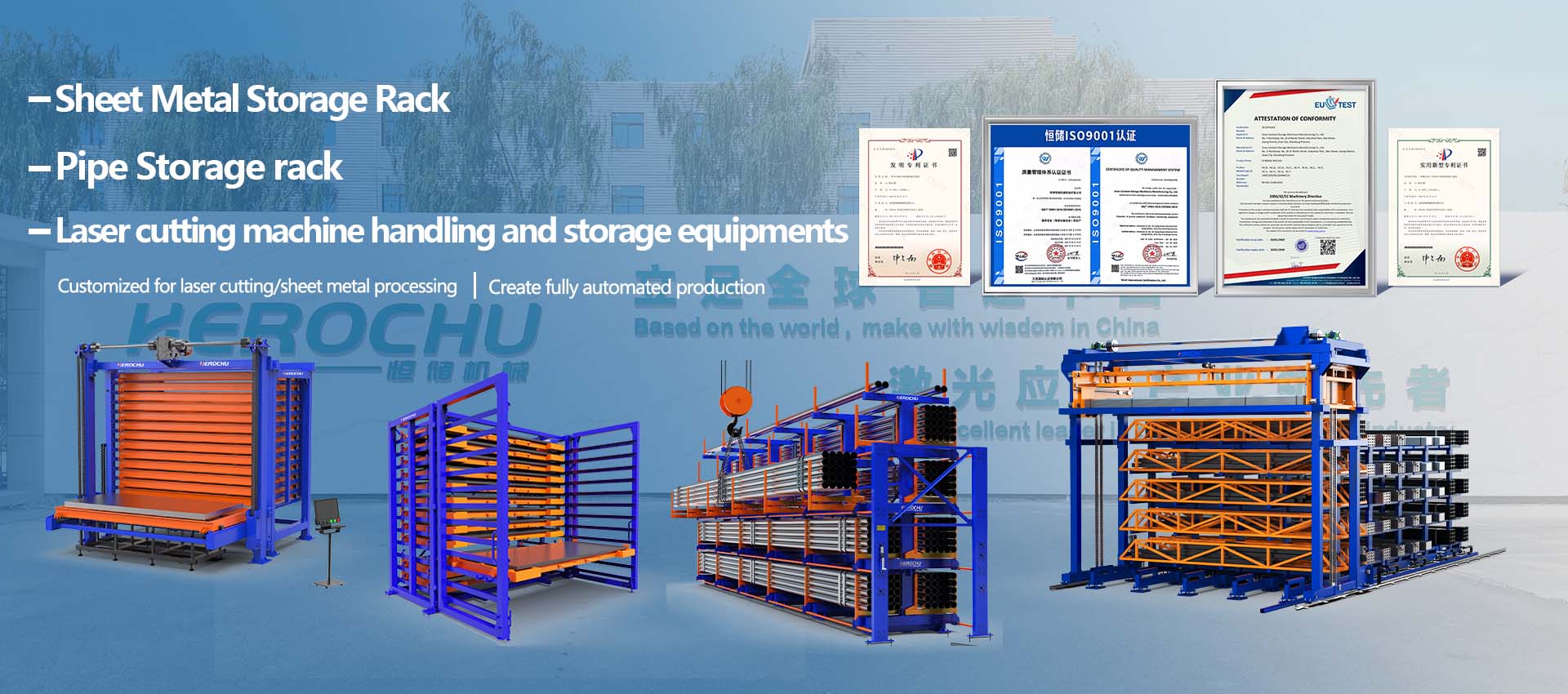
Dual-Function Design: Palletizer and Depalletizer in One Machine
Most palletizing equipment moves material in one direction — from the production line onto a pallet. But pipe processing workflows do not always follow a single-direction model. A tube mill may need to depalletize incoming raw pipe for secondary operations such as end-facing, threading, or coating before re-palletizing the finished product. A pipe distributor receiving mixed loads from multiple mills needs to break down incoming pallets and re-stack pipes into customer-specific order configurations. These workflows demand a machine that handles both stacking and unstacking with equal reliability.
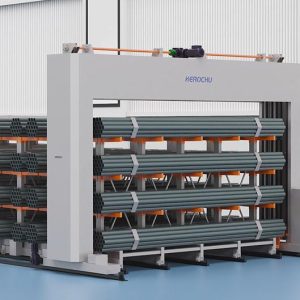
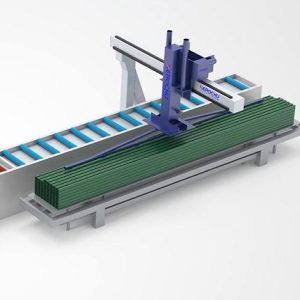
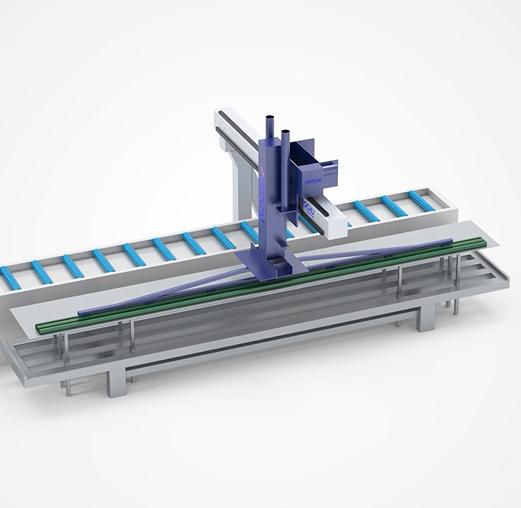
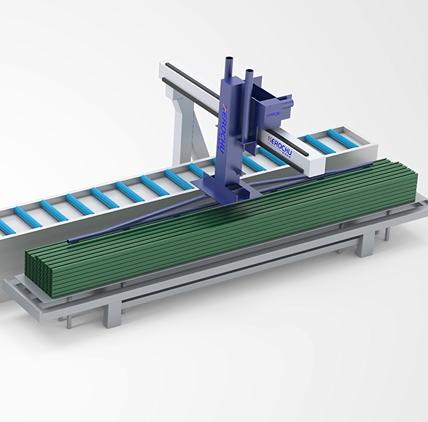
The Herochu intelligent pipe palletizing manipulator addresses this dual requirement through a gantry-type mechanism with programmable end-effector control. In palletizer mode, the manipulator picks pipes from the infeed conveyor and stacks them onto pallets according to the selected pattern. In depalletizer mode, the same gantry arm picks pipes from an incoming pallet and places them onto a discharge conveyor feeding downstream processing stations. The operator selects the operating mode from the HMI, and the PLC loads the corresponding motion program — no mechanical changeover, no tool swap, no recalibration.
This dual-function capability reduces floor space requirements compared to installing separate palletizer and depalletizer units. It also eliminates the material transfer zone between two machines, removing the conveyor junction where pipes commonly misalign or jam. For facilities with constrained floor layouts or variable production schedules that alternate between palletizing and depalletizing duties, the combined machine offers a configuration that dedicated single-function equipment cannot match.
Gantry-Type Mechanical Architecture
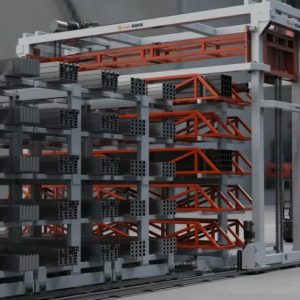
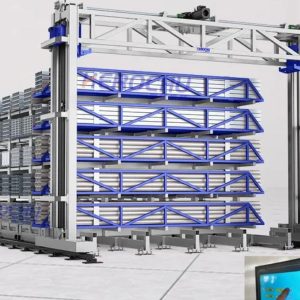
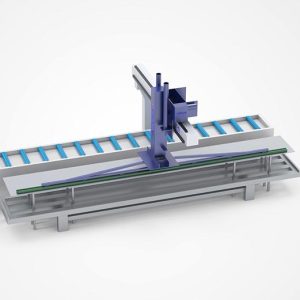
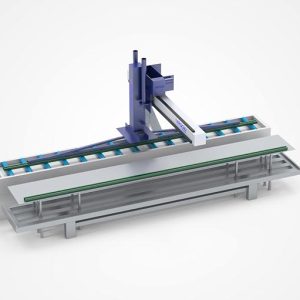
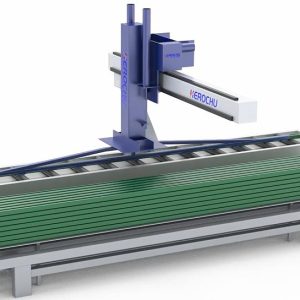
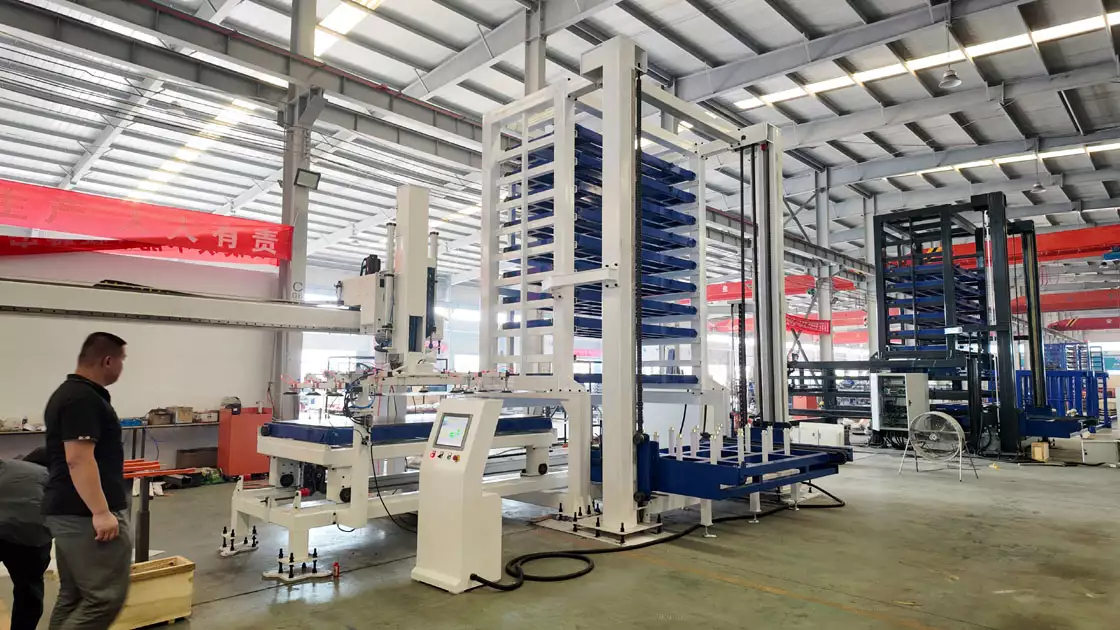
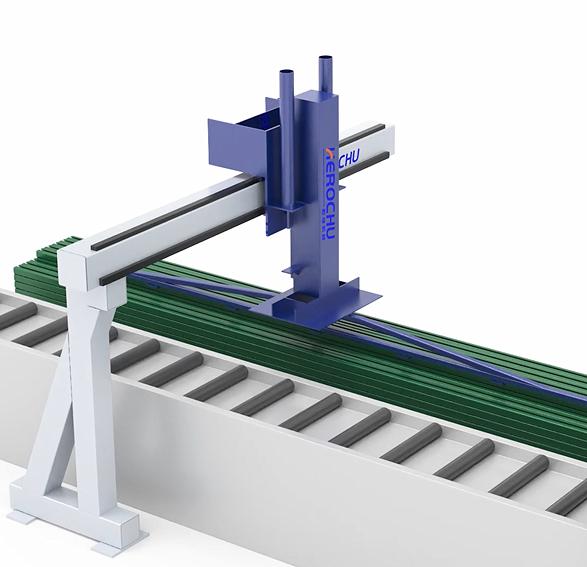
The Herochu intelligent pipe palletizing manipulator uses a column-type gantry frame with three axes of servo-controlled motion: bridge travel along the X-axis, carriage traverse along the Y-axis, and gripper vertical travel along the Z-axis. The bridge beam spans the full width of the pallet zone plus the adjacent conveyor, allowing the gripper to reach any coordinate within the machine’s rectangular working envelope.
Unlike articulated-arm robots that carry all actuator mass at the joint and require substantial counterbalancing, the gantry configuration distributes mass along the fixed frame structure. Drive motors mount at the column bases and bridge ends rather than at the arm joints, reducing the inertia the servo drives must overcome during acceleration. This distribution of mass allows the gantry to move heavier payloads — up to several hundred kilograms per pick cycle when handling a full layer of steel pipes — without the oversized motors and gearboxes that a comparable articulated robot would need.
The structural frame uses welded box-section steel columns and bridge beams with internal ribbing at load-transfer points. Finite element analysis during the design phase identifies stress concentrations at column-to-baseplate welds and bridge-to-carriage rail mounts, with reinforcement added to keep deflection under full payload below the threshold that would affect positioning accuracy. For a typical machine handling 6-meter pipes with a bridge span of 4 to 5 meters, deflection at mid-span under maximum payload stays below 0.5 mm — within the positioning tolerance of the stacking pattern.
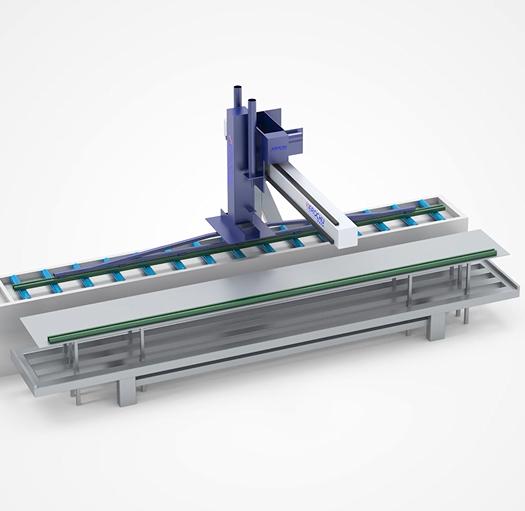
The rack-and-pinion drive on the bridge axis uses hardened and ground gear rack matched to a helical pinion on the servo gearbox output shaft. Helical tooth engagement, as opposed to straight-cut spur gearing, reduces backlash by maintaining continuous tooth contact through the mesh cycle. This is important for positioning repeatability: every tooth-flank clearance in the drive train accumulates into gripper position error, and reducing backlash at the primary drive axis improves layer-to-layer placement consistency across thousands of cycles.
Control Intelligence and Adaptive Stacking
The term “intelligent” in intelligent pipe palletizing manipulator refers to the control system’s capacity to sense, calculate, and adjust — not merely execute pre-programmed motion profiles. The Herochu manipulator uses a PLC with motion control modules that receive real-time feedback from servo encoders, photoelectric sensors, and load cells, then modify motion parameters within the cycle based on that feedback.
One example of adaptive behavior: during depalletizer operation, the gripper descends toward a pipe layer on an incoming pallet. A laser distance sensor mounted adjacent to the gripper measures the actual height of the top layer before contact, and the PLC compares this measurement to the expected height from the program. If the measured height differs — because the pallet settled during transport, because a strap loosened and allowed a layer to shift, or because the stacking pattern on the incoming pallet does not match the program’s assumption — the PLC adjusts the Z-axis target position to compensate. The gripper descends to the actual pipe surface rather than colliding with it or stopping short. This adaptive height sensing prevents the gripper damage and pipe surface marking that occur when a rigid program assumes geometry that does not match reality.
During palletizer mode, the manipulator monitors the pipe count at the infeed and adjusts layer formation timing accordingly. If a gap appears in the infeed pipe stream — for example, because the tube mill operator paused production briefly — the manipulator holds at its current position rather than cycling empty. When pipes resume, the PLC recalculates the remaining pick count for the current layer and resumes stacking seamlessly. This prevents the partial layers and pattern gaps that confuse downstream bundling equipment and produce non-conforming pallets.
End-Effector Selection for Material Compatibility
The gripper assembly at the end of the Z-axis mast is the only part of the manipulator that contacts the product, so its design determines compatibility with different pipe materials and surface finishes. Herochu offers several end-effector configurations, selected during the specification phase based on the customer’s product mix.
For bare steel pipe, electromagnetic grippers provide the fastest pick-and-release cycle. A rectangular electromagnet array spans the full length of the pipe layer, energizes on contact, and releases instantly on de-energization. Cycle time for electromagnet grip-and-release is typically under one second, making this the preferred option for high-speed tube mills where palletizing cycle time limits overall line throughput.
For galvanized, painted, or coated steel pipe, mechanical grippers with soft-contact pads avoid the surface marks that electromagnets can leave on finished coatings. The gripper uses two opposing jaw sets with polyurethane or rubber contact pads. Clamping force adjusts through pneumatic pressure regulation, with different pressure setpoints stored in the recipe system for different pipe diameters and wall thicknesses. Thin-wall pipe requires lower clamping force to prevent ovalization; heavy-wall pipe requires higher force to prevent slippage during rapid traverse.
For PVC and plastic pipe, vacuum grippers or soft mechanical jaws handle the lightweight, low-friction material without the deformation risk that steel pipe grippers impose. Plastic pipe’s lower density means the manipulator can typically handle larger layer counts per pick cycle — up to 15 or 20 pipes per layer for small-diameter PVC conduit — increasing throughput relative to steel pipe stacking where weight limits layer size.
Switching between end-effector types requires a mechanical changeover at the Z-axis mounting flange, typically with quick-release pins and multi-coupling connectors for pneumatic and electrical lines. The changeover takes under 10 minutes for a trained operator, and the PLC automatically loads the correct motion parameters, clamping force settings, and sensor calibration values associated with the selected end-effector.
Safety Architecture for Manipulator Operation
The Herochu intelligent pipe palletizing manipulator incorporates safety systems at mechanical, electrical, and software levels. The primary safeguarding device is a light-curtain array that surrounds the machine’s working envelope. If any object larger than the curtain’s minimum detectable diameter — typically 14 mm, sufficient to detect a hand or arm — interrupts any beam, the safety relay drops power to all motion axes within the machine’s stopping time requirement. The stopping time calculation, verified during commissioning and re-verified annually, confirms that the gantry arm comes to a complete stop before a person walking at 1.6 meters per second can reach the hazard zone after crossing the light curtain boundary.
Emergency stop buttons use a dual-channel safety circuit with force-guided relay contacts. Pressing any E-stop button opens both channels simultaneously; if one channel fails to open, the safety relay detects the discrepancy and prevents restart until the fault is corrected. This redundant architecture addresses the single-point failure concern — a welded contact in a single-channel system would leave the machine operable despite an apparent emergency stop activation.
Software-level safety includes axis travel limits enforced by both the motion controller and an independent safety PLC. The motion controller’s soft limits prevent the program from commanding motion beyond the machine’s physical boundaries; the safety PLC monitors actual axis position against hard limits and triggers a safety stop if any axis approaches within a configured margin of a mechanical end stop. This dual-layer position monitoring protects against both programming errors and sensor failures that could drive an axis into a hard stop at full speed.
Protective guarding encloses all drive components — rack and pinion, chain drives, and cable carriers — that present pinch-point or entanglement hazards. Guard panels use expanded metal mesh with openings sized to prevent finger access while maintaining visibility for operator monitoring. Interlock switches on each guard panel connect to the same safety circuit as the light curtains, so opening any panel during automatic operation initiates a controlled stop.
Reliability Built into the Mechanical Design
The intelligent pipe palletizing manipulator follows a design philosophy that emphasizes structural simplicity over complexity. Fewer moving components mean fewer potential failure points, and components that do move are selected for operating life measured in millions of cycles rather than thousands. Linear guide rails on all three axes use recirculating ball bearing blocks with double-lipped seals that exclude the metallic dust common in tube mill environments. Sealed bearings throughout the drive train eliminate the need for daily grease point lubrication — the single most commonly skipped preventive maintenance task in busy production facilities.
The gear rack on the bridge axis runs inside a protective cover that prevents pipe debris and coolant spray from contaminating the tooth engagement. An automatic lubrication system meters a controlled volume of grease to the rack-and-pinion interface at programmed intervals, typically every 8 to 12 operating hours, from a reservoir that holds a 3-month supply. Low-reservoir and clogged-line sensors alert maintenance personnel before lubrication failure leads to accelerated rack wear.
Electrical cabinets use positive-pressure filtered ventilation to keep the internal environment clean regardless of ambient dust levels. Cabinet door seals, cable gland entries, and connector hoods all maintain IP54 protection against dust ingress and water spray from nearby washdown operations. Inside the cabinet, PLC modules, servo drives, and terminal blocks mount on a backplane with forced-air cooling ducts that direct airflow across heat-generating components first, then exhaust through filtered vents — a thermal management layout that extends electronic component life in the 40°C-plus ambient temperatures typical of tube mill electrical rooms.
The low failure rate that Herochu cites for this machine family is not a marketing claim but a consequence of design choices: oversized drive components operating well below rated capacity, sealed bearings that exclude contaminants, automatic lubrication that removes the human error variable, and electrical protection that keeps control electronics in a stable thermal environment. Each of these choices adds modestly to machine cost at the time of purchase and subtracts substantially from total cost of ownership over the machine’s 15-to-20-year operating life.