
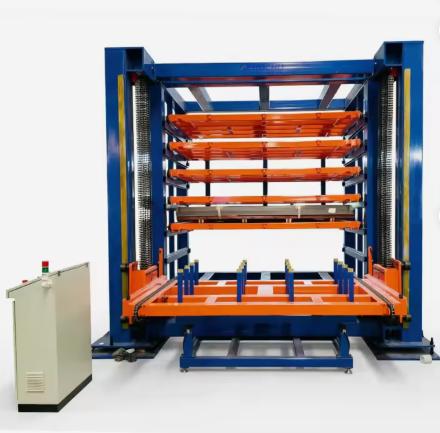
Automated Multi-Level Plate Depot with Robotic Retrieval for Laser and Punch Fabrication
Mixed-technology fabrication shops — those running fiber laser cutting machines alongside CNC turret punch presses — face a material logistics problem that single-technology shops do not. A laser cuts any geometry the nesting software can generate, but it does so at a speed that varies with material thickness and contour complexity. A punch press processes thin-gauge sheet at rates that far exceed laser speeds for simple hole patterns and notching, but it requires tooling setups and is limited to the geometries its punch-and-die library supports. Feeding both machine types from a shared plate inventory, without starving either or wasting floor space on redundant staging areas, demands a material handling system that understands the operational rhythms of each technology. Herochu’s automated multi-level plate depot with robotic retrieval is engineered for exactly this environment.
Automated Multi-Level Plate Depot with Robotic Retrieval for Laser and Punch Fabrication
Mixed-technology fabrication shops — those running fiber laser cutting machines alongside CNC turret punch presses — face a material logistics problem that single-technology shops do not. A laser cuts any geometry the nesting software can generate, but it does so at a speed that varies with material thickness and contour complexity. A punch press processes thin-gauge sheet at rates that far exceed laser speeds for simple hole patterns and notching, but it requires tooling setups and is limited to the geometries its punch-and-die library supports. Feeding both machine types from a shared plate inventory, without starving either or wasting floor space on redundant staging areas, demands a material handling system that understands the operational rhythms of each technology. Herochu’s automated multi-level plate depot with robotic retrieval is engineered for exactly this environment.
The Mixed-Technology Material Flow Challenge
Consider a fabrication shop that runs two punch presses and three lasers. The punch presses consume primarily 0.8 mm to 2.0 mm galvanized and cold-rolled sheet at rates exceeding 200 strokes per minute. A single punch press can process 15 to 25 sheets per hour depending on the part geometry and the number of tool stations on the turret. The lasers handle the thicker stock — 3.0 mm through 20 mm hot-rolled and stainless plate — and the complex contour cutting that punch tooling cannot economically address.
The two machine types pull from overlapping but distinct zones of the material inventory. Both consume 1.5 mm and 2.0 mm cold-rolled sheet. The punch presses pull heavily from the thin-gauge galvanized range. The lasers consume the thick plate and the stainless grades. An efficient material flow system must deliver the right grade and gauge to the right machine at the right moment without creating a bottleneck at the shared inventory access point.
Manual material handling in this environment creates a compounding inefficiency. Each machine’s operator spends part of every hour locating, retrieving, and staging the next sheet. When a rush order for 300 punched brackets hits the schedule, the punch press operator might pull sheets from the same stack that the laser operator was planning to use for a scheduled nest an hour later, creating a conflict that neither operator discovers until the laser’s stock runs dry.
The Herochu Multi-Level Depot Architecture
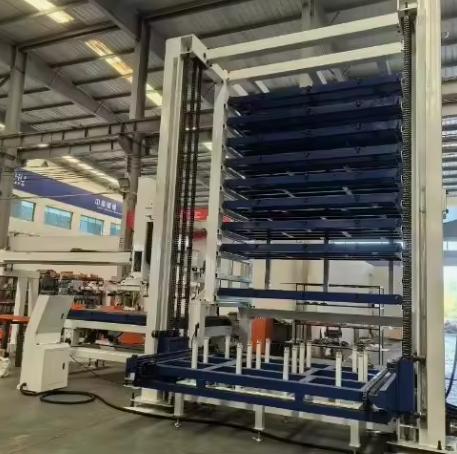
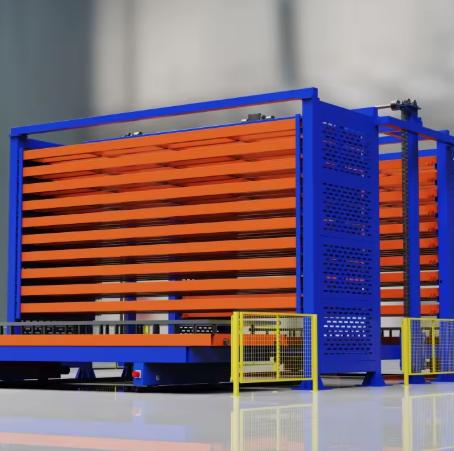
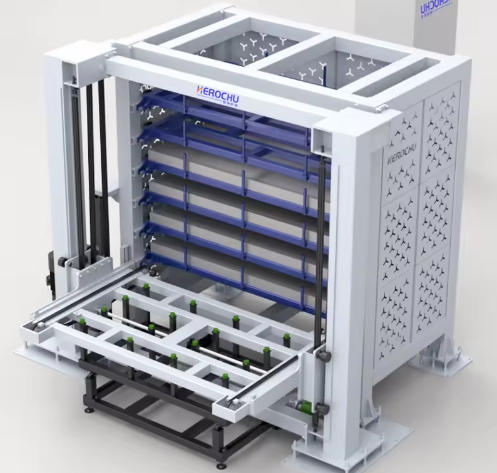
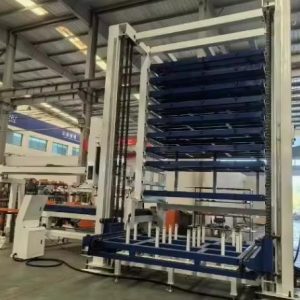
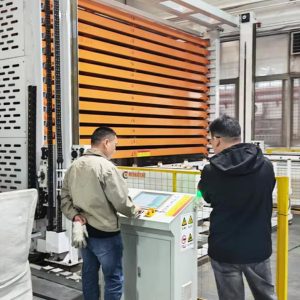
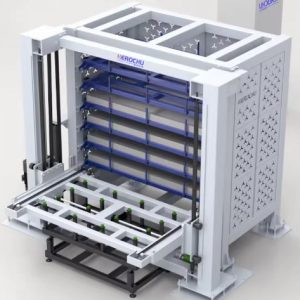
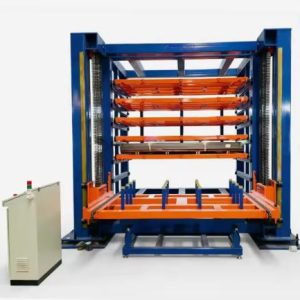
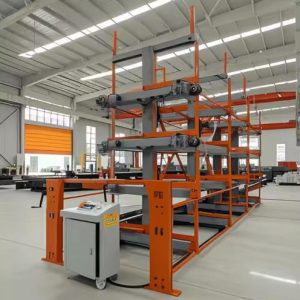
The Herochu plate depot is a purpose-built automated storage structure that centralizes raw sheet inventory serving multiple downstream processing machines. Unlike a general-purpose warehouse rack, the depot is engineered specifically for flat sheet plate and is optimized for rapid retrieval and delivery cycles rather than long-term static storage.
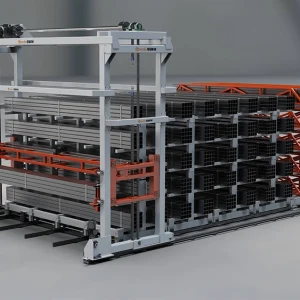
The depot structure consists of modular storage bays arranged in single or multi-tower configurations. Each bay accommodates sheets from 3000×1500 mm up to 6000×2500 mm across eight to ten vertical levels. The inter-level clear space of 350 mm — configurable upward for operations that store sheet with attached stiffeners or lifting lugs — provides sufficient clearance for the robotic retrieval end-effector to enter, lift, and extract a sheet without contacting the plate stored on the level above.
The structural frame uses hot-rolled steel columns and beams connected with hot-dip galvanized bolted joints. The bolted connection design serves two purposes: it allows the depot to be dismantled and relocated if the factory layout changes, and it eliminates the on-site welding that would compromise the corrosion protection at every joint in a welded frame.
Load capacity per storage position is 3,000 kg on the smaller HC-A3015 model and 5,000 kg on the HC-A4015, HC-A4020, and HC-A6020 models. The 5,000 kg rating accommodates dense plate stacks — roughly 28 sheets of 4000×2000×3.0 mm mild steel per position — providing sufficient buffer stock to support multi-shift production without requiring midday replenishment.
Robotic Retrieval: The Gantry Manipulator System
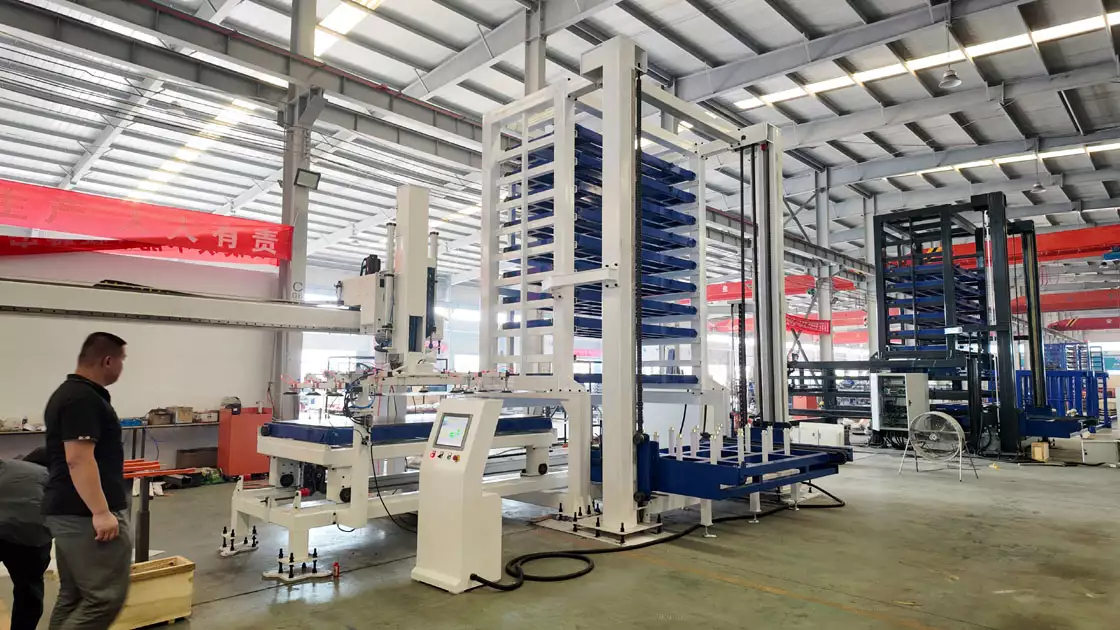
Sheet retrieval from the depot is performed by a gantry-style robotic manipulator traveling on floor-mounted precision rails. The gantry bridge spans the full width of the depot and travels longitudinally to access any bay position. Vertical motion is provided by a servo-driven lifting mast with rack-and-pinion transmission and dual-channel braking.
The retrieval sequence for a scheduled sheet begins when the WCS receives a material request from a downstream machine controller. The request specifies the material grade, thickness, and sheet dimensions. The WCS queries the inventory database, identifies the depot position holding the correct material, and dispatches the gantry to that location. Retrieval priority logic favors positions closest to the requesting machine to minimize travel time, but can be overridden by FIFO rules for age-sensitive materials such as pre-painted or vinyl-coated sheet.
The gantry’s end-effector employs the zoned vacuum system common across Herochu’s material handling platforms. For depot retrieval — where sheets are picked from a flat stack rather than individually separated — the system uses a combination of vacuum lift and a mechanical sheet separator. A pneumatically actuated edge-lifting finger raises the corner of the top sheet slightly to break any oil-film adhesion or static bond with the sheet below before the vacuum zones engage. This two-step separation sequence virtually eliminates the double-sheet pickup that plagues vacuum-only systems working from dense plate stacks.
Once the sheet is lifted, the gantry traverses to the requesting machine’s loading station. For punch presses, the loading station is typically positioned adjacent to the machine’s sheet clamps, and the gantry deposits the sheet onto a powered roller table that feeds it into the punch’s gripper system. For laser cutters, the loading station is the laser bed itself, and the gantry places the sheet directly onto the cutting slats.
Scheduling Logic for Mixed Workloads
The depot’s WCS layer includes a production scheduler that sequences retrieval requests across all connected machines. The scheduler operates on a rolling horizon — typically 30 to 60 minutes — and optimizes the gantry’s movement pattern to minimize unloaded travel.
The optimization problem is non-trivial. Suppose Punch 1 completes at T+3 minutes and needs 1.5 mm galvanized sheet from depot position B4. Laser 2 completes at T+5 minutes and needs 3.0 mm stainless from depot position C7. The gantry is currently at position A1. The scheduler evaluates the combined travel path — A1 to B4 (retrieve for Punch 1), B4 to Punch 1 loading station (deliver), Punch 1 to C7 (retrieve for Laser 2), C7 to Laser 2 loading station (deliver) — and compares it against alternative sequences. It also checks whether any retrieval can be pre-staged at a machine-side buffer position while the gantry is passing nearby on an unrelated mission.
The scheduler does not replace the facility’s production scheduling system. It operates within the schedule established by the ERP or MES system, optimizing only the material retrieval sequence to minimize the time between a machine’s “ready for next sheet” signal and the arrival of that sheet at the loading station.
Laser and Punch Press Integration Details
Integration with laser cutting machines follows the interface protocol described earlier: hardwired digital I/O for safety interlocks and basic handshake signals, Ethernet-based communication for job data and nesting file exchange.
Integration with CNC turret punch presses requires additional consideration because punch presses handle sheets differently than lasers. A punch press grips the sheet edge and moves it in X and Y under the punching head. Sheet alignment relative to the gripper reference position is critical — a misalignment of even 2 mm can cause the punch to strike outside the intended hit zone, potentially damaging the tooling or producing scrap parts.
The Herochu gantry deposits sheets onto the punch press loading table with a positioning accuracy of ±1 mm, verified by a laser displacement sensor on the end-effector that measures the distance to a known reference edge on the loading table. After deposition, the punch press’s own sheet-positioning system takes over for final alignment before the grippers engage. The handshake protocol between the depot WCS and the punch press controller confirms that the sheet has been successfully transferred and that the depot gantry is clear of the punch press work envelope before the punch cycle can begin.
For punch press cells equipped with automatic sheet loaders, the Herochu depot can interface with the loader’s controller rather than directly with the punch press, depositing sheets onto the loader’s input table and allowing the loader to handle the final delivery to the punch press grippers. This layered integration preserves the punch press manufacturer’s standard automation interface and simplifies commissioning.
Inventory Visibility and Consumption Tracking
A multi-level depot holding several hundred sheets across multiple material grades and thicknesses requires inventory visibility that goes beyond a whiteboard tally at the loading dock. The Herochu WMS maintains a real-time digital ledger of every sheet in the depot, updated with each retrieval and each replenishment event.
The ledger records include the material certificate reference for each sheet or batch of sheets, enabling full forward and backward traceability. When a quality issue arises on a finished welded assembly, the production team can trace the raw material back through the depot inventory record to the specific mill heat and coil number, identifying the scope of potentially affected product with precision rather than quarantining an entire month’s production.
Consumption tracking is equally granular. The WMS logs which production order consumed which sheet, on which date, at which machine, and during which shift. This data supports activity-based costing models that allocate raw material cost to specific customer jobs rather than spreading it across a period-cost average. For fabricators operating on thin margins — and few do not — the difference between job-level and period-level material costing can be the difference between accurately identifying profitable product lines and making pricing decisions based on averaged data that obscures the true economics of each job.
Depot Replenishment Workflow
Raw material enters the depot through a dedicated receiving station equipped with a hydraulic lift table or powered roller conveyor. The receiving operator places an incoming stack of sheets on the lift table, scans the supplier’s material certificate barcode or QR code, and confirms the received quantity. The WMS creates an inventory record for each sheet in the stack, assigns depot storage positions based on the configured storage policy, and queues retrieval and storage missions for the gantry.
The storage policy is configurable by material grade and can follow several strategies. The “zone by machine” strategy groups material destined for a particular downstream machine in bays closest to that machine. The “zone by grade” strategy groups all material of a given grade together regardless of which machine will consume it. The “FIFO” strategy assigns the oldest available position regardless of grade or destination. The appropriate strategy depends on the facility’s production pattern and can be changed through the WMS configuration interface without reprogramming the PLC.
For high-volume operations receiving multiple truckloads of sheet per day, the receiving station can be equipped with an automated destacking system that separates sheets from the incoming stack and presents them individually to the gantry for storage. This eliminates the manual step of the operator feeding sheets one at a time to the gantry pickup point.
Operational Resilience and Fault Tolerance
A depot serving four to six production machines must tolerate component failures without halting the entire fabrication operation. The Herochu system incorporates several layers of fault tolerance.
The gantry drive system uses dual servo motors on the bridge axis, either of which can maintain motion at reduced speed if the other faults. The vacuum system employs multiple independently powered vacuum zones; a failure in one zone degrades lift capacity but does not prevent operation if the remaining zones can handle the sheet weight. The PLC runs on a redundant power supply with automatic failover.
The WCS software supports a manual override mode that allows an operator to direct the gantry to specific positions using the HMI touchscreen if the automated scheduling function is unavailable. In a worst-case scenario where the gantry itself is inoperative, the depot’s bolted structural design allows sheets to be retrieved by forklift from ground-level positions, though at significantly reduced speed. The depot degrades gracefully rather than failing catastrophically.
Remote diagnostics capability allows Herochu service engineers to connect to the depot’s PLC via VPN, review the event log, and diagnose issues without dispatching a field service technician. Many faults can be resolved through remote parameter adjustments or a guided power-cycle sequence conducted by the on-site operator under remote supervision.
Space Recovery and Layout Flexibility
A multi-level plate depot occupying a 150-square-meter footprint with eight storage levels provides 1,200 square meters of effective storage area — roughly eight times the footprint. For a facility currently storing sheet inventory across 400 square meters of floor-level racking, a 150-square-meter depot consolidates that inventory into a smaller area while adding retrieval automation.
The recovered 250 square meters of floor space can accommodate an additional punch press, a press brake cell, a welding station, or a quality inspection area. In facilities constrained by building footprint rather than height, vertical densification through a Herochu depot is often the least expensive path to capacity expansion — substantially cheaper than constructing a building addition or leasing additional industrial space in a neighboring facility.
The depot’s modular, bolted construction also supports reconfiguration if the facility’s production layout changes. Relocating a depot from one bay to another, or adding storage capacity by extending the rail system and adding bays, involves disassembly, transport, and reassembly of pre-fabricated structural components rather than demolition and new construction.
Conclusion
Fabrication shops running both laser cutters and punch presses operate two distinct production rhythms within a shared material inventory. Manual handling creates conflicts between these rhythms that erode machine utilization on both sides. Herochu’s automated multi-level plate depot resolves these conflicts by centralizing inventory in a vertically dense, robotically served structure that delivers the right sheet to the right machine at the moment it is needed — governed by a scheduling layer that understands the operational tempo of each downstream process and optimizes retrieval paths accordingly. The result is not simply automated storage; it is a material logistics platform that enables mixed-technology fabrication cells to operate at their combined rated capacity.
FAQ
Here are some frequently asked questions about our sheet metal racks and pipe storage solutions. We hope you find them helpful!
Q1: Can I request a custom size or color?
Absolutely. We offer complimentary design services and deliver efficient, tailored solutions to meet your specific requirements.
Q2: Are you a manufacturer or a distributor?
We are a direct manufacturer with over 15 years of industry experience and expertise.
Q3: Is there a minimum order quantity?
No. We welcome orders of any size, starting from a single unit.
Q4: How can I get detailed product information?
Click the “Get a Quote” button to receive product images, detailed specifications, and videos. Our team is always ready to assist.
Q5: How do I provide my storage rack requirements?
Simply share the type, dimensions, and quantity of materials you plan to store, along with any other specific needs. We will develop a professional storage solution for you. Alternatively, leave your contact details for a personalized consultation.
Q6: Do you offer automated loading systems or robotic arms?
Yes. We provide loading robotic arms and integrated loading/unloading systems tailored to your laser cutting machine’s table size and material handling method (e.g., board rack, exchange platform, or material warehouse). Contact us with your details for a customized proposal.
Q7: Do you provide on-site installation and debugging?
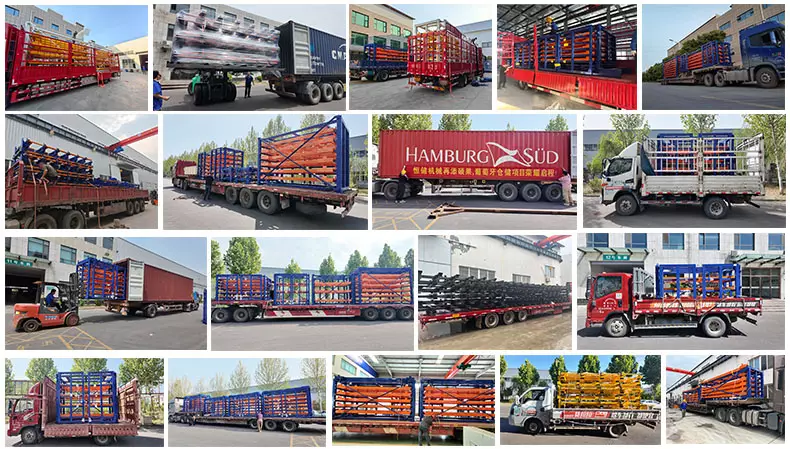
Yes. Our technicians can travel to your facility for installation and debugging, ensuring successful operation. We have served clients globally, including in the USA, South Korea, Russia, Qatar, Mexico, South Africa, Egypt, and Lebanon.
Q8: How do you ensure product quality?
Our quality assurance includes:
A team of over 40 technical engineers for professional debugging and support.
A dedicated quality control department compliant with ISO9001 standards.
CE certification for all exports.
Rigorous load testing before shipment to ensure structural safety and reliability.
Q9: Where is your factory located?
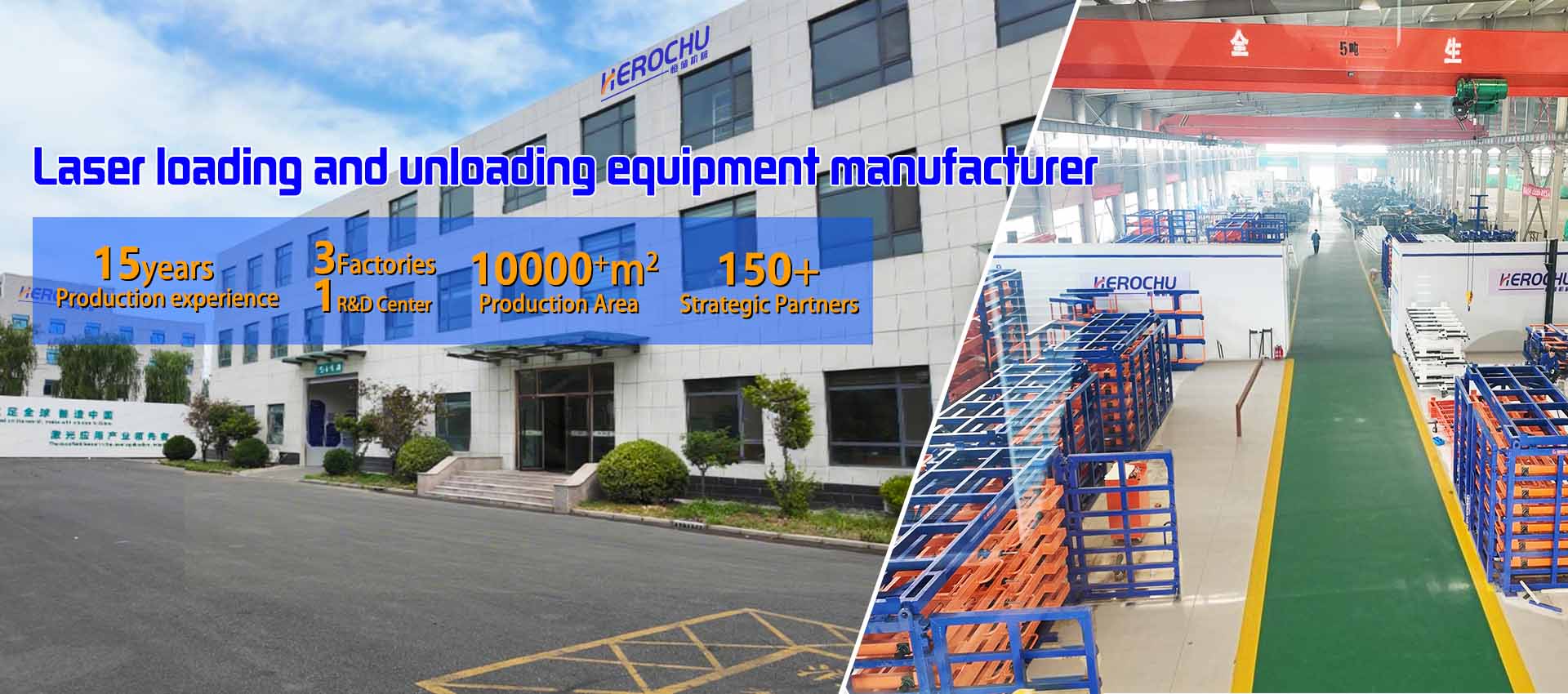
Our modern 10,000-square-meter manufacturing facility is located in Jiyang Industrial Park, Jinan, Shandong, China.
Q10: How can I evaluate your company’s capabilities?
We offer virtual video factory tours and warmly welcome on-site visits.
Q11: What does your company specialize in?
Jinan Constant Storage Machinery Manufacturing Co., Ltd. is a high-tech enterprise specializing in the R&D, production, sales, installation, and service of intelligent storage solutions. Our product range includes sheet material warehouses, drawer-style shelves, cantilever racks, servo manipulators, gantry loaders, and fully automated handling systems. Supported by a skilled technical team and advanced equipment, we are committed to delivering high-performance storage products and solutions to customers worldwide.
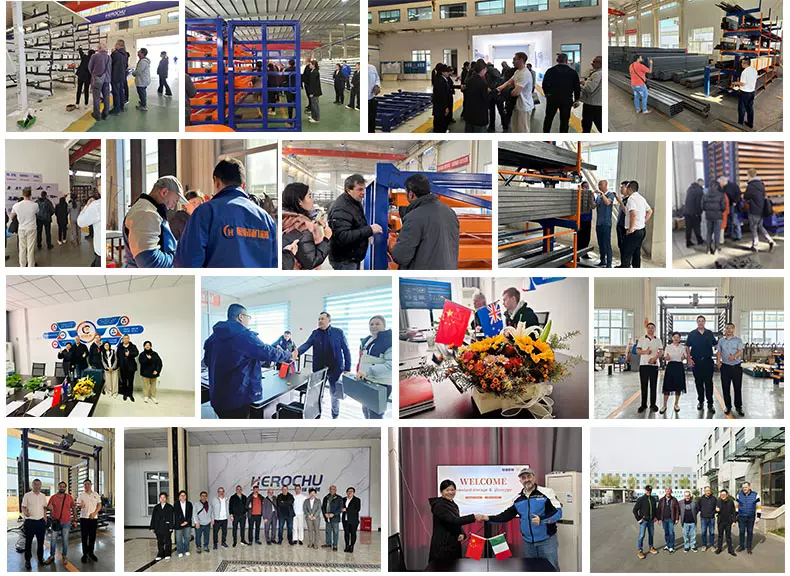
Customer visit
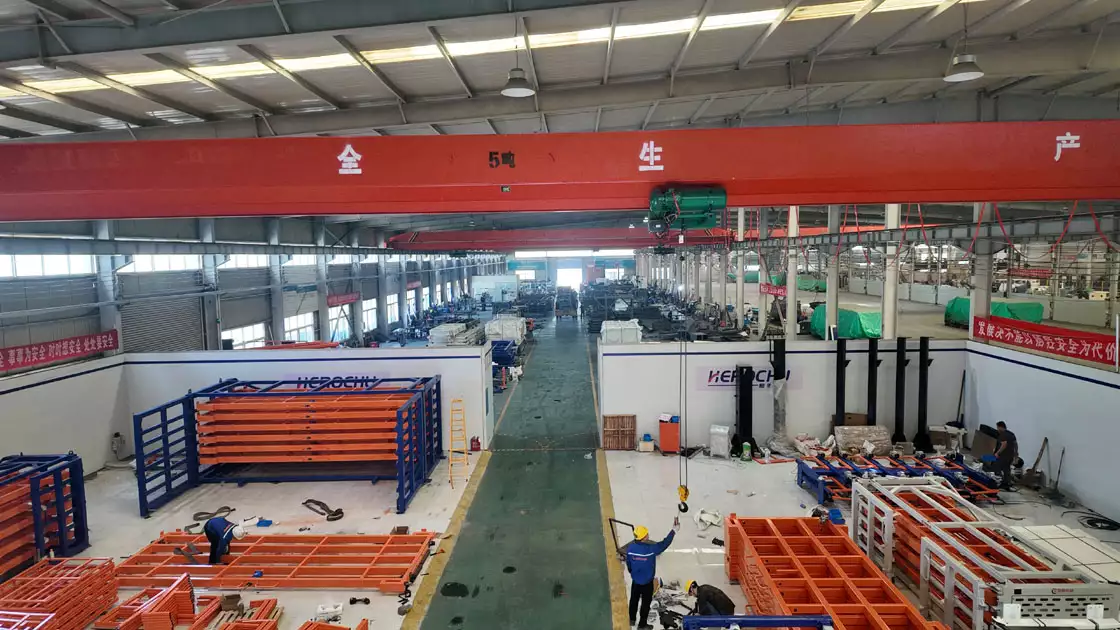
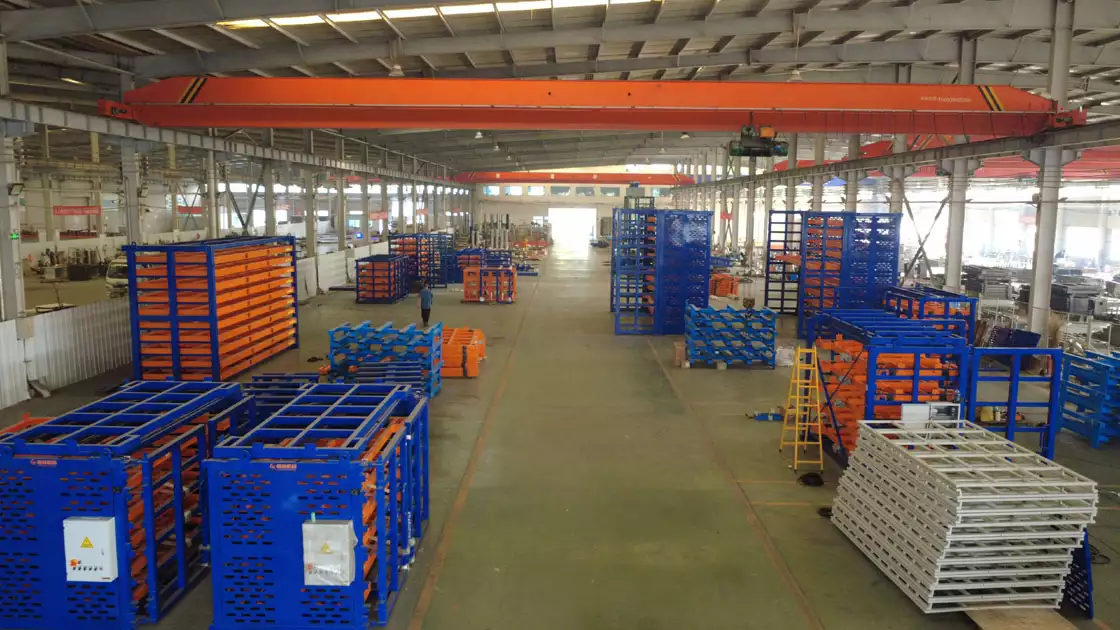
Herochu has always been adhering to the market-centric approach to meet customer requirements to the maximum extent, and the business philosophy of “creating brands with heart and gaining reputation with sincerity”. It provides customers with high-quality products and services with rigorous military quality, professionalism, and excellence, and has won unanimous praise in the Chinese aerospace, Chinese weapons, Chinese railways, automobile manufacturing, engineering machinery, non-ferrous metal titanium alloy and other industries.
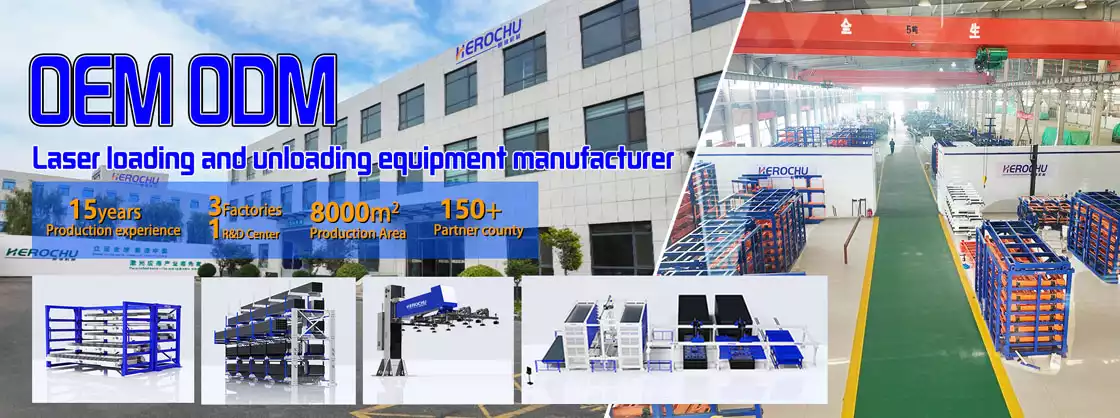
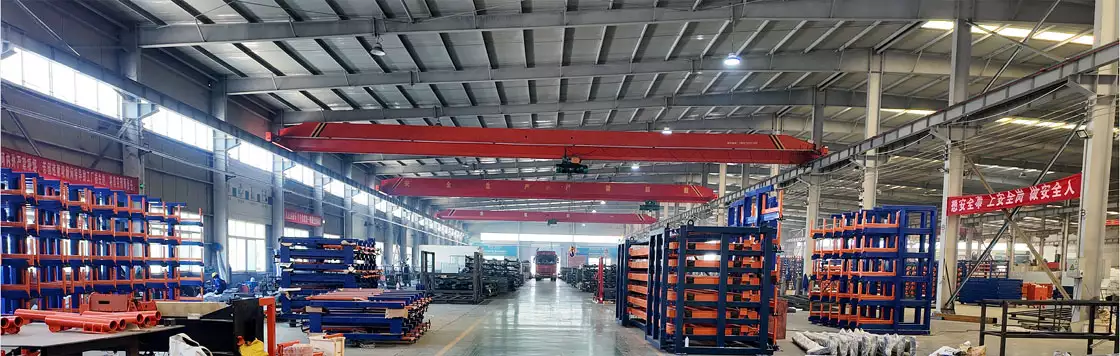
Factory

Hot Selling Machines
-
Sheet Metal Handling Equipment
Laser-Based Loading Equipment for Automated Sheet Metal Processing
Read moreRated 0 out of 5 -
Vacuum Sheet Lifter
Steel Plate Vacuum Lifters for Safe and Efficient Sheet Metal Handling
Read moreRated 0 out of 5 -
Sheet Metal Handling Equipment
CNC Sheet Material Handling Equipment for High-Throughput Metal Fabrication
Read moreRated 0 out of 5 -
Pneumatic Manipulator
Pneumatic Cantilever Loading Manipulator for Precision CNC Sheet Feeding
Read moreRated 0 out of 5 -
Automatic Sheet Metal Storage System
Automated Multi-Level Plate Depot with Robotic Retrieval for Laser and Punch Fabrication
Read moreRated 0 out of 5 -
Automatic Sheet Metal Storage System
Smart High-Density Vertical Storage Carousel with Auto-Feeding for Laser Cutting
Read moreRated 0 out of 5 -
Automatic Sheet Metal Storage System
Intelligent 3D Automated Warehouse Rack for Steel Plate Storage
Read moreRated 0 out of 5 -
Automatic Sheet Metal Storage System
AI-Enabled Automated Sheet Metal Storage System for Laser Cutting Production
Read moreRated 0 out of 5
Related products
-
Pipe Storage Rack
Steel bar stock storage racks | horizontal bar storage rack
Read moreRated 0 out of 5 -
Pipe Storage Rack
Cantilever sheet metal rack-Electric cantilever sheet metal rack
Read moreRated 0 out of 5
Product Categories