
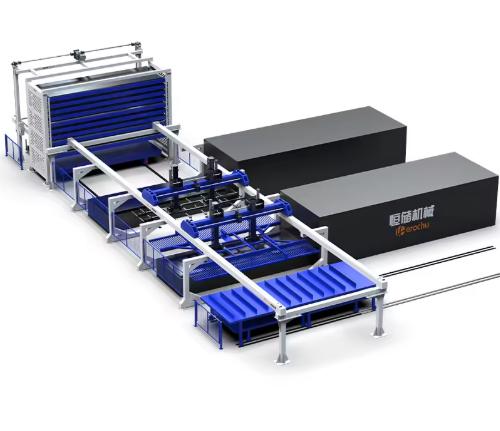
Smart Sheet Material Handling Automation Solution for Laser Cutter
Laser cutting has transformed sheet metal fabrication over the past two decades, but the material handling that feeds those laser cutters has lagged behind. Walk through most fabrication shops and the pattern is consistent: a skilled operator spends more time maneuvering sheets with an overhead crane than the laser spends cutting. Every minute the cutting head sits idle represents lost throughput that no amount of laser power or cutting speed can recover.
Smart Sheet Material Handling Automation Solution for Laser Cutter
Laser cutting has transformed sheet metal fabrication over the past two decades, but the material handling that feeds those laser cutters has lagged behind. Walk through most fabrication shops and the pattern is consistent: a skilled operator spends more time maneuvering sheets with an overhead crane than the laser spends cutting. Every minute the cutting head sits idle represents lost throughput that no amount of laser power or cutting speed can recover.
Herochu’s smart sheet material handling automation solution closes this gap. Rather than treating the loader as an isolated peripheral bolted onto a laser cutter, Herochu engineered an integrated automation platform where material flow becomes a parallel, continuous process running alongside — not after — the cutting cycle. The system combines adaptive vacuum gripping, variable-frequency gantry motion, and Siemens PLC-based multi-machine coordination to transform sheet handling from a manual bottleneck into an automated background operation.
This article examines how Herochu smart material handling automation integrates with laser cutting workflows, from end-effector adaptability through control architecture to the floor-space and labor-efficiency gains that justify the capital investment.
The Automation Gap in Laser Cutting Workflows
To understand why a dedicated smart handling solution matters, it helps to quantify what conventional loading methods cost in lost productivity. A fiber laser cutting machine with a 6 kW or 12 kW resonator can pierce and profile steel sheet at feed rates measured in meters per minute. Yet in a manual-handling environment, the actual cutting time per shift rarely exceeds 50% to 60% of available machine hours. The remainder goes to craning raw sheets onto the shuttle table, removing cut part nests, stripping scrap skeletons, and repositioning the next plate.
Operators in these environments face a compounding set of problems. Oil-coated sheets stick together, requiring manual peeling and separation. Large-format plates flex during lifting, making single-operator placement imprecise. Scrap skeletons — thin frames of material remaining after parts are cut — are awkward to grip and dangerous to handle manually. Each of these friction points steals minutes from every cutting cycle, and those minutes accumulate into hours of lost production across a shift.
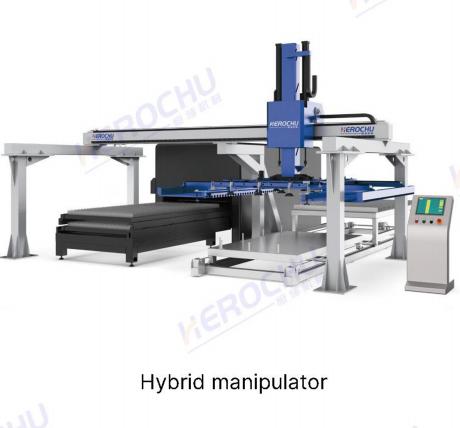
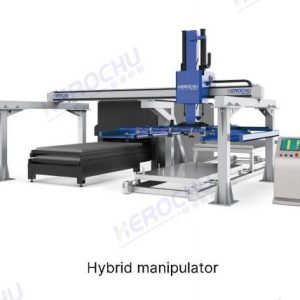
Herochu addresses this by making the loading and unloading cycle autonomous. The smart gantry system retrieves raw sheets from storage, stages over the laser bed, loads precisely, and clears cut parts and skeletons — all without operator intervention. The laser operator transitions from material handler to process supervisor, monitoring multiple machines rather than wrestling with individual sheets.
Adaptive Vacuum Gripping: The Intelligence Layer
The core intelligence in Herochu’s handling solution resides in the end-effector — the gripping assembly that makes physical contact with the sheet. Standard vacuum lifters work adequately for solid, flat plates. They fail when presented with the conditions common in laser cutting environments: oil-coated surfaces, partially cut nests, and the skeletal remains of fully processed sheets.
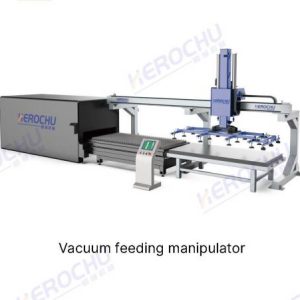
Herochu’s zoned vacuum suction matrix solves these problems through segmentation. The end-effector mounts a grid of oil-resistant suction cups arranged with adjustable spacing to accommodate sheet sizes from 3,000 × 1,500 mm up to 6,000 × 2,500 mm. Critically, the vacuum manifold divides into independently controlled sectors, each addressable from the Siemens PLC interface.
This zoned architecture enables material-specific gripping strategies. When loading a raw, unprocessed steel plate, all vacuum zones activate simultaneously for maximum holding force. When retrieving a partially cut nest where some parts have already been removed — or a completed skeleton frame where the majority of the original plate area is now void — the control system activates only the zones that register solid material contact. Zones positioned over cut-out areas remain sealed, preserving vacuum pressure in the active circuits rather than bleeding into open space.
The pressure sensors in each zone provide continuous feedback during transit. If a single cup loses adhesion — from a surface irregularity, an oil patch, or an unexpected cut-out — the affected zone reports the pressure drop to the PLC. The system can then decide whether to continue the transfer (if sufficient redundant grip remains), pause and re-attempt cup seating, or abort the cycle and alert the operator. This closed-loop monitoring eliminates the blind-grip risk inherent in single-circuit vacuum lifters.
Double-Sheet Detection and Separation
Oil-film adhesion between stacked metal sheets is one of the most persistent problems in automated sheet handling. Rolling mill lubricants, rust-preventative coatings, and atmospheric humidity combine to create a surface tension bond between adjacent sheets that far exceeds the weight of a single plate. When a vacuum lifter descends on a stack, the top two or three sheets may cling together as a single unit — a condition that, if undetected, loads multiple plates onto the laser bed and causes cutting-head collisions, part misalignment, and potential machine damage.
Herochu integrates automated sheet separation into every pickup cycle. The gantry executes a controlled micro-flexing motion: after initial grip, the Z-axis lifts the sheet slightly and applies a small-amplitude bending force along one edge. This localized flexure breaks the oil-film surface tension between the gripped sheet and the one beneath it. Simultaneously, compressed air nozzles inject a high-velocity air stream into the gap created by the flexure, further separating the layers.
Thickness sensors or magnetic proximity detectors mounted on the gripper frame measure the gripped material before the gantry proceeds with full-speed translation. If the sensor registers a total thickness consistent with two or more sheets, the PLC triggers a re-separation cycle and flags the event in the operational log. This detection-and-response loop prevents double-sheet loading without requiring the operator to visually inspect every pickup — a critical capability for the unattended night shifts that justify the automation investment.
Multi-Machine Coordination: The One-to-Two Loop
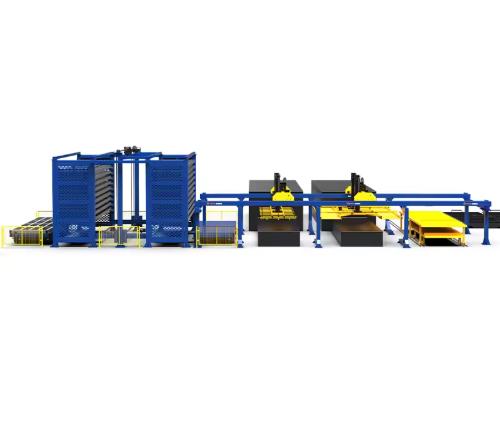
Herochu configures its gantry systems in a one-to-two continuous loop that defies the traditional sequential relationship between loading and cutting. In a conventional setup, the sequence runs: load sheet, cut sheet, unload parts, load next sheet, cut next sheet — each step waiting for the previous one to finish. The Herochu architecture parallelizes this workflow.
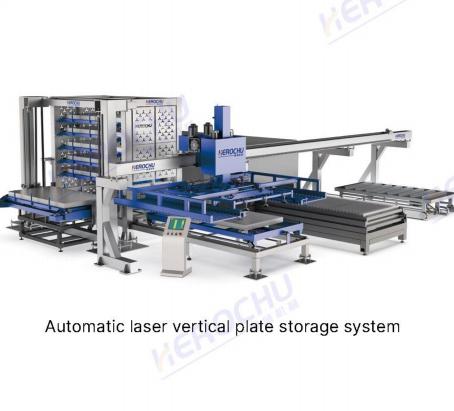
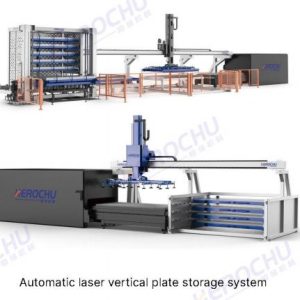
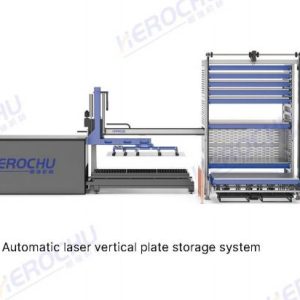
The gantry extracts a raw sheet from the vertical storage tower and stages it in a ready position above Laser Cutter A. Laser Cutter A completes its current cutting cycle, the shuttle table opens, and the gantry places the fresh sheet with sub-millimeter positioning accuracy — typically within two to three seconds of table availability. The gantry then traverses to Laser Cutter B, where it retrieves the finished part nest or scrap skeleton deposited by the previous cycle, delivers it to the output zone, and begins the retrieval sequence for the next raw sheet destined for Cutter B.
This continuous loop eliminates queuing. Neither laser cutter waits for the other to finish loading before starting its next cycle. The gantry moves between machines at 50 meters per minute, completing load and unload operations faster than the cutting cycles themselves. From the perspective of production scheduling, material handling drops out of the critical path entirely — it becomes a background service rather than a sequential step.
Control Architecture: Siemens PLC and Omron Sensing
The digital backbone of Herochu’s smart handling solution runs on Siemens PLC logic with Omron sensor arrays for material tracking and Schneider Electric components for power distribution. This component standardization serves a practical purpose beyond brand consistency: it ensures that maintenance technicians familiar with industrial automation standards can diagnose and service the system without proprietary tooling or vendor-locked training.
The touchscreen HMI displays live operational data: spatial coordinates of the gantry along all axes, vacuum pressure levels in each suction zone, material weight from integrated load cells, and inventory counts within the connected storage tower. Operators can monitor multiple machines from a single panel, switching between gantry views as needed.
Weight analytics add a layer of process verification. Before each transfer, the load cells weigh the gripped material and compare the reading against the expected sheet weight programmed into the job file. A mismatch triggers an alert — the sheet may be the wrong thickness, the wrong material grade, or a double-sheet condition that escaped the separation routine. This weight gate prevents incorrect material from reaching the laser bed, where a cutting program optimized for 2 mm mild steel would produce scrap if run on 3 mm stainless.
Vertical Storage Integration and Floor Space Recovery
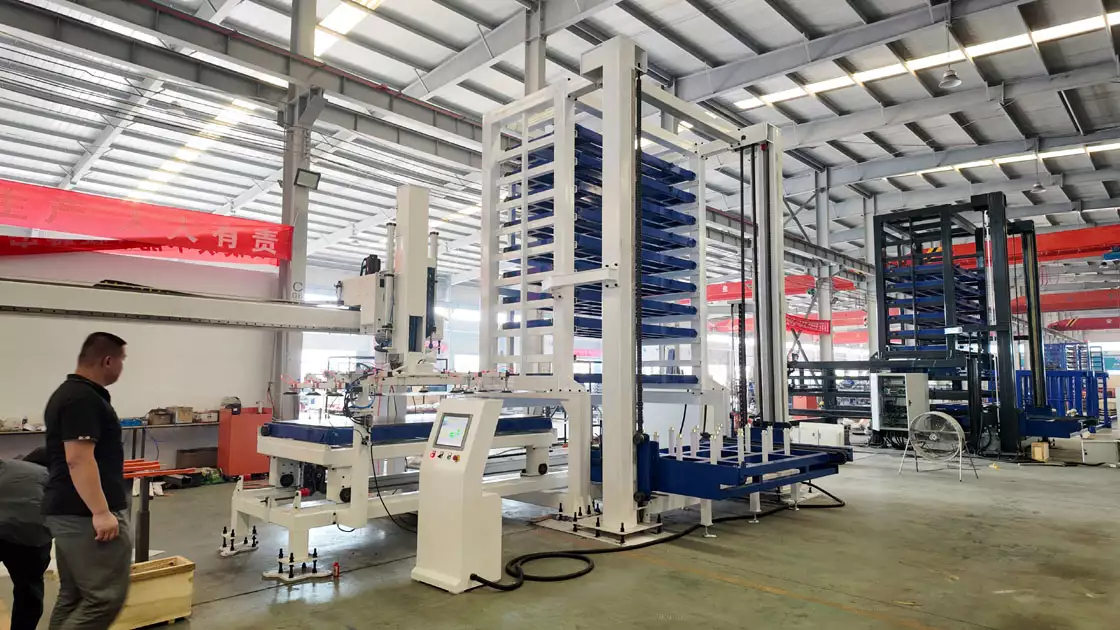
The Herochu gantry interfaces directly with multi-tier cantilever storage towers housing 8 to 13 or more levels per tower. Each level supports 3,000 kg to 5,000 kg of material — enough for full bundles of raw steel sheet at common thicknesses. By stacking inventory vertically rather than spreading it across floor-level pallets or A-frame racks, the AS/RS (automated storage and retrieval system) reclaims roughly 70% of the floor area that manual storage methods consume.
This space recovery changes the economics of shop floor layout. Rather than dedicating hundreds of square meters to material staging, fabricators can install additional laser cutters, press brakes, or welding cells in the recovered footprint. The storage tower also improves material organization: each tier can be assigned to a specific material grade, thickness, or job batch, with the control system tracking inventory by location and automatically selecting the correct sheet for each cutting program in the queue.
For facilities running unattended third shifts, the tower becomes the material buffer that sustains continuous operation. Raw stock loaded into the tower during the day shift feeds the gantry through the night. When a material tier empties, the system either switches to the next available tier of the same specification or pauses operations and logs the depletion event for morning shift replenishment.
Safety Systems for Automated Environments
Operating a 50-meter-per-minute gantry carrying steel sheets weighing hundreds of kilograms through a shared production environment demands rigorous safety architecture. Herochu systems carry CE compliance certification and align with ISO 9001 quality management standards.
Fail-safe check valves on all vacuum and pneumatic circuits maintain gripping pressure during a complete compressed air system failure. This means a shop-wide air outage does not result in a dropped sheet — the check valves lock residual pressure in the closed circuit, holding the load until pressure can be restored under controlled conditions or the sheet can be manually lowered.
LiDAR path scanners sweep the gantry travel envelope continuously. When the scanner detects an obstruction — a forklift, a misplaced material cart, or a person inside the exclusion zone — the control system initiates a controlled deceleration profile rather than an abrupt emergency stop. Controlled deceleration preserves grip stability on the payload, whereas an instantaneous stop would subject the sheet to inertial forces that risk shifting or dropping the load.
Perimeter safety light curtains define the boundaries of the automated work zone. Interlocks prevent automatic cycle restart until the zone is verified clear of personnel. These physical barriers are supplemented by visual and audible warning indicators that activate during gantry motion, providing multi-sensory cues to anyone working in proximity to the automated area.
Economic Justification
The return on investment for Herochu smart material handling automation materializes through three channels: machine utilization, labor reallocation, and floor space efficiency.
On machine utilization, the arithmetic is direct. If a laser cutter operates at 55% utilization under manual handling and the Herochu system raises that figure to 85% or higher, the effective cutting capacity of each machine increases by more than 50% without purchasing an additional laser. For a fabrication shop running two or three laser cutters, this utilization gain may defer or eliminate a capital equipment purchase entirely.
On labor, the automation shifts the operator’s role from material handling — a physically demanding, repetitive task with ergonomic risk — to process oversight. One operator monitoring two or three automated laser cells replaces the two or three operators previously required for single-machine manual loading. The labor savings alone, at prevailing manufacturing wage rates, typically recover the system cost within 18 to 36 months.
Floor space efficiency from vertical tower storage provides a secondary ROI stream. Recovering 70% of the material staging footprint means additional production equipment can be installed without facility expansion. For shops operating in high-cost industrial real estate markets, this space recovery can represent hundreds of thousands of dollars in avoided lease or construction costs.
Conclusion
Smart sheet material handling automation represents the logical next step for fabrication shops that have already invested in high-speed fiber laser cutting capability. The laser itself has become fast enough that further gains in cutting speed yield diminishing returns — the bottleneck has shifted to how quickly material reaches the cutting bed and how quickly finished parts leave it.
Herochu’s solution addresses this bottleneck at the system level rather than the component level. The zoned vacuum gripping adapts to solid plates, partial nests, and scrap skeletons without reconfiguration. The Siemens PLC control matrix coordinates material flow across multiple machines in a continuous parallel loop. Vertical storage integration recovers floor space and enables the unattended operation that turns a two-shift facility into a 24-hour production asset. For fabrication operations evaluating their next automation investment, the material handling layer — not the cutting layer — offers the highest marginal return per dollar spent.
FAQ
Here are some frequently asked questions about our sheet metal racks and pipe storage solutions. We hope you find them helpful!
Q1: Can I request a custom size or color?
Absolutely. We offer complimentary design services and deliver efficient, tailored solutions to meet your specific requirements.
Q2: Are you a manufacturer or a distributor?
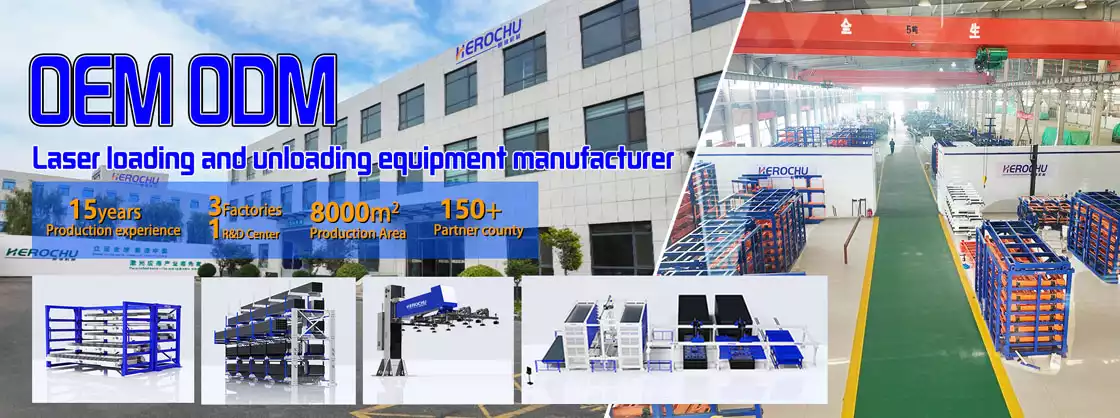
We are a direct manufacturer with over 15 years of industry experience and expertise.
Q3: Is there a minimum order quantity?
No. We welcome orders of any size, starting from a single unit.
Q4: How can I get detailed product information?
Click the “Get a Quote” button to receive product images, detailed specifications, and videos. Our team is always ready to assist.
Q5: How do I provide my storage rack requirements?
Simply share the type, dimensions, and quantity of materials you plan to store, along with any other specific needs. We will develop a professional storage solution for you. Alternatively, leave your contact details for a personalized consultation.
Q6: Do you offer automated loading systems or robotic arms?
Yes. We provide loading robotic arms and integrated loading/unloading systems tailored to your laser cutting machine’s table size and material handling method (e.g., board rack, exchange platform, or material warehouse). Contact us with your details for a customized proposal.
Q7: Do you provide on-site installation and debugging?
Yes. Our technicians can travel to your facility for installation and debugging, ensuring successful operation. We have served clients globally, including in the USA, South Korea, Russia, Qatar, Mexico, South Africa, Egypt, and Lebanon.
Q8: How do you ensure product quality?
Our quality assurance includes:
A team of over 40 technical engineers for professional debugging and support.
A dedicated quality control department compliant with ISO9001 standards.
CE certification for all exports.
Rigorous load testing before shipment to ensure structural safety and reliability.
Q9: Where is your factory located?
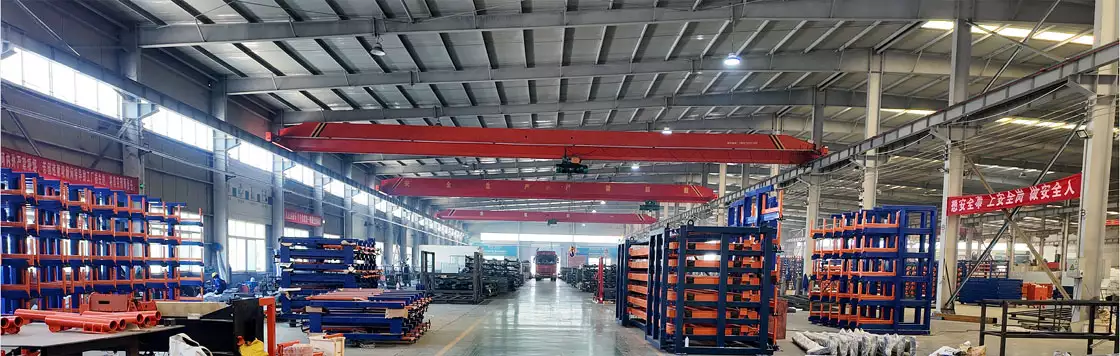
Our modern 10,000-square-meter manufacturing facility is located in Jiyang Industrial Park, Jinan, Shandong, China.
Q10: How can I evaluate your company’s capabilities?
We offer virtual video factory tours and warmly welcome on-site visits.
Q11: What does your company specialize in?
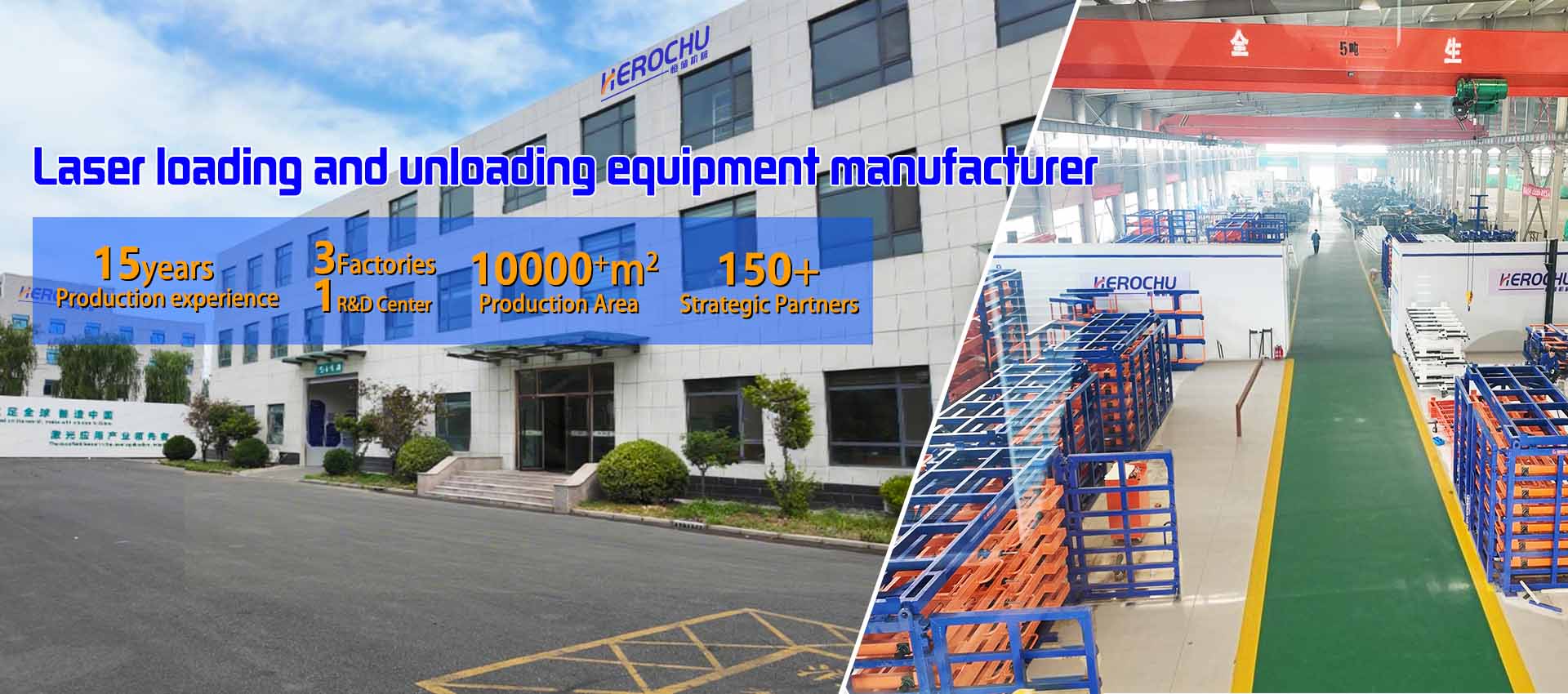
Jinan Constant Storage Machinery Manufacturing Co., Ltd. is a high-tech enterprise specializing in the R&D, production, sales, installation, and service of intelligent storage solutions. Our product range includes sheet material warehouses, drawer-style shelves, cantilever racks, servo manipulators, gantry loaders, and fully automated handling systems. Supported by a skilled technical team and advanced equipment, we are committed to delivering high-performance storage products and solutions to customers worldwide.
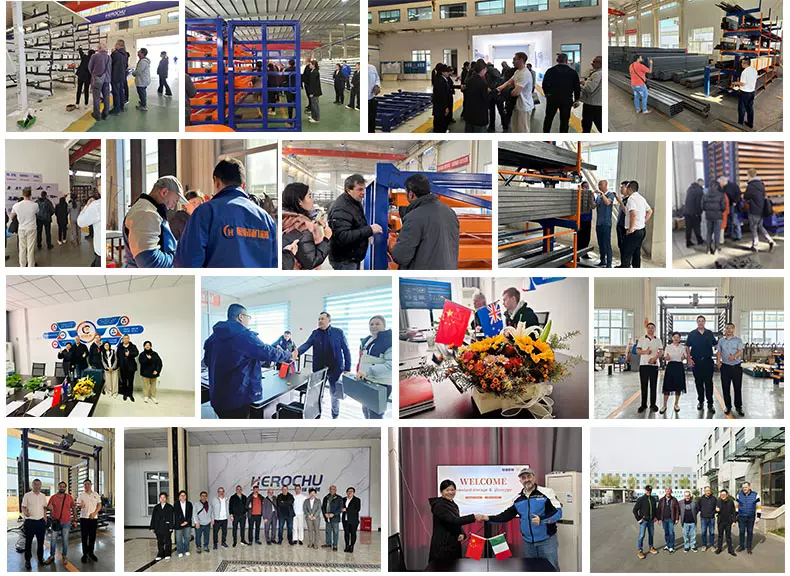
Customer visit
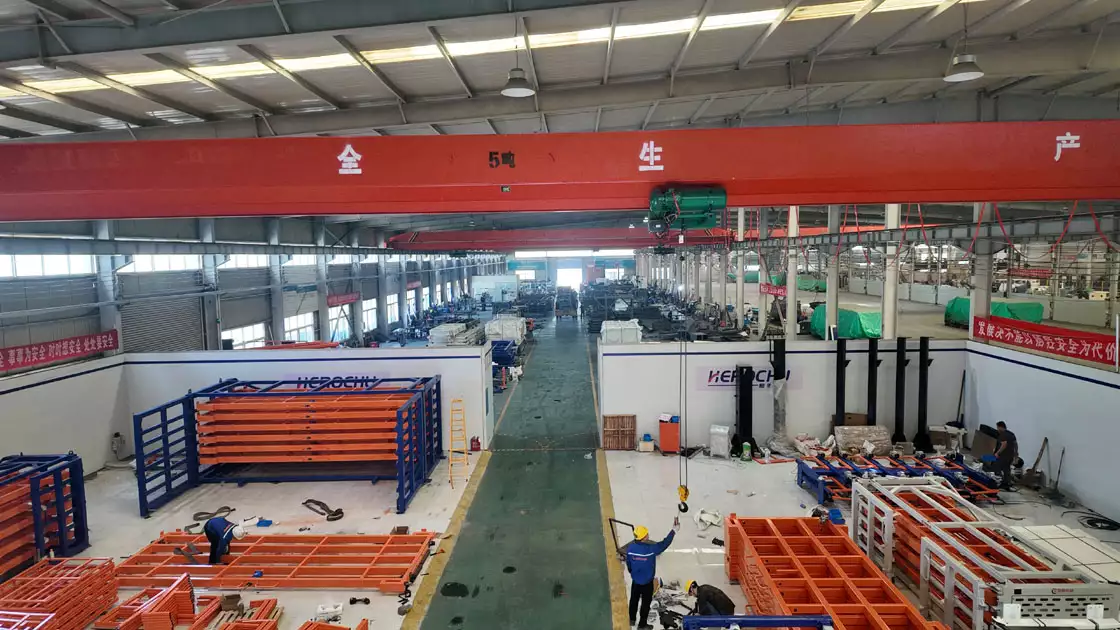
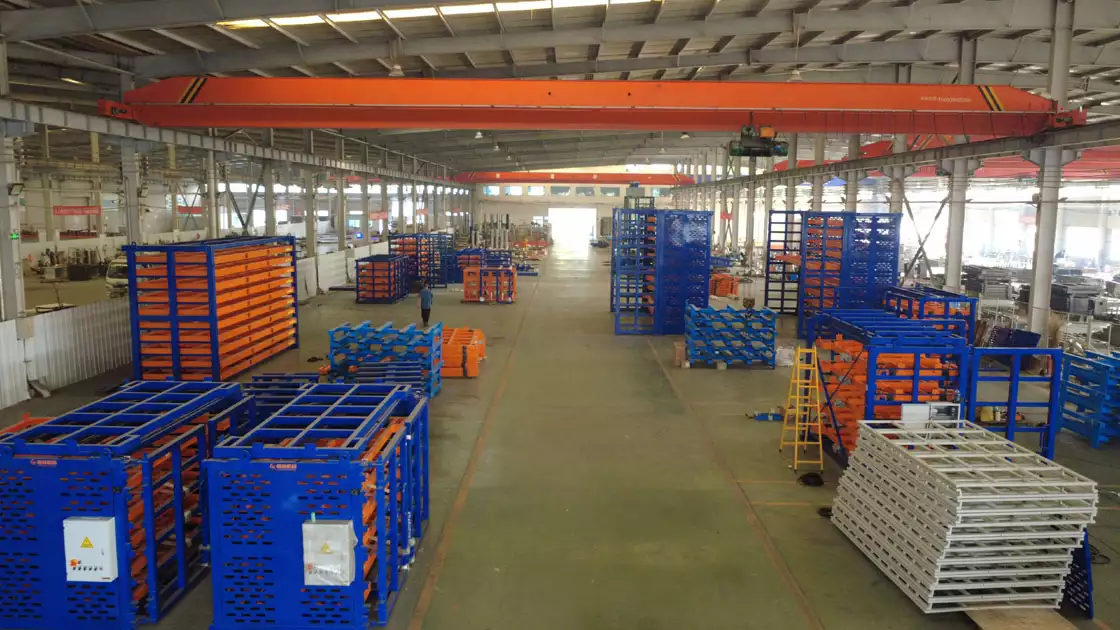
Herochu has always been adhering to the market-centric approach to meet customer requirements to the maximum extent, and the business philosophy of “creating brands with heart and gaining reputation with sincerity”. It provides customers with high-quality products and services with rigorous military quality, professionalism, and excellence, and has won unanimous praise in the Chinese aerospace, Chinese weapons, Chinese railways, automobile manufacturing, engineering machinery, non-ferrous metal titanium alloy and other industries.
Factory

Hot Selling Machines
-
Gantry Loading and Unloading Manipulator
High-Efficiency Gantry Loading Unloading Robot for Fiber Laser
Read moreRated 0 out of 5 -
Gantry Loading and Unloading Manipulator
Automatic Sheet Loading System for Laser Cutting Machine
Read moreRated 0 out of 5 -
Gantry Loading and Unloading Manipulator
Smart Sheet Material Handling Automation Solution for Laser Cutter
Read moreRated 0 out of 5 -
Gantry Loading and Unloading Manipulator
Heavy-Duty Gantry Loader Unloader for Steel Plate Handling — Herochu Industrial Automation
Read moreRated 0 out of 5 -
Vertical metal sheet racks
Vertical Roll-Out Sheet Metal Storage Rack – Heavy-Duty Industrial Racking System
Read moreRated 0 out of 5 -
Vertical metal sheet racks
Vertical Pull-out Sheet Metal Scrap Rack for Storing Laser-Cutting Waste
Read moreRated 0 out of 5 -
Vertical metal sheet racks
High Density Vertical Roll Out Sheet Metal Rack for Space-Saving Industrial Storage
Read moreRated 0 out of 5 -
Vertical metal sheet racks
Heavy Duty Vertical Roll-Out Sheet Metal Rack for Industrial Workshops
Read moreRated 0 out of 5
Related products
-
Pipe Storage Rack
Long Metal Cargo Cantilever Storage Rack | Roll Out Long Objects Racks
Read moreRated 0 out of 5
Product Categories