
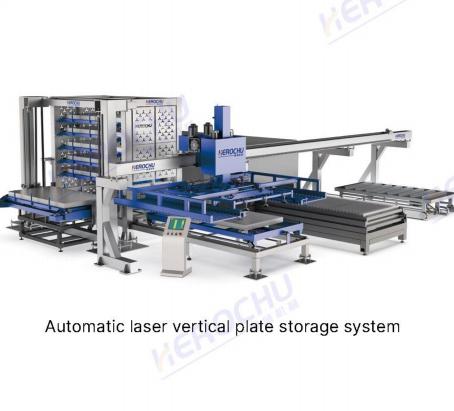
High-Efficiency Gantry Loading Unloading Robot for Fiber Laser
Herochu high-efficiency gantry loading unloading robot for fiber laser cutting features 50 m/min traverse, Siemens PLC, Omron sensors, 90-degree rotation, and AS/RS vertical storage integration. CE and ISO 9001 compliant manipulator for 24/7 production.
High-Efficiency Gantry Loading Unloading Robot for Fiber Laser
Fiber laser cutting technology has advanced to the point where a 12 kW or 20 kW resonator can profile steel sheet at speeds that push the physical limits of the motion platform. The laser itself is no longer the throughput constraint. What limits production in most fiber laser cells today is the sequence of events that happen between cutting cycles: the loading of raw sheet, the unloading of cut parts, and the removal of scrap skeletons. Each of these steps, when performed manually, consumes minutes per cycle — minutes during which an expensive fiber laser cutting machine sits idle.
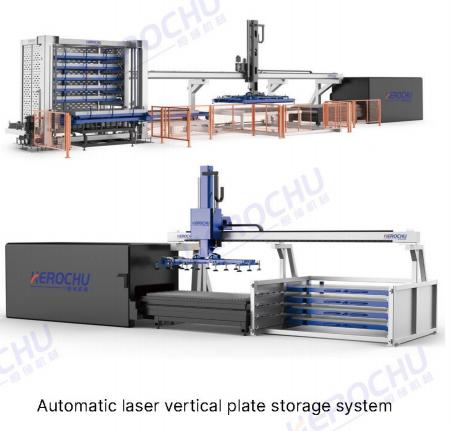
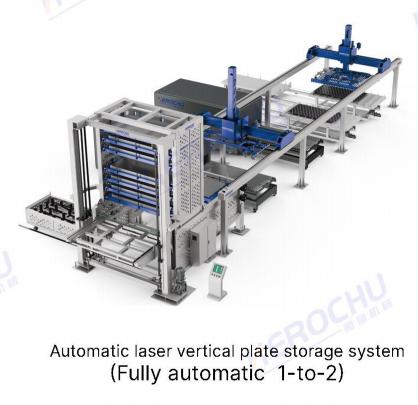
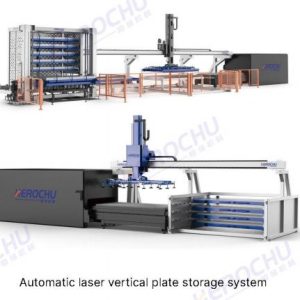
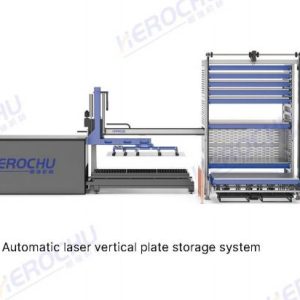
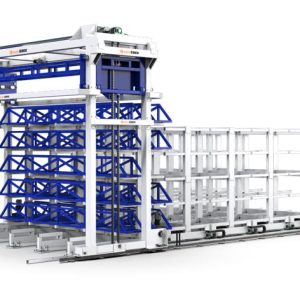
Herochu’s high-efficiency gantry loading unloading manipulator robot addresses this constraint by making material handling a parallel process that runs continuously alongside the fiber laser’s cutting cycle. The manipulator retrieves raw sheets from vertical storage, loads them onto the laser bed with sub-millimeter precision, retrieves finished parts and skeletons, and deposits them in designated output zones — all without operator intervention. In a one-to-two configuration, a single Herochu gantry robot keeps two fiber laser cutting machines fed through continuous automated cycles, enabling the unattended night-shift production that recovers system investment in under three years.
This article examines the structural, kinematic, control, and storage integration elements that define Herochu’s gantry manipulator platform for fiber laser applications.
Structural Rigidity: The Foundation of High-Speed Manipulation
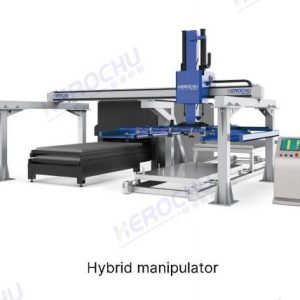
The mechanical platform that supports Herochu’s fiber laser loading robot begins with a bilateral overhead gantry truss structure fabricated from high-tensile profile steel and heavy rectangular steel tubing. This dual-sided architecture distributes structural loads across two parallel load-bearing members rather than concentrating them on a single beam — a design choice that suppresses the torsional deflection and harmonic resonance that would otherwise limit acceleration rates and degrade positioning accuracy.
The engineering logic behind this bilateral design traces to the operational demands of fiber laser automation. A fiber laser with a 6 kW resonator can cut 1 mm mild steel at feed rates exceeding 40 meters per minute. To keep pace, the loading robot must complete its traverse, pickup, and placement cycles within the cutting cycle duration. That means accelerating a gantry carrying up to several hundred kilograms of steel sheet across shop-floor spans of 15 to 25 meters — and doing so repeatedly, cycle after cycle, across multi-shift operations.
A single-beam gantry under these conditions would flex during acceleration and deceleration. That flexure translates into positioning error at the end-effector, which means the sheet lands off its programmed placement coordinate and the cutting program’s nested part layout no longer matches the physical sheet. The bilateral truss eliminates this variable by maintaining geometric stability across the full acceleration envelope.
Stress-relieved weldments further contribute to long-term accuracy. The frame undergoes thermal stress relief after fabrication to release residual internal stresses introduced during welding. Without this treatment, the frame would gradually deform over months and years of operation as internal stresses redistribute — a slow degradation that produces creeping positioning errors, increased bearing wear, and eventually the need for mechanical realignment. Herochu’s stress-relieved frames maintain their as-built geometry for the service life of the installation.
Critical mounting interfaces — linear guide rail seats, rack-and-pinion drive mounts, and vertical lift attachment points — receive finish machining on large-scale column gantry milling centers. This machining step establishes absolute parallelism between rail axes over the full machine span, eliminating the tracking friction and premature bearing wear that result from even sub-millimeter rail misalignment.
Motion Dynamics: Speed, Precision, and Cycle Time Optimization
The kinematic system driving Herochu’s gantry loading unloading robot combines variable-frequency servo motors, heavy-duty linear guide rails, and ground rack-and-pinion drive mechanisms to achieve horizontal travel speeds of up to 50 meters per minute. In practical terms, this means the gantry covers a 20-meter shop axis in approximately 24 seconds — faster than the shuttle table exchange time on most fiber laser cutting machines.
Vertical Z-axis lifting employs synchronized pneumatic cylinders or high-torque hydraulic rams, selected according to the payload class of the specific installation. Lift speeds range from 9 to 12 meters per minute, enabling a full vertical stroke of roughly two seconds for typical pick-and-place operations at storage tower tiers. Pneumatic configurations offer an advantage in shops with existing compressed air infrastructure: faster actuation, cleaner operation, and lower maintenance requirements. Hydraulic configurations provide the sustained holding force and precise position control needed when handling the heaviest sheet stacks at the uppermost payload ratings.
High-resolution encoders on every driven axis close the position feedback loop to the servo drives. The system corrects trajectory deviations in real time, maintaining sub-millimeter repeated positioning accuracy through thousands of cycles. This encoder-based closed-loop control eliminates the accumulated error that open-loop stepper systems accumulate over multiple moves — a critical distinction for fiber laser applications where sheet placement accuracy directly affects part quality and scrap rate.
The 90-degree rotary axis integrated into the manipulator’s end-effector carriage enables mid-transit sheet rotation. When raw sheets are stored lengthwise in the vertical tower but must feed crosswise into a specific fiber laser machine, the robot executes the rotation during the traverse rather than stopping at a floor-level reorientation station. This in-air rotation eliminates a time-consuming intermediate step and keeps the cycle time within the cutting cycle window.
End-Effector Intelligence: Adaptive Gripping for Fiber Laser Workflows
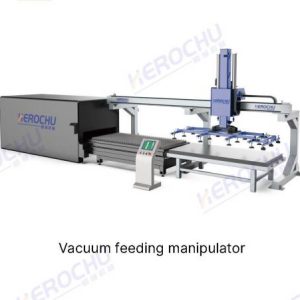
The manipulator’s end-effector — the gripping assembly that physically contacts the sheet — employs a zoned vacuum suction matrix that adapts its grip pattern to the specific condition of each sheet. This adaptability matters because fiber laser cutting cells handle sheets in three distinct states: raw unprocessed plates, partially cut part nests, and finished skeleton frames.
For raw sheet pickup, the vacuum manifold activates all suction zones simultaneously, distributing grip force across the full sheet area. Oil-resistant cup materials maintain adhesion on rolling-mill lubricated surfaces, and the zoned architecture allows individual zones to compensate for surface irregularities without compromising overall grip integrity.
For unloading partially cut nests, the control system activates only the zones positioned over solid material surfaces, referencing the cutting program’s nest layout data. Zones over cut-out areas remain sealed to preserve vacuum pressure in the active circuits. This selective activation prevents the vacuum bleed-down that would occur if all cups were activated across a sheet with significant void area.
For skeleton frame retrieval — where cutting has removed 40% to 60% of the original plate area, leaving a thin web framework — zoned control becomes essential. The system concentrates vacuum on the remaining solid web sections, verified by continuous pressure monitoring in each independent zone. A non-zoned lifter attempting to grip a skeleton frame would lose vacuum the moment enough cup area spanned the open cut-outs.
Double-sheet detection and separation routines are integrated into every pickup cycle. After initial grip, the Z-axis executes a controlled micro-flexing sequence — a small-amplitude bending motion along one sheet edge — while compressed air nozzles inject high-velocity air between sheet layers to break oil-film surface tension. Magnetic proximity sensors or thickness detectors verify single-sheet pickup before the robot proceeds with full-speed translation. If double-sheet is detected, the cycle pauses and repeats the separation routine rather than risking a multi-sheet load on the laser bed.
Control Architecture: Siemens PLC, Omron Sensors, Schneider Electric
Herochu standardizes the control electronics across its gantry loading unloading robot platform on industry-recognized components: Siemens programmable logic controllers for core system logic, Omron sensor arrays for material tracking and position verification, and Schneider Electric components for power distribution and circuit protection.
This standardization serves operational reliability as much as performance. Maintenance technicians in any industrialized region can source replacement components and access service documentation without proprietary tooling or vendor-specific training programs. The component ecosystem is supported by global supply chains, reducing the risk of extended downtime while waiting for specialized parts.
The Siemens PLC executes several control functions simultaneously. Motion control coordinates servo drives across all axes, maintaining synchronization between horizontal translation, vertical lift, and rotary positioning. Vacuum management monitors pressure in each suction zone, activates and deactivates zones according to the material condition, and triggers separation routines when double-sheet conditions are detected. Safety logic processes inputs from LiDAR scanners, light curtains, and emergency-stop circuits, executing controlled deceleration or immediate stop protocols according to the hazard classification of each trigger event.
The touchscreen Human-Machine Interface provides operators with real-time visualization of all system parameters: gantry position coordinates along every axis, vacuum pressure levels in each zone, material weight from integrated load cells, storage tower inventory status, and production cycle counts. Job queuing allows pre-loading of cutting programs with specified material grades, thicknesses, and sheet sizes. The system executes jobs in sequence, tracking material consumption and logging cycle data for each completed operation.
Load cell weight verification adds a process quality gate. Before each transfer, the system weighs the gripped material and compares the reading against the expected weight for the material specified in the active job. A discrepancy triggers an alert — potentially a wrong-thickness sheet, an incorrect material grade substitution, or a double-sheet condition — and halts the transfer until the operator resolves the mismatch.
AS/RS Vertical Storage: Reclaiming Floor Space, Enabling Lights-Out Production
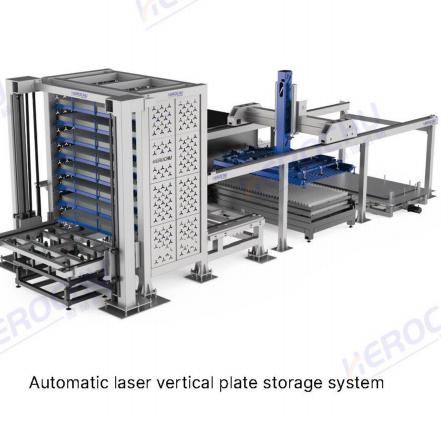
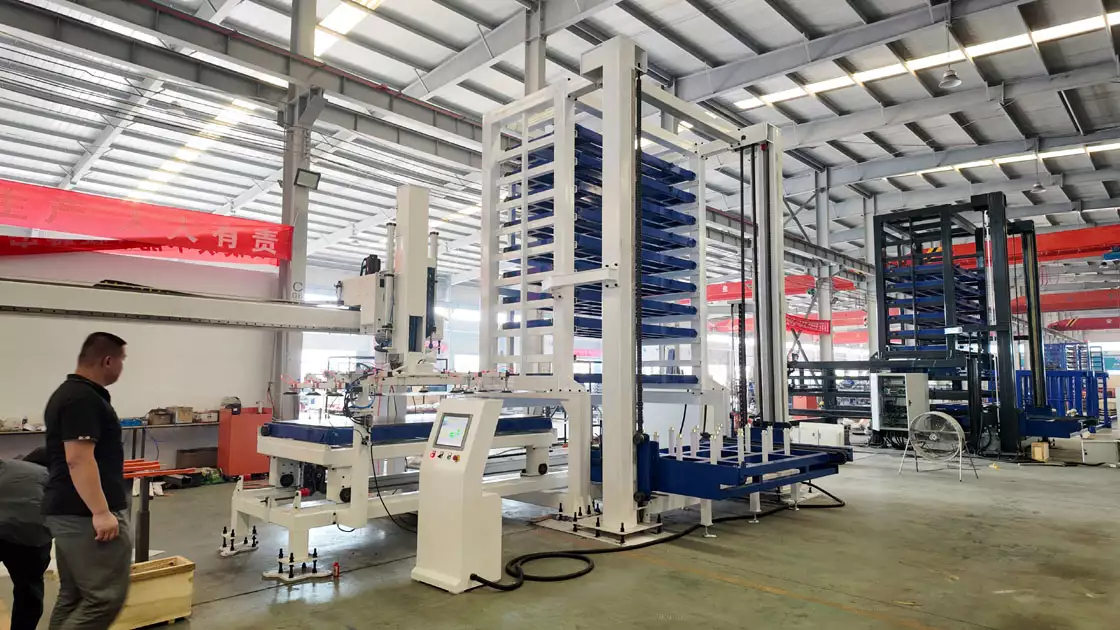
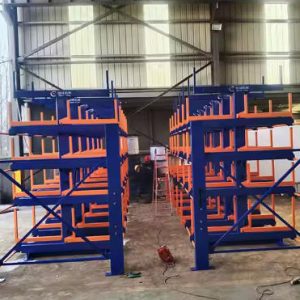
The Herochu gantry loading unloading robot interfaces directly with automated storage and retrieval systems consisting of multi-tier vertical cantilever towers. These towers house 8 to 13 or more storage levels, each rated for 3,000 kg to 5,000 kg of material — enough capacity for full bundles of raw sheet steel at common thicknesses and sheet dimensions.
The floor space arithmetic of vertical storage is compelling. Flat-stacking raw sheet inventory on pallets or A-frame racks consumes hundreds of square meters in a busy fabrication shop. The same inventory, stacked vertically in a tower occupying a footprint of perhaps 20 to 30 square meters, reclaims roughly 70% of that floor area. The recovered space can house additional fiber laser cutting machines, press brakes, welding stations, or improved material flow lanes — any of which generates revenue from previously wasted square footage.
Beyond space recovery, vertical storage enables the inventory organization that makes unattended production practical. Each tower tier is assigned to a specific material specification: grade, thickness, and sheet dimensions. The control system tracks inventory by tier, decrementing counts as sheets are retrieved and alerting operators when tiers approach depletion. When a job queue calls for a particular material, the robot retrieves from the correct tier without operator direction.
For lights-out manufacturing, the tower becomes the material buffer that sustains production through the unattended shift. Operators load the tower with the full night’s material requirement during the day shift. The robot retrieves sheets according to the queued job list, tracking consumption and skipping jobs when their material specification runs out. At shift change, operators find completed cut parts in the output zone, scrap in collection bins, and a production log detailing every cycle executed.
Safety Systems: CE Compliance and Multi-Layer Protection
Operating a 50-meter-per-minute gantry carrying steel sheets weighing hundreds of kilograms through a shared production environment demands a safety architecture that anticipates failure modes rather than merely reacting to them.
Fail-safe check valves on all pneumatic and vacuum gripping circuits represent the first layer. In the event of a complete compressed air system failure — a shop-wide compressor shutdown, a severed air line, or a pneumatic component failure — the check valves lock residual pressure in the closed circuit. The load remains gripped rather than dropping. This passive safety mechanism requires no electrical power, no control system intervention, and no operator action to function.
LiDAR path scanners sweep the robot’s travel envelope continuously, building a real-time map of the area through which the gantry moves. When the scanner detects an intrusion — a person, a forklift, or misplaced equipment inside the exclusion zone — the control system initiates a controlled deceleration rather than an emergency stop. Controlled deceleration preserves grip stability on the payload; an instantaneous stop would subject the sheet to inertial forces that risk shifting or dropping the load.
Perimeter safety light curtains define physical boundaries around the automated work zone. Interlocks prevent automatic cycle restart until the zone is verified clear of personnel. Visual and audible warning indicators activate during gantry motion, providing sensory cues to anyone working in proximity.
Herochu gantry systems carry CE compliance certification and are designed to meet ISO 9001 quality management standards. The documented safety architecture, component traceability, and test protocols support the regulatory compliance requirements of fabrication facilities operating in European, North American, and Asian markets.
Return on Investment: The Productivity Arithmetic
The economic justification for Herochu’s gantry loading unloading robot rests on three measurable returns: increased machine utilization, reduced direct labor, and recovered floor space.
Machine utilization in a manually loaded fiber laser cell typically runs between 50% and 60%. The remaining 40% to 50% of available machine time represents loading, unloading, part extraction, and skeleton removal — all activities during which the laser is idle. Herochu automation eliminates this idle time by executing material handling as a parallel background process. Utilization rates rise to 85% or higher, effectively adding 25 to 35 percentage points of productive cutting time per shift.
For a fabrication shop running two fiber laser cutters across two shifts, that utilization gain translates to an additional 4 to 6 hours of cutting capacity per machine per day — the equivalent of adding a full production shift without purchasing additional lasers or hiring operators. The avoided capital expenditure on an additional fiber laser cutting machine alone can exceed the cost of the Herochu automation system.
Direct labor savings work on a parallel track. Two manually loaded fiber lasers require either two operators (one per machine) or a single operator running between machines with inherent idle gaps. With Herochu automation, one operator supervises both machines during manned shifts, and lights-out configuration eliminates the night-shift labor requirement entirely. At typical manufacturing wage and burden rates, the labor savings recover the system investment within 18 to 36 months.
Conclusion
Herochu’s high-efficiency gantry loading unloading manipulator robot addresses the fundamental productivity constraint in fiber laser cutting environments: the time gap between cutting cycles. By transforming material handling from a sequential, operator-dependent process into a parallel, automated background operation, the system raises laser utilization from the 50%–60% manual-handling ceiling to sustained rates above 85%. The bilateral truss frame, zoned vacuum gripping, Siemens PLC control architecture, and vertical AS/RS storage integration combine to deliver a platform that enables the unattended production capability which defines competitive sheet metal fabrication today.
FAQ
Here are some frequently asked questions about our sheet metal racks and pipe storage solutions. We hope you find them helpful!
Q1: Can I request a custom size or color?
Absolutely. We offer complimentary design services and deliver efficient, tailored solutions to meet your specific requirements.
Q2: Are you a manufacturer or a distributor?
We are a direct manufacturer with over 15 years of industry experience and expertise.
Q3: Is there a minimum order quantity?
No. We welcome orders of any size, starting from a single unit.
Q4: How can I get detailed product information?
Click the “Get a Quote” button to receive product images, detailed specifications, and videos. Our team is always ready to assist.
Q5: How do I provide my storage rack requirements?
Simply share the type, dimensions, and quantity of materials you plan to store, along with any other specific needs. We will develop a professional storage solution for you. Alternatively, leave your contact details for a personalized consultation.
Q6: Do you offer automated loading systems or robotic arms?
Yes. We provide loading robotic arms and integrated loading/unloading systems tailored to your laser cutting machine’s table size and material handling method (e.g., board rack, exchange platform, or material warehouse). Contact us with your details for a customized proposal.
Q7: Do you provide on-site installation and debugging?
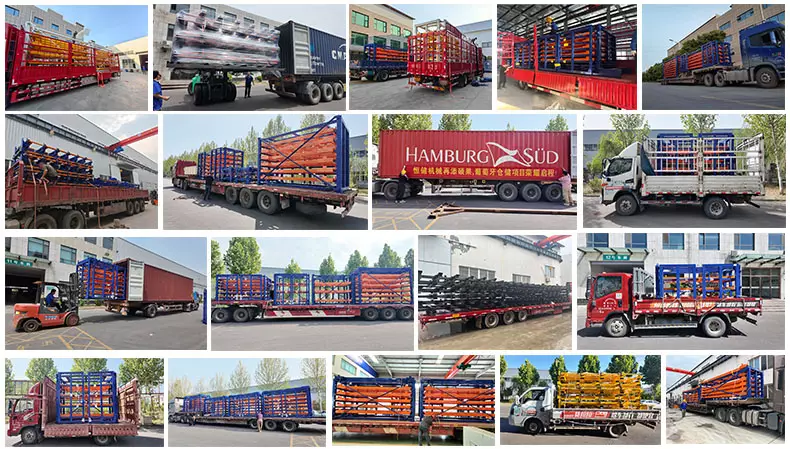
Yes. Our technicians can travel to your facility for installation and debugging, ensuring successful operation. We have served clients globally, including in the USA, South Korea, Russia, Qatar, Mexico, South Africa, Egypt, and Lebanon.
Q8: How do you ensure product quality?
Our quality assurance includes:
A team of over 40 technical engineers for professional debugging and support.
A dedicated quality control department compliant with ISO9001 standards.
CE certification for all exports.
Rigorous load testing before shipment to ensure structural safety and reliability.
Q9: Where is your factory located?
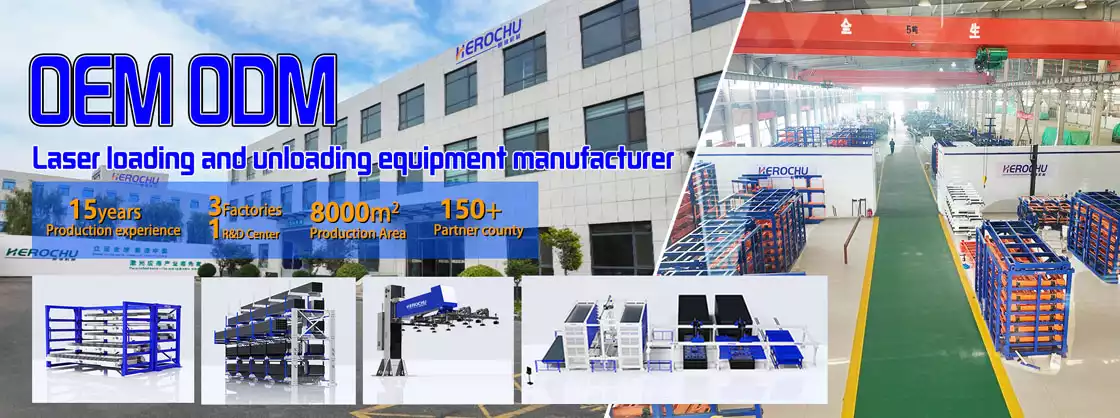
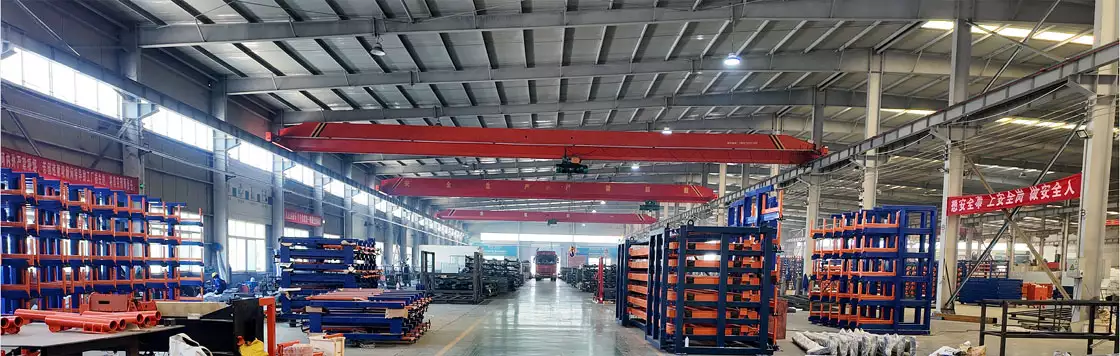
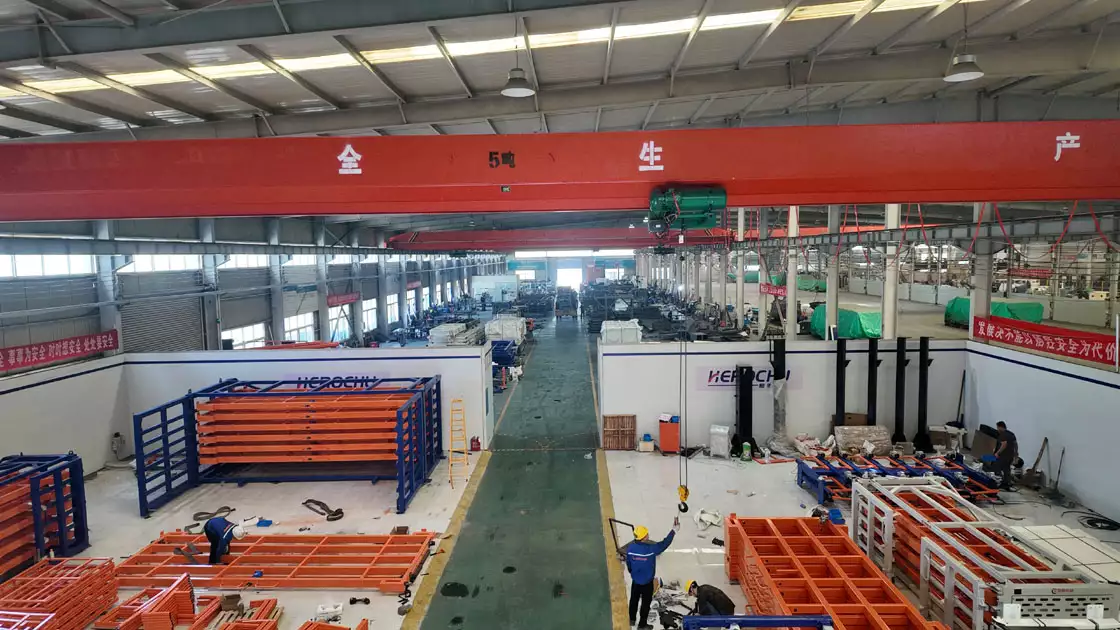
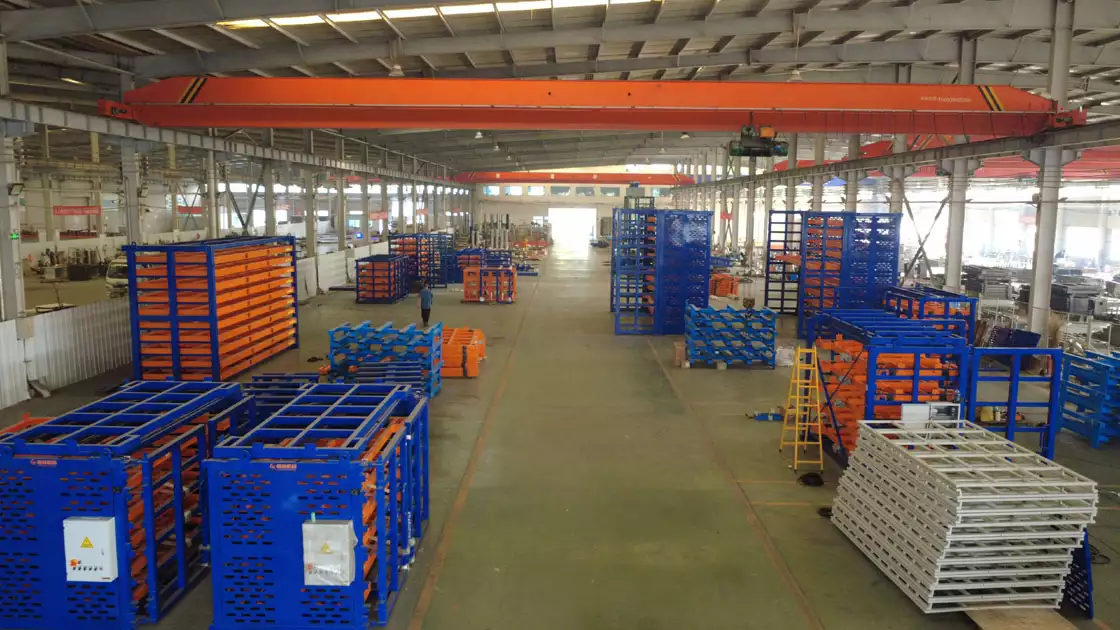
Our modern 10,000-square-meter manufacturing facility is located in Jiyang Industrial Park, Jinan, Shandong, China.
Q10: How can I evaluate your company’s capabilities?
We offer virtual video factory tours and warmly welcome on-site visits.
Q11: What does your company specialize in?
Jinan Constant Storage Machinery Manufacturing Co., Ltd. is a high-tech enterprise specializing in the R&D, production, sales, installation, and service of intelligent storage solutions. Our product range includes sheet material warehouses, drawer-style shelves, cantilever racks, servo manipulators, gantry loaders, and fully automated handling systems. Supported by a skilled technical team and advanced equipment, we are committed to delivering high-performance storage products and solutions to customers worldwide.
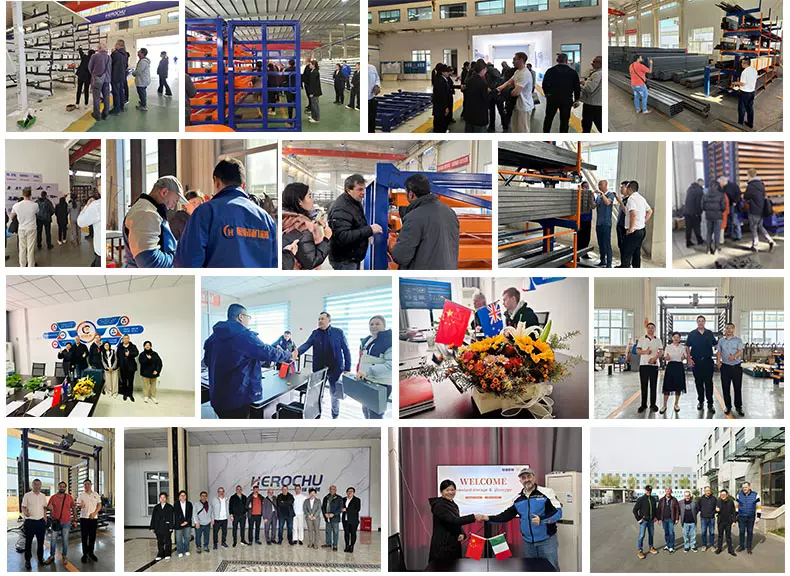
Customer visit
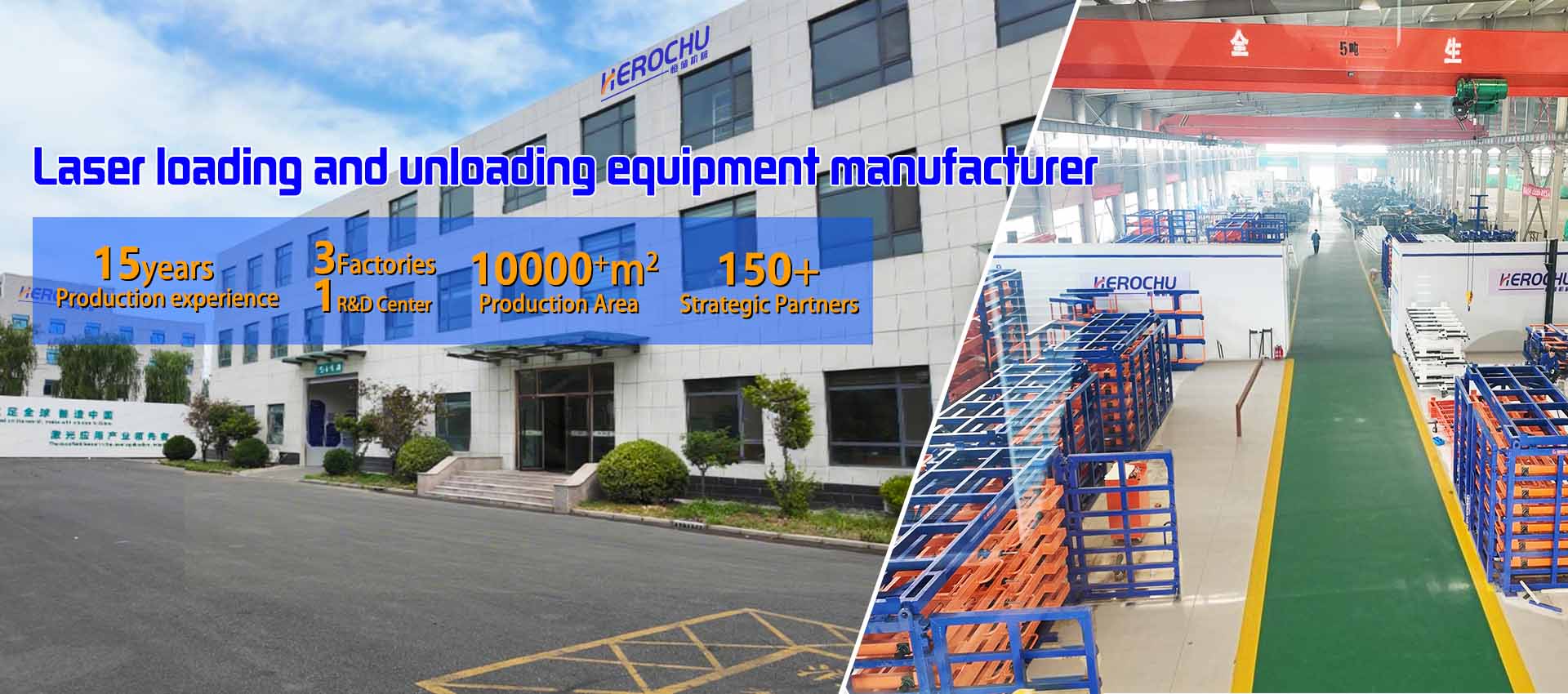
Herochu has always been adhering to the market-centric approach to meet customer requirements to the maximum extent, and the business philosophy of “creating brands with heart and gaining reputation with sincerity”. It provides customers with high-quality products and services with rigorous military quality, professionalism, and excellence, and has won unanimous praise in the Chinese aerospace, Chinese weapons, Chinese railways, automobile manufacturing, engineering machinery, non-ferrous metal titanium alloy and other industries.
Factory

Hot Selling Machines
-
Steel Pipe Warehouse Storage Rack
Heavy Duty Telescopic Cantilever Shelving 8T/Layer Capacity for 6-Meter Long Pipes Bundles
Read moreRated 0 out of 5 -
Electric Telescopic Pipe Cantilever Storage Rack
Heavy-Duty Long Goods Cantilever Racking for 6-Meter Steel Pipes
Read moreRated 0 out of 5 -
Steel Pipe Warehouse Storage Rack
High-Capacity Storage System for Industrial Steel Pipe
Read moreRated 0 out of 5 -
Gantry Loading and Unloading Manipulator
High-Efficiency Gantry Loading Unloading Robot for Fiber Laser
Read moreRated 0 out of 5 -
Gantry Loading and Unloading Manipulator
Automatic Sheet Loading System for Laser Cutting Machine
Read moreRated 0 out of 5 -
Gantry Loading and Unloading Manipulator
Smart Sheet Material Handling Automation Solution for Laser Cutter
Read moreRated 0 out of 5 -
Gantry Loading and Unloading Manipulator
Heavy-Duty Gantry Loader Unloader for Steel Plate Handling — Herochu Industrial Automation
Read moreRated 0 out of 5
Related products
-
Heavy Duty Cantilever Racking Systems
Heavy Duty Pipe Racking Automatic Storage Rack System Warehousing Steel Pallet Tubes Profile Pallets Rack
Read moreRated 0 out of 5 -
Pipe Storage Rack
Tube Bar Cantilever Rack | Bars and Tubes Storage Systems
Read moreRated 0 out of 5
Product Categories