Laser cutting operations depend on a steady, uninterrupted flow of material to the cutting bed. Yet for many fabrication shops, the bottleneck is not the laser itself—it is the manual labor required to position each sheet onto the machine. A vacuum sheet metal lifter for laser cutting addresses this constraint directly, transforming a multi-person task into a controlled operation that one operator can execute safely and repeatedly.
Herochu manufactures pneumatic and electric vacuum lifting systems designed specifically for the demands of modern sheet metal fabrication. This article examines how vacuum lifting technology fits into laser cutting workflows, what technical considerations matter most, and why single-person sheet metal loading has become a practical standard for shops seeking to reduce labor costs without compromising throughput.
The Operational Reality of Sheet Metal Loading
A standard 3000 mm × 1500 mm carbon steel sheet at 3 mm thickness weighs approximately 106 kg. At 6 mm, the same footprint approaches 212 kg. At 8 mm, it exceeds 280 kg. These are not weights that a single worker can handle manually without risk of injury or damage to the material surface.
The challenge intensifies at the laser cutting bed. Unlike a flat storage rack, the cutting table is equipped with support slats—narrow, raised steel strips that hold the sheet during processing. Dragging a heavy plate across these slats is not an option: it risks misaligning the slats, scratching the material, and creating a safety hazard for the operator. The sheet must be lifted, positioned, and lowered gently into place.
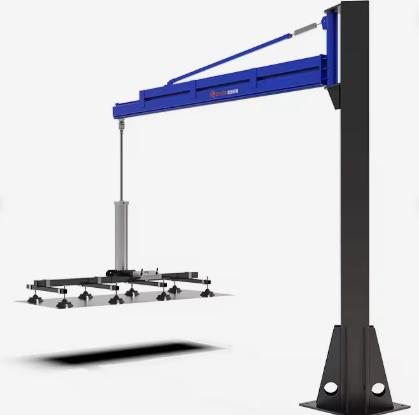
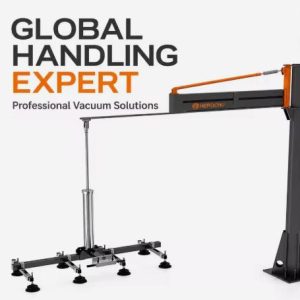
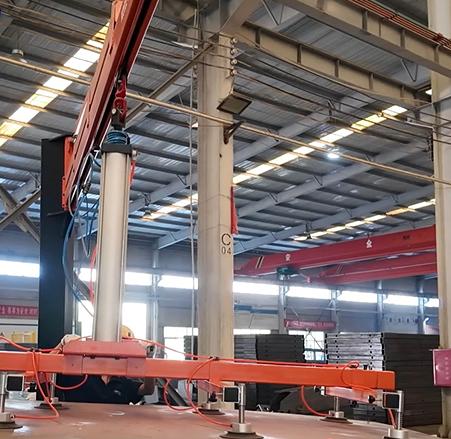
Herochu vacuum lifters are engineered around this specific requirement. By using suction cups to grip the sheet from above, the lifter eliminates the need for manual edge handling entirely. The operator controls the lift through a handle-mounted valve or remote pendant, moving the sheet in three dimensions with minimal physical effort.
Core Design Principles
Herochu’s modular architecture prioritizes adaptability across different production environments. The vacuum sheet metal lifter for laser cutting is built around several key design decisions:
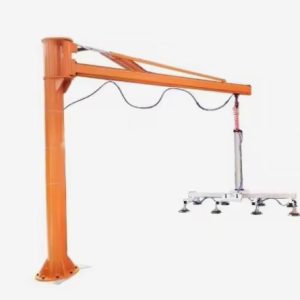
Lightweight structure with modular assembly. The aluminum alloy boom and column assembly can be disassembled for transport or repositioned within a facility without specialized rigging equipment. This matters for shops that reconfigure their layout periodically or need to move equipment between buildings.
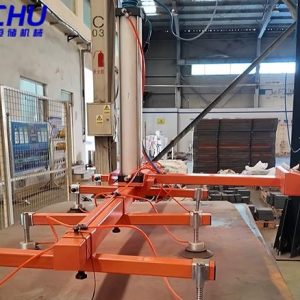
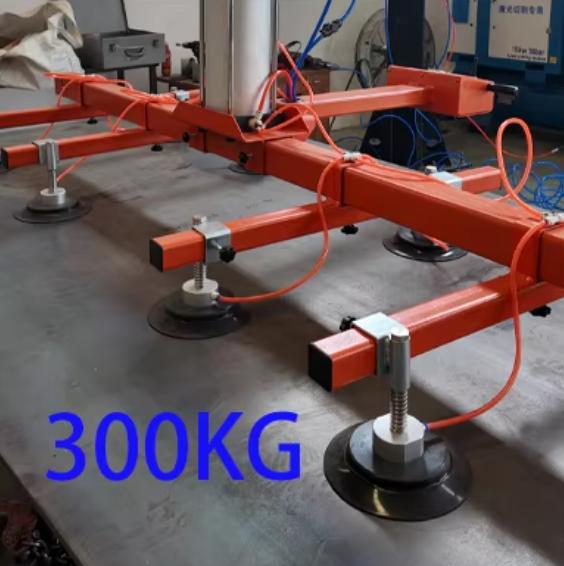
Vacuum suction cups configured for sheet handling. The HC-RP3015-300 model uses eight vacuum cups with 200 mm diameters, distributed across a lifting beam that matches the 3000 mm × 1500 mm sheet format. The cup arrangement ensures even load distribution, reducing the risk of sheet deflection during transport.
Emergency air-cut protection. If the compressed air supply is interrupted—due to a compressor fault, hose failure, or power loss—the vacuum system’s check valve maintains suction long enough for the operator to lower the load safely. This is not an optional accessory but a fundamental safety requirement for pneumatic lifting systems. Regulatory guidance for vacuum lifting equipment specifies that holding time after power failure must be considered in the equipment’s design and operating instructions .
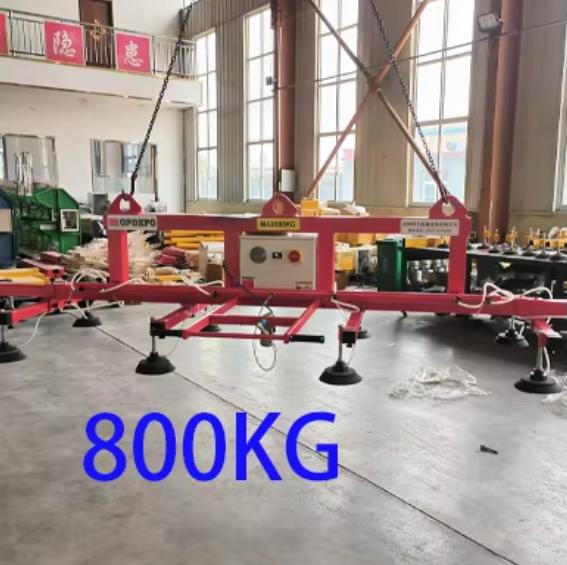
Rotation and positioning flexibility. The 220-degree rotation angle allows the operator to pick a sheet from a storage stack, rotate it into alignment with the cutting bed, and lower it without repositioning the lifter’s base. The 700 mm lifting stroke provides sufficient clearance for loading over the cutting table’s edge.
Technical Specifications and Load Capacity
The Herochu HC-RP series is available in configurations to match different sheet formats and weight ranges:
| Parameter | HC-RP3015-300 | HC-RP4020-500 |
|---|---|---|
| Sheet Dimensions | 3000 × 1500 mm | 4000 × 2000 mm |
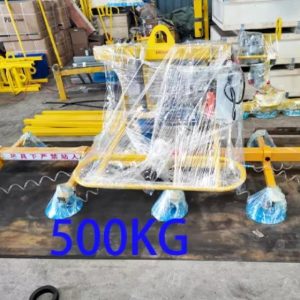
| Max Load | 300 kg | 500 kg |
| Sheet Thickness | 1–8 mm | 1–12 mm |
| Vacuum Cups | 8 × 200 mm | 8 × 200 mm |
| Rotation Angle | 220° | 220° |
| Lifting Stroke | 700 mm | 700 mm |
For operations handling thicker materials—up to 20 mm—Herochu offers a heavy-duty plate lifter machine configuration rated at 1000 kg, with pneumatic or electric power options. The heavier configuration maintains the same eight-cup arrangement but increases the vacuum reservoir capacity and uses reinforced structural components.
The load capacity specification is not a theoretical maximum. It represents the rated working load with an appropriate safety margin. In practice, the vacuum system’s holding force must account for dynamic factors: acceleration and deceleration during movement, potential surface contamination on the sheet, and the condition of the cup sealing lips .
Single-Person Operation in Practice
The economic case for vacuum lifting is straightforward. A two-person manual loading team consumes roughly 0.5 labor-hours per sheet change, assuming a 15-minute cycle. Over a single shift with 30 sheet changes, that is 15 labor-hours of loading activity. A vacuum lifter reduces this to approximately 7.5 labor-hours—a 50% reduction in loading labor.
Beyond direct labor savings, the vacuum lifter reduces the risk of musculoskeletal injuries associated with repetitive heavy lifting. It also minimizes material damage. Manual handling of sheet metal frequently results in scratched surfaces, bent corners, and edge dents—defects that may require rework or generate scrap. The vacuum lifter’s soft suction cups and controlled descent eliminate these failure modes.
Herochu’s pneumatic sheet plate lifter is designed for integration with existing laser cutting operations. The unit can be floor-mounted adjacent to the cutting machine or configured for overhead mounting on a jib crane or bridge crane, depending on the shop’s layout and ceiling height.
Conclusion
The vacuum sheet metal lifter for laser cutting is not a replacement for skilled labor—it is a tool that makes that labor more productive and less hazardous. By handling the physical load, the operator can focus on positioning accuracy, monitoring the cutting process, and managing material flow. For shops evaluating automation options, the vacuum lifter represents a relatively low-cost entry point with immediate returns in labor efficiency and workplace safety.