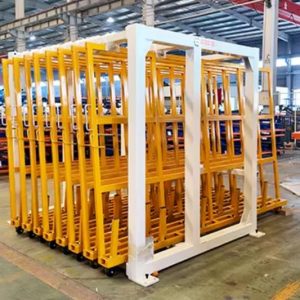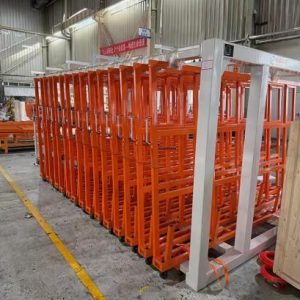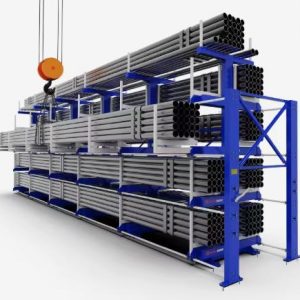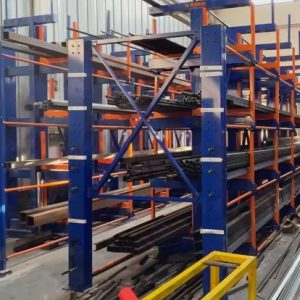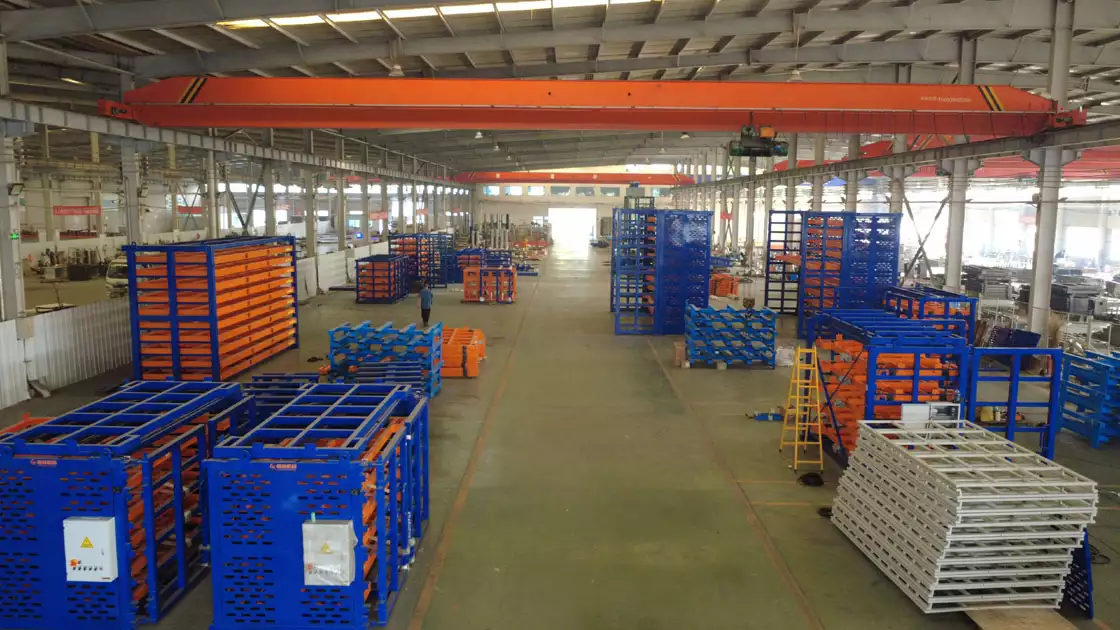
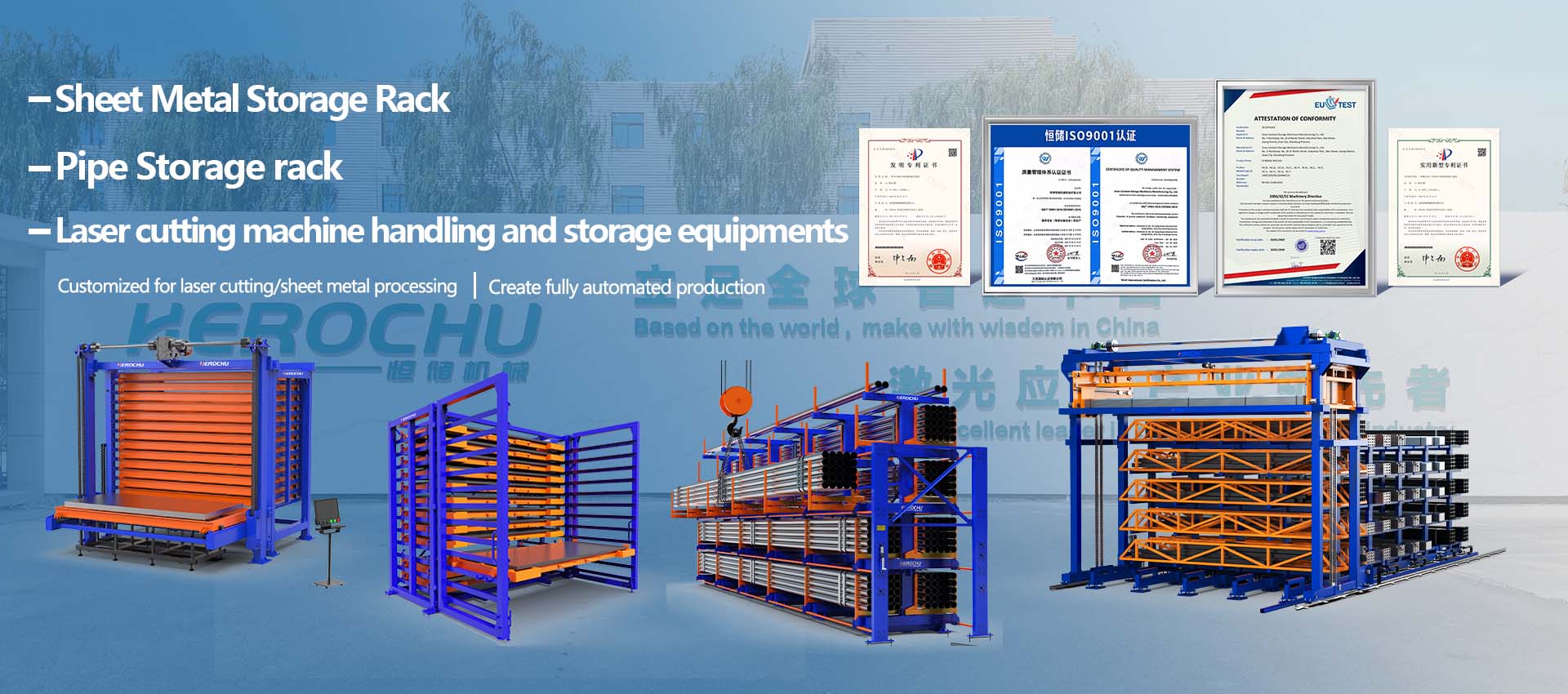
Every square meter of industrial warehouse floor has a carrying cost — rent, lighting, climate control, insurance, and the simple opportunity cost of what else could occupy that footprint. When sheet metal storage sprawls across the floor in flat stacks and wide-aisle cantilever bays, those carrying costs multiply against inventory that generates no revenue while it sits. Herochu motorized roll-out drawer racking tackles the equation from the floor-plan side, compressing sheet metal storage into vertical drawer towers that free space for revenue-producing operations.
The Floor Space Equation
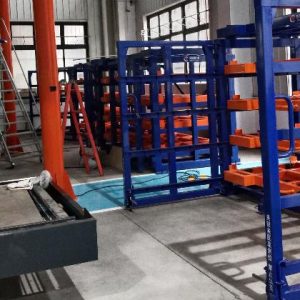
A standard cantilever rack layout for 6,000-millimeter sheet requires roughly 4 meters of aisle width for safe forklift maneuvering, plus the rack depth itself. A row of five such bays with access aisles on both sides consumes approximately 120 square meters of floor area. Replace that layout with two Herochu HC-B6015E-65 motorized drawer towers, each occupying about 15 square meters including operator clearance at the front, and the total storage footprint drops to 30 square meters — a 75 percent reduction for the same sheet metal capacity.
That recovered 90 square meters is not just an abstract efficiency number. It represents space that can host an additional cutting table, a press brake cell, a welding station, or finished-goods staging — all activities that directly generate billable output.
Vertical Architecture with Horizontal Access
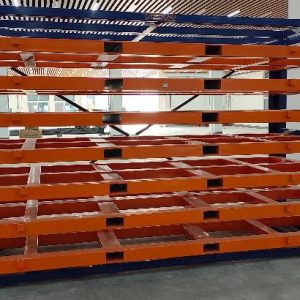
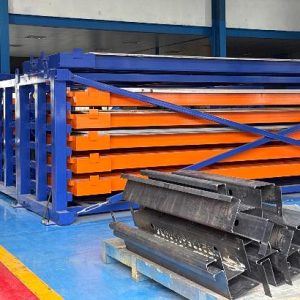
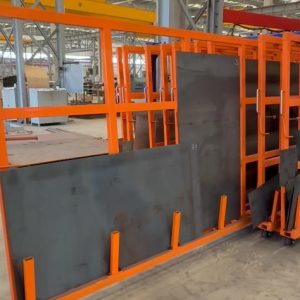
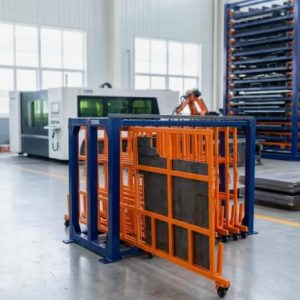
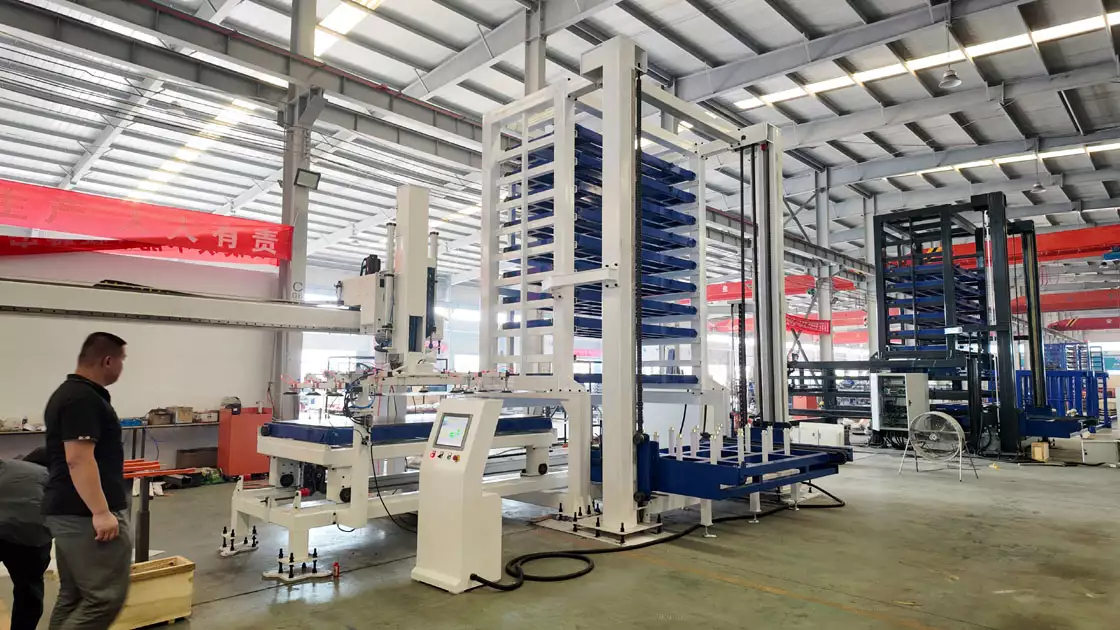
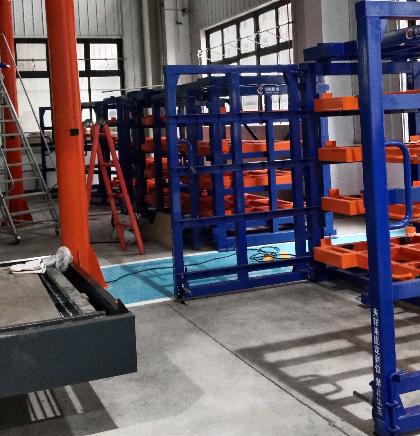
The defining feature of Herochu roll-out drawer racking is the drawer extension geometry. Unlike a standard vertical carousel that rotates inventory to a fixed pick station, the Herochu system extends each drawer horizontally from the tower frame. The drawer travels outward on industrial bearing rails until the full sheet surface sits clear of the frame, presenting the material in a flat, level plane accessible from above by crane or from the side by forklift.
This horizontal extension design preserves overhead crane compatibility — a critical requirement in heavy fabrication shops where magnetic or vacuum lifters are the standard sheet handling method. Vertical carousels and vertical lift modules, by contrast, present sheets at a single fixed access opening, forcing crane-reliant shops to add a secondary handling step.
Drive Train and Motion Control
The motorized roll-out mechanism on Herochu racking uses a rack-and-pinion linear drive — a gear motor that rotates a hardened pinion gear engaged with a toothed rack running the full stroke length of each drawer rail. This drive type delivers consistent speed regardless of drawer position, unlike chain or cable systems that can develop slack and speed variations as the payout length changes.
The control system operates on industrial wireless remote — no pendant cables, no fixed control pedestals, no operator tethered to the machine. The remote provides dedicated extend and retract buttons, plus an emergency stop. Drawer selection is handled by a rotary switch at the tower’s control panel that indexes the active drawer circuit, ensuring only one drawer can be energized at a time.
Travel speeds vary by model and drawer capacity, ranging from 2.28 meters per minute on units handling 3,000-kilogram drawers up to 5.27 meters per minute on the largest 20,000-kilogram rated model. These speeds are deliberate — heavy sheet metal loads on extended cantilevered drawers generate substantial moment forces, and the controlled pace keeps inertial loads within the frame’s engineered safety margin.
Load Distribution and Structural Design
The frame backbone of every Herochu motorized drawer tower is built from Q235B structural steel — a grade specified for its combination of yield strength (235 megapascals minimum), weldability, and consistent mechanical properties across production batches. The dual-beam crossbar configuration at each tier level provides two parallel load paths, so concentrated weight from thick plate stock transfers through both beams to the vertical columns rather than relying on a single member.
Drawer floors use continuous steel decking rather than spaced cross-members. This eliminates point loads on individual sheets and prevents sag between supports — a meaningful consideration when storing thin-gauge material that can develop permanent set under its own weight if supported only at the edges.
The frame’s column-to-baseplate connections are fully welded and gusseted, not bolted. Welded moment connections resist the overturning forces generated when a fully loaded drawer extends to its maximum reach. Anchor bolt patterns for floor mounting are specified in the installation drawings and sized for seismic considerations when required by local building code.
Classification Storage in Practice
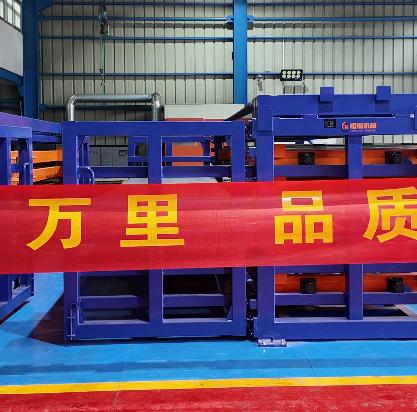
A single Herochu tower can store six different material classifications simultaneously, each in its own dedicated drawer. The practical benefit shows up most clearly in shops that run mixed-material cutting nests. When a nesting program calls for three plates of 6-millimeter mild steel, two of 3-millimeter stainless, and one of 8-millimeter aluminum, the operator calls each drawer in sequence, retrieves the required sheets, and stages them at the cutting table — no sorting through mixed stacks, no mistaken gauge selections, no recuts caused by wrong-material errors.
The drawer divider system extends this classification granularity within individual drawers. A drawer that holds 3,000-millimeter by 1,500-millimeter sheets can be divided into two or three compartments along its length, allowing a single drawer to store mild steel, galvanized, and aluminum sheet in separate bays. Dividers are adjustable, so the classification layout can evolve as the shop’s material mix changes over time.
Installation and Commissioning
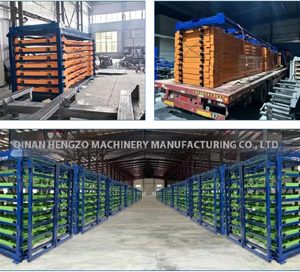
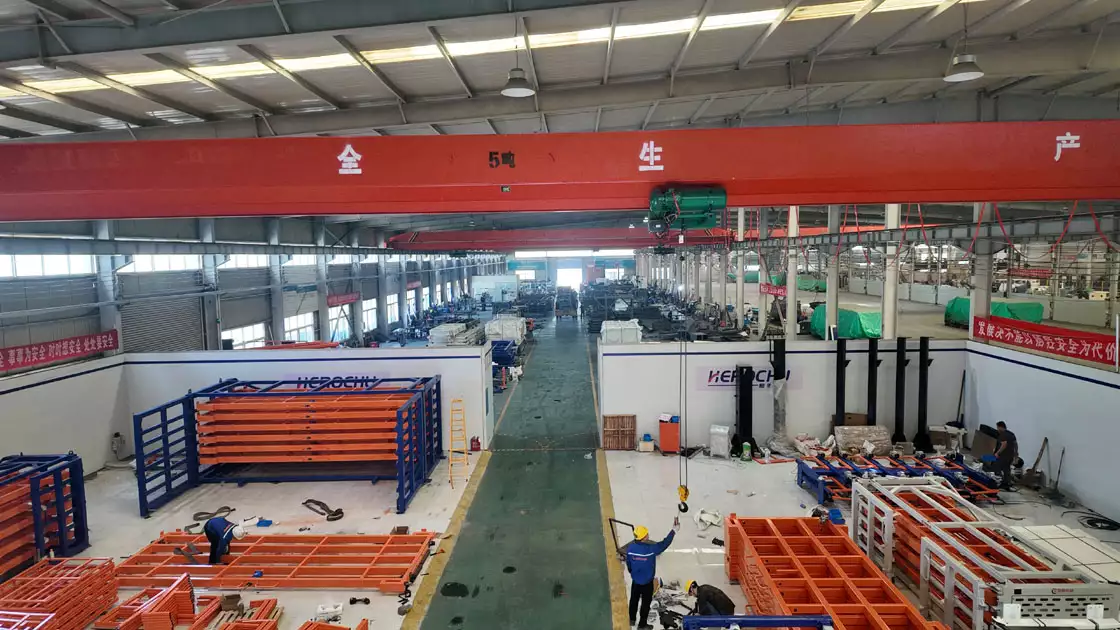
Herochu roll-out drawer racking ships in pre-assembled sub-sections that reduce on-site build time. The frame columns, crossbeams, and drawer carriages arrive as welded assemblies rather than loose components. On-site work consists of standing the columns, connecting the crossbeams, mounting the drawer carriages onto the bearing rails, and wiring the motor controller to the shop’s three-phase supply.
Each shipment includes a 3D assembly animation that shows the build sequence step by step, plus dimensioned PDF drawings and a hardware schedule listing every fastener by size, quantity, and torque specification. The commissioning step involves a remote review — Herochu engineering examines installation photographs or video before authorizing the first powered cycle — which catches misaligned connections or wiring errors before they can cause damage under load.
Service Life and Maintenance Intervals
The specified service life for Herochu motorized drawer racking is 15 to 20 years under normal industrial duty cycles. The primary wear components are the drawer extension bearings and the motor brushes. Bearings are sealed industrial roller units rated for radial loads well above the drawer’s maximum loaded weight — the sealing is the longevity factor, keeping abrasive workshop dust out of the rolling elements. Annual regreasing through accessible grease fittings maintains the seal integrity and lubricant film.
Motor brushes, the only electrical wear item, are field-replaceable through a service port on the motor housing. The controller’s cycle counter provides objective data for brush replacement scheduling rather than relying on calendar-based estimates that may over-service lightly used units or under-service high-duty-cycle units.
Comparing Motorized vs. Manual Drawer Racking
Manual crank-operated drawer cabinets serve a real purpose in low-throughput shops where the fetching a sheet once or twice per shift justifies the physical effort. Herochu offers crank-operated systems alongside motorized units for exactly this use case. When daily retrieval counts climb into the dozens per shift, the case for motorization becomes arithmetic, not preference.
A manual crank drawer requiring 45 seconds of cranking per retrieval cycle consumes roughly 45 minutes of operator time across 60 daily retrievals. The motorized equivalent takes about 30 seconds of remote-control operation per cycle — and the operator can use those 30 seconds to position the crane or forklift, so the retrieval time overlaps with the material handling setup rather than running sequentially.
For shops averaging 100 or more sheet retrievals per day, the labor savings from motorization typically offset the equipment price premium within 12 to 18 months. For shops running two or three shifts, the payback arrives even faster.
Summary
Herochu motorized roll-out drawer racking takes the vertical storage density of a drawer cabinet and adds electric drive for sustained high-throughput operation. The system condenses floor space, eliminates manual cranking, protects sheet metal condition, and provides classification-grade organization at the individual drawer level. It is storage equipment built for shops where material handling speed directly affects machine tool utilization — and where every recovered square meter of floor space translates into productive capacity.