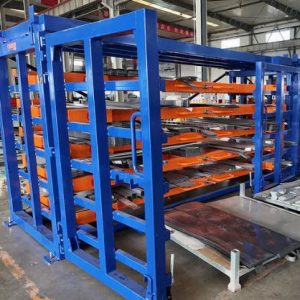
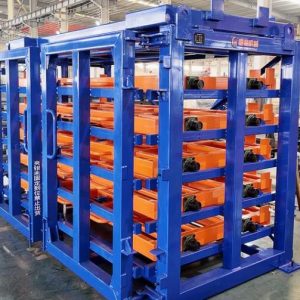
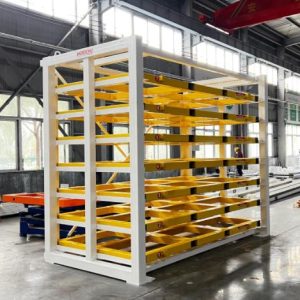
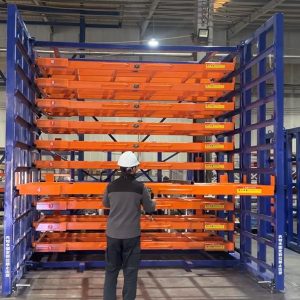
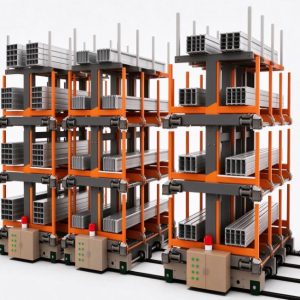
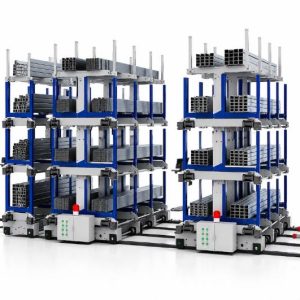
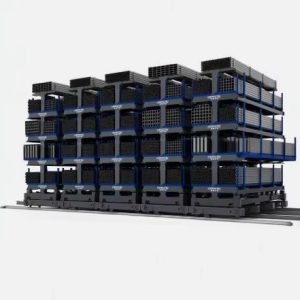
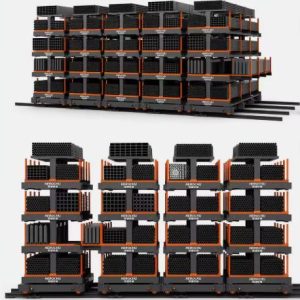
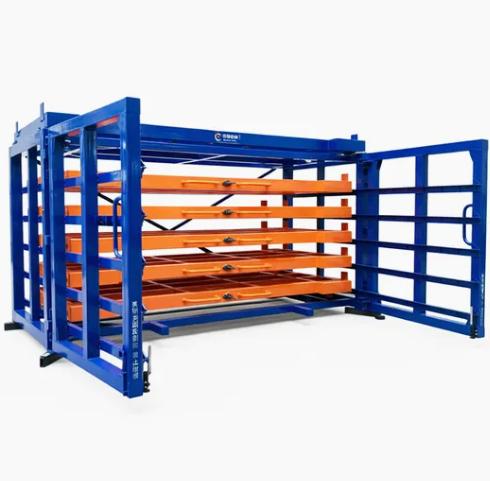
A multi-drawer roll-out sheet metal storage rack is a vertical storage system with independent pull-out drawers that bring large flat plates and panels to the operator at ground level, eliminating restacking and crane dependency for routine retrieval. Herochu manufactures these racks with up to six storage levels, 2,000–4,000 kg per-layer weight capacity, and a pull-out design that lets a single person access a specific sheet from a multi-tonne stack.
Large flat plates are the hardest sheet metal format to store efficiently. They are too big for standard shelving, too heavy for manual lifting, and too varied in size for a fixed cantilever layout to accommodate without wasted space. A multi-drawer roll-out rack addresses all three constraints by treating each storage level as a independent, low-friction platform that travels to the picker.
How the Roll-Out Drawer Changes Material Flow
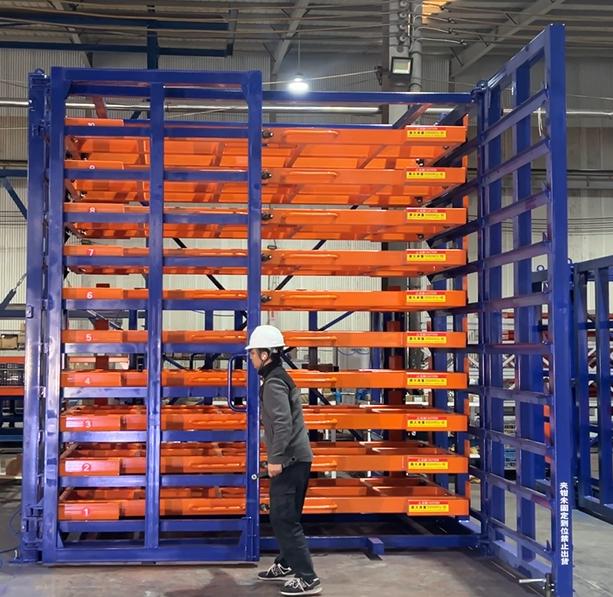
In a conventional floor stack, retrieval is a top-down process: the operator removes sheets from the top until the required gauge is reached, then restacks the removed material. That sequence consumes time even when the required sheet is near the bottom, and it introduces handling damage every time a sheet is moved unnecessarily. A roll-out drawer inverts the sequence. The operator extends the drawer containing the target material, picks the sheet, and closes the drawer. Nothing above or below the target sheet is disturbed.
Herochu’s drawer mechanism uses a roller track under the drawer board, engineered so that the drawer remains easy to pull even after a heavy load. The company specifies that a 3-tonne drawer can be moved with minimal force on the crank-out configuration, and the manual-pull version uses a comparable low-friction track design. For large panels, this is the difference between a two-person retrieval and a single-operator task.
Large Format Capability: Up to 6,000 × 2,000 mm and Beyond
Herochu’s multi-drawer rack platform is sized around large flat stock. The HC-B3015 series accommodates sheets up to 6,000 × 2,000 mm as a standard maximum feeding format, with a minimum format of 800 × 800 mm. Single-layer payload is commonly rated at 3,000 kg, with single-layer weight in the 2,000–4,000 kg range depending on drawer configuration. Storage layers are typically six or fewer, but the frame can be customized for taller installations.
The large-format capability matters for more than sheet metal. The same drawer architecture is specified in workshops storing molds, tooling plates, and heavy flat components that benefit from independent, ground-level access. In a mold storage application, the drawer prevents the “digging” process that damages mold surfaces when heavy dies are stacked and restacked on floor pallets.
Safety Architecture: Lock, Limit, and Interlock
A multi-drawer rack with heavy panels at height requires more than a strong frame. Herochu builds in three mechanical safety layers. A built-in limit device stops each drawer at its designed extension point, preventing the drawer from being pulled out too far and reducing the risk of tip-over. A drawer lock secures the drawer in the closed position, preventing unauthorized access or accidental opening during forklift movement. An interlock system—available as a configuration option—mechanically prevents more than one drawer from opening at a time, using a steel linkage rather than a software control.
The frame itself is welded carbon steel with a double anti-corrosion coating. The coating is specified for oil and moisture resistance, which matters in laser cutting shops where coolant mist and hydraulic oil are present. The light blue frame finish aids visibility in busy production areas, but the protective layers beneath it are the functional barrier against corrosion.
Integrating with Laser Cutting and Automated Workflows
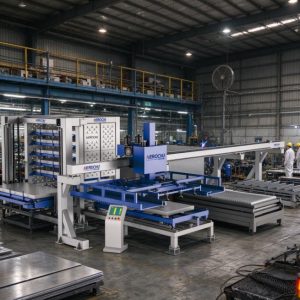
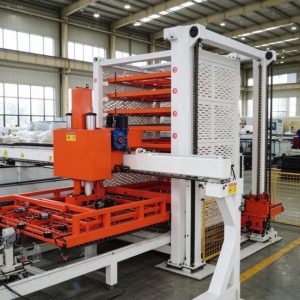
Herochu’s storage platform is designed to sit upstream of laser cutting and automated loading systems. The company supplies automated panel storage depots for sheets from 2,500 × 1,300 mm to 6,000 × 2,500 mm, with 8–13 levels and pallet loads up to 3,000 kg. The manual multi-drawer rack shares the same structural logic—vertical storage, independent access, crane-compatible loading—so a shop that starts with manual drawers can later add automated loading and unloading without abandoning the storage concept.
For shops already running MES-integrated production, the drawer rack provides a physical organization layer that supports digital inventory tracking. Each drawer can be assigned a fixed location code, making it easier to map storage positions to MES material records. The rack does not require a digital control system to deliver its core benefit, but it is compatible with the location-based inventory logic that MES integration depends on.
Frequently Asked Questions
Q: What is the largest sheet a multi-drawer roll-out rack can store?
A: Herochu’s standard HC-B3015 configuration accommodates sheets up to 6,000 × 2,000 mm. The company’s automated storage platform extends to 6,000 × 2,500 mm. Custom formats outside these ranges can be quoted.
Q: Can one person retrieve a sheet from a fully loaded multi-drawer rack?
A: Yes, for drawers within the manual-pull or crank-out rating. The roller track and low-friction design are engineered so that a single operator can extend and retract a loaded drawer without assistance. A 3-tonne drawer on the crank-out version is specified for two-finger operation.
Q: How does the interlock prevent tip-over?
A: The interlock is a mechanical steel linkage between drawer-extension latches. When one drawer is open, the linkage locks the drive pinions of adjacent tiers, preventing a second heavy drawer from extending and shifting the center of gravity beyond the frame’s safe zone.
Q: Is the rack compatible with crane loading?
A: Yes. The drawer can be extended to ground level for crane placement of heavy plates, then pushed back into the rack. Routine retrieval remains manual, so the crane is not tied up during picking.
Q: Can the rack be connected to a laser cutting automation system later?
A: The manual rack is a standalone storage unit, but Herochu’s broader storage platform includes automated depots and loading systems that share the same vertical, drawer-based storage logic. A manual rack can serve as the starting point for a phased automation plan without discarding the initial investment.