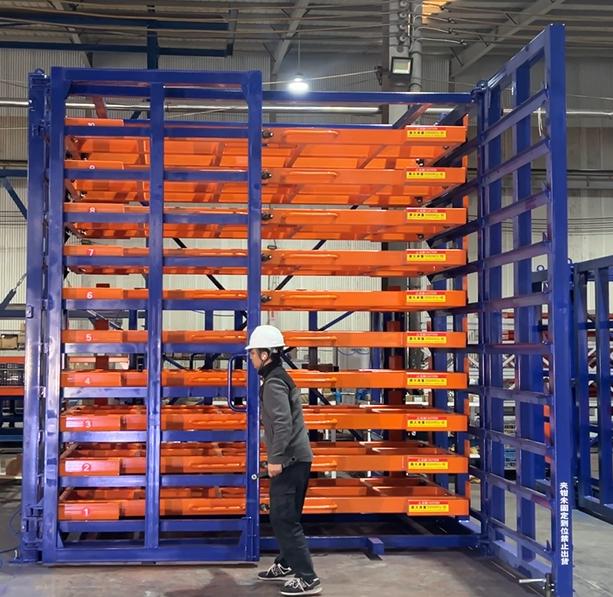
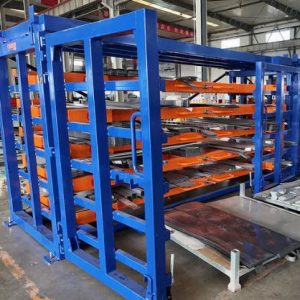
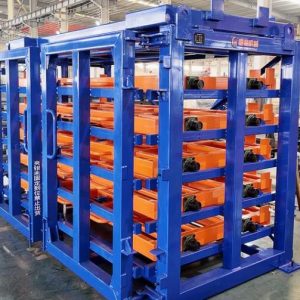
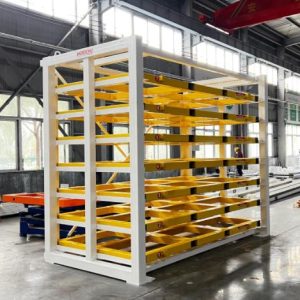
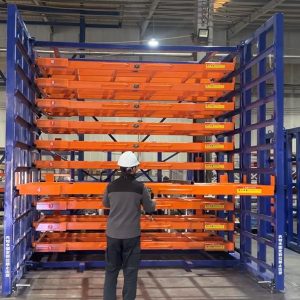
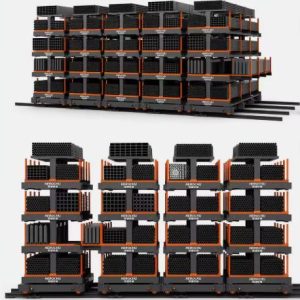
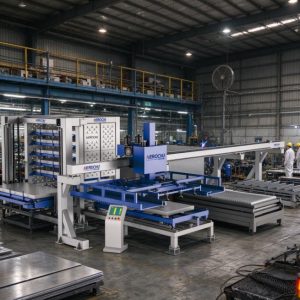
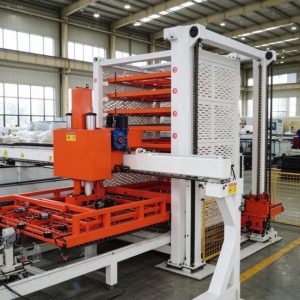
A high-density manual drawer rack for metal sheets and aluminum plates is a pull-out storage system that lets one operator retrieve a specific sheet from a multi-tier stack without restacking or waiting for a crane. Herochu builds these racks with welded steel frames, per-drawer loads up to 3,000 kg, and a footprint that converts wasted floor space into organized vertical storage.
Most fabrication shops still store sheet metal in floor stacks or on static cantilever arms. That approach works until the first job requires a 2 mm aluminum sheet buried under six sheets of 10 mm mild steel. Then a forklift, two workers, and twenty minutes disappear—only to repeat the same sequence when the material goes back. Herochu’s manual drawer rack eliminates that cycle by turning each storage level into an independent, accessible drawer.
Why Pull-Out Drawers Change the Math of Sheet Storage
A drawer system delivers three immediate operational gains. First, selectivity reaches 100%: every sheet is reachable without disturbing the material above or below it. Second, ground-level picking means no climbing, no reaching into deep cantilever pockets, and no crane time for routine retrieval. Third, the vertical stack format uses height instead of aisle width—exactly the direction warehouses should go when floor area is expensive and ceiling clearance is available.
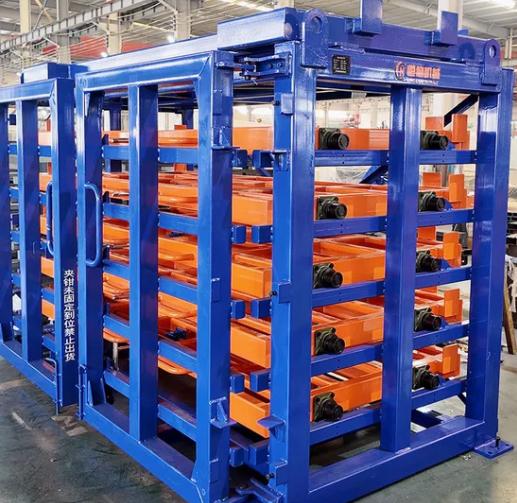
Herochu’s rack structure relies on thick welded steel and a roller track under each drawer bed. The track is engineered so that even a fully loaded drawer moves with minimal effort; the company specifies that a single person can glide a 3-tonne drawer with two fingers via a sealed planetary gearbox on the crank-out version. For manual-pull configurations, the same low-friction principle applies through polyamide glide strips that isolate the drawer bed from the frame, preventing metal-to-metal scuffing that mars aluminum and polished stainless surfaces.
Built for Aluminum and Mixed-Metal Loads
Aluminum plates present a particular storage challenge: they are light enough to be handled manually but soft enough to scratch, and they are often stored alongside steel sheets that outweigh them several times over. Herochu addresses this with a load-distribution frame that supports each drawer across its full width, rather than concentrating stress at the corners. The double anti-corrosion coating—applied to both the carbon steel frame and the drawer components—resists oil, coolant, and humidity in workshop environments.
For warehouses handling mixed inventories, the drawer format also creates a simple visual management system. Each drawer can be labeled by alloy, thickness, or job number. A built-in lock and limit device prevents a drawer from being pulled past its safe extension, and an interlock linkage can be specified so that only one drawer opens at a time—a mechanical safeguard against tip-over when heavy plates are stored at height.
Customization Without Custom Lead Times
Herochu treats drawer count, drawer dimensions, and load rating as configurable parameters rather than fixed catalog options. A standard HC-B3015 configuration might use six drawers with a 3,000 kg per-drawer rating and an 18,000 kg total payload, but the same frame architecture supports fewer, deeper drawers or more, shallower drawers depending on the sheet format mix. The company also provides 3D model design and graphic design support so that the rack can be planned into an existing warehouse layout before fabrication begins.
For a building-materials shop or a machinery repair operation, that flexibility matters more than raw capacity. A repair shop may need five drawers for commonly used plate sizes and one deep drawer for long offcuts. A manufacturing plant may want identical drawers across every level to simplify inventory counting. Both are achievable within the same Herochu platform.
Frequently Asked Questions
Q: Can a manual drawer rack handle aluminum sheets without scratching them?
A: Yes. Herochu’s drawer beds use polyamide glide strips and a load-spreading frame that keep aluminum and stainless surfaces away from bare steel contact points. The drawers also prevent the sheet-to-sheet scuffing that occurs when plates are restacked on the floor.
Q: What is the maximum load per drawer?
A: Herochu rates standard configurations at up to 3,000 kg per drawer, with total rack payloads reaching 18,000 kg on the HC-B3015 series. Higher or lower ratings are available as custom specifications.
Q: Does the rack require a crane for everyday use?
A: No. The manual drawer design is intended for ground-level picking by a single operator. Crane hoisting remains compatible for loading oversized or exceptionally heavy plates onto a drawer, but routine retrieval does not depend on overhead equipment.
Q: How does the limit device prevent drawer falling?
A: A mechanical travel-limit system stops the drawer at its designed extension point, and a per-tier interlock can be specified to keep adjacent drawers locked while one is open. These are steel linkage mechanisms, not software-dependent controls.
Q: Can the rack be integrated into an existing warehouse without redesigning the floor?
A: In most cases, yes. Herochu provides 3D model design support to verify clearances, aisle widths, and lifting access against the existing layout before the rack is built.