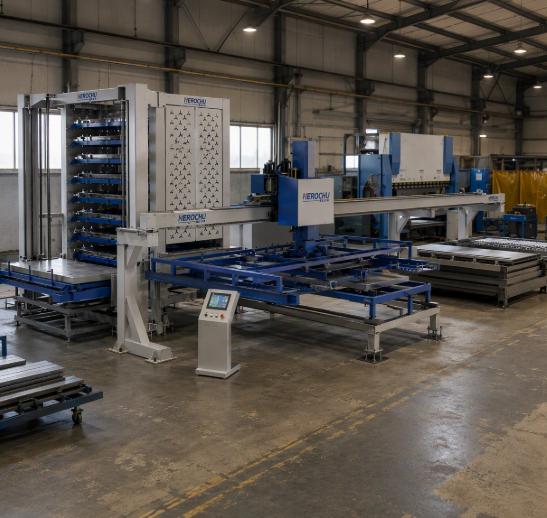
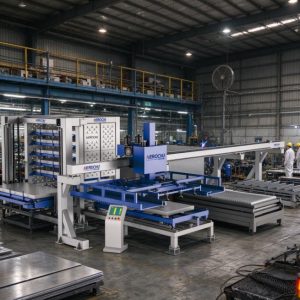
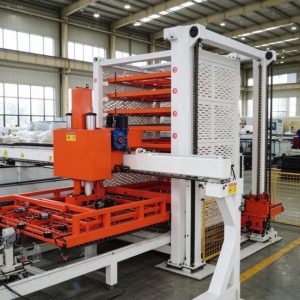
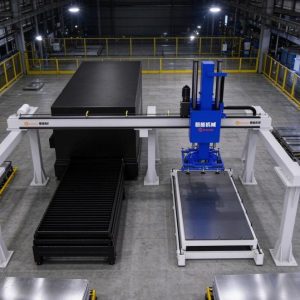
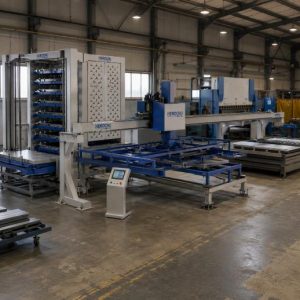
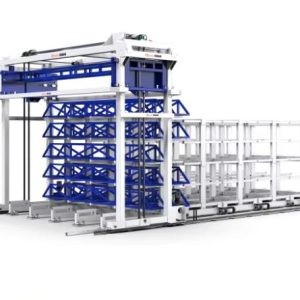
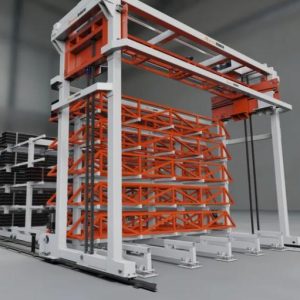
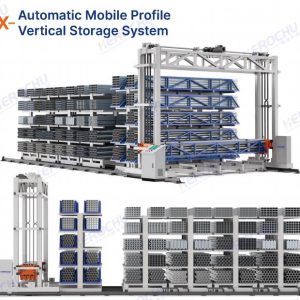
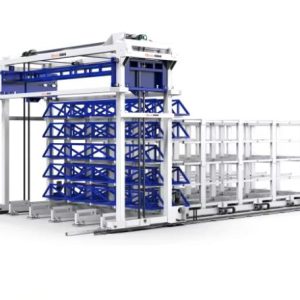
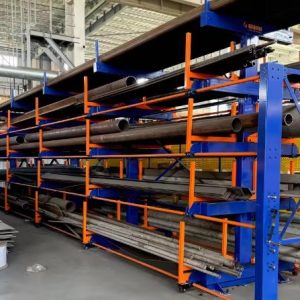
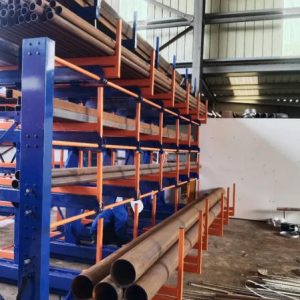
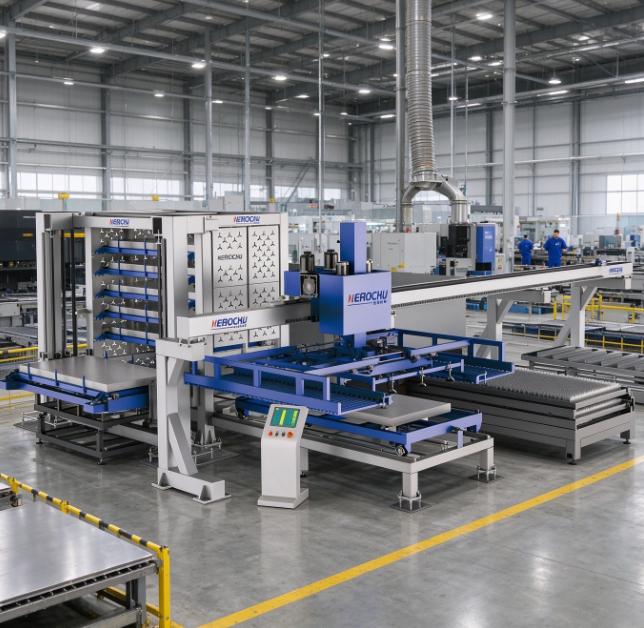
An automated panel three-dimensional storage depot holds sheet metal in vertical rack bays and delivers each pallet to the laser cutting line without an operator. Herochu builds these depots for sheets from 2500 × 1300 mm to 6000 × 2500 mm, with 8–13 levels, 3 t or 5 t rated layers, and pallet loads from 300 kg to 3000 kg.
A 6 kW fiber laser cuts a full 3000 × 1500 mm sheet of 2 mm mild steel in a few minutes. Finding that sheet, checking it against the job order, and hauling the skeleton away usually takes longer. Most fabricators do not have a laser problem. They have a material flow problem, and it sits between the delivery door and the machine bed.
What “three-dimensional” storage changes
Flat storage puts pallets on the floor and stacks them two or three high. Every square metre of rack footprint buys about one square metre of storage. Vertical bays stack the same pallets above one another, so a depot eight to thirteen levels high holds several times the material on the same concrete.
Herochu’s site comparisons put that gain at 200% to 400% in usable storage against conventional flat racking, depending on ceiling height and sheet format.
The layout also changes how material is touched. A forklift driver drags a pallet out of a flat stack; in a depot, a stacker crane or robot arm slides forks under the pallet and sets it on a transfer station. The stack is never dragged, so the surface reaches the laser the way it left the mill.
One cycle, from truck to cutting bed
- Inbound. A forklift or an overhead crane places the pallet on the loading station. Herochu machines accept both modes, so a shop without a crane can run the depot today and add crane loading later.
- Weight check. The station weighs the pallet before it enters the rack. An out-of-tolerance load stops at the door instead of stalling a crane at level eleven.
- Scan in. The operator scans the label. The WMS assigns a bay and level, and the crane stores the pallet there. No manual location entry.
- Call out. A laser program requests material, the WMS selects the matching pallet, and the crane delivers it to the outfeed station in sequence with the cutting schedule.
- Return. Offcuts go back into a bay and stay linked to the job, so the next nesting run consumes them before new stock is opened.
The sequence runs around the clock. A PLC with a touch screen drives the mechanics; the WMS decides what moves next. Unmanned operation is the design condition, not an upgrade.
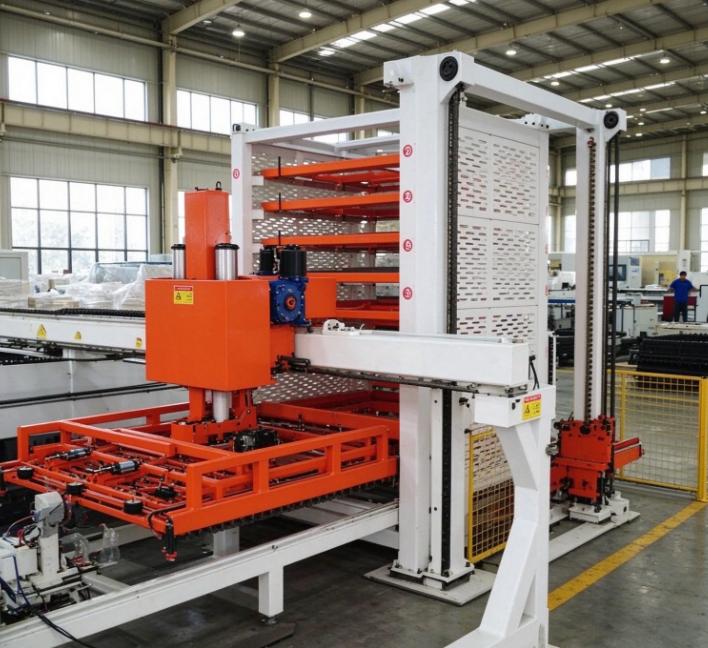
Nothing gets scratched between processes
Sheet metal spends most of its life waiting. A depot closes it inside a dust-proof, moisture-proof structure and handles it with purpose-built forks and fixtures instead of dragging stacks. On pre-painted, stainless, or aluminium stock that protection usually covers the cost of the enclosure.
Inventory that survives an audit
The WMS answers the questions that cost money when they go unanswered: how much 3 mm cold-rolled is on hand, which batch it came from, when it arrived, and whether it is nearing shelf life. Scan-in plus automatic positioning gives 100% location accuracy, which removes the phantom stock that hides a shortage and the duplicate order that hides a surplus.
Because the system connects to the ERP, production, warehouse, and logistics data live in one record. A planner sees whether a job can start tomorrow without walking the floor.
Specifications
| Item | Range |
|---|---|
| Sheet formats | 3015 / 4015 / 4020 / 6015 / 6020 / 6025 mm |
| Storage levels | 8–13 |
| Load per layer | 3 t / 5 t |
| Pallet load | 300 kg – 3000 kg |
| Air consumption | 1.5 m³/min |
| Air supply | 0.6–0.7 MPa |
| Control | PLC + touch screen, WMS, ERP link |
| Inbound modes | Forklift and overhead crane |
A depot is a civil decision as much as a machine purchase. Herochu sizes each unit around the site, the sheet envelope, and the pallet load, so column spacing, ceiling height, and door width are settled on drawings before the machine is ordered. Modular structure lets storage positions be added later.
Questions buyers ask
How much floor space does a 13-level depot need?
It depends on sheet format and bay count. A 3015 depot needs less than half the footprint of a 6025 unit holding the same tonnage. Herochu sizes the layout from a site drawing and the number of storage positions required.
Can one rack hold several sheet sizes?
Yes. Bays are configured by format, so mixed formats work as long as each bay matches its pallet. Shops running both 3015 and 4020 sheets usually dedicate bays to each.
Does it work with an existing laser cutter?
In most cases, yes. The depot feeds a separate loading system or the machine’s own table, and the interface is matched during the site survey rather than assumed from a catalogue.
The takeaway
Vertical storage is not a luxury for shops with spare floor. It is also the one form of storage that takes the forklift out of the material path. When the depot, the WMS, and the laser share one schedule, the machine cuts more hours per week than any upgrade to the cutting head can deliver. Herochu builds that link as one system, from the inbound station to the last offcut returning to its bay. Send a layout drawing and material list for a sizing proposal.