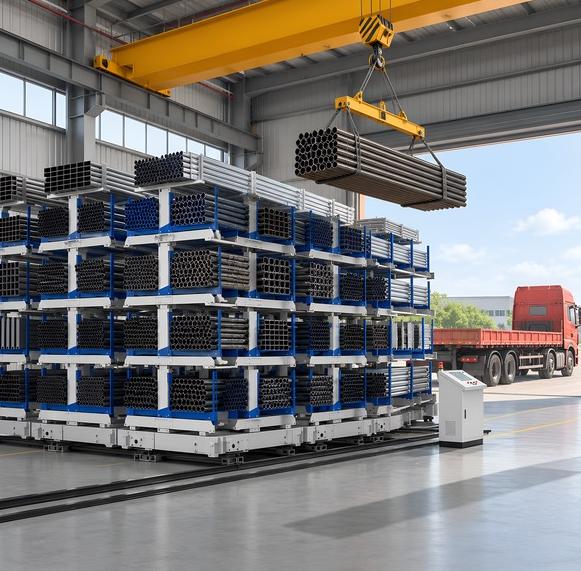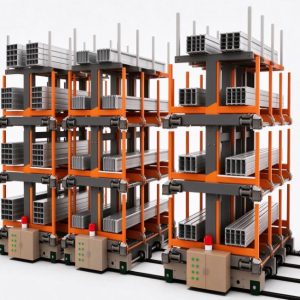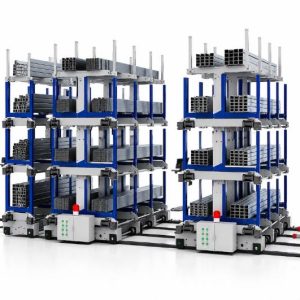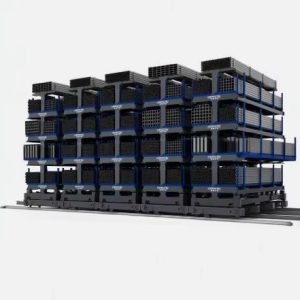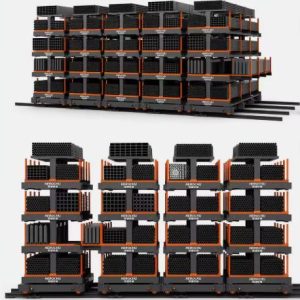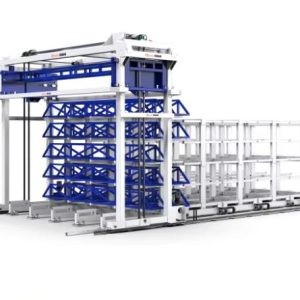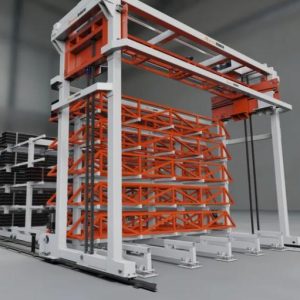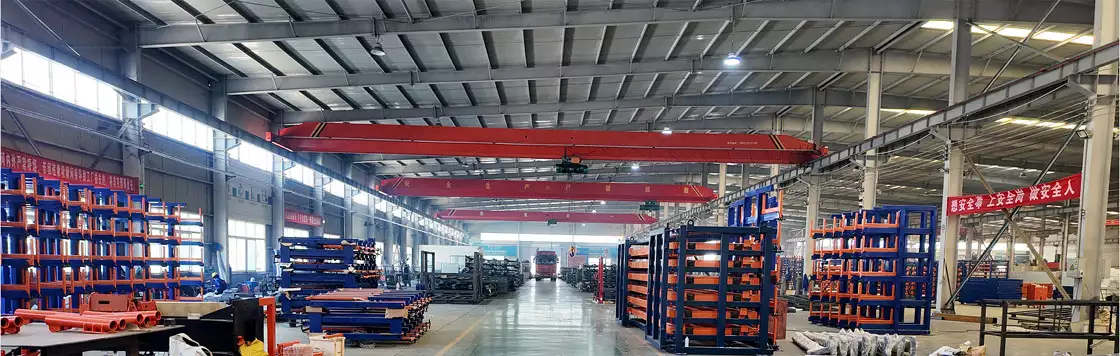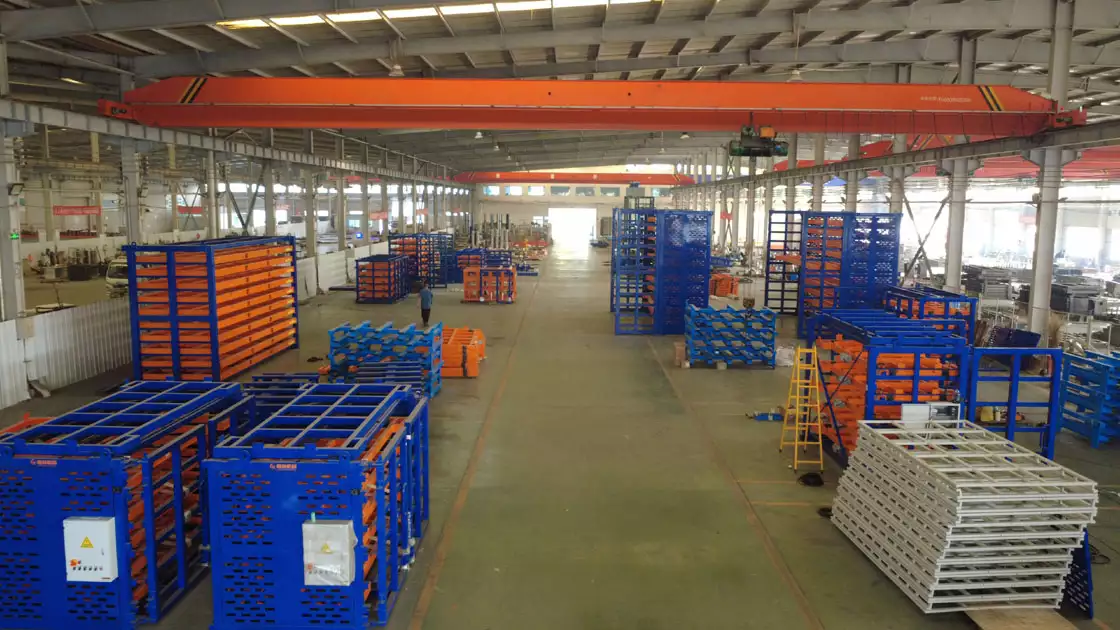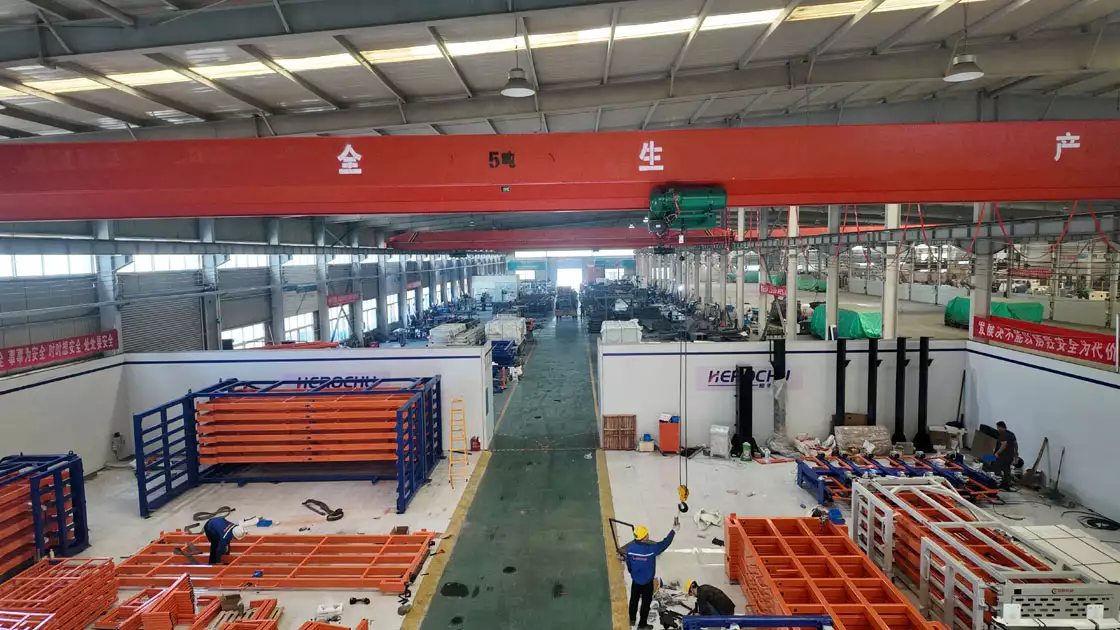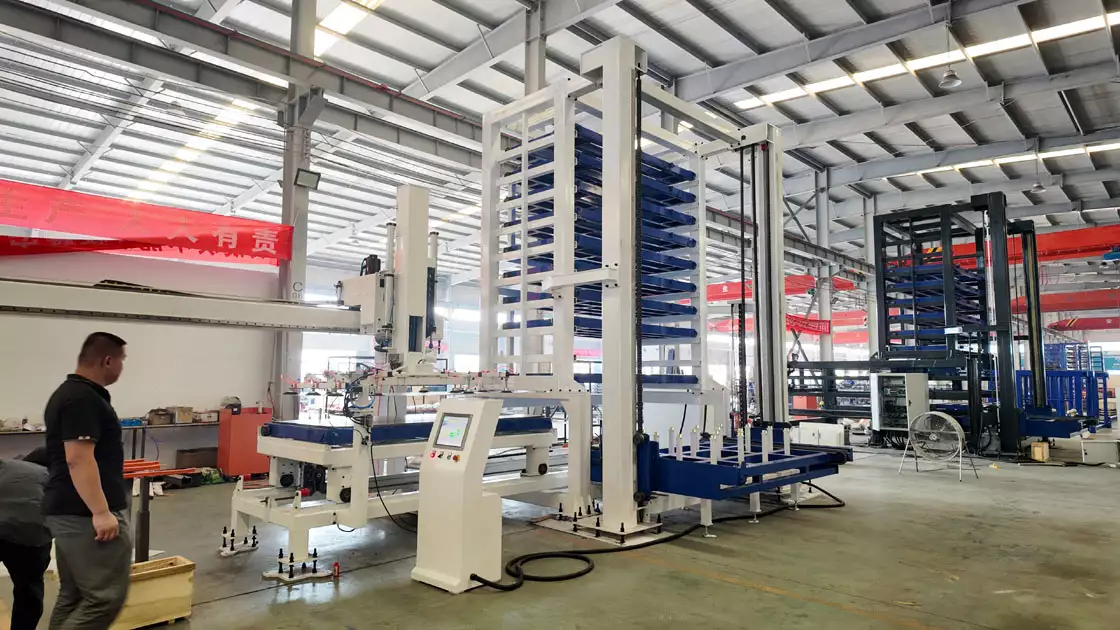
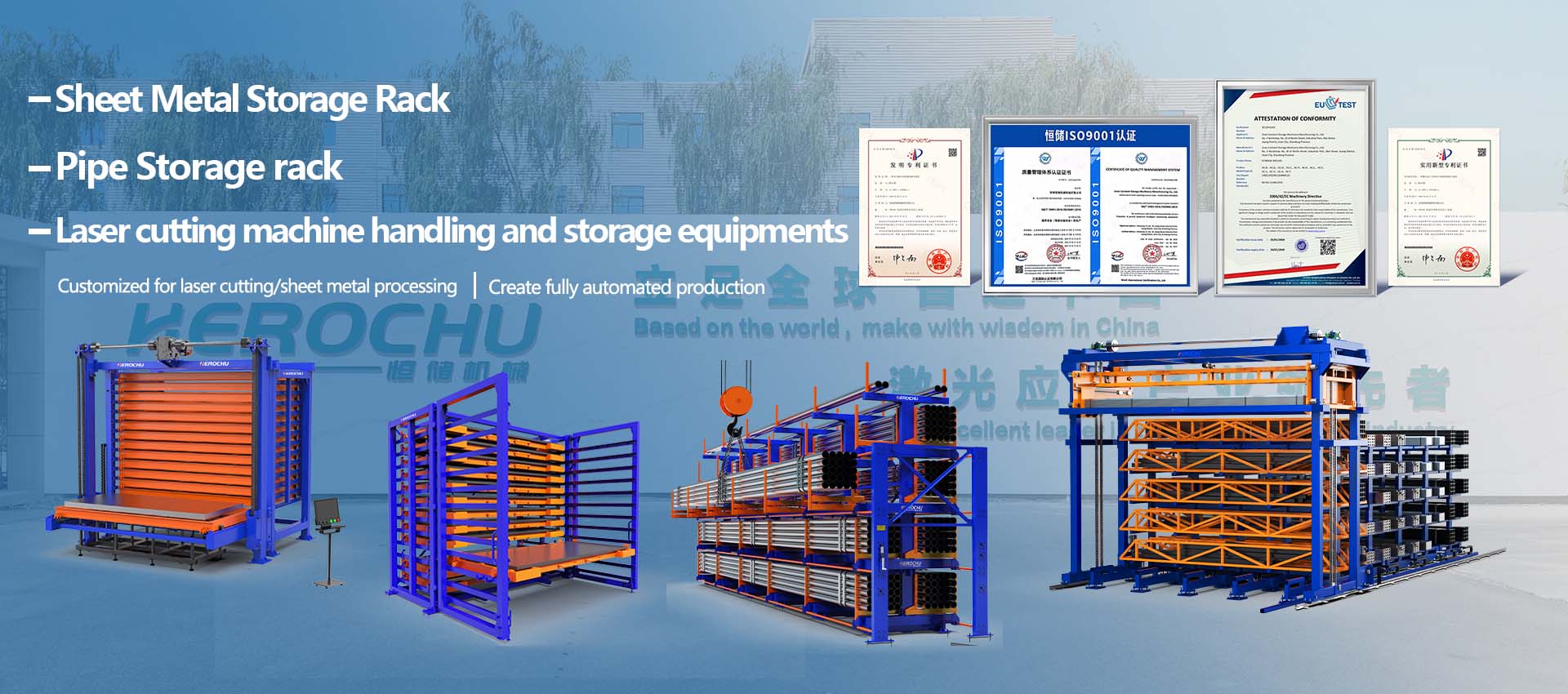
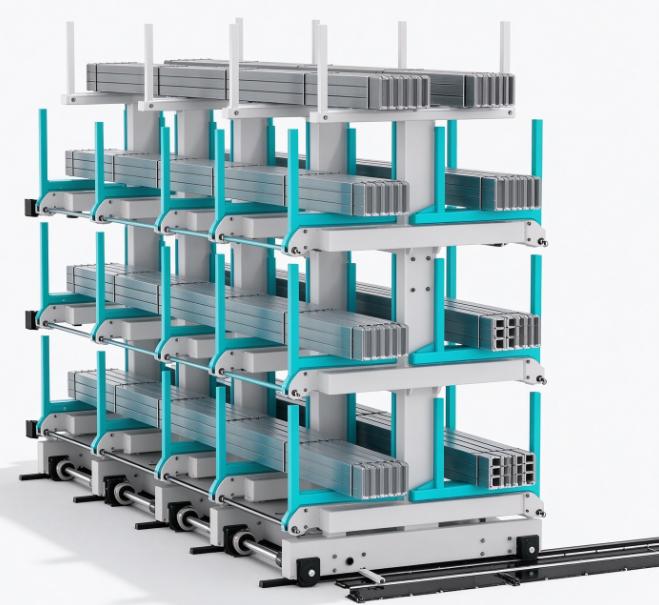
Heavy duty mobile telescopic cantilever racking combines extending cantilever arms with a rail-mounted base, so a tower travels to the aisle and the arms reach the load instead of the forklift entering the rack. Herochu builds units rated at 3,000–5,000 kg per level per side for pipe and profile lengths from 6,000 to 12,000 mm.
Two mechanisms in one machine
Most storage debates treat “mobile” and “telescopic” as separate ideas. In heavy long-goods storage they belong together.
The rail base is what saves floor. Towers sit in a block with almost no gap, and a single shared aisle opens in front of whichever tower is called. The telescopic arms are what makes that arrangement usable. When a tower parks at the aisle, the arms extend outward so the load sits over open floor, and a crane hook, a sling or a forklift mast can lift straight up without the truck body entering the rack frame.
Remove either half and the concept weakens. A mobile rack with fixed arms is awkward to unload at height. A telescopic rack on fixed bases still burns an aisle per bay.
Where the load actually goes
A cantilever column is a bending problem, not a compression problem. The arm carries a load at a distance, so the column has to resist a moment at every arm level, and the base has to resist the sum of those moments without lifting at the rear. That is why cantilever racking is judged by load per level per side rather than by total capacity alone.
At 5,000 kg on a single side, the moment at the base is substantial. Three things keep it controlled. The column is fabricated from heavy section steel with a welded base plate and stiffened arm connections. Arms are pitched at fixed intervals so bundles sit close to the column, which cuts the moment arm. And the tower undercarriage is a rigid welded frame tying both rails together, so the base cannot spread under load.
Loading practice matters as much as the steel. A 5,000 kg layer assumes the load is spread across the arm length, not hung at the tip. Herochu publishes the permissible load per level for each model, and the safe working figure should always be read together with the load position.
Drive, transmission and why the speeds are low
The base runs on a linear guide rail with chain drive transmission. Chains suit this duty because they tolerate dust, mill scale and temperature swings that would shorten the life of a smoother transmission, and they fail visibly rather than silently.
Motion figures:
| Function | Speed |
|---|---|
| Carriage positioning | 27 mm/s |
| Racking travelling | 1–5 m/min |
| Vertical lifting | 9 m/min |
| Inlet and outlet | 12 m/min |
The 27 mm/s carriage speed looks slow on paper and feels right in the aisle. A tower loaded to 5,000 kg per level has a high centre of mass; rapid starts produce sway at the top of the column that no control system can fully cancel. Moving at 27 mm/s removes the input that causes the sway. Travel between positions at 1–5 m/min is the compromise between a shift-long wait and an unstable block.
Siemens PLC control sits above the drives. Position stops are taught, not guessed, and the interlock logic prevents a second tower from being commanded while the aisle is occupied.
Structure and duty cycle
Mobile cantilever racking is usually specified for a 10–20 year life in a working shop, which changes the design brief. Paint thickness, weld quality, arm locking and rail alignment all matter more than they would in a static rack that never moves.
Points worth checking in any quote, Herochu’s included:
- Arm locking. Arms should lock into the column and be adjustable in pitch, so the layout can follow a change in product mix.
- Rail anchoring. Floor-mounted rails take repeated point loads from a travelling tower; anchor spacing and slab condition decide whether the rails stay true.
- Plate support. Optional plate support converts arm pairs into a surface for flat bar, sheet packs or bundled profiles that would otherwise sag between arms.
- Clearance. Towers need a few centimetres of running clearance and a defined home position, both of which are set during commissioning.
When telescopic arms pay for themselves
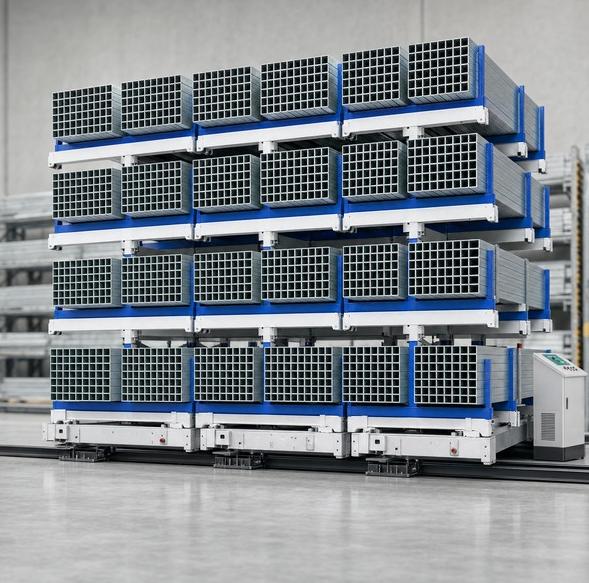
The case for telescopic arms is strongest where three conditions appear together: long material, high levels, and a handling method that cannot enter a rack frame. Overhead cranes are the clearest example. A crane lifts vertically, so a load buried two metres inside a fixed rack is unreachable without dragging it. Extended arms bring the load out to the hook.
The same logic applies to forklifts fitted with long load handlers, and to sites where two people handle a bundle by sling. Less manual reaching, less dragging of bundles across arms, fewer damaged ends on finished tube.
FAQ
What does “heavy duty” mean in this category? For Herochu’s S-series it means 3,000 kg per level on the HC-G6053EM-5 and 5,000 kg per level on the 9,000 mm and 12,000 mm models, with five or six levels and customisable tower counts. The rating applies per level per side.
Can arms be repositioned for a different product mix? Yes. Arm pitch is adjustable on the column, and plate support is an optional add-on for flat or bundled goods.
Why is the carriage so slow at 27 mm/s? Because stability, not speed, limits a loaded cantilever tower. Slow positioning keeps the top of the column from swaying and protects the rail from shock loading.
Does the system work with an overhead crane rather than a forklift? It is designed for exactly that case. Telescopic arms extend the load into open air under the crane hook.
How many towers can share one aisle? Herochu standard configurations run five or seven towers, and the count is set by available floor and the number of SKUs.
Specifying the right unit
Start with three facts: longest piece, heaviest bundle per level, and the handling equipment that will do the picking. A 12,000 mm, 5,000 kg specification with crane access points to the HC-G12065EM-7. A 6,000 mm shop with lighter tube lands on the HC-G6053EM-5 and saves capital. Herochu engineers both from the same rail and control platform, so the decision is about your stock, not about two different product families.