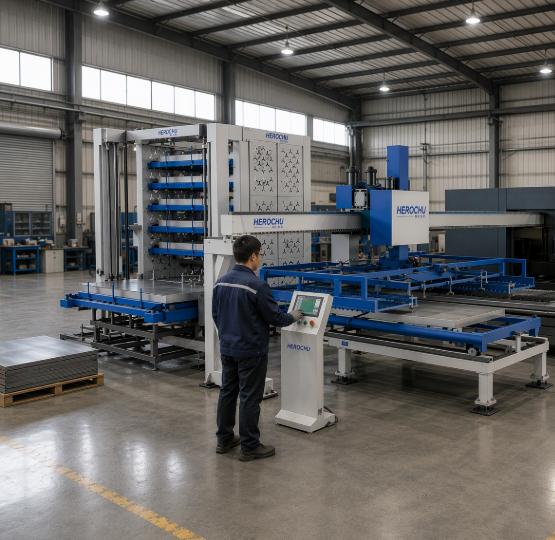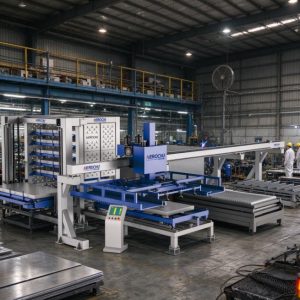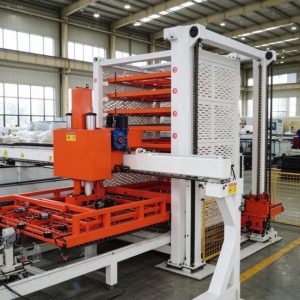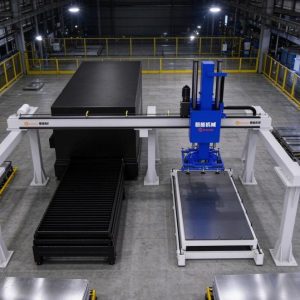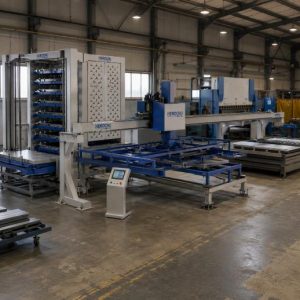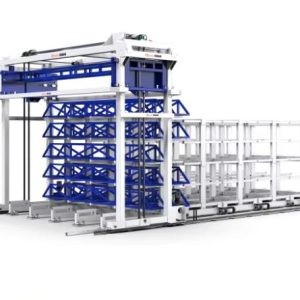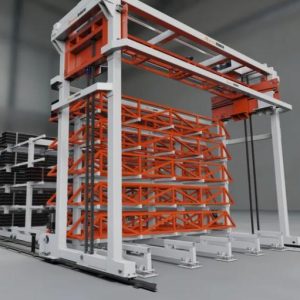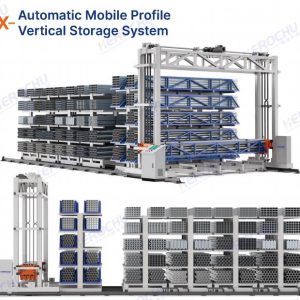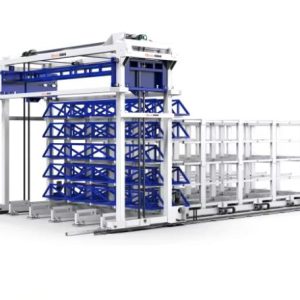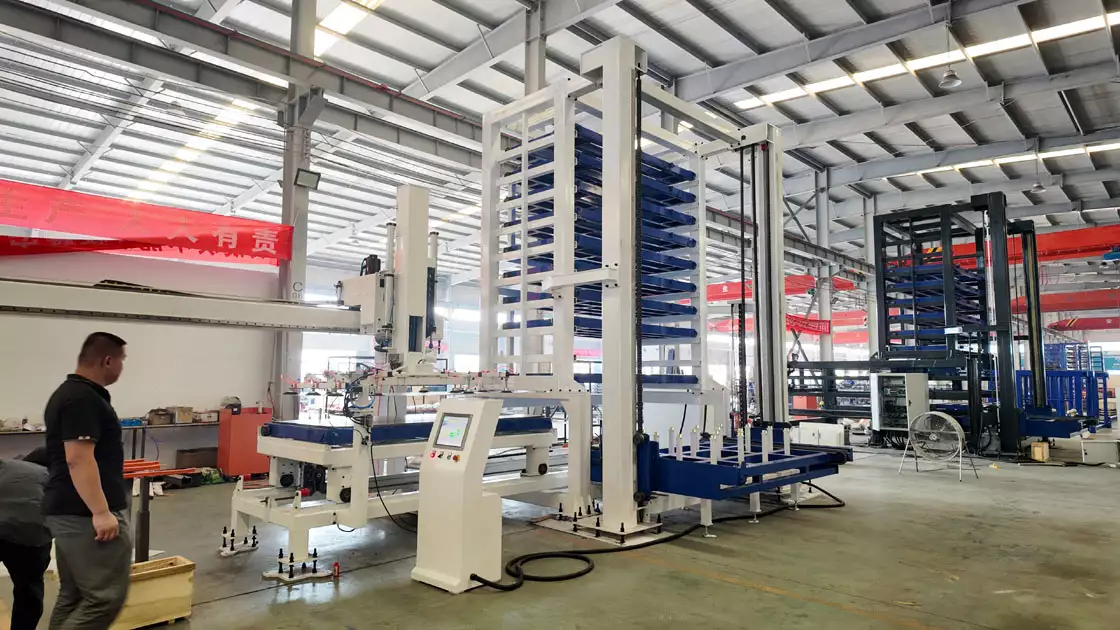
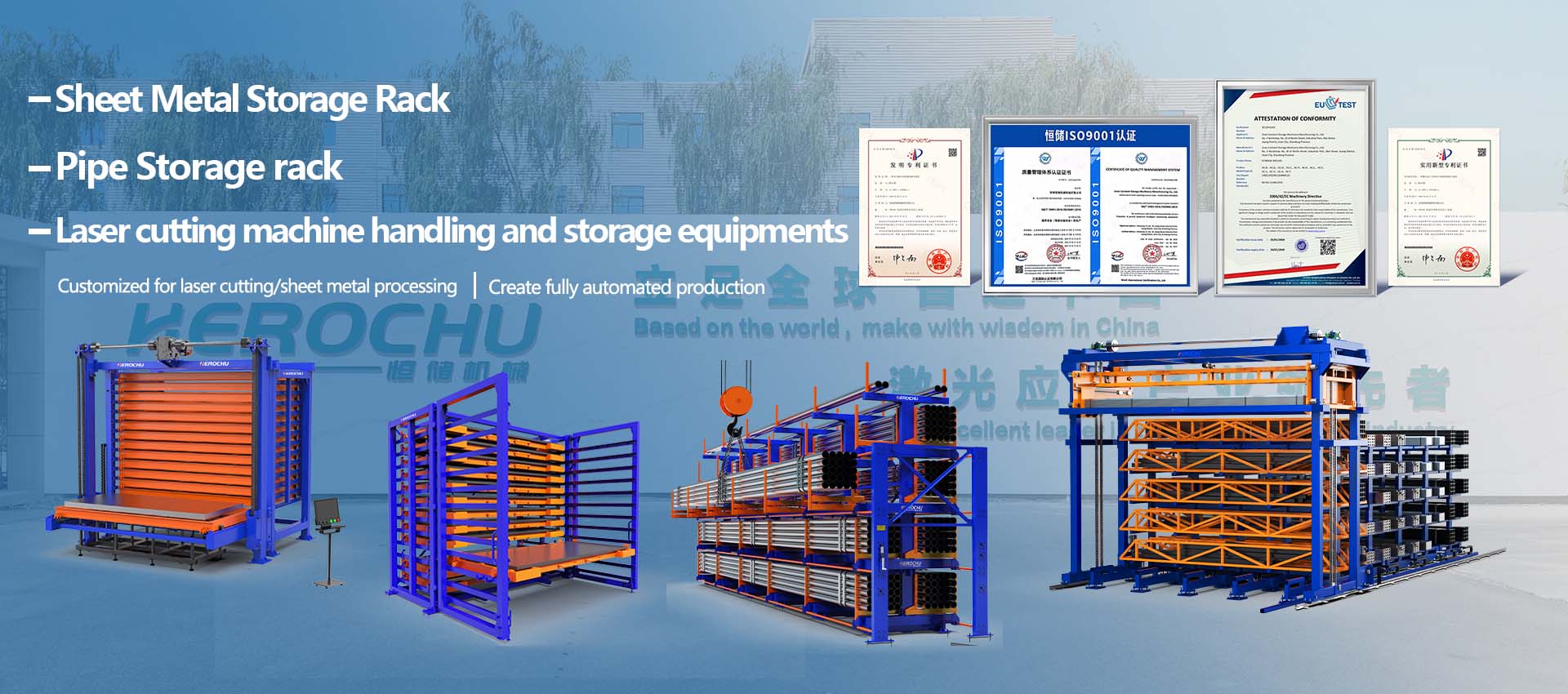
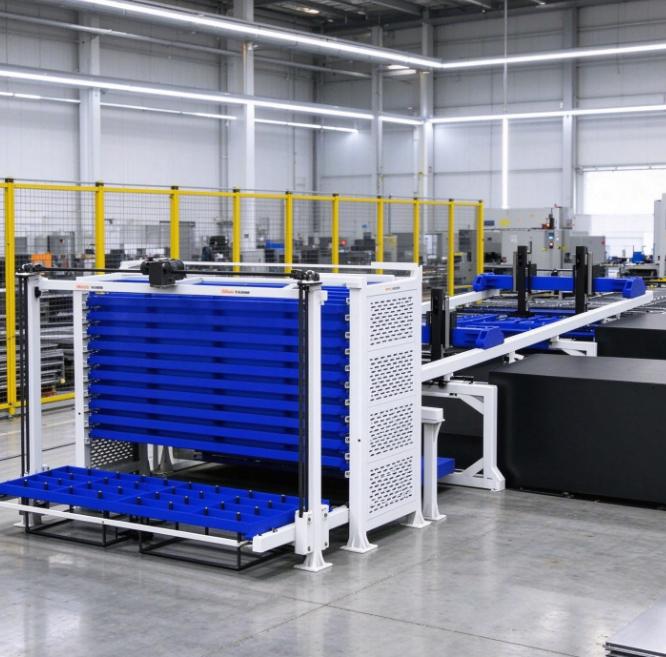
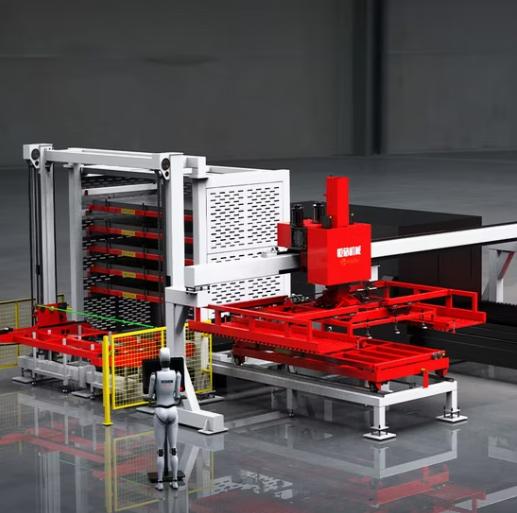
A loader with a built-in storage system feeds a laser cutter from a vertical rack instead of a floor stack, so blanks arrive at the table without an operator. Herochu systems combine vacuum loading, gripper unloading, and 8–13 levels of storage in one cell, with pallet loads from 300 kg to 3000 kg and repeatability of ±2 mm.
Every fabricator that buys a second laser hits the same wall a few months later: the machine can cut around the clock, but the material handling around it is still a one-shift operation. Automating the cut without automating the material flow moves the bottleneck instead of removing it.
What a loader with storage actually is
Three components share one control philosophy:
- A storage rack holding pallets in vertical bays eight to thirteen levels high, served by a stacker crane or robot arm.
- A loader that takes one sheet from the pallet and places it on the laser table under computer control, using a vacuum field matched to the sheet format.
- An unloader in the same head, using grippers to take the cut sheet and skeleton off the table when the program ends.
Add the WMS that tracks every pallet and the cell becomes a small automated warehouse with a laser attached: the storage is the buffer that lets the loader work ahead of the machine.
Manual handling versus loader with storage
| Task | Manual cell | Loader with storage |
|---|---|---|
| Find material | Walk the floor, read labels | WMS retrieves the exact pallet |
| Move pallet | Forklift or pallet truck | Crane delivers to transfer station |
| Lift sheet | Vacuum lifter, alignment by eye | Vacuum head, datum positioning |
| Remove cut sheet | Gloves, manual lift | Gripper, automatic |
| Inventory record | Paper or spreadsheet, updated later | Scan-in, real-time, ERP-linked |
| Second and third shift | Overtime or idle machine | Unattended |
| Space for material | Flat racks, floor-bound | Vertical bays, 200–400% more per m² |
The table is not an argument about comfort. It is an argument about how many hours a week the laser cuts, and how many of those hours depend on a person being present.
The night shift problem
A laser earns its keep when it cuts. A shop running one shift on a 4 kW machine uses roughly a quarter of the asset it paid for. Two shifts double output on the same capital; a third, unmanned shift triples it. That third shift only exists if nothing in the chain needs a human at 2 a.m.
Herochu builds the cell for that condition: the loader stages the next blank while the current sheet is cut, the unloader clears the table unasked, and the WMS keeps pulling pallets until the schedule ends. If a program fails, the cell stops safely.
Protecting material between processes
A loader that handles sheets badly is worse than a careful operator. Two failures matter:
Double-pick. Two sheets lifted as one produce a cut at double thickness, which damages nozzle, lens, and part. Separation logic in the Herochu head prevents the pick before it reaches the table.
Surface damage. Dragging a stack over forks scores the top sheet. Purpose-built forks and fixtures, plus a closed dust-proof and moisture-proof rack, keep the surface intact from delivery to the cutting bed. On stainless, aluminium, or coated stock, that protection is often the fastest payback in the project.
The numbers that define the cell
| Parameter | Value |
|---|---|
| Sheet formats | 2500 × 1300 to 6000 × 1500 mm (HC-RT series) |
| Storage levels | 8–13 |
| Load per layer | 3 t / 5 t |
| Pallet load | 300–3000 kg |
| Arm traverse | 10–30 m/min |
| Lifting speed | 5–10 m/min |
| Fork adjustment | 5–20 m/min |
| Repeatability | ±2 mm |
| Air supply | 0.6–0.7 MPa, 1.5 m³/min |
What to decide before ordering
Three questions shape the configuration, and all three are cheaper to answer on paper than on site:
- What sheet envelope must the cell cover? A shop cutting only 3015 blanks does not need a 6025 machine, and paying for capacity it never uses adds cost and floor space.
- How many hours of material should the rack hold? One shift and a full unattended weekend are very different rack heights.
- How will the cell talk to the ERP? Job release, consumption, and remnant tracking all depend on that link being defined at the start.
Herochu reviews these against the customer’s drawing and proposes a layout with storage positions, crane travel, and loader reach drawn to scale.
Questions buyers ask
How much labour does the cell remove?
It removes the handling role rather than the whole team. Most customers redeploy the operator to programming, quality, or a second machine, which is where the payback usually shows up first.
Can the cell run overnight with nobody in the building?
Yes. Inbound pallet loading is the only manual step, and it is done before the shift ends. From there the WMS feeds the laser until the schedule is complete.
The short version
A loader without storage automates the lift. A loader with storage automates the shift. The second version is the one that lets a laser run while the building is empty, and it is the version Herochu builds: tower, loader, unloader, WMS, and ERP link as one system, sized to the sheet envelope and the tonnage the shop actually moves.