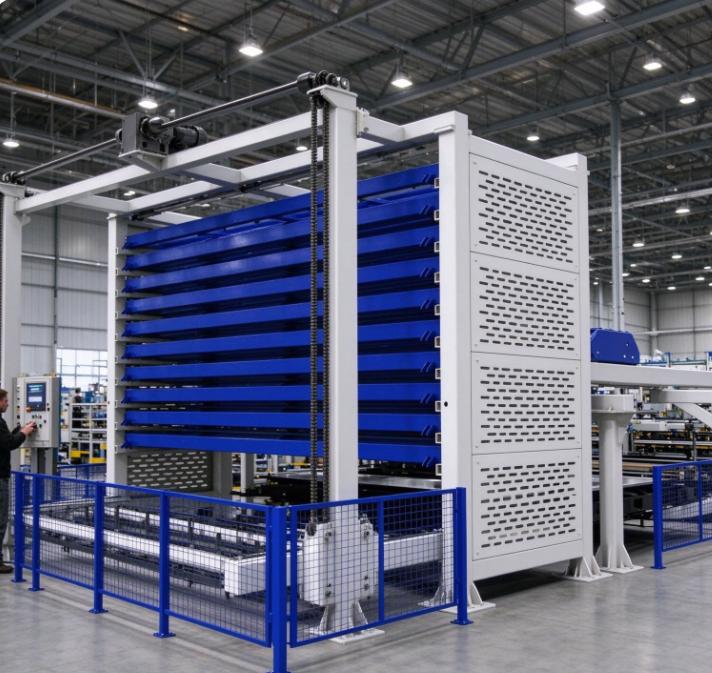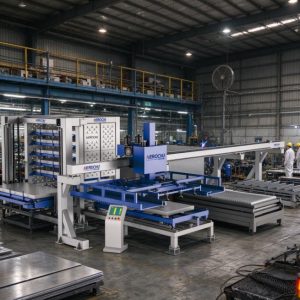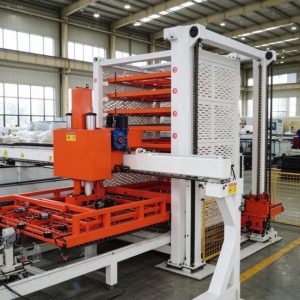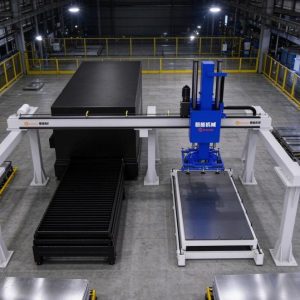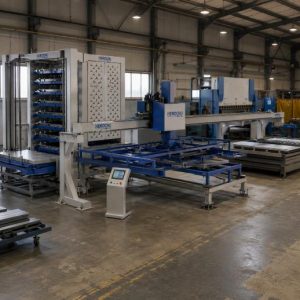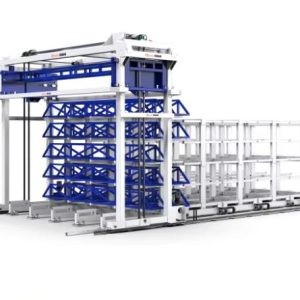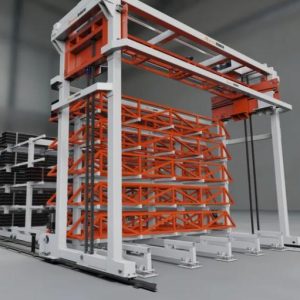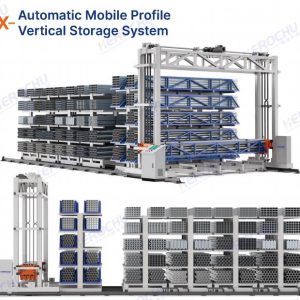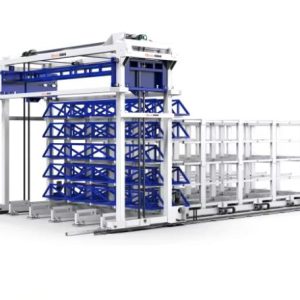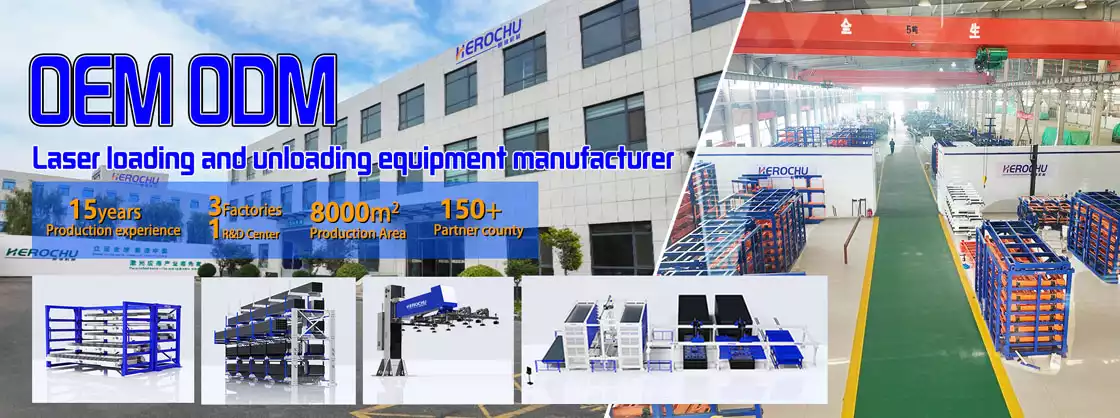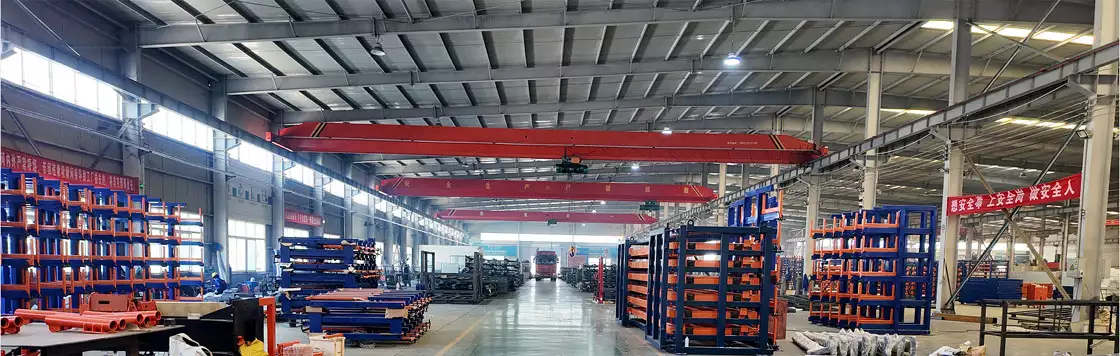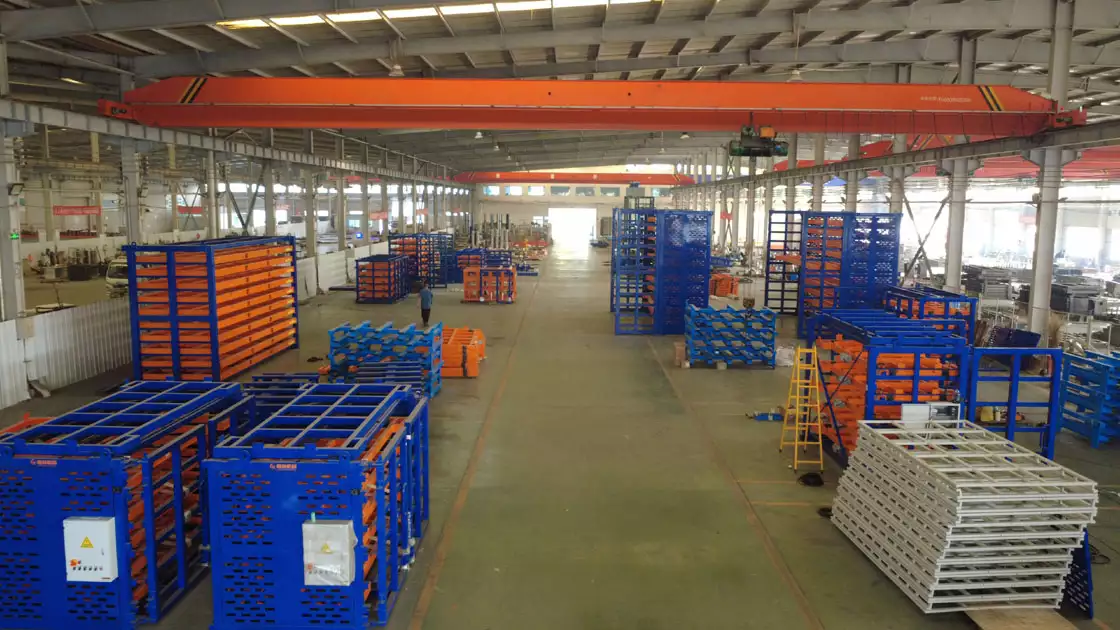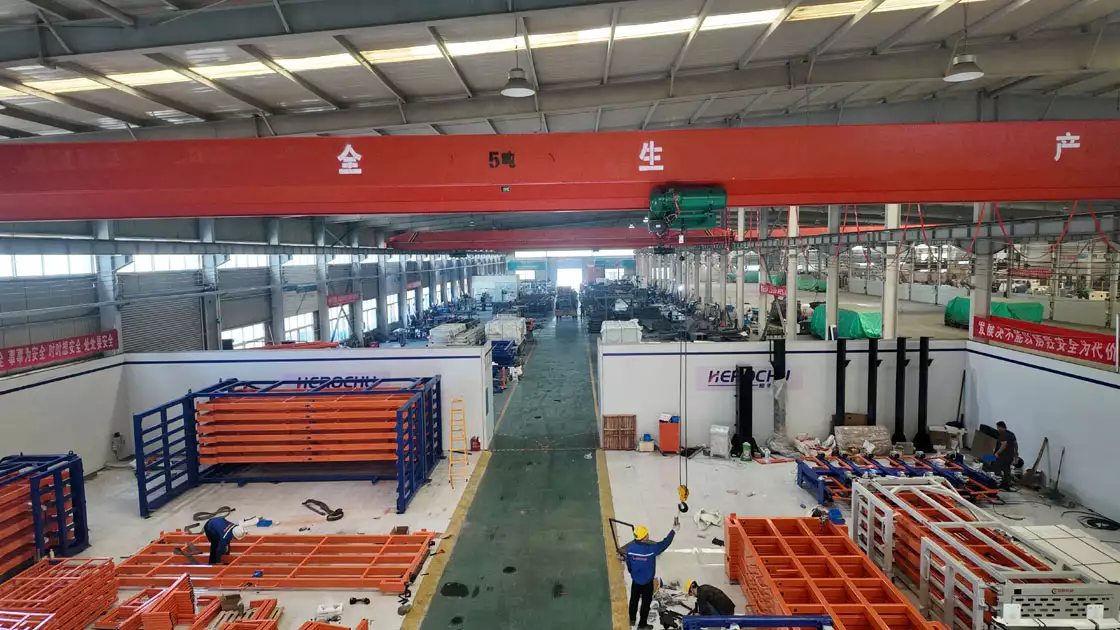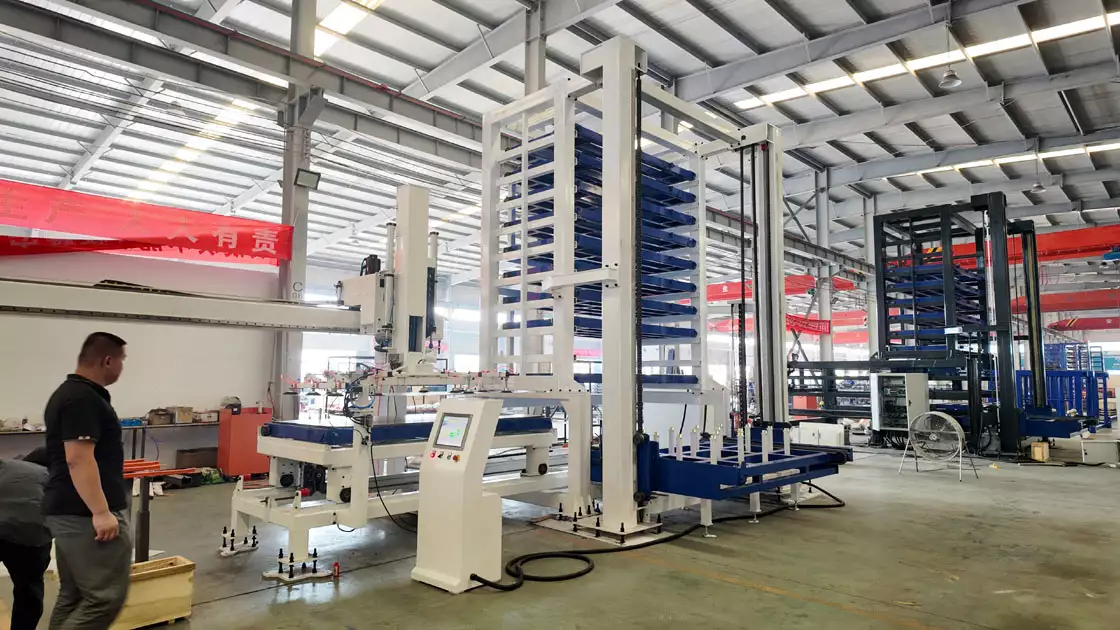
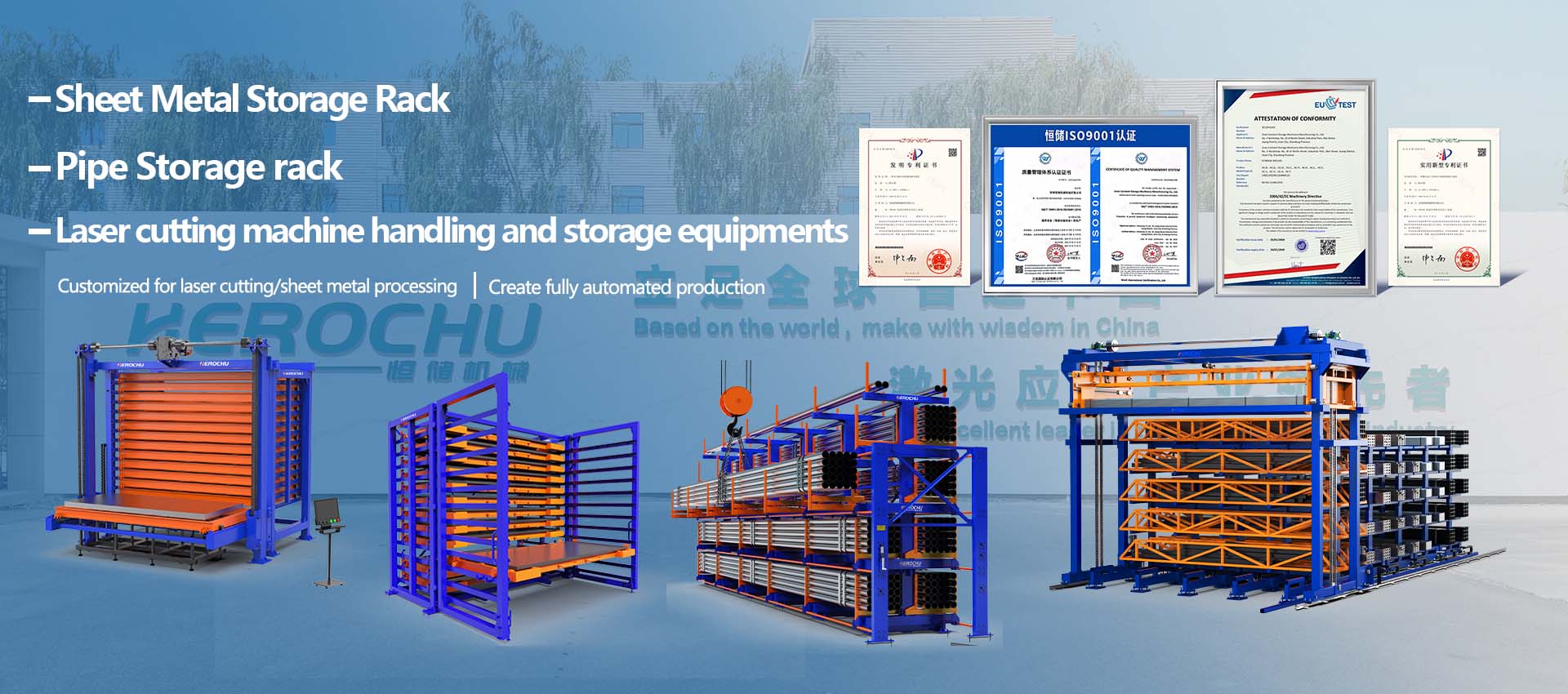
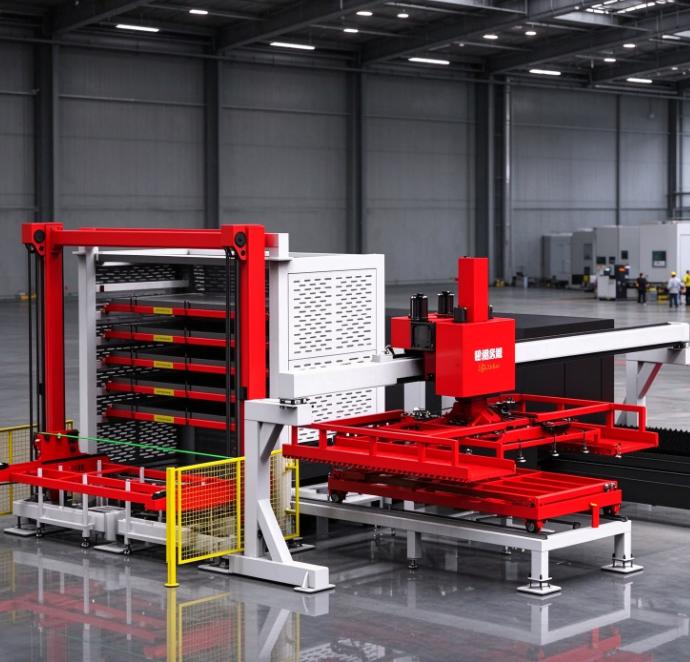
Automated sheet metal storage and handling systems for laser cutters fall into four types: vertical panel towers, three-dimensional storage depots, gantry loaders, and combined cells that do all three. Herochu supplies the combined cell, covering formats from 2500 × 1300 mm to 6000 × 2500 mm, 8–13 levels, and pallet loads up to 3000 kg.
Buying sheet metal automation is not like buying a laser. The laser has a datasheet with a power figure, and that figure is comparable across suppliers. Storage and handling are configured around a building, a material mix, and a production calendar, which is why two quotes for “automation” can differ by a factor of three and both be correct.
The four system types
1. Vertical panel tower. Pallets stacked in a tower with an extraction table at the front. Small footprint, moderate capacity, cheapest entry into automated buffer storage. It solves the space problem and part of the handling problem, because an operator still lifts the sheet from the table to the laser.
2. Three-dimensional storage depot. A rack of 8 to 13 levels served by a stacker crane or robot arm, with forklift and crane loading at the inbound station. Capacity is higher than a tower, and the crane delivers pallets to a transfer point rather than to a person.
3. Gantry loader. A bridge over the laser table with a vacuum head for loading and grippers for unloading. It removes the manual lift and the table clearing, and suits a machine that already has adequate storage behind it.
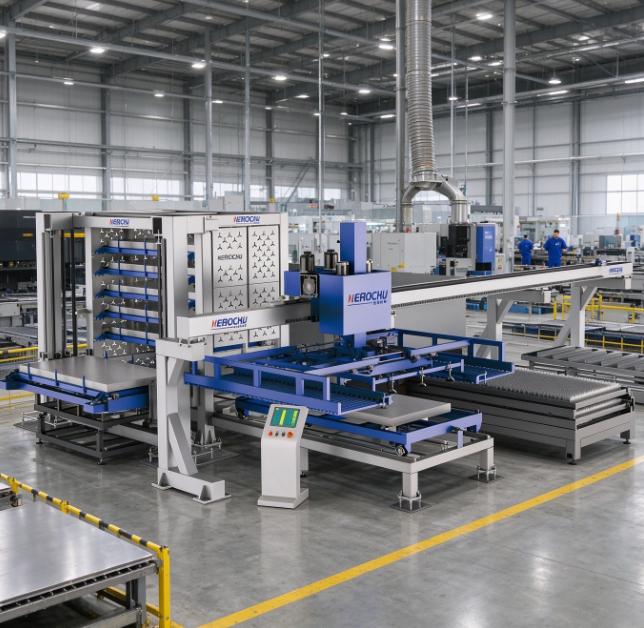
4. Combined cell. Depot, loader, and unloader under one control system, with the WMS scheduling both storage and machine feeding. This is what Herochu builds, and it is the only configuration that removes the operator from a whole shift rather than from a single task.
Criteria that change the design
Sheet envelope. Formats run from 3015 to 6025. Oversizing for occasional large work is a common and expensive mistake; a 6025 cell needs more floor, height, and air than a 3015 cell that covers 90% of the job book.
Weight per pallet. Herochu racks run 3 t or 5 t rated layers with pallet loads from 300 kg to 3000 kg. Thin-gauge shops and 20 mm plate shops need completely different fork and fixture designs, so the load case is fixed before the price.
Retrieval speed. Arm traverse of 10–30 m/min and lifting of 5–10 m/min decide whether the cell keeps a fast laser fed. A slower cell just creates a new bottleneck in place of the old one.
Positioning accuracy. ±2 mm repeatability is the working figure. A sheet placed outside that window produces parts that are geometrically correct but dimensionally out of position.
Storage height versus building height. Eight levels or thirteen is a civil decision. Above the practical limit means a taller rack and longer crane travel; below it means more footprint per pallet.
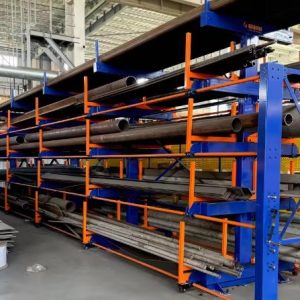
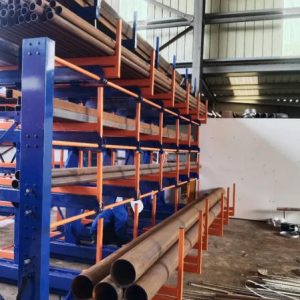
Material sensitivity. Closed, dust-proof construction protects coated, stainless, and aluminium stock. An open rack saves money until the first customer rejects a scratched sheet.
Site readiness checklist
- Air: 1.5 m³/min at 0.6–0.7 MPa for the depot and loader circuit.
- Floor: flatness along the crane rail, and point loads at the rack feet.
- Height: clear height to the lowest obstruction, not to the roof deck.
- Flow: where material enters, where the laser sits, and how far a pallet travels between them.
Shops that answer these four before the first meeting save a design iteration. Herochu asks for a site drawing and a material list in the first exchange for that reason.
Integration decides success
A storage system that does not talk to the ERP is an expensive rack. The useful integrations are specific: job release from planning, so the crane retrieves the pallet the schedule needs; consumption reporting, so inventory reflects what was cut rather than what was issued; remnant tracking, so offcuts return to a bay and get consumed by the next nesting run; and batch traceability with expiry warnings for coated, oiled, and certified material.
Herochu’s WMS covers all four and connects to the customer’s ERP, with scan-in and automatic positioning giving 100% location accuracy. Stock counts become a query rather than a physical count.
What the investment returns
Three returns are measurable and one is usually ignored. Measurable: floor space (200% to 400% more storage per square metre than flat racking), labour (the handling role leaves the shift), and utilisation (the laser cuts through shifts that used to be idle). Ignored: material loss. Fewer scratched sheets, fewer double-picks, fewer offcuts lost in a stack. On coated or stainless work, that line alone can carry a project.
A simple test before committing: count the hours per week the laser waits for material. Above ten, handling automation pays back faster than an upgrade to the cutting source.
Questions buyers ask
Is a tower or a depot the better starting point?
A tower suits one machine with limited floor and a modest material range. A depot suits higher tonnage, several formats, or plans to add machines. Herochu quotes both against the same material list.
Can the system be expanded after installation?
Storage positions can be added as throughput grows, and the modular structure is designed for it. Expansion is easier when the original layout reserves the room.
Does the automation replace the operator?
It replaces the handling task. Most customers move the operator to programming, inspection, or a second machine, and the third shift runs with nobody in the building.
Choosing without regret
The systems that disappoint are sized from a catalogue, not from a building and a material list. Get the envelope, the pallet weight, the retrieval speed, and the ERP link right and the rest follows. Herochu builds the depot, the crane, the vacuum and gripper head, the WMS, and the controls as one system, and sizes it from your site drawing.