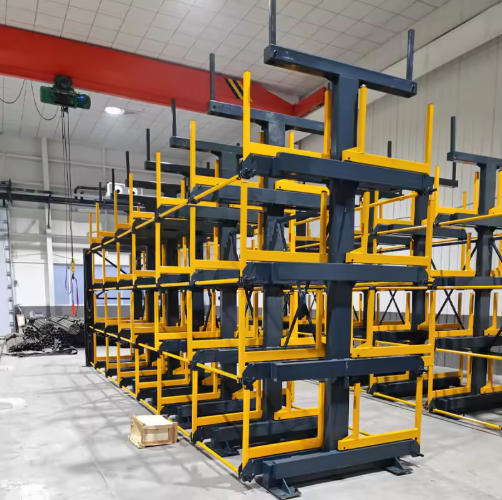
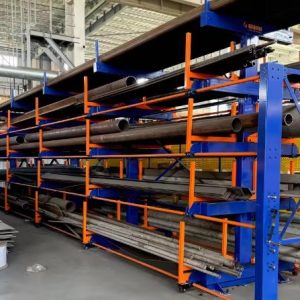
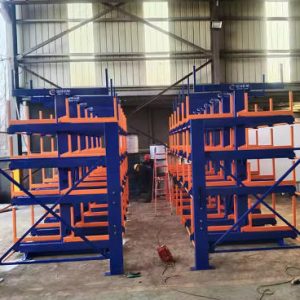
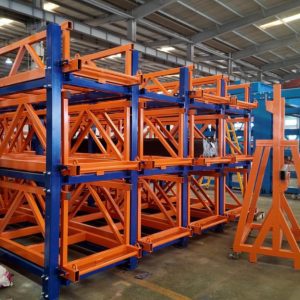
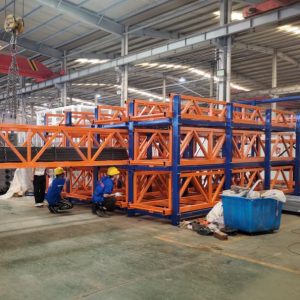
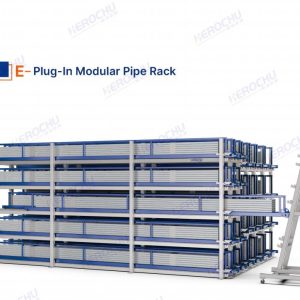
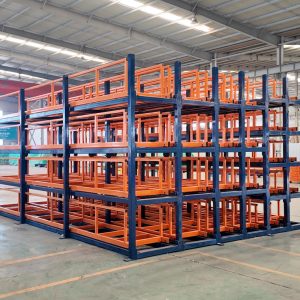
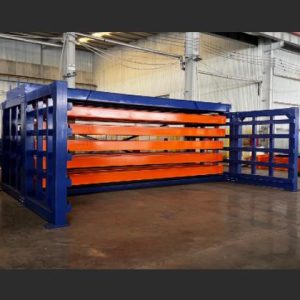
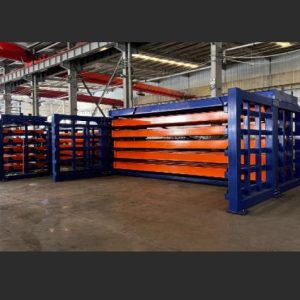
What is a telescopic cantilever racking system? A cantilever rack whose arms extend forward on a crank-driven carriage. The stored bundle moves out of the rack, so a crane can lift it vertically without side clearance.
How many layers can a bay have? Five or six are standard, and both are customised to the material and crane height. Layer count, clear space and arm pitch are set at the order stage.
What loads are supported? 3,000 kg per level on the HC-G6053S and HC-G6053, 5,000 kg per level on the HC-G9065 and HC-G12065.
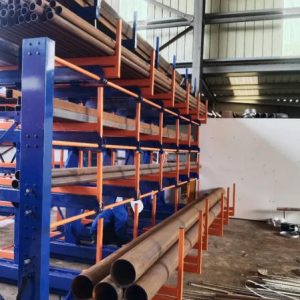
Can profiles and pipe share the same rack? Yes. Arms adjust individually, and arm stoppers can be fitted on pipe tiers only, so round and flat sections coexist in one frame.
Does it comply with European safety requirements? Herochu racks are built to CE and ISO 9001 standards, load-tested before dispatch, and delivered with structural documentation and steel certificates.
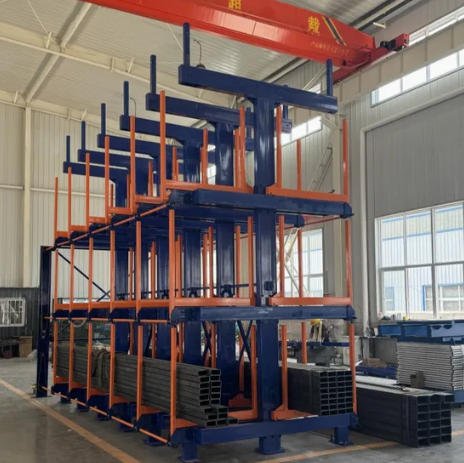
What is a full-extension crank-out steel storage rack? A cantilever rack whose arms extend the full length of the load on a manual crank, placing the bundle outside the rack envelope so a crane or forklift can lift it vertically.
How much weight does each level carry? 3,000 kg on the 6 m models, 5,000 kg on the 9 m and 12 m models. Layer count and clear space are customised to the material.
Can it be used outdoors or in an unheated building? Yes. With no electrical components and a powder-coated Q235B or Q355B frame, the system works in cold stores, canopies and open yards.
What maintenance does it require? Quarterly inspection of the pinion for debris, greasing of carriage rollers twice a year, stopper pin checks after impact, and annual anchor bolt torque verification.
Is the rack certified? Herochu racks comply with CE and ISO 9001 requirements, are load-tested before shipment, and are delivered with steel mill certificates and structural documentation.