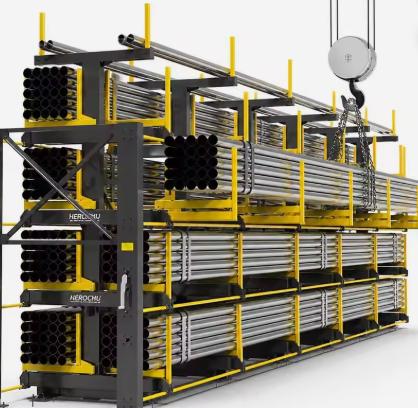
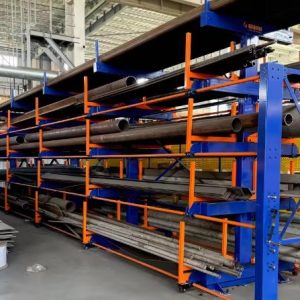
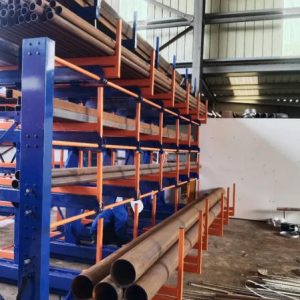
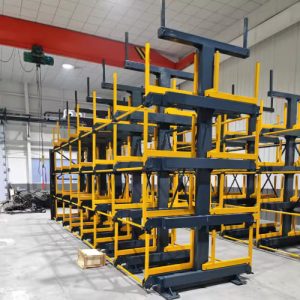
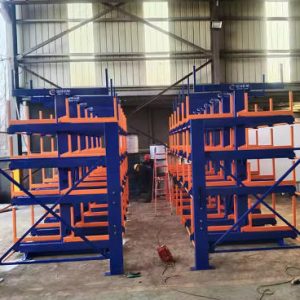
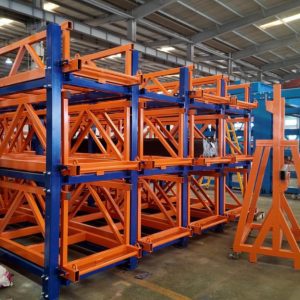
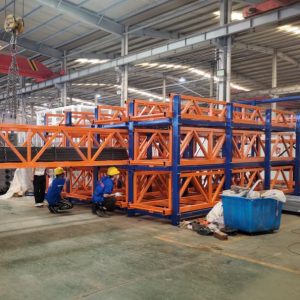
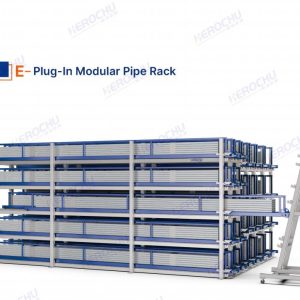
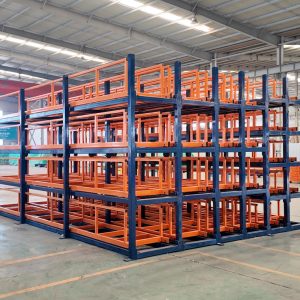
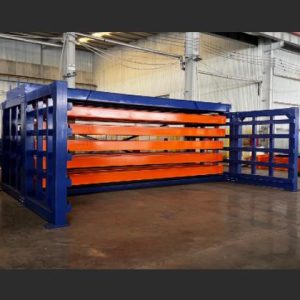
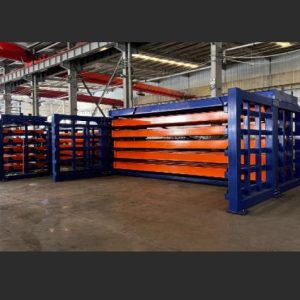
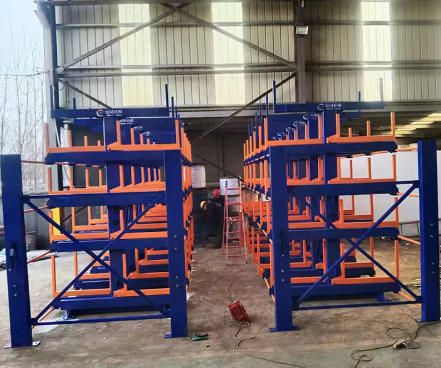
Herochu roll-out pipe and tube storage racks extend every arm by manual crank, so 6 m to 12 m tube is lifted clean instead of dragged. 3–5 t per level, Q235B steel, CE certified.
Round stock is the least forgiving load in a warehouse. A pipe bundle rests on a narrow contact line, rolls at the slightest slope, and shifts inside its strapping after a few lifts. Store it four tiers high in a static rack and the third bundle down becomes a twenty-minute job with a crane and a spreader bar. Herochu builds the roll-out pipe and tube storage rack to remove that job from the schedule.
Quick answer: A roll-out pipe and tube rack holds each bundle on an arm that extends by manual crank, bringing the load outside the rack so a crane can lift it straight up. No digging, no dragging, no surface damage.
The handling problem with round loads
Three things go wrong with pipe in conventional storage.
The first is rolling. Any arm that is not perfectly level, or any bundle that is not perfectly banded, will drift, and operators respond by over-strapping or chocking with timber offcuts — neither a real engineering control.
The second is reach. A 6 m tube bundle at the back of a 1,200 mm deep bay sits roughly 1,000 mm behind the front face. A crane hook cannot descend onto it, and a forklift cannot pull it out without dragging the bundle above.
The third is damage. Dragging tube across steel arms scores the outside wall, and on galvanised or epoxy-coated pipe that score becomes the first corrosion site.
A roll-out design addresses all three at once: the load travels on an arm that extends to the operator, instead of the operator reaching for the load.
How the manual crank system works
Each arm carries a carriage running on internal rollers. The crank at the column face drives a pinion along a fixed rack, and the carriage moves out along the arm. Because the drive is rack and pinion rather than cable or chain, extension is positive in both directions: the arm cannot creep out under load, and it cannot run away when the load is removed.
Full travel brings the bundle clear of the rack face, so a crane hook lands directly on the bundle centre, lifts vertically, and swings away — no side clearance, no angled pull, no contact with the tier above.
Torque at the handle stays within a range one person can turn while wearing gloves. That matters more than it sounds: a crank needing two operators does not get used, and the rack reverts to a static one.
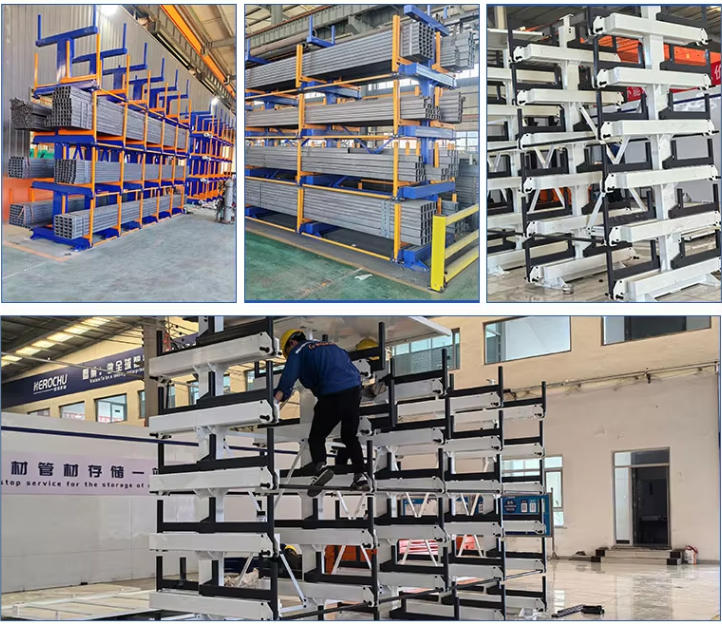
Load ratings across the range
| Model | Material length | Max load per level | Layers |
|---|---|---|---|
| HC-G6053S | 6,000 mm | 3,000 kg | 5 |
| HC-G6053 | 6,000 mm | 3,000 kg | 5 |
| HC-G9065 | 9,000 mm | 5,000 kg | 6 |
| HC-G12065 | 12,000 mm | 5,000 kg | 6 |
Clear space between levels is quoted at 600 mm and adjusted to order. The frame is Q235B as standard with Q355B for the 5,000 kg tiers, and the dual-beam crossbar tying each pair of arms is what keeps a 12 m bay stable when a heavy bundle sits toward the tip.
What changes in the aisle
Because retrieval happens from above, the aisle serves transport only. A 12 m tube layout with forklift retrieval typically needs 4.5 m to 5 m of clear aisle; a top-loading roll-out layout fits inside 3 m, and in crane-served bays the forklift need not enter the storage zone at all. On a 40 m run with four aisles, that returns 60 m² to 80 m² of floor — enough for the second staging lane that is usually the real bottleneck.
Matching the crank system to the load
Not every tier needs the same mechanism, and Herochu configures bays tier by tier.
High-turnover stock — the two or three sizes that ship daily — belongs on the lower tiers where crank effort is lowest and the crane path is shortest.
Slow-moving or long-tail sizes can sit above on fixed arms, since they are touched a few times a month and the crane can reach them when needed.
Bundled versus loose stock should not share a compartment. Bundled tube rolls as a unit; loose tube spreads. Independent compartments keep the two behaviours apart, and arm stoppers sized to the diameter hold loose lengths in place during extension.
Materials beyond steel pipe
The same frame handles PVC conduit, aluminium extrusion and stainless tube. Polymer loads are lighter but wider, so arm pitch increases; aluminium is soft, so Herochu supplies a protective arm liner as an option rather than leaving the buyer to modify the arm afterwards.
Maintenance, honestly stated
A mechanical system has a short service list: inspect the pinion for swarf quarterly, grease carriage rollers twice a year, check stopper pins after any impact, confirm anchor bolt torque annually. No motors, no drives, no electrical inspection, no software. Where maintenance labour is the scarcest resource on site, that list is the strongest argument for manual over powered.
FAQ
How does a roll-out pipe rack differ from a standard cantilever rack? The arms extend on a carriage driven by a manual crank. The stored bundle travels out to the crane instead of being dragged out by a forklift, which removes the digging cycle.
What is the maximum pipe length? Standard bays handle 6,000 mm, 9,000 mm and 12,000 mm stock. Longer or shorter spans are built as custom frames.
Can the rack be loaded and unloaded from both sides? Yes. The dual-side mechanical assistance design allows access from either face, which suits bays placed against a wall as well as free-standing runs.
How is the rack tested before delivery? Each assembled bay is load-tested to its rated level capacity and shipped with CE and ISO 9001 documentation plus mill certificates for the steel.
The bottom line
Pipe storage fails for handling reasons, not for lack of space. A roll-out arm converts a horizontal drag into a vertical lift, and that single change removes most of the damage and most of the pick time. Herochu builds the frame to carry the load and the crank to bring it to you.