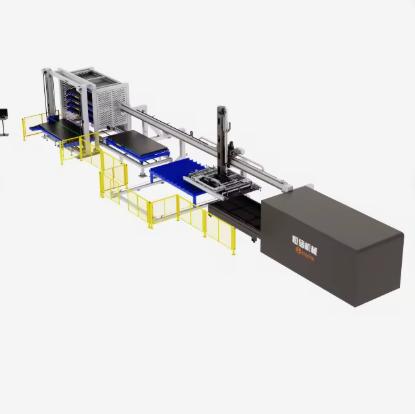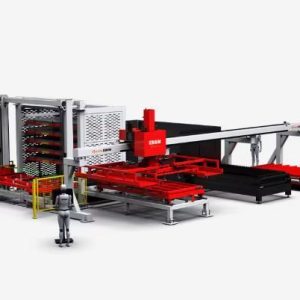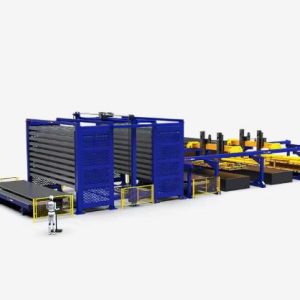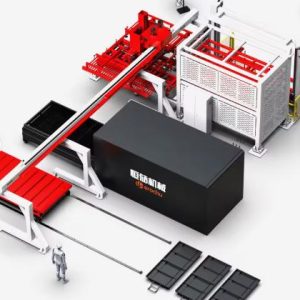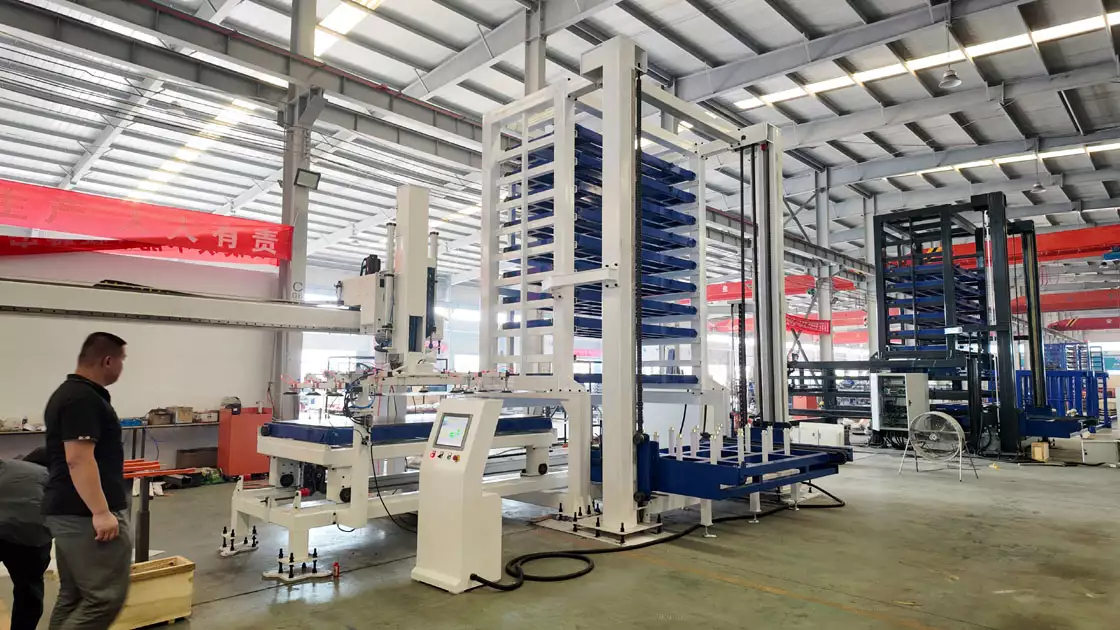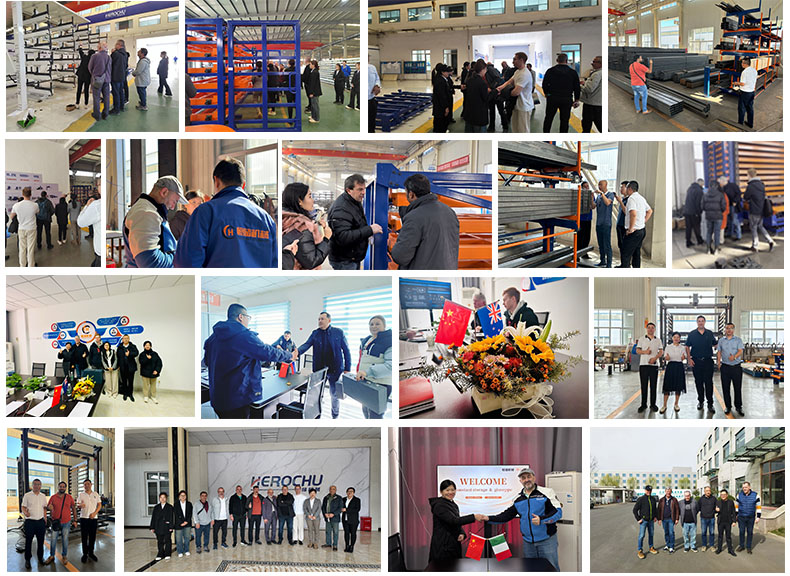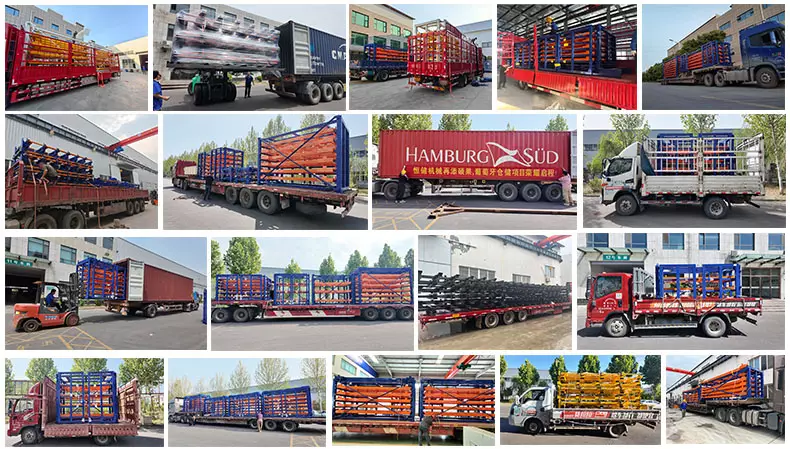
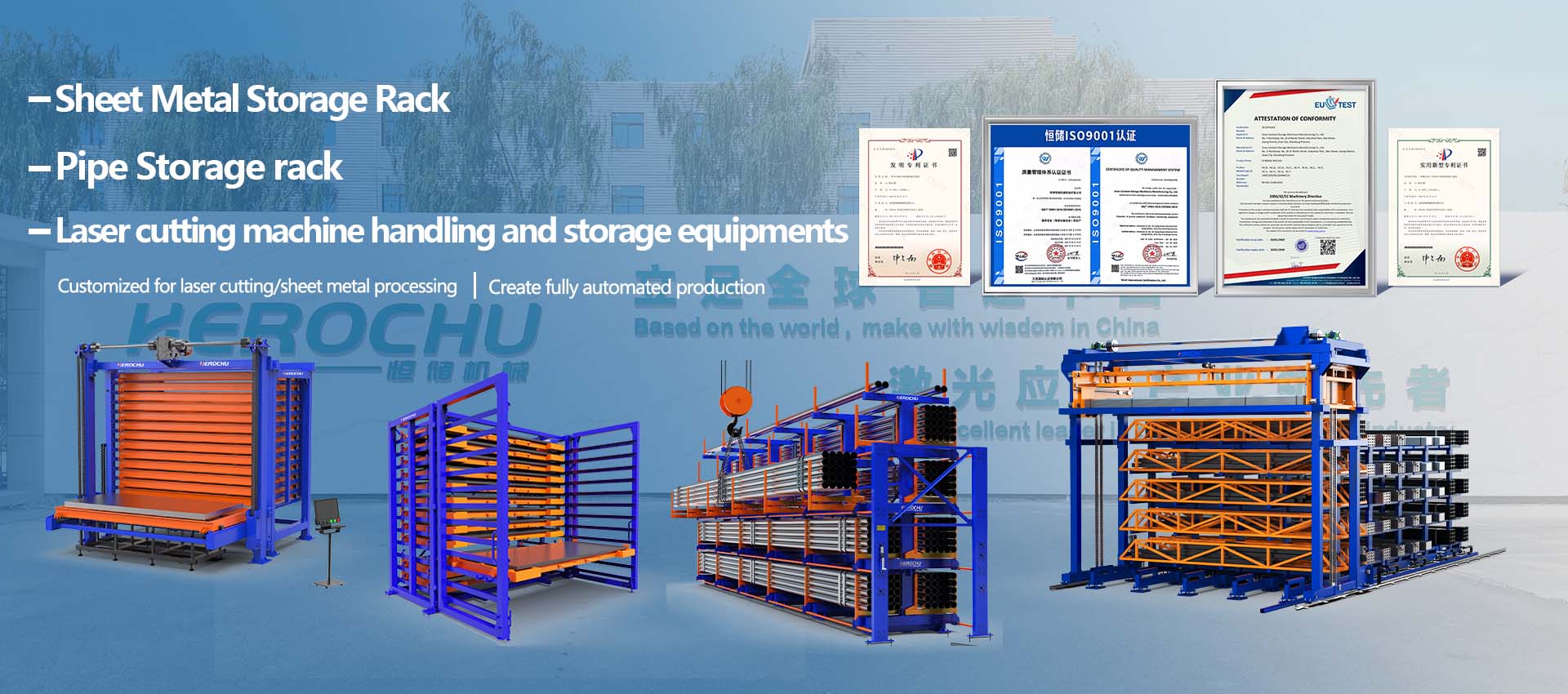
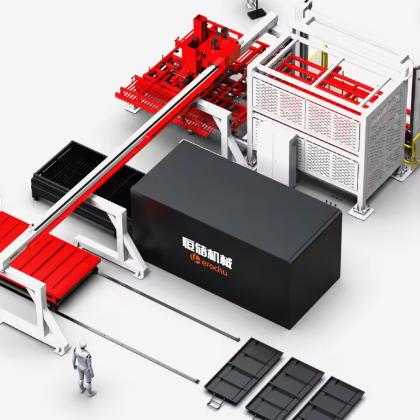
Sheet metal laser cutting is rarely a one-machine operation anymore. A fabricator running three or four lasers faces a material problem before a cutting problem: who loads the raw plates, who moves them between machines, who removes finished parts from the table, and how does inventory stay accurate while all of this happens. Herochu’s fully automated material handling and tower storage system answers with a single integrated flow: vertical tower storage, gantry robot loading and unloading, and a material cart, all synchronized with multiple laser cutting machines for end-to-end automated processing.
Four components, one continuous flow
The system is built from four parts that work as one.
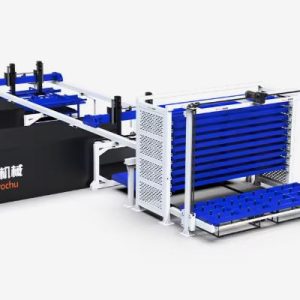
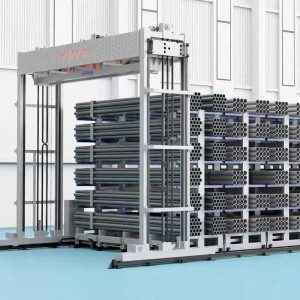
A vertical storage tower holding raw sheets in 8 to 10 layers, with per-tier capacities from 3,000 to 5,000 kg and a maximum sheet weight of 500 kg.
A gantry robot with vacuum suction lifters that loads and unloads the cutting machines.
A material cart that shuttles sheets between tower and machines at 5-15 m/min.
WMS/WCS software that decides what moves, where, and when.
Nothing in that chain depends on a person making a decision between steps. Storage, handling, and loading/unloading are fully automated, and the sequence repeats identically on every cycle. The operator’s role shifts from moving material to supervising the system, watching the HMI, monitoring schedules, and stepping in only when a job changes.
Synchronized with several machines at once
The distinguishing feature of this system is multi-device synchronization. The Herochu system is not bolted to a single laser; it is engineered to serve a group of machines on a shared schedule. When one laser finishes a job, the cart and gantry already know the next material assignment. When two machines request sheets at the same moment, the software sets priorities, calculates the optimal retrieval route, and coordinates the handling equipment accordingly.
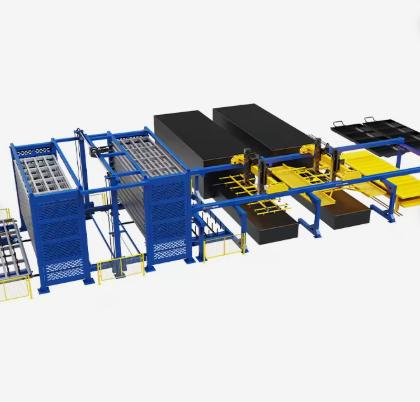
The tower doubles as a buffer. Different sheet grades, thicknesses, and sizes sit in their own tiers, and the system switches material according to the real-time cutting schedule. Mixed-material jobs that once required manual changeovers between machines can now run back to back without stopping the line. That is the difference between an automated machine and an automated processing center.
The software brain: WMS and WCS
At the center of the Herochu system sits a digital management layer that connects the physical machinery to the factory’s business systems. The WMS/WCS modules integrate with ERP and MES, synchronizing production planning with inventory control. Every plate is tracked in real time, with specification, batch number, location, and material usage recorded automatically, so stock counts stop depending on someone’s memory or a clipboard.
Task dispatching is automatic and visible. The system calculates routes, assigns jobs to the cart and gantry, and presents the operator with clear visual feedback on an HMI touchscreen. Human error in stock counts and job routing is largely removed, which is exactly what a production manager wants from automation: fewer surprises, fewer phone calls, fewer searches for a missing plate.
What the numbers look like after installation
Fully automated material handling changes the economics of the cutting floor. Non-cutting time, the minutes spent waiting for material, for a forklift, or for a free operator, is compressed because the next sheet is always staged. One operator can supervise the whole cell. Floor space occupied by horizontal racks and buffer stock is returned to production, since vertical tower storage uses up to 70-80% less footprint for the same inventory.
Consistent handling also protects the product. Vacuum suction lifters pick sheets without scratching, the gantry never drags material across a table, and cut parts are unloaded and sorted without manual heavy lifting. Fewer damaged sheets means fewer rejected parts, and fewer rejects is direct profit.
The same economics hold after dark. With the tower loaded at shift end, the cell keeps producing without staff, and the morning shift finds finished parts instead of an idle machine. Plants moving toward lights-out operation use the system as the first fully automated step on the cutting floor.
A practical path for existing shops
Automation does not require a new building. The tower occupies the space where horizontal racks used to stand, the cart follows a path laid out on the existing floor, and docking is matched to the exchange tables already on the lasers. Commissioning is planned around production so the changeover happens in stages: tower and storage first, gantry loading next, full synchronization last. Shops keep cutting while the system comes online.
Herochu engineers the entire layout around the site, customizing tower position, cart path, and machine docking to the production environment and the existing laser fleet. The result is an automated processing center where the machines, not the material handlers, set the pace of production. For shops planning the next capacity step, the system grows with the fleet: towers, carts, and gantries are modular, so adding another laser later means adding material handling capacity in the same footprint.