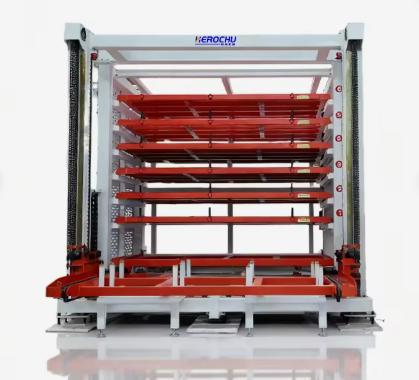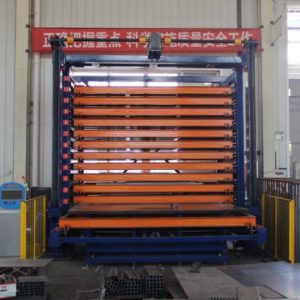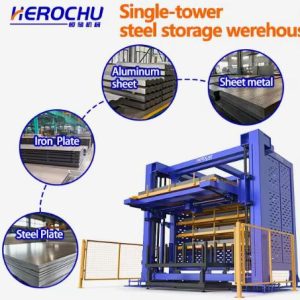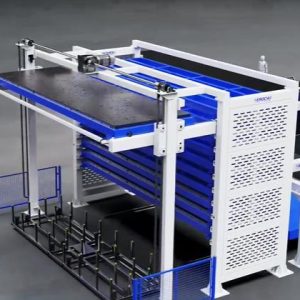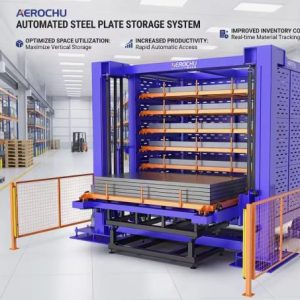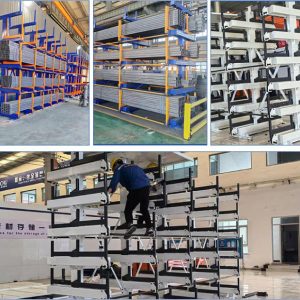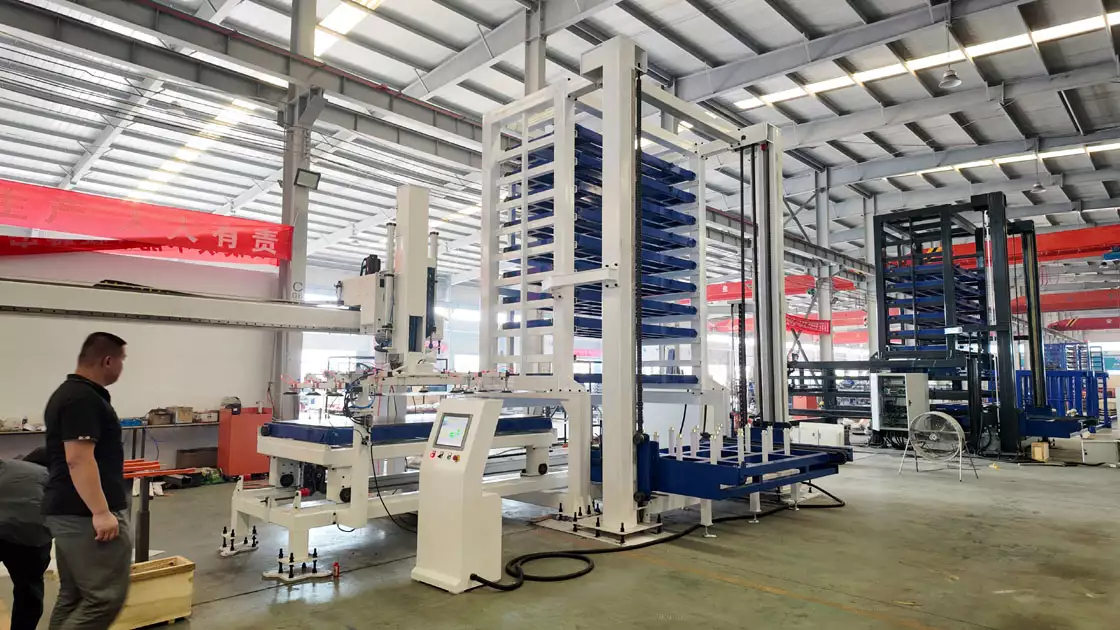
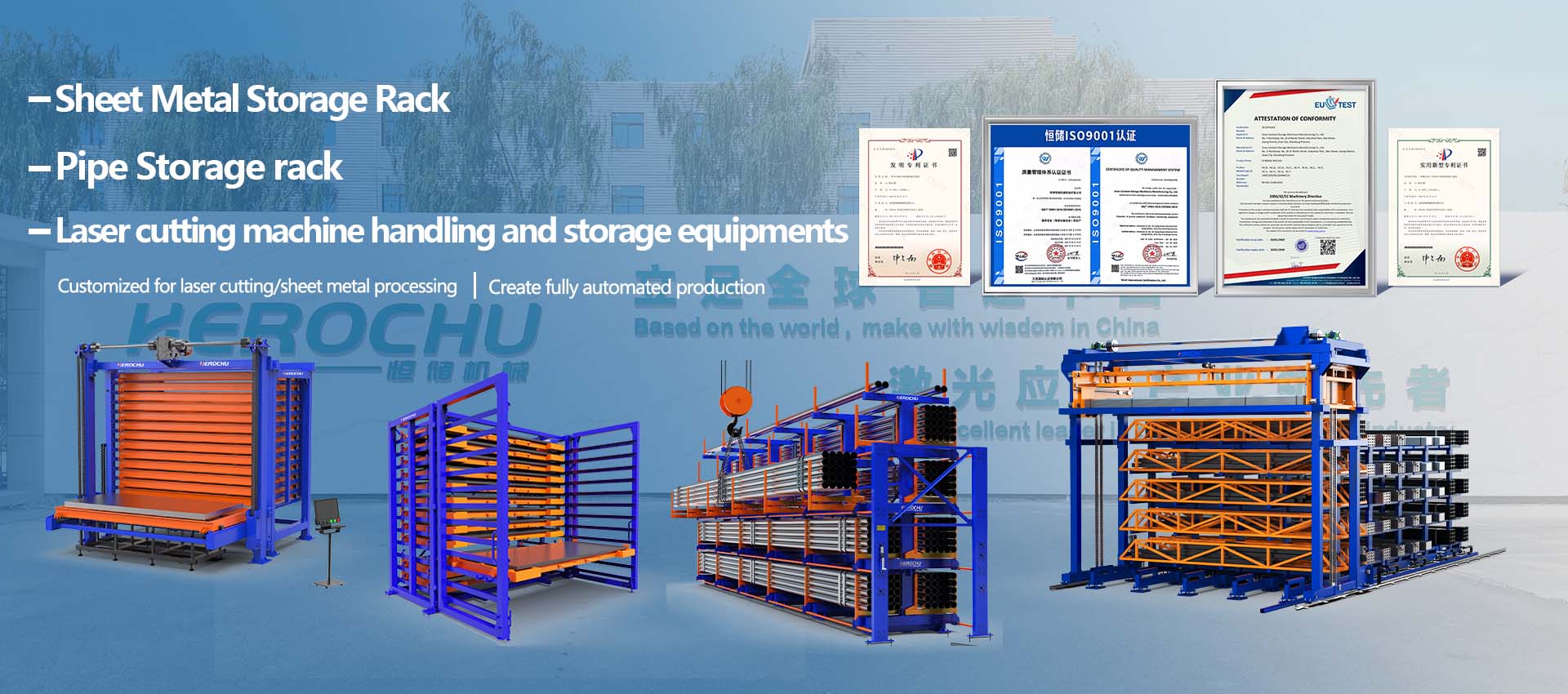
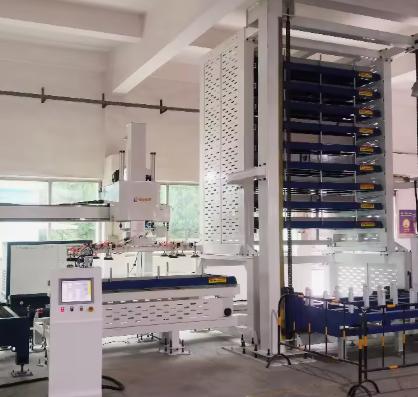
When a fabrication shop upgrades from manually fed laser cutting to a workflow where raw sheet enters one end and finished parts exit the other, the piece that makes that transition possible sits between the raw inventory and the cutting bed. A fully automatic steel plate storage tower designed specifically for laser cutting integration does more than store material. It feeds the machine, retrieves cut skeletons, updates the inventory ledger, and hands the next sheet to the loading frame before the operator has time to think about it.
Herochu builds these towers under the HC-S series, with models sized to handle sheet dimensions from 3000 x 1500 mm up to 6000 x 2000 mm. A single installation can house anywhere from six to fifteen storage levels, each tier independently rated for 3000 kg to 5000 kg of material. That means a ten-tier tower stocked with 6-meter steel plates holds thirty to fifty metric tons within a footprint smaller than three parking spaces.
Mechanical Architecture That Supports Lights-Out Production
The tower frame relies on high-strength Q235B structural steel welded into a rigid column-and-beam skeleton. Herochu engineers run Simsolid finite-element simulations during the design phase to verify that deflection under full payload remains within operational tolerance across every shelf level. The result is a structure that stays dimensionally stable through thousands of retrieval cycles, which matters because the positioning repeatability of +/- 2 mm depends on the frame not shifting over time.
Each storage level carries a roll-out drawer assembly that extends the full depth of the shelf. For the larger HC-S6020-105 configuration, the drawer assembly accommodates sheets up to 6000 mm long and 2000 mm wide, with a clearance gap of 350 mm between stored layers to allow the vacuum end-effector to descend, grip, and extract a single sheet without disturbing the stack above or below it.
Lift motion runs on chain-driven linear guide rails powered by a 5.5 kW to 11 kW motor, depending on tower height and payload requirements. Vertical travel speed spans 5 to 15 meters per minute, adjustable through the PLC interface. The horizontal transfer mechanism that shuttles sheets between the tower aisle and the loading station uses a separate 1.5 kW to 2.2 kW drive, keeping the two axes independently controllable for simultaneous operation when the control logic permits it.
Zoned Vacuum Gripping and Double-Sheet Prevention
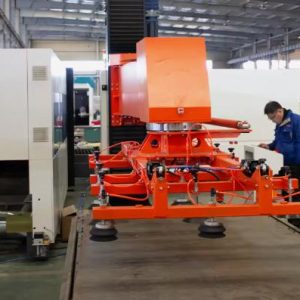
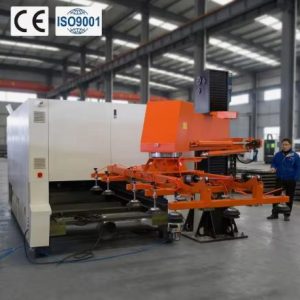
The end-effector that picks sheets from the tower deploys a zoned vacuum suction matrix. Individual suction zones can be activated or deactivated based on sheet dimensions, meaning a 1500 mm-wide plate activates only the central and relevant side zones while a 2000 mm-wide plate engages the full array. This selective actuation preserves vacuum pressure where it counts and reduces compressed-air consumption during partial-width picks.
A double-sheet detection circuit checks each pickup cycle. If two sheets adhere together — a common occurrence with oily or film-coated stock — the sensor triggers a separation protocol that vibrates the stack and retries the pick before flagging the operator. Thickness verification runs in parallel: the system cross-references the gripped sheet’s measured thickness against the production order’s bill of materials, so a 2 mm mild steel blank never reaches a machine programmed for 1.5 mm stainless.
The Zero-Distance Handling Advantage
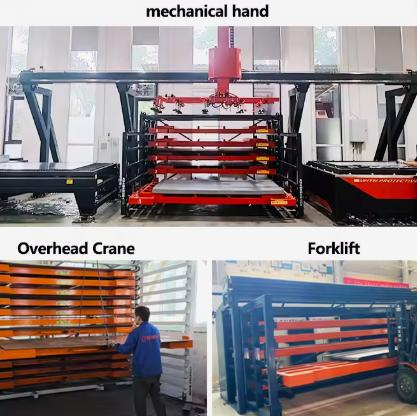
What differentiates a tower purpose-built for laser cutting from a general-purpose ASRS is the proximity to the cutting machine. Herochu positions the tower discharge station less than two meters from the laser shuttle table. In this configuration, the tower’s transfer mechanism deposits a fresh sheet onto the shuttle, the shuttle rolls into the cutting envelope, and cutting begins. When the program completes, the shuttle rolls back out, the skeleton extraction gripper removes the leftover frame, and the next sheet loads.
No forklift enters the equation. No overhead crane operator waits for a signal. The tower manages the entire sequence through a Siemens S7-1200 or S7-1500 PLC communicating over Profinet with the laser machine’s CNC controller and the factory ERP server. The control logic includes a material staging queue that pre-positions the next required sheet on a buffer shelf while the current sheet is being cut, reducing changeover time between jobs to single-digit seconds.
ERP Integration and Real-Time Inventory Visibility
The Herochu HC-S series runs on an intelligent WMS layer that maintains a live digital twin of every storage position. Each incoming sheet receives a barcode or RFID tag at the receiving dock. As the tower intake station accepts the sheet, the WMS logs its dimensions, grade, thickness, heat number, and storage location. When the ERP system issues a cutting work order, the WMS reserves the matching material, instructs the tower to retrieve it, and deducts it from available inventory the moment the vacuum gripper confirms pickup.
This closed-loop tracking delivers 100% inventory accuracy. The days of cycle-counting steel plate stock by walking the floor with a clipboard end the day the tower goes online. Batch traceability extends backward through the supply chain because the system records which heat of steel went into which customer order, a requirement increasingly demanded by automotive and aerospace contract manufacturers.
Operational Throughput and Labor Impact
Shops that install a Herochu fully automatic storage tower alongside their laser cutting cells typically report a 40% to 60% increase in daily cut-part output without adding machine tools. The gain comes from eliminating the idle intervals where a cutting machine waits for an operator to finish another task, locate the correct plate, rig it to a crane, and position it on the bed. With the tower handling retrieval and loading, the laser runs closer to its theoretical maximum duty cycle.
Labor reallocation is the second economic lever. One technician overseeing a tower-fed laser cell replaces two or three forklift drivers and material handlers who previously shuffled plate stock around the bay. The personnel who remain shift into higher-value roles — quality inspection, program optimization, secondary processing — rather than spending their shifts moving metal from rack to machine and back again. For shops running a third unsupervised shift, the tower enables genuine lights-out manufacturing where the system runs unattended from end-of-day until morning startup.
Model Selection and Configuration Logic
Herochu supplies four standard frame sizes in the HC-S series. The HC-S3015-63 handles sheets up to 3000 x 1500 mm across six tiers, with 3000 kg per level. The HC-S4015-85 and HC-S4020-85 step up to 4000 mm length and either 1500 mm or 2000 mm width, both offering eight tiers at 5000 kg per level. The largest configuration, HC-S6020-105, stretches to 6000 x 2000 mm sheets across ten tiers at 5000 kg each.
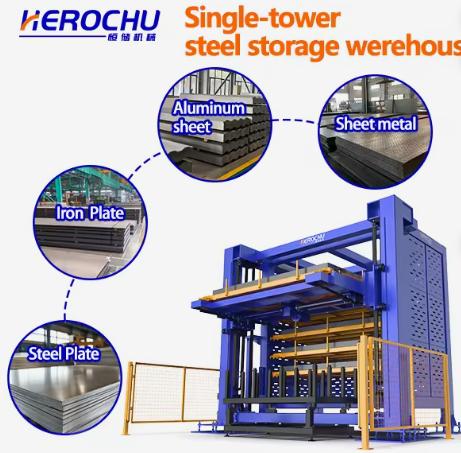
Beyond these standard footprints, Herochu engineers custom builds around the customer’s existing floorplan. Tower height, number of storage levels, clearance space between layers, and even the direction of drawer extension — front-to-back or left-to-right — are configurable parameters. Single-tower and twin-tower arrangements are both supported, with the latter doubling storage density in the same floor area by running two elevator columns in parallel aisles.
Voltage options cover 220V and 380V at 50 Hz or 60 Hz, which means the system ships ready for North American, European, and Asian electrical standards without aftermarket transformer retrofits. Sensor enclosures carry an IP67 rating, protecting the positioning lasers and proximity switches from the metallic dust and cutting fluid mist ubiquitous in fabrication environments.
Installation Footprint and Facility Requirements
A single-tower HC-S installation needs a level concrete floor with anchor points along the column base plates. Herochu provides a foundation drawing specifying bolt patterns and load distribution so the customer’s civil contractor can prepare the pad before the tower ships. The tower itself arrives in modular sections that bolt together on site, with the lift mechanism pre-assembled and tested at the factory. Typical installation runs three to five days from truck arrival to powered commissioning, assuming the foundation is ready and electrical drops are in place.
Electrical supply requirements are straightforward: a dedicated circuit at the specified voltage, protected by a breaker sized for the lift motor’s inrush current. The control cabinet includes a main disconnect, transformer for the 24V DC control circuit, and terminal blocks for the Profinet or Ethernet/IP connection to the plant network. Herochu’s commissioning engineer handles PLC parameter tuning, WMS configuration, and ERP interface mapping during the on-site startup window.
For facilities planning an eventual second tower or additional laser cell, the WMS software license covers multi-tower expansion. Adding a second tower later means bolting it adjacent to the first, extending the transfer rail, and updating the inventory map in software — no forklift fleet expansion, no additional floor space carved out of production, no new headcount.
Maintenance and Long-Term Serviceability
The chain-driven lift mechanism runs on hardened sprockets and tensioned roller chain with automatic lubrication points accessible from the tower exterior. Guide rails use recirculating ball-bearing carriages rated for the full dynamic load of a loaded drawer plus the elevator carriage. Herochu specifies a quarterly inspection interval for chain tension, rail alignment, and vacuum cup condition, with annual replacement recommended for high-cycle vacuum elements.
The Siemens S7 PLC logs motor current draw, cycle count, and fault history to an onboard SD card, which the maintenance team can export for trend analysis. If the lift motor begins drawing above-baseline current — a sign of chain wear or guide misalignment — the WMS flags it before it becomes a stoppage. Spare parts availability is supported through Herochu’s distribution network, with critical wear components kept in regional stock for same-week delivery across most industrial markets.
The Herochu fully automatic steel plate storage tower for laser cutting transforms the area around a cutting machine from a staging yard into an integrated production cell. It eliminates the manual handling that bottlenecks throughput, enforces inventory discipline that manual systems cannot match, and unlocks the extra shift capacity that pays back the capital investment inside twelve to eighteen months at typical utilization rates.