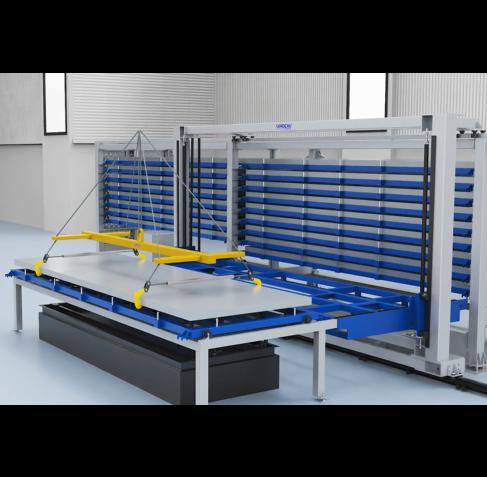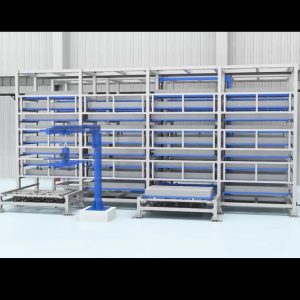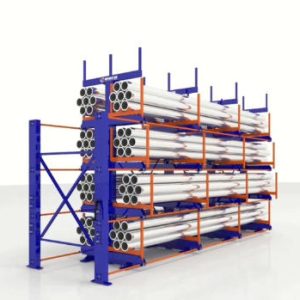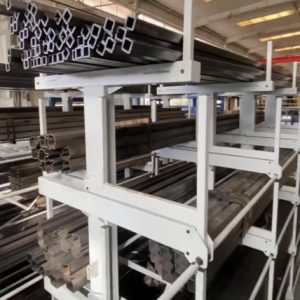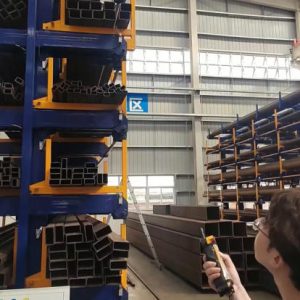
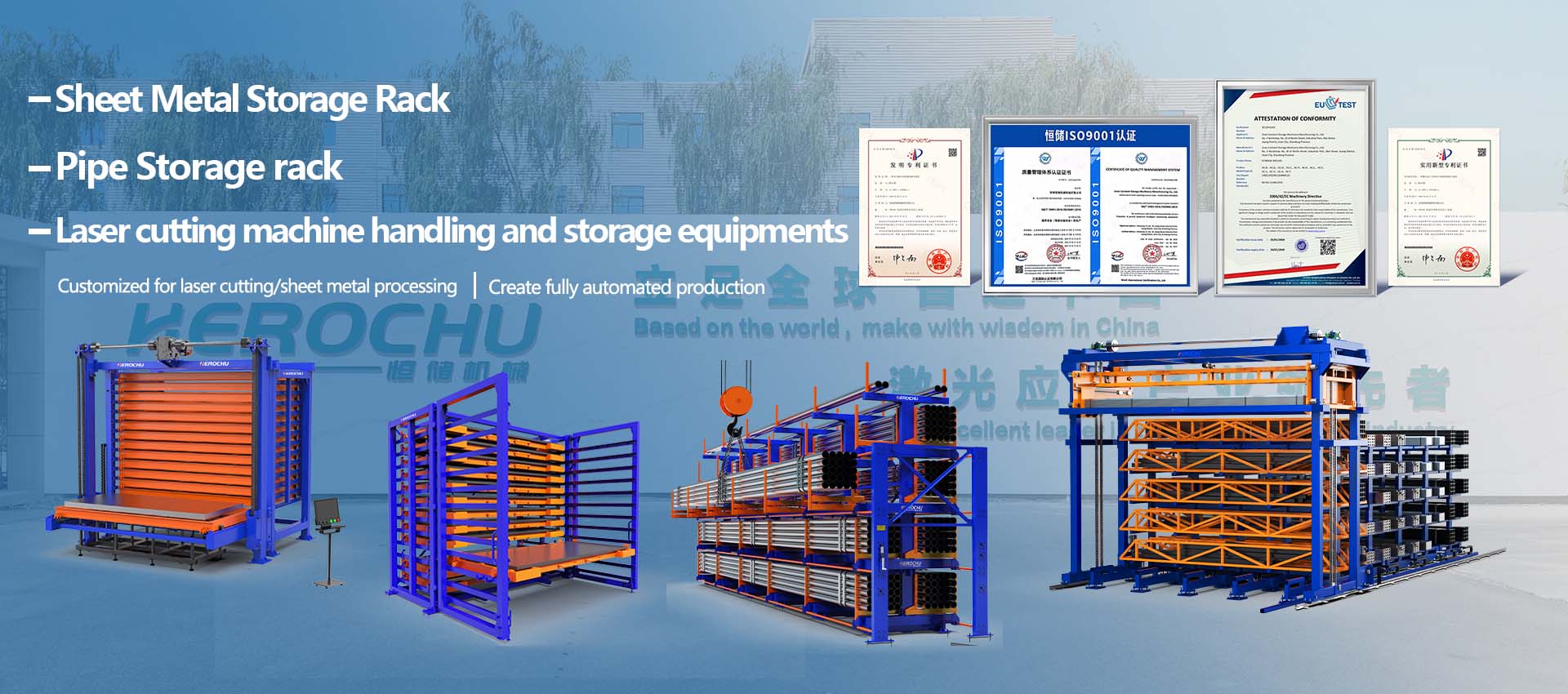
An automated panel storage WMS warehouse links every slot to a database record, so a sheet is booked in, located and issued without manual counting. A loading robot handles bundles at goods-in and sheets at the machine. Herochu pairs the WMS with a PLC-controlled multi-tower bank and ERP interfaces for live stock, batch traceability and expiry warnings.
Two automations, one flow
Buyers often use “automated” to mean the stacker crane, then discover the hard part sits on either side of it. Bundles arrive by truck and must be unpacked; sheets must reach a machine bed. If both ends stay manual, the tower becomes an island in the middle of a manual process.
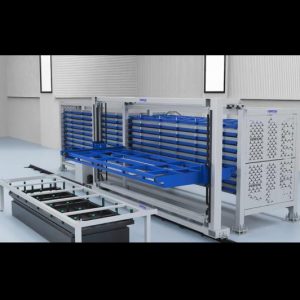
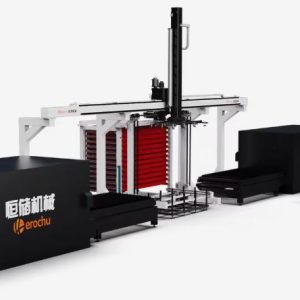
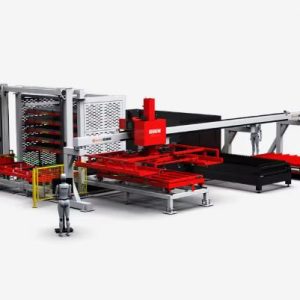
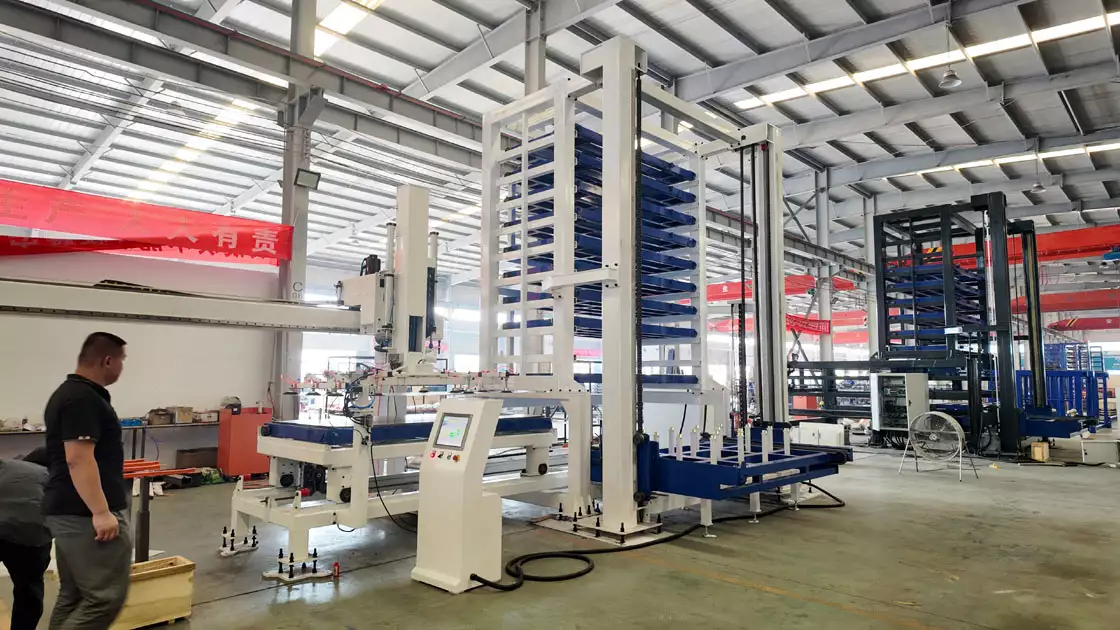
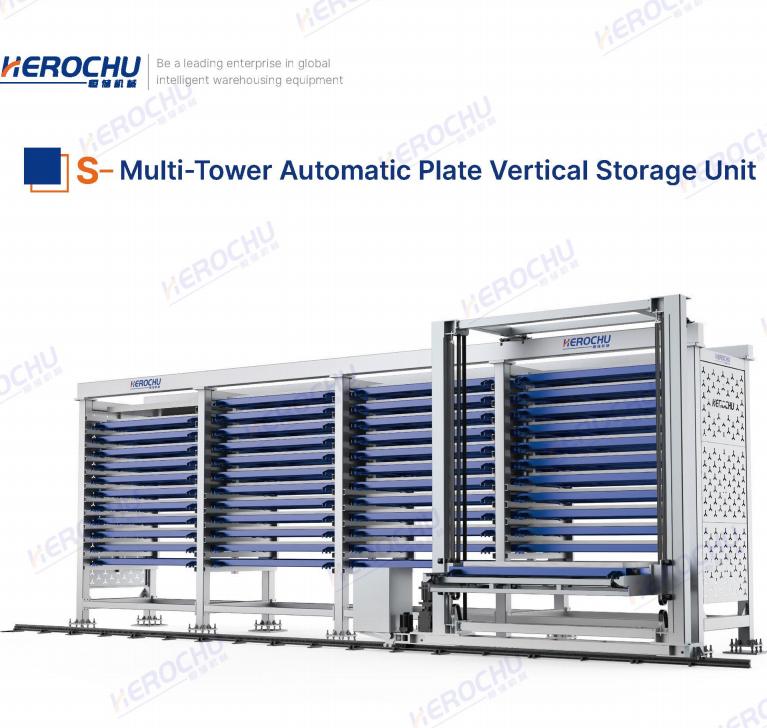
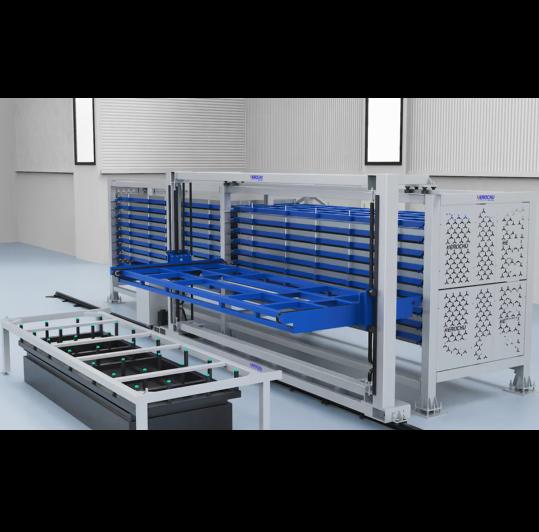
The working configuration pairs three elements: the tower bank that stores, the WMS that knows what is stored, and a loading robot that moves material in and out. Herochu builds this as one control scope, so a scan at goods-in, a slot assignment and a delivery at the machine all reference the same record.
What the WMS owns
A warehouse management system in a sheet metal plant is not an inventory list. It holds the rules that keep the physical store and the database identical:
- Slot logic. Free slots are offered by size, weight and material family, not chosen by the operator.
- Batch traceability. Each receipt carries a batch or heat number, so a quality claim traces back to the coil or plate it came from.
- Expiry warnings. Coated, oiled and film-protected sheets have a shelf life; the system flags stock before the protection fails.
- Live quantity and weight. The dashboard reports stock by dimension, grade and tonnage without a count.
- ERP synchronisation. Orders pull material and receipts post back, so planning and finance see the shop floor number.
- On-demand stocktaking. A cycle count runs on one tower, one grade or the whole store at any time.
Herochu states a 100 percent accuracy rate for scan-in with automatic positioning. The mechanic is simple: the machine, not the operator, records where the tray went. Manual put-away is where location errors begin.
The loading robot’s job
A loading robot here is not the tower extractor. It is the unit that meets the outside world, and its duty cycle decides how much of the shift can run unmanned.
| Duty | End effector | What it changes |
|---|---|---|
| Depalletising incoming bundles | Vacuum or magnetic array | Goods-in becomes a one-person task |
| Feeding the cutting machine | Vacuum cups with sheet detection | Less waiting between nests |
| Removing parts and skeleton | Magnetic or combined gripper | Less manual handling at the bed |
| Loading the storage cart | Vacuum matched to surface | Links robot to tower without a driver |
End effector choice follows the material mix. Vacuum suits flat, clean aluminium and stainless; magnetic arrays suit mild steel and thick plate; mixed shops need a quick-change head. Sheet detection matters more than payload: a robot lifting two sheets will jam a laser bed or double-feed a slot, and the sensor set prevents it.
Running an unmanned shift
A night shift with no operator is achievable, but only with defined exceptions. The system must decide what to do when a sheet is out of tolerance, a slot holds an unexpected tray, or an order calls for material the WMS shows but the scan does not confirm. Plants that succeed set three rules before going unmanned:
- Any mismatch blocks the affected slot, not the whole store.
- Work continues from confirmed stock; unconfirmed stock is quarantined for the day shift.
- The robot has a safe park position and a defined restart after interruption.
With those rules, a Herochu installation runs retrieval and delivery overnight while one supervisor watches alarms remotely. What it cannot do is settle a quality dispute or re-slot a misdeclared bundle; those stay human tasks.
Data that production planning can use
Once every movement is recorded, the warehouse produces reports the plant never had. Three change behaviour:
- Consumption by grade and gauge, which shows whether the material master matches what the cutting programme uses.
- Dwell time by slot, which exposes slow-moving stock occupying prime low levels.
- Retrieval frequency by sheet size, which guides re-slotting and shows when a second extractor is justified.
None of this needs new hardware. It needs scan-in and scan-out every time, which is a process decision backed by the fact that the machine will not release a tray without a record.
Specification context
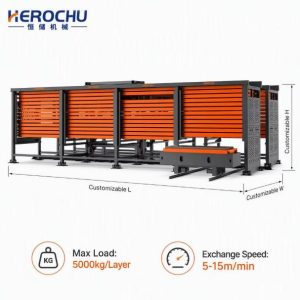
The Herochu S-series covers sheets from 3,000 x 1,500 mm to 6,000 x 2,000 mm, with two to four towers, 6 to 12 layers and 3,000 or 5,000 kg per level. Transfer speed runs 5-15 m/min, repeatability is ±2 mm, and clear space between levels is 240 mm as standard. Tower count, layers and clear space are customised, which lets the same WMS and control platform serve a two-tower cell and a four-tower hub.
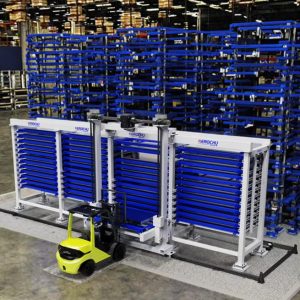
Capacity follows the usual vertical arithmetic: four towers at twelve levels and 5,000 kg per level is up to 240 tonnes on a footprint that would otherwise hold a handful of stacks.
FAQ
Does the WMS replace the ERP? No. The WMS owns physical location and movement; the ERP owns purchasing, costing and orders. The interface passes receipts, issues and balances between them.
Can one loading robot handle bundles and machine feeding? Yes, with a suitable end effector and enough reach. Many plants use one robot for both because the peaks do not overlap.
How is batch traceability kept across a cut sheet? The batch number stays on the parent sheet record, and remnant and part records inherit it at cutting, so a claim is traceable after the sheet leaves the tower.
What happens during a power interruption? The controller retains slot status, and on restart the system verifies tray positions before accepting commands. Position is confirmed, not assumed.
Herochu commissions the tower bank, the loading robot and the WMS as one package, and trains the team that will run the first unmanned shift.