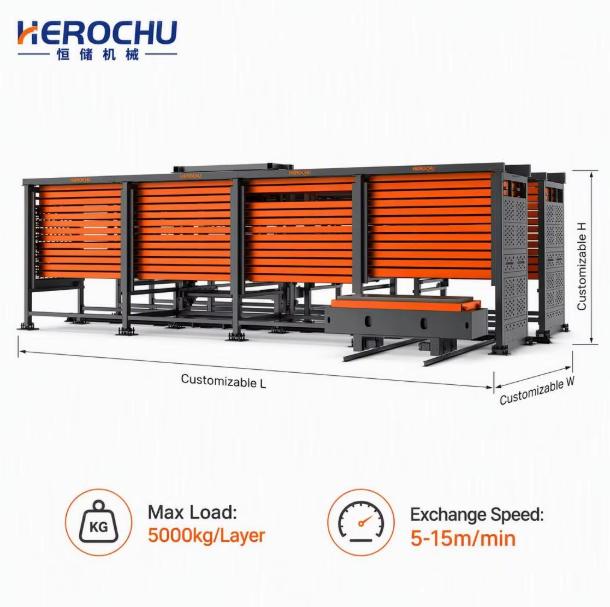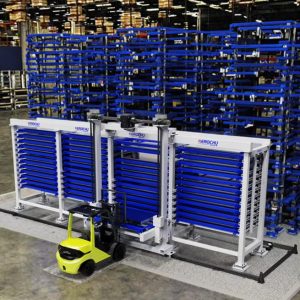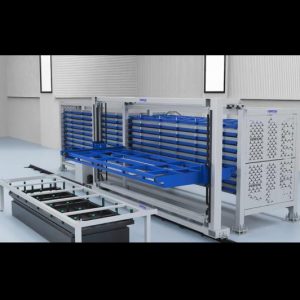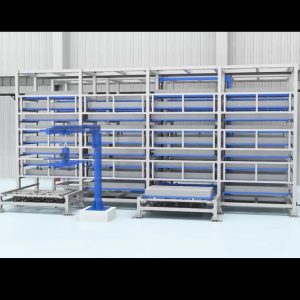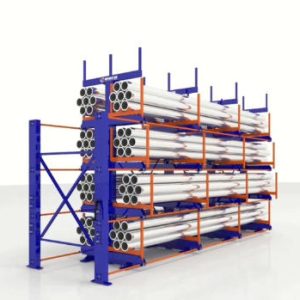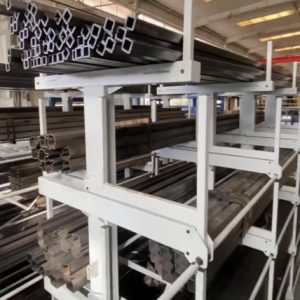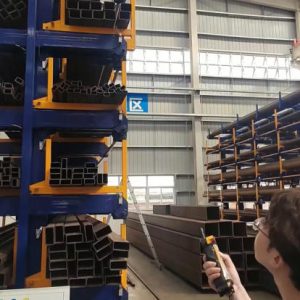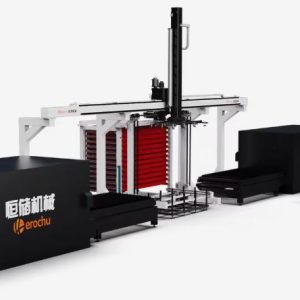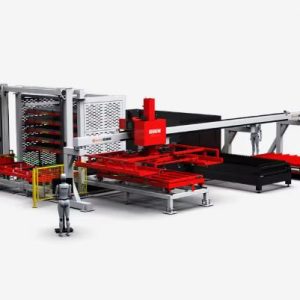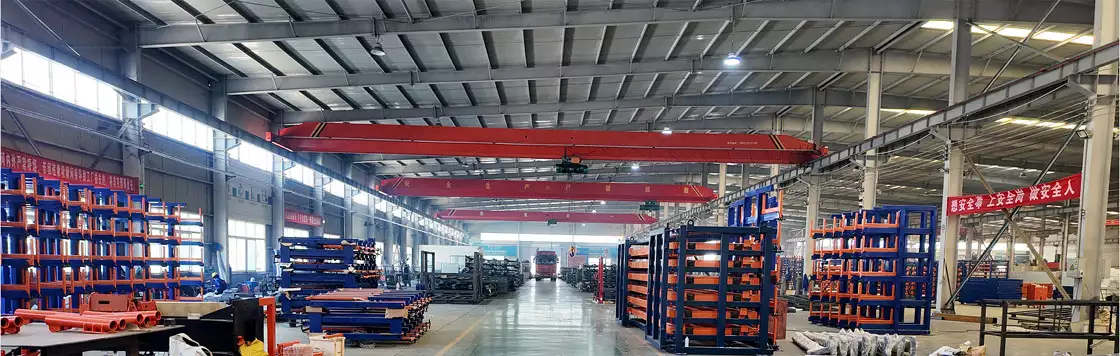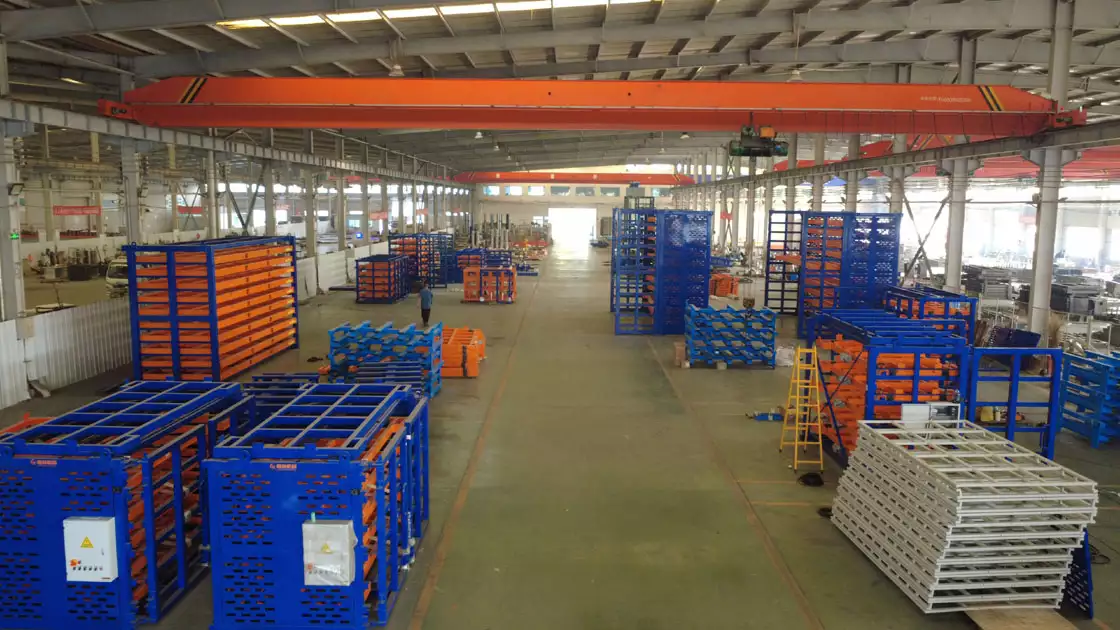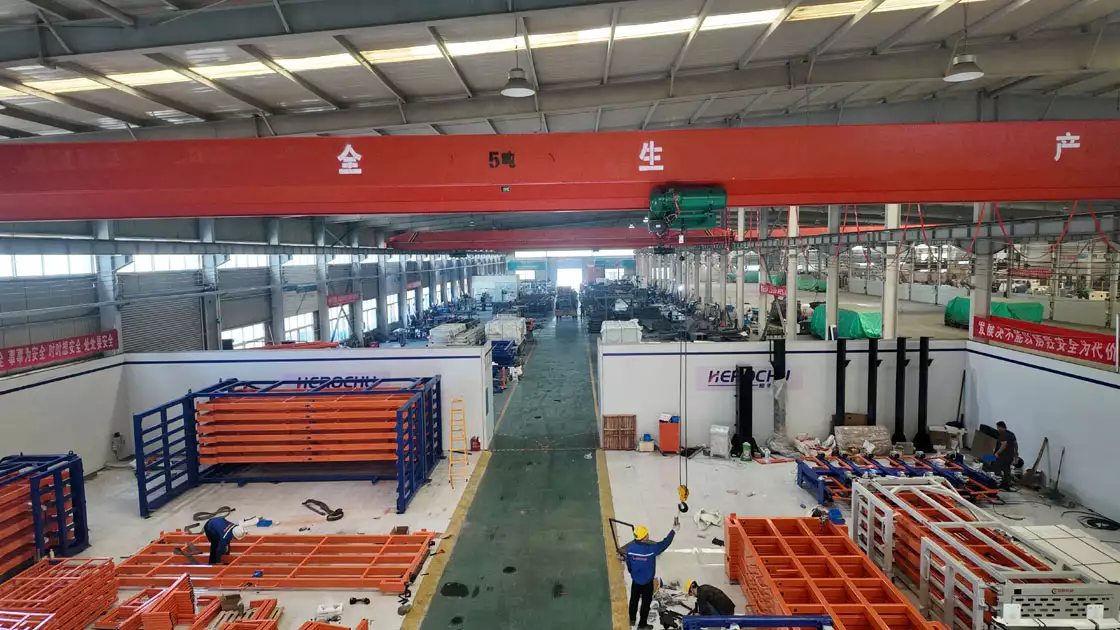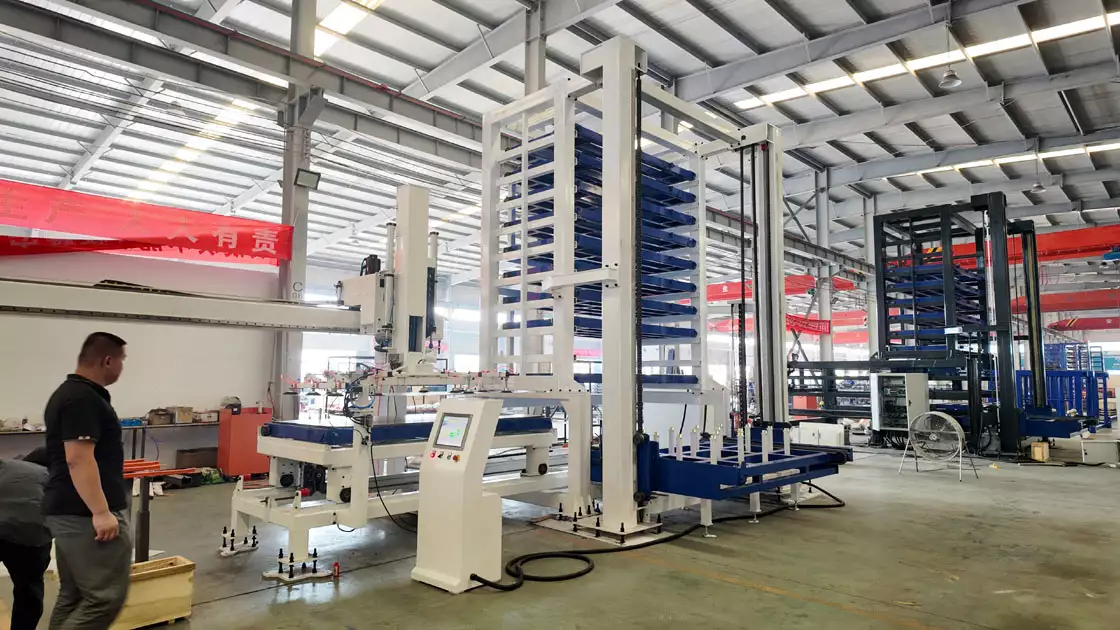
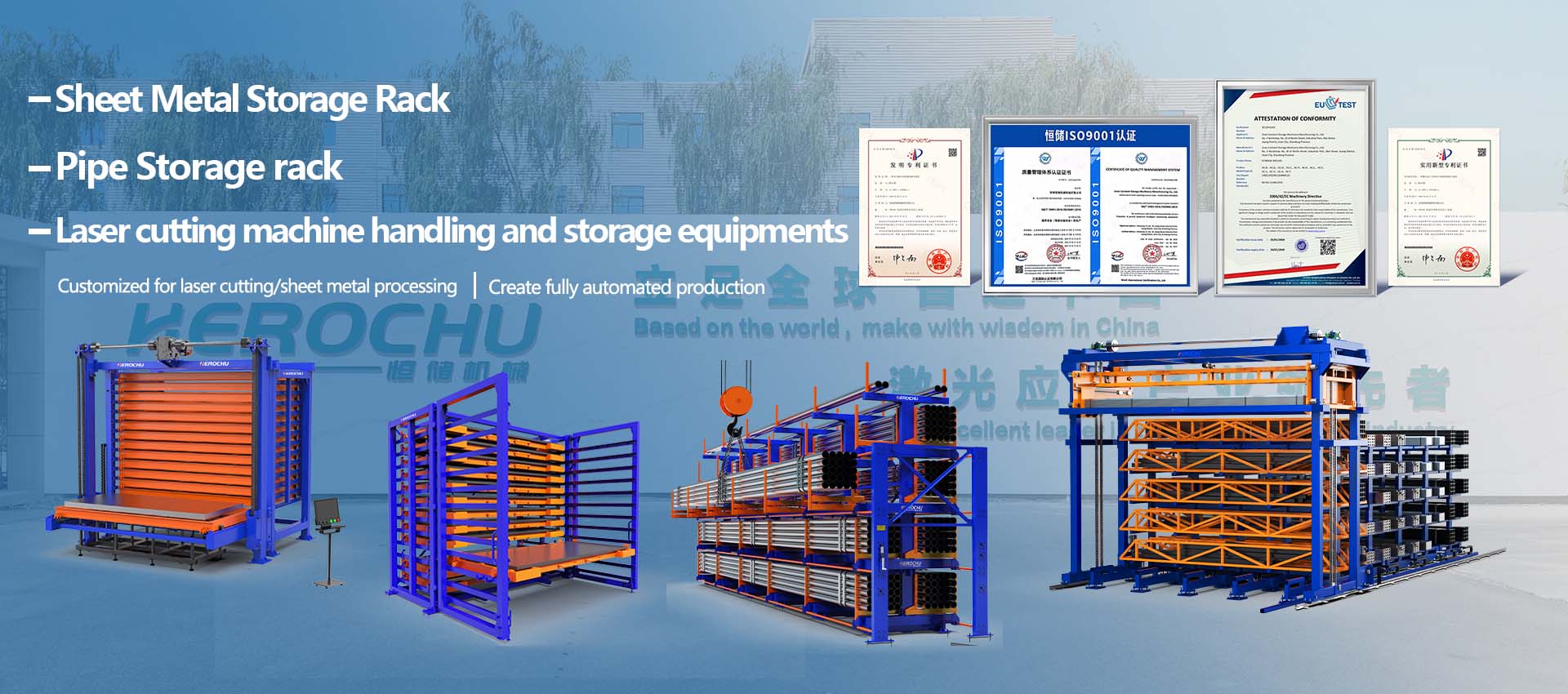
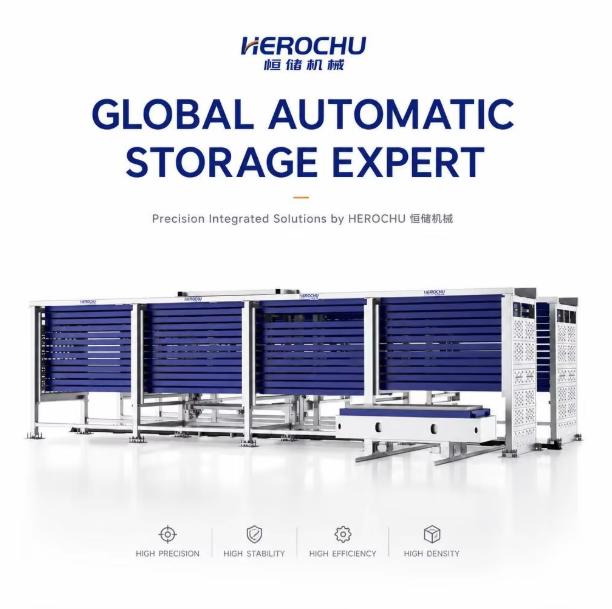
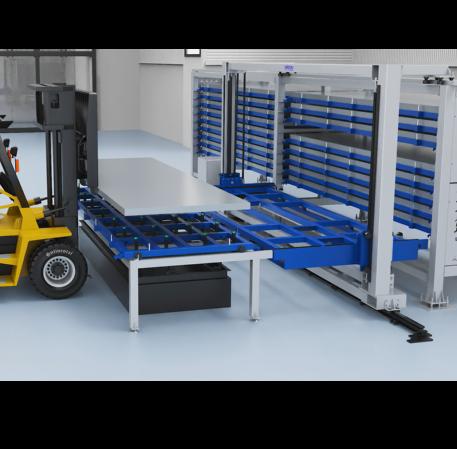
A fully automatic multi-tower panel storage and retrieval system keeps metal sheets in two to four vertical towers served by a PLC-controlled extractor. An operator requests a sheet on the touchscreen, the machine picks it from its slot and delivers it on a material cart, and the WMS updates dimensions, weight and quantity in real time. Herochu builds this format for sheets up to 6,000 x 2,000 mm.
What the system replaces on the floor
Most sheet metal shops still run on stacks. A laser operator walks to a pile, measures a sheet by hand and drags it out with a suction lifter. The stack hides the problem: the sheet the job needs sits somewhere in the middle, and moving forty sheets to reach it costs an hour the schedule did not include.
A multi-tower system breaks that pattern in three ways. It turns floor area into indexed vertical slots, gives every sheet a known location, and replaces the operator’s memory with a record the supervisor and the ERP can both read. Cutting does not change; material flow does.
The retrieval cycle, step by step
- The incoming sheet is scanned at goods-in. The WMS records alloy, thickness, dimensions and weight, then assigns a free slot.
- The stacker travels to that slot and the extractor moves the tray onto the storage level. Positioning is automatic, so the database slot and the steel always match.
- When a job is released, the operator selects material on the PLC touchscreen. No code to type, no crane to drive: one touch sends the request.
- The extractor pulls the tray, the lift descends, and the sheet transfers to the cart. Travel speed runs 5 to 15 m/min depending on load and distance.
- The cart delivers to the laser, punch or press brake, and the WMS books the sheet out at the same moment.
Fully automatic here means the machine completes the whole path without anyone touching the load. The human decision is which sheet, not how to reach it. That split is what lets one person run storage and cutting on a night shift.
What two, three or four towers buy you
A single tower is a buffer. Two towers let one machine serve the aisle from both sides, which shortens average travel. Three and four towers turn the unit into a classified store: stainless in one, aluminium in another, thick plate low down where the load path is shortest, thin coated sheet higher up where it is light and rarely called.
Tower count also sets throughput and redundancy. If one extractor serves every tower, a fault stops the whole bank, so three-shift buyers usually add a second mast or accept a manual bypass level. Four towers at twelve layers gives 48 positions in a bay that once held six stacks and two forklifts.
Specifications that decide the model
| Model | Sheet size (mm) | Towers | Layers | Load per level |
|---|---|---|---|---|
| HC-S3015-2-63 | 3,000 x 1,500 | 2 | 6 | 3,000 kg |
| HC-S4015-3-85 | 4,000 x 1,500 | 3 | 8 | 5,000 kg |
| HC-S4020-4-105 | 4,000 x 2,000 | 4 | 10 | 5,000 kg |
| HC-S6020-4-125 | 6,000 x 2,000 | 4 | 12 | 5,000 kg |
Clear space between levels is 240 mm as standard and adjustable at build stage, which matters when the store must take pallets or cradles. Tower and layer counts are customised, so a shop starting with two towers can add a third without changing the control architecture. Repeatability is ±2 mm across the range.
Why ±2 mm repeatability pays for itself
Two millimetres sounds like a tolerance nobody needs on a storage machine. It matters at the handover point. Laser beds, punch clamps and press brake gauges are set to a datum, and a sheet arriving 8 mm off centre forces the operator to re-square it by hand, or lets the machine probe an edge that is not where the program expects. Off-datum sheets cause head crashes, scrapped first parts and burned nozzles. At ±2 mm material lands inside the working envelope every time.
The same accuracy protects the sheet. A fork entering a tray 10 mm low lifts the level above it, and a 5,000 kg level dropping onto polished stainless is an expensive event. Precision here is damage prevention before it is speed.
Capacity in tonnes, and the number buyers forget
Four towers, twelve layers, 5,000 kg per level: up to 240 tonnes. That is simple arithmetic, and it is where the slab becomes the constraint. A concentrated 5,000 kg load on a small footprint is a different structural problem from the same tonnage spread over stacks on dunnage. Herochu reviews point loads, anchor layout and floor flatness with the customer’s engineer before shipment, because retrofitting a foundation costs far more than designing it in.
FAQ
How long does one retrieval take? Most calls finish in one to three minutes, including lift travel and cart handover. Tower count and distance to the line set the real figure.
Can one tower hold different sheet sizes and thicknesses? Yes. Each level is a slot with its own record, so mixed gauges can share a tower as long as the tray suits the largest sheet assigned to it.
Does the system replace forklifts completely? It replaces the forklift inside the storage aisle. Most plants keep one truck for deliveries and for moving the cart between buildings.
What happens if the WMS and the ERP disagree? The WMS stays the physical truth, because every slot is tied to a scan event. ERP reconciliation flags differences instead of overwriting the location record.
Herochu configures each S-series system around the sheet sizes, tonnage and shift pattern of the plant it serves, and hands over the WMS and ERP interfaces within the same commissioning scope.