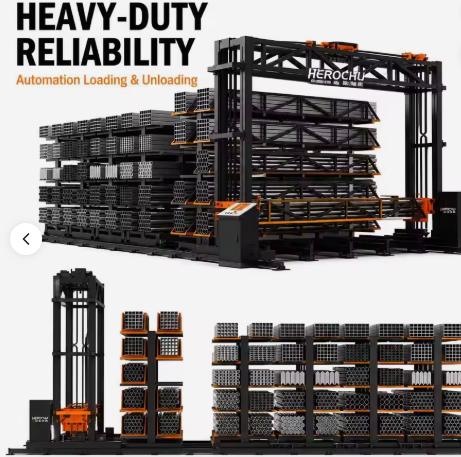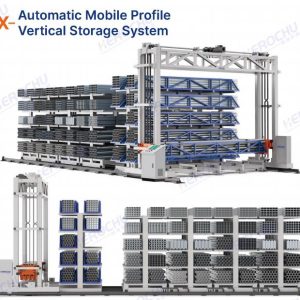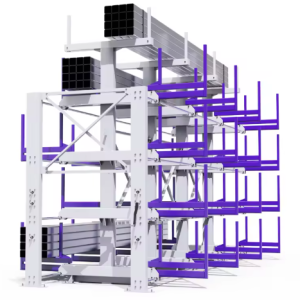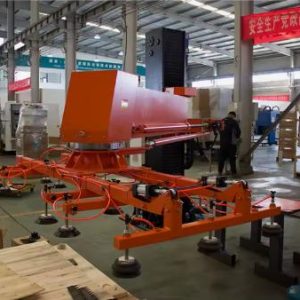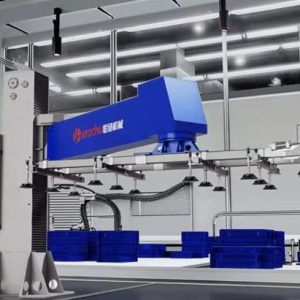
Profile storage has traditionally forced a compromise: you can have density, or you can have access, but rarely both. Herochu’s Automatic Mobile Profile Vertical Storage System CE Certified removes that trade-off by combining vertical high-density racking with a mobile gantry platform that travels to the material rather than requiring the material to travel to a fixed station.
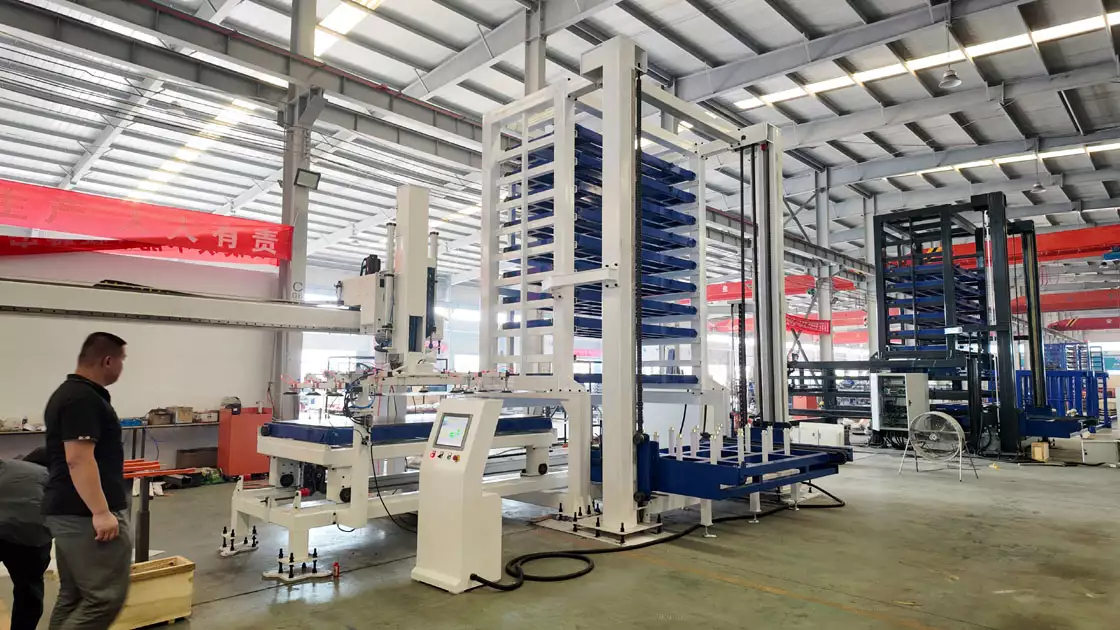
The system is built around a single-column vertical architecture that stores profiles in discrete compartments across multiple levels. Unlike fixed tower systems that lock a storage location to a single point on the floor plan, the mobile configuration allows the retrieval unit to reposition along a rail path, serving multiple loading points or interfacing directly with downstream processing equipment. This mobility is particularly relevant in workshops where profile flow changes by job or where floor space is already committed to CNC saws, bending centers, or welding stations.
Each layer is rated for loads that accommodate both single heavy sections and bundled profiles. The vertical lift and horizontal travel motions are driven through a linear guide and chain transmission arrangement, delivering stable positioning without the sway that affects suspended crane systems when handling long stock. Herochu specifies vertical speeds around 9 meters per minute and inlet/outlet speeds of 12 meters per minute, rates calibrated for the physics of heavy profiles rather than the demands of parcel sorting.
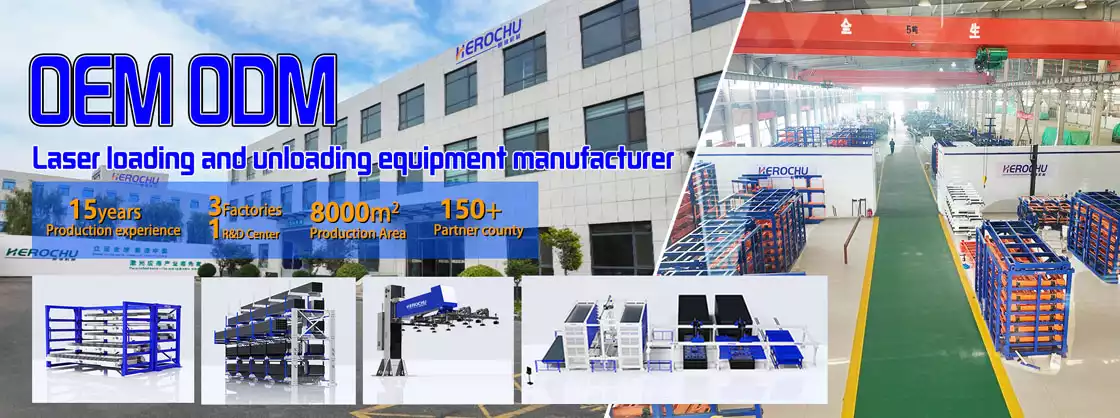
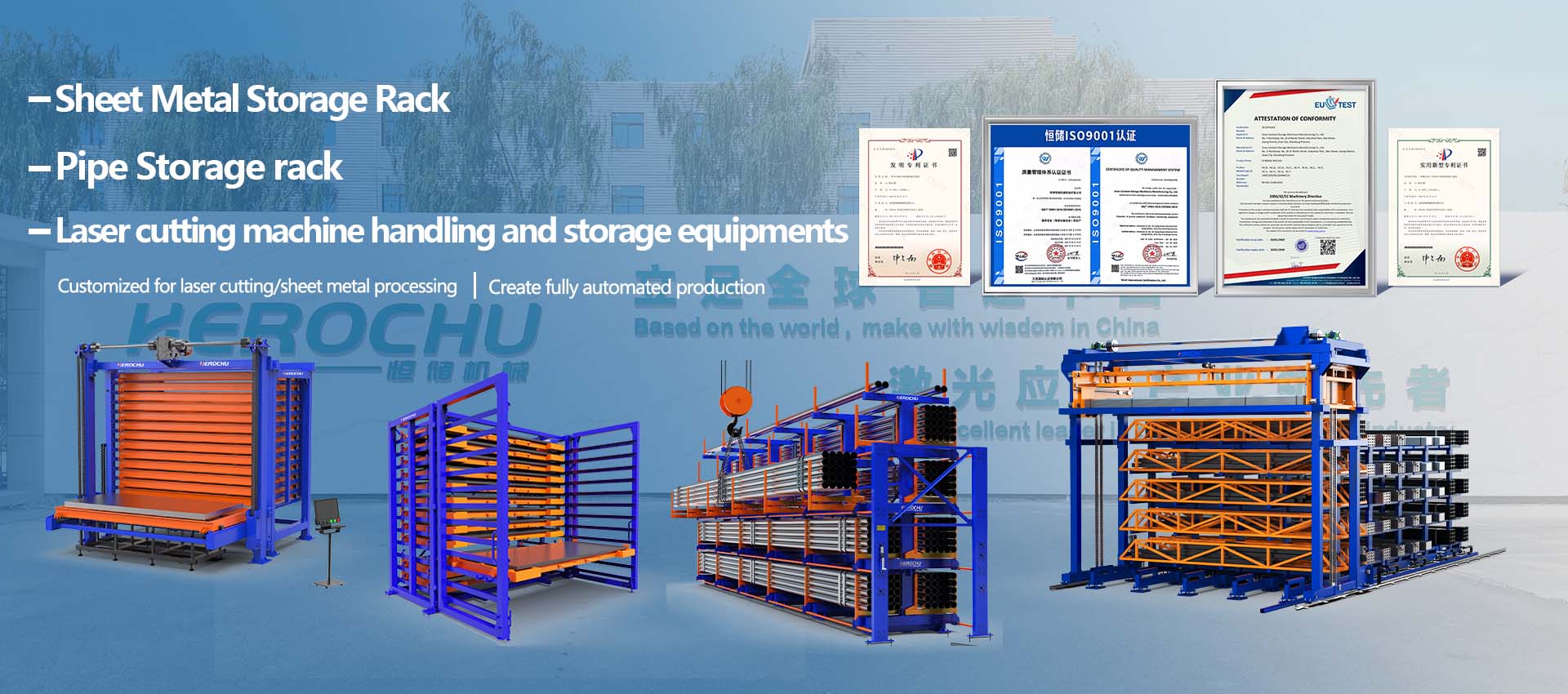
The CE certification matters for European and export-oriented operations, but it also signals a broader engineering discipline. Herochu builds these units under ISO 9001 quality procedures with load testing before shipment. For a fabricator running aluminum extrusions or steel sections, the certification is not a marketing badge—it is the documentation that safety officers and insurers require before automated equipment enters the production floor.
Operationally, the mobile configuration changes how material flows through a facility. In a fixed tower system, an operator retrieves a bundle and transports it to the saw. With the mobile unit, the retrieval head can position itself at a transfer station adjacent to the cutting line. The profile moves from storage to saw infeed with fewer touches and less forklift traffic. Herochu reports that automated retrieval in these configurations cuts material turnover time substantially compared to manual handling.
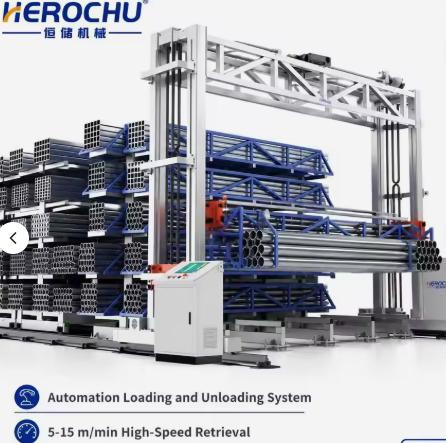
The control architecture supports this integration. The system operates through a PLC and industrial touchscreen interface, with manual, semi-automatic, and fully autonomous modes available. For shops not yet ready for lights-out operation, the semi-auto mode lets operators call a specific compartment and have the gantry present it at an ergonomic height, eliminating the climb-and-reach cycle that consumes time and creates fall risk.
Inventory accuracy is another gain that accumulates quietly. Every put-away and retrieval is logged against a compartment address. The system knows what went in, when, and what came out. For operations running job shops with hundreds of active profile SKUs, this replaces the clipboard-and-memory method that fails as soon as the person who “knows where everything is” takes a day off.
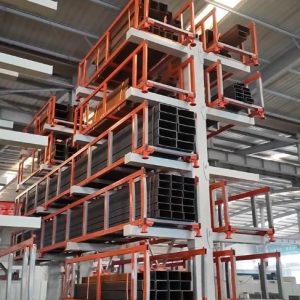
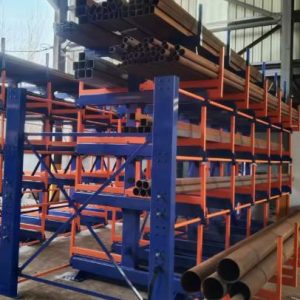
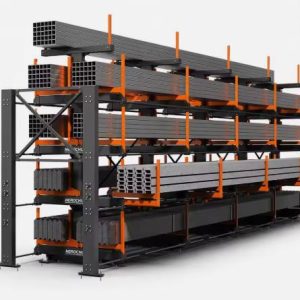
Herochu configures the number of levels and compartment dimensions around the customer’s actual profile mix. A facility storing window frame extrusions at 6 meters needs different geometry than one handling structural angles at 12 meters. The modular construction accommodates both without forcing the shorter material into a system designed for the longest piece in the building.
The Automatic Mobile Profile Vertical Storage System CE Certified is not the right answer for every warehouse. Facilities with perfectly stable product mixes and abundant floor space may find a fixed system sufficient. But for operations where flexibility, certification, and floor-space recovery matter, the mobile tower delivers vertical density without anchoring the workflow to a single point.