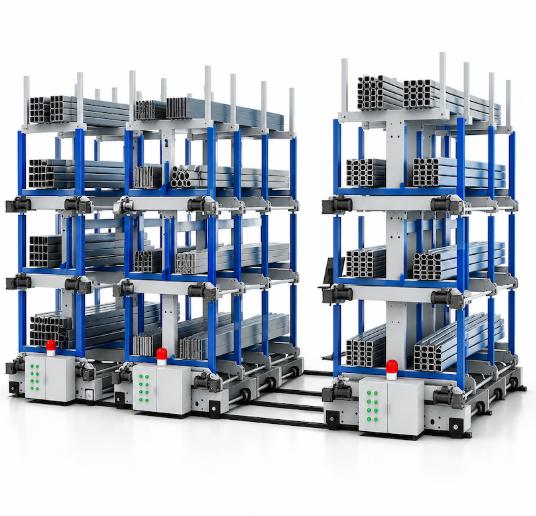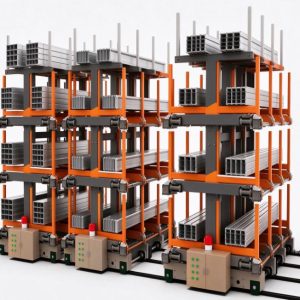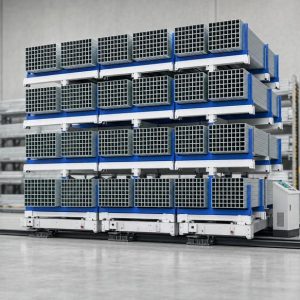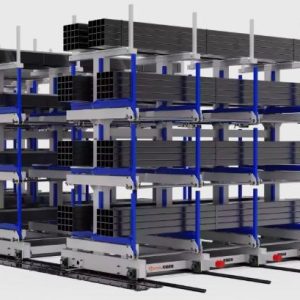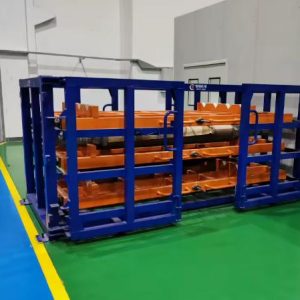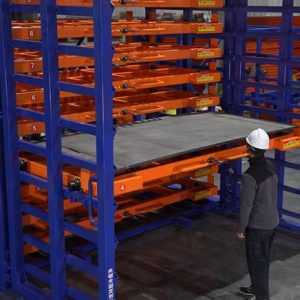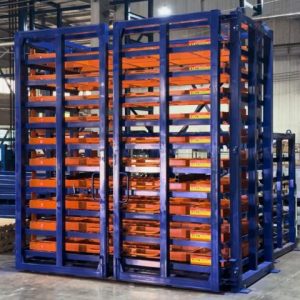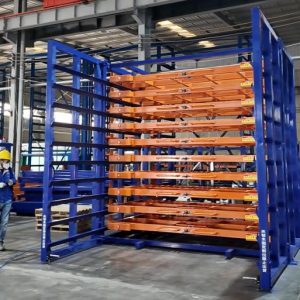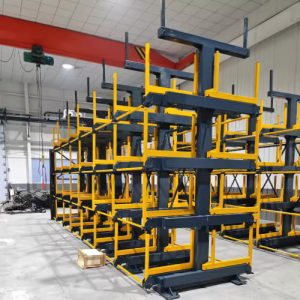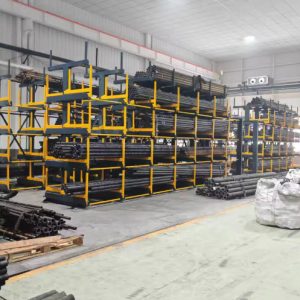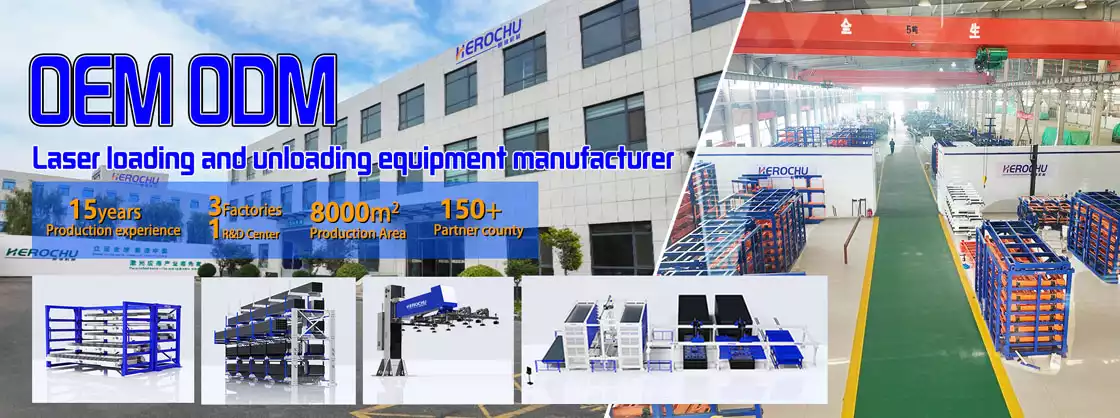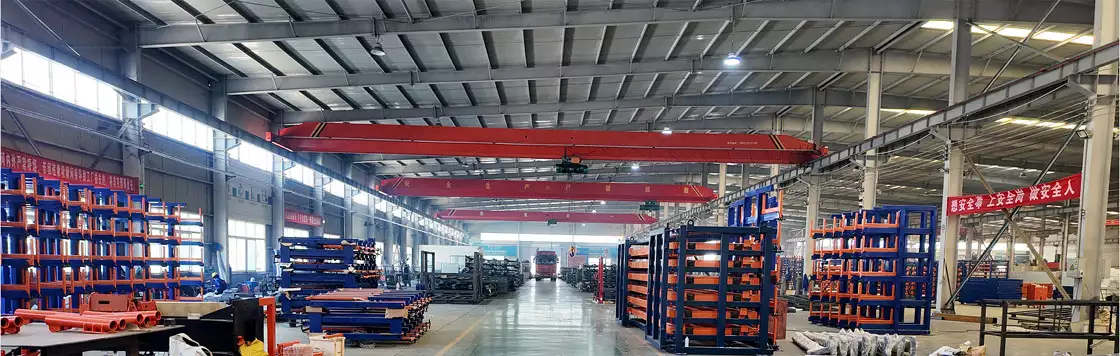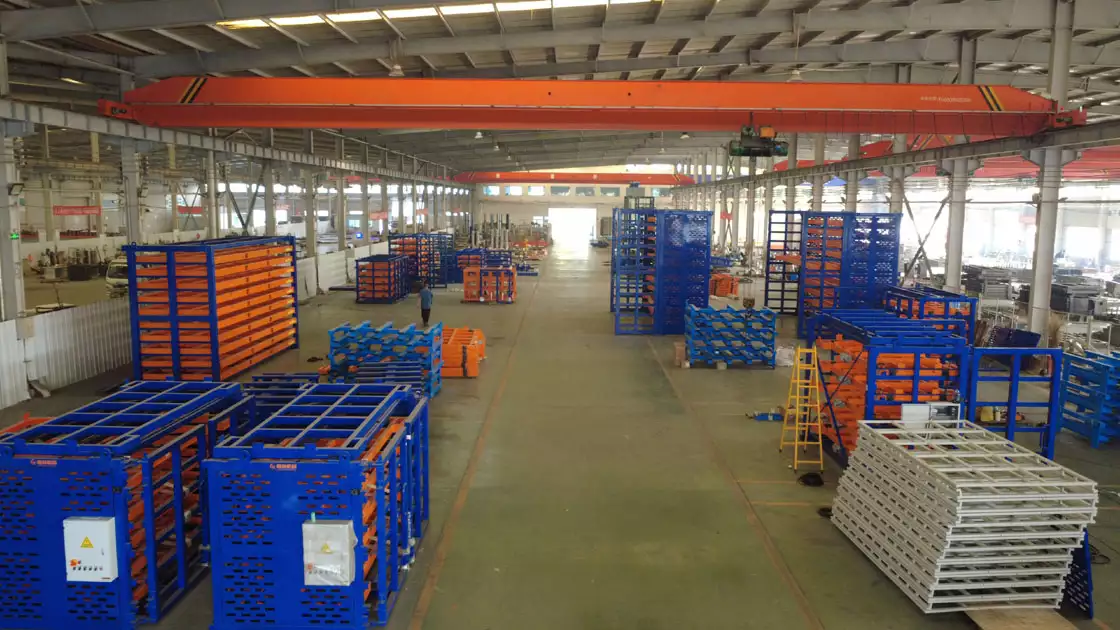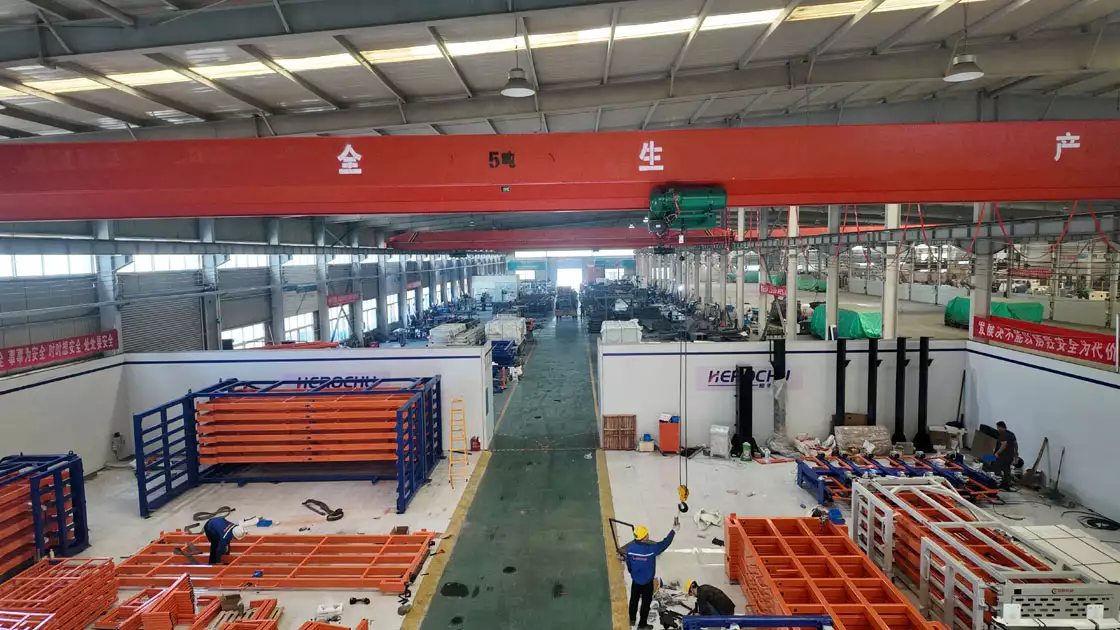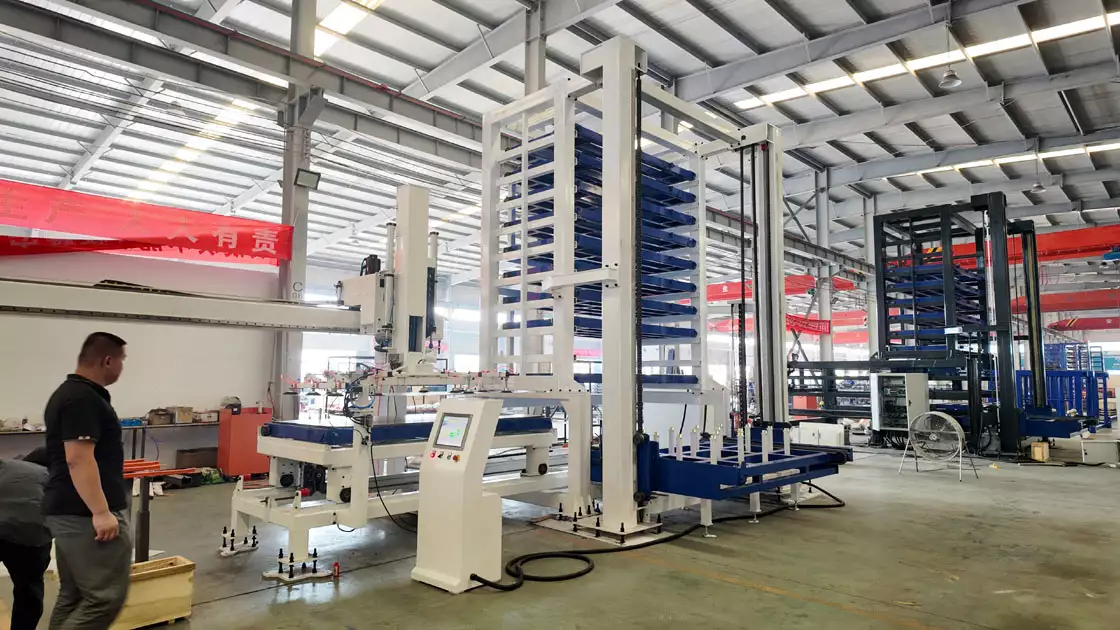
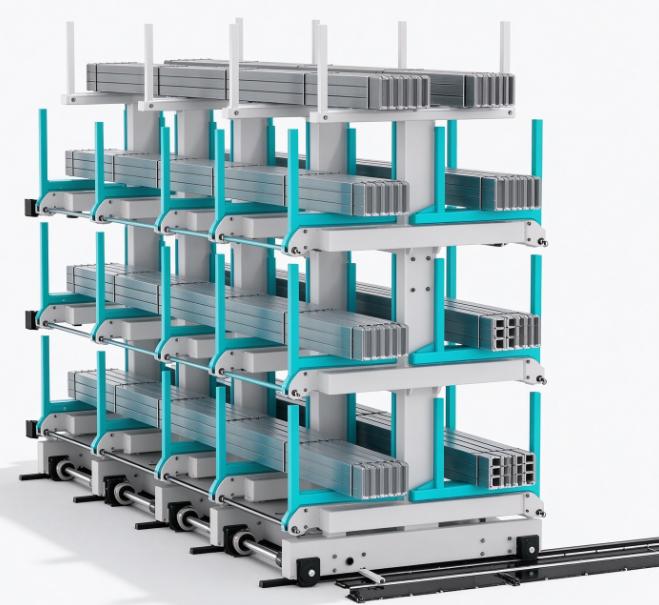
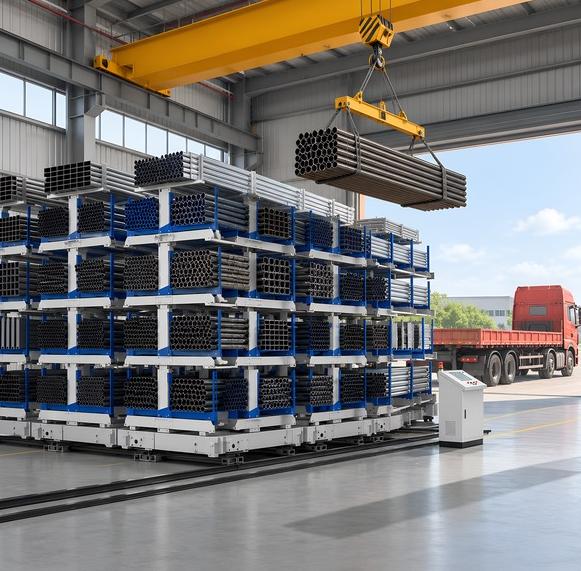
A rail-type heavy-duty cantilever racking system from Herochu mounts loaded towers on floor rails, so they close into a dense block and open only the aisle in use. One aisle serves the whole block instead of one aisle per row, and the rail carries the travel load straight into the slab.
What Makes a Cantilever System Rail-Type?
Three details separate a rail-type system from a static rack: a continuous floor rail, a wheeled carriage under every tower, and a drive that moves the tower along that rail.
The rail is a machined guide, not a pallet truck track. It sits on a grouted base or is embedded flush with the floor, and it carries both the vertical load of a loaded tower and the overturning moment a long arm produces. That is the structural job a static rack gives to its base plate.
Movement runs on a linear guide with chain transmission. The chain pulls, the guide holds the tower vertical, and a block that has opened a hundred times still lines up within millimetres — which matters when a crane is dropping a 5 t bundle into a 6 m pocket.
How Do You Size the System From a Material List?
Sizing starts with the inventory, not the catalogue. Five inputs settle nearly every configuration.
- Longest piece. Material length picks the frame: 6,000 mm, 9,000 mm or 12,000 mm.
- Heaviest bundle per level. This picks the load class, 3 t or 5 t per side.
- Positions required. Positions divided by levels per tower gives the tower count.
- Handling equipment. Crane span, forklift type and bundle width set the clear opening.
- Building limits. Free height, column grid, slab capacity and rail run define what fits.
A plant storing 12 m tube in 4 t bundles with 84 positions lands on the 12 m frame, six levels and seven towers, with the rail run set by bay length rather than preference.
Full Technical Specification
| Parameter | HC-G6053EM-5 | HC-G9055EM-7 | HC-G12065EM-7 |
|---|---|---|---|
| Material length | 6,000 mm | 9,000 mm | 12,000 mm |
| Layers | 5 (customized) | 5 (customized) | 6 (customized) |
| Load per level, per side | 3,000 kg | 5,000 kg | 5,000 kg |
| Towers | 5 (customized) | 7 (customized) | 7 (customized) |
| Traveling speed | 1–5 m/min | 1–5 m/min | 1–5 m/min |
| Vertical lifting speed | 9 m/min | 9 m/min | 9 m/min |
| Inlet and outlet speed | 12 m/min | 12 m/min | 12 m/min |
| Movement mode | Linear guide rail + chain | Same | Same |
| Transmission | Chain drive | Chain drive | Chain drive |
| Discharge | Electric assistance | Electric assistance | Electric assistance |
| Control | PLC | PLC | PLC |
| Plate support | Optional | Optional | Optional |
Arm length runs from 3,000 mm to 6,000 mm and column height reaches 12 m on the larger frames. Herochu matches frame dimensions to the building’s column spacing so the block does not waste the last two metres of a bay.
How Does the PLC Control Sequence Work?
The control layer stays simple so a warehouse technician can run it without a controls engineer on call.
The operator selects a block and aisle on the panel. The PLC checks the interlocks — aisle clear, no vehicle in the zone, no fault active — ramps the drive, travels to position and stops on the encoder mark. Soft start and soft stop come from the variable-frequency drive, which is why a loaded tower moves at 5 m/min without the bundle rocking.
Fault codes read in plain text: chain slack, overtravel, photocell blocked, drive overload. Each points at a component rather than a subsystem, which shortens downtime on a machine sitting in the middle of the material flow.
What Does the Floor Need to Provide?
The rail is only as good as the slab under it. Four conditions are checked before anchors are set: concrete thickness and strength, distance to slab joints, flatness across the rail line, and reinforcement position where anchors will be drilled.
Flatness matters more than most buyers expect. A 3 mm step under a loaded carriage shows up as a knock and speeds wheel wear. A run that crosses a construction joint will crack its grout unless the joint is bridged or the run is split.
Where the slab is marginal, a steel base beam grouted to the floor spreads load over a wider footprint and keeps anchor spacing reasonable. Herochu confirms slab capacity and anchor design per project against actual tower loads.
Where the System Fits in a Steel Service Centre
Bar and tube storage sits upstream of the saw and the welding line, and every minute spent finding a bundle is a minute the machines wait. A rail-type block lets the crane open the exact pocket for a size or heat number, lift, and close up behind.
The shared aisle also frees floor for a saw infeed that would otherwise be a permanent traffic lane. In a service centre handling mixed profiles, that flexibility is worth more than raw cube gain, because the profile mix changes faster than the building.
Frequently Asked Questions
How many aisles does the system need? One shared picking aisle for the whole block. Two appear only where a building column or fire wall splits the block.
Can the layers be changed after installation? Layer count is fixed at fabrication. Arm positions can be adjusted within the design, but adding levels changes the load case and needs engineering review.
Does the drive work in an unheated shed? Yes. Lubricant grade and control enclosure rating are specified for the site temperature range.
What drives lead time? Frame fabrication and rail length. Slab survey and anchor design come first, because a rail set in the wrong place cannot be corrected by adjusting the rack.
Summary
A rail-type heavy-duty cantilever racking system trades one aisle for a block of towers on rails, and the return shows up as recovered floor, straighter bar and faster bundle retrieval. Get the five sizing inputs right, confirm the slab, and keep the control logic simple enough for the shift team to own. Herochu supplies layout, frames, rail and drive as one package, so the interfaces stay inside one supplier.