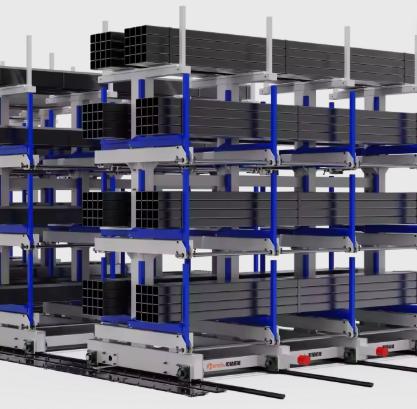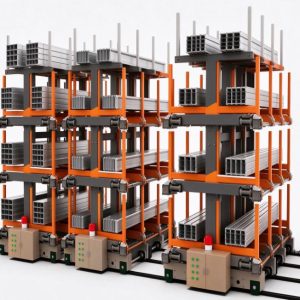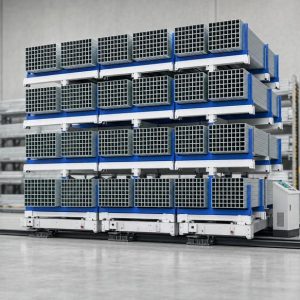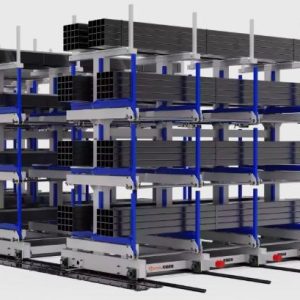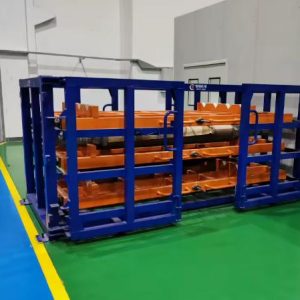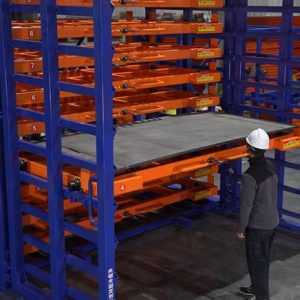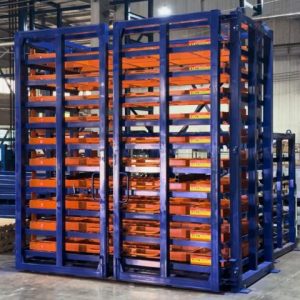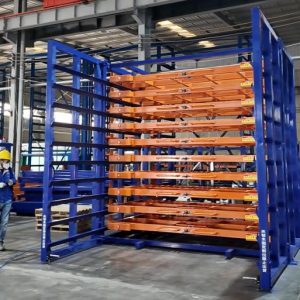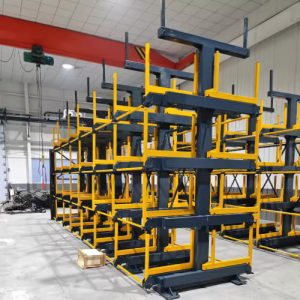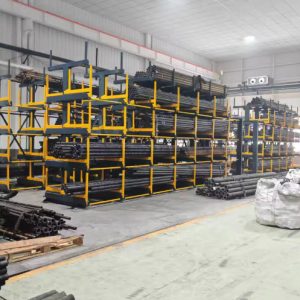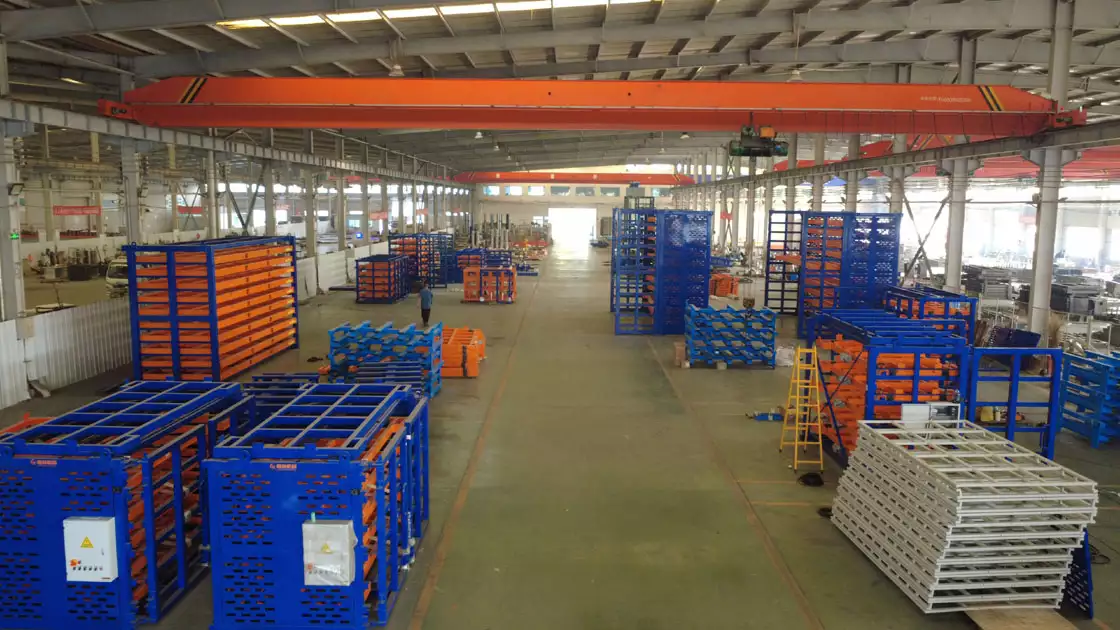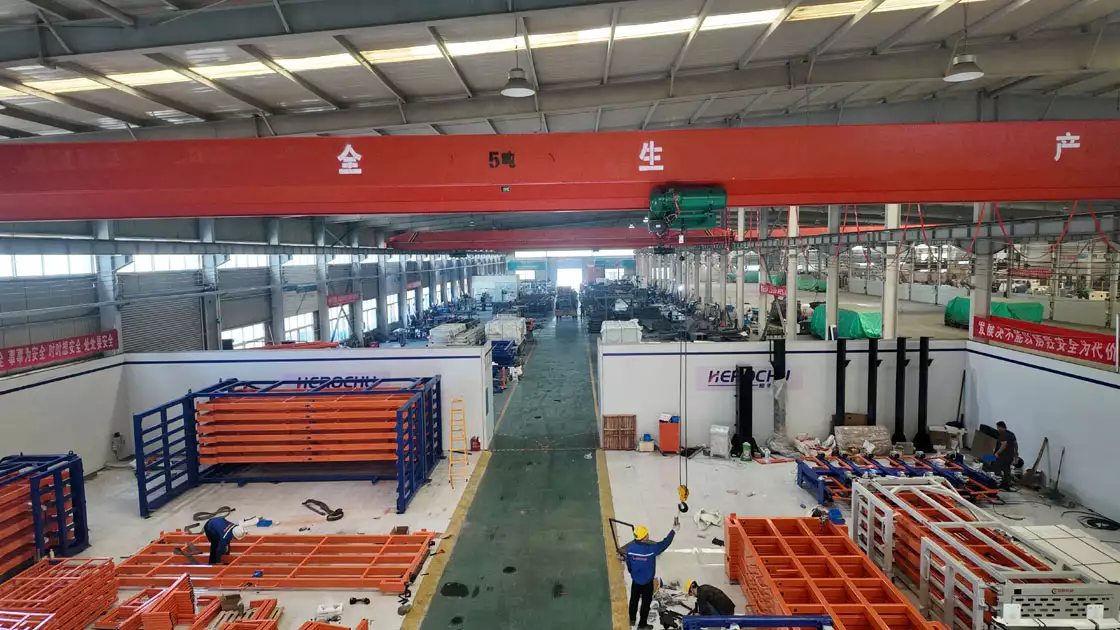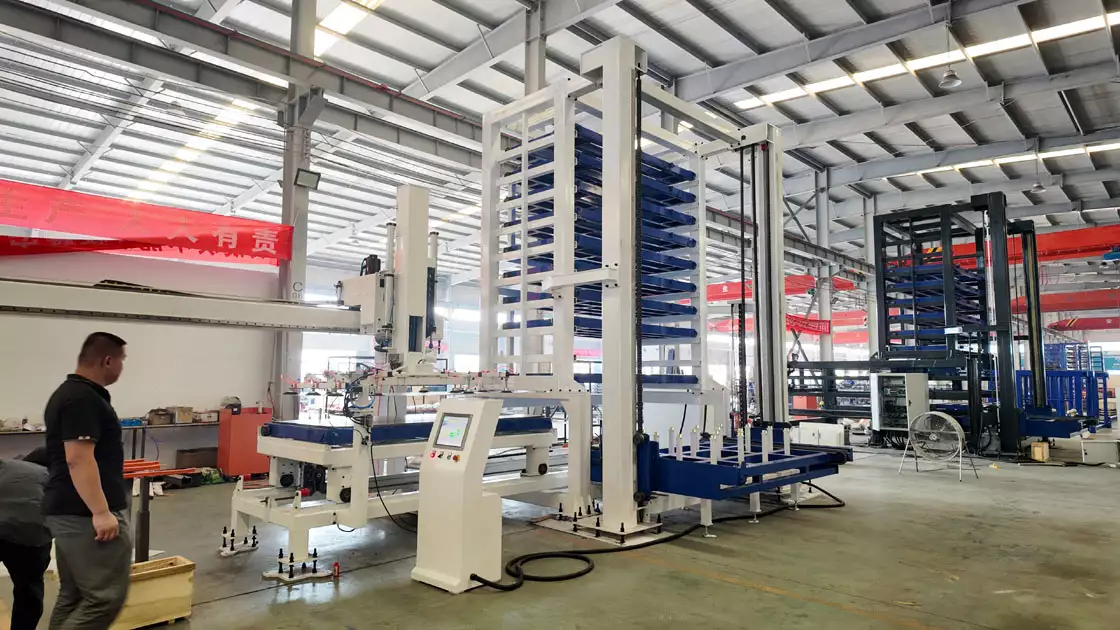
A heavy-duty vertical rail cantilever rack stores long pipe, tube and bar on levels that lift inside the tower. Towers travel into a shared aisle on rails, and the carriage brings any level down to handling height, so height stops being a reason to leave the top shelves empty.
What Does Vertical Movement Add to a Rail Cantilever Rack?
Most cantilever racks compromise between height and reach. The top level is cheap storage per square metre and expensive per pick, because reaching it means a crane, a ladder or a basket, and crews quietly stop using it.
A lifting carriage removes that trade-off. Herochu builds each level as a powered platform on the column, lifting at 9 m/min and moving in and out at 12 m/min with electric-assist discharge. A level 9 m up reaches working height in about a minute, loaded.
A column can run to 12 m with five or six levels, and every level becomes a first-row pick: travel at 1 to 5 m/min brings the right tower to the aisle, and the lift brings the right level to the hook.
How High Can You Build Before It Stops Paying?
Height pays until the structure costs more than the floor it saves. Three limits usually set the ceiling.
Column design comes first. A 12 m column carrying 5 t per level on a 3 m arm produces a large overturning moment at the base, and that moment must pass through the carriage and rail into the slab. Past 12 m, section sizes and rail loading grow faster than storage gain.
Handling comes second: if the crane hook or forklift mast stops at 7 m, the top levels have nobody to service them.
Code comes third. Seismic and wind provisions in some regions treat a 12 m storage structure differently from a 6 m one, so the design case is settled before fabrication rather than after.
A practical rule: the top level should still be used weekly. If a level is touched only at stocktake, four levels built well beat six built badly.
What Does a Pick Actually Take?
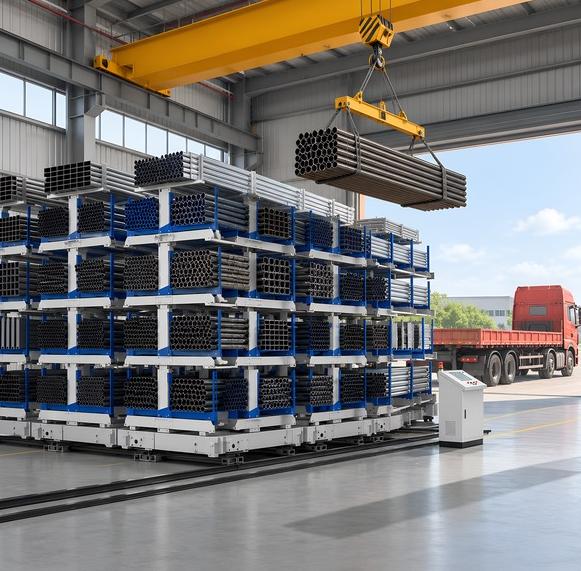
Take a 12 m bundle from level 5 of a seven-tower system. The operator selects the pocket, the block opens, the tower travels into the aisle, the carriage lowers the level to 1.2 m, the crane takes the bundle, and the block closes.
Travel takes the biggest share of the cycle, and it is short. Parting an aisle moves the group by one aisle width, about 4 m, so a minute at 4 m/min covers it even when two groups shift.
Against a static rack holding the same bundle at 9 m with no lift, the vertical system wins on picks above level three and loses slightly on level one. For a service centre taking eight to twelve bundles an hour, the crossover arrives well before the end of the first shift.
How Much Load Sits on a Level?
Ratings run at 3 t for the 6 m frame and 5 t for the 9 m and 12 m frames, quoted per side per level and confirmed against the bundle in project engineering. Arm length from 3,000 mm to 6,000 mm sets how wide a bundle can be and how far its centre of gravity sits from the column; a 6,000 mm arm at the same weight produces several times the bending moment of a 3,000 mm arm.
Arm spacing, by contrast, follows the shortest and most flexible item in stock. A 12 m pipe on two arms 11 m apart bows under its own weight; on three or four arms it stays straight. Thin-wall tube normally takes 2,500 mm to 3,000 mm spacing, heavy wall pipe 4,000 mm.
Vertical Rail Storage Versus Floor Storage
The comparison that convinces most plant managers is floor area for the same number of bundle positions. The figures are indicative planning values for 12 m material at one bundle per position.
| Layout | Positions | Floor used | Notes |
|---|---|---|---|
| Floor stacking, 3 high | 84 | About 400 m² plus aisles | Bundle damage, poor access to the bottom |
| Static cantilever, 4 levels | 84 | About 250 m² | One aisle per row |
| Vertical rail, 6 levels | 84 | About 100 m² with shared aisle | Every level is a first-row pick |
The vertical layout uses roughly a quarter of the floor of loose stacking. In a leased building, that difference often pays for the rack before the depreciation schedule does. Herochu sizes the frame so the density gain does not come at the cost of a level nobody can reach.
Safety on a Tall Vertical Rack
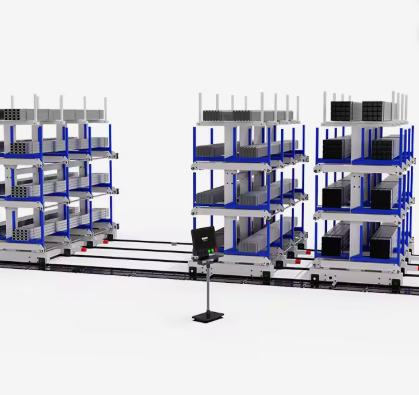
A powered level changes the risk profile, so the controls carry most of the safety duty. Aisle occupancy sensing stops travel when a person or truck is in the zone, lift commands are inhibited unless the level is locked in its carriage, and overload indication shows before the drive engages.
The rule crews break first is the aisle rule, so the PLC enforces it rather than signage. Herochu commissions each system with a load test on every level and an interlock test on every gate and photocell.
Frequently Asked Questions
Can the lifting carriage serve every level? Yes. Each level is powered and stops at its own programmed position.
How long does a full-height lift take? At 9 m/min, a 9 m lift takes about one minute; in and out movement at 12 m/min adds seconds.
Is the vertical rack suitable for a low building? It works, but the density argument weakens: in a 7 m building, a four-level frame captures most of the height without a tall column.
Can pipes of different lengths share one tower? Yes, within arm length and load limits. Short pieces overhang inward rather than into the aisle.
Summary
A vertical rail cantilever rack makes height usable. The rail solves horizontal density, the lifting carriage solves vertical access, and together they keep every level in the picking rotation. Settle three numbers first: the tallest level the crane can service, the arm spacing the thinnest tube needs, and the positions the inventory requires. Herochu builds the layout around those answers.