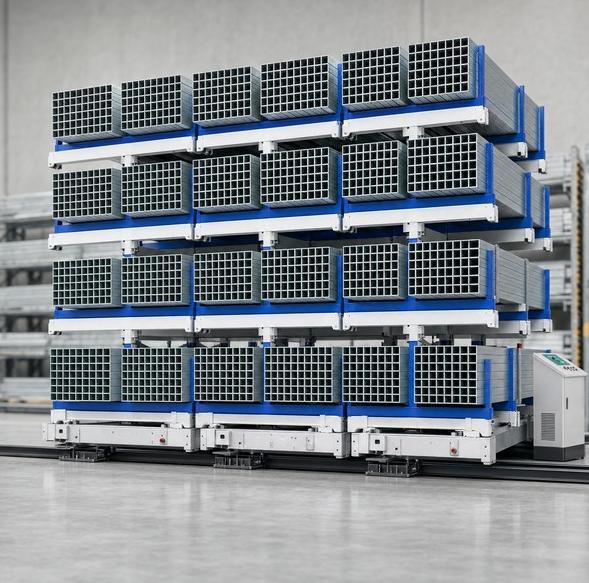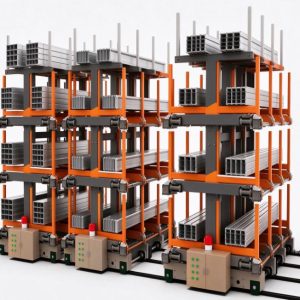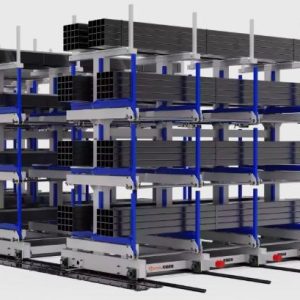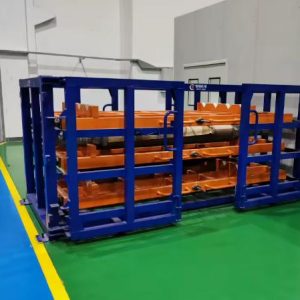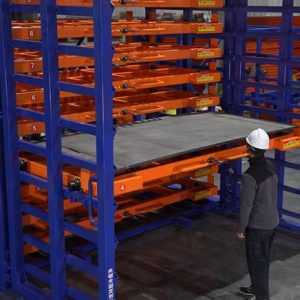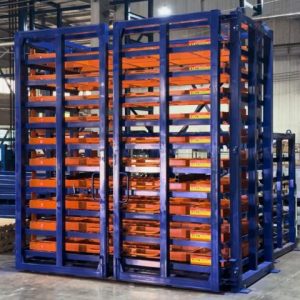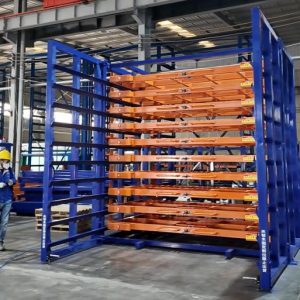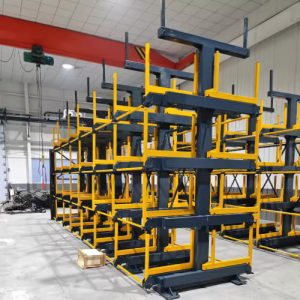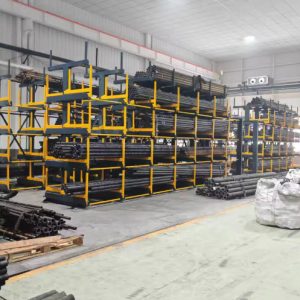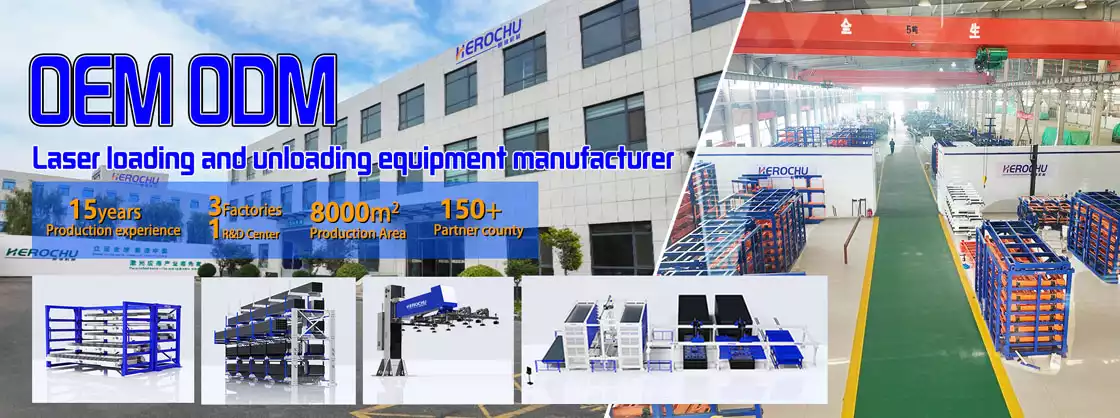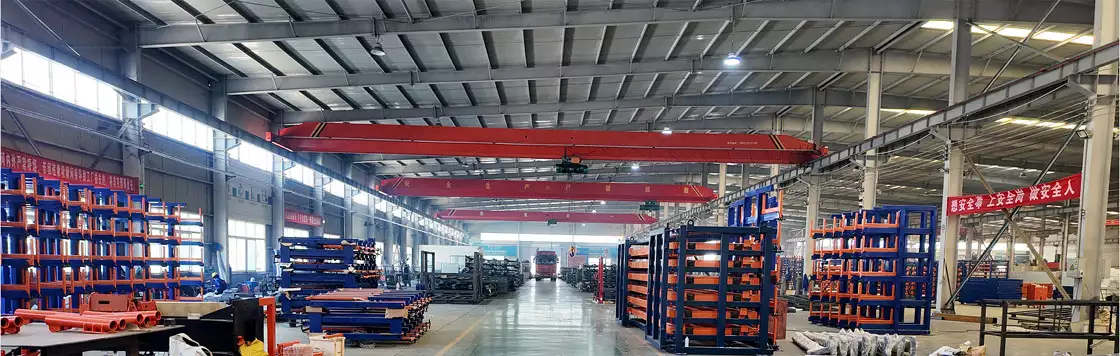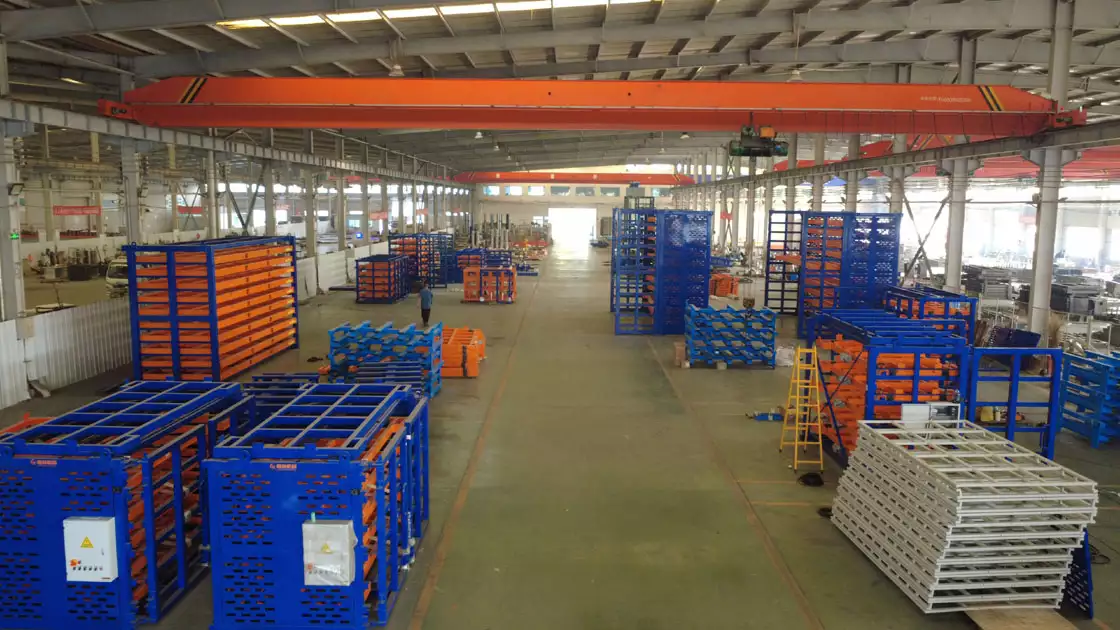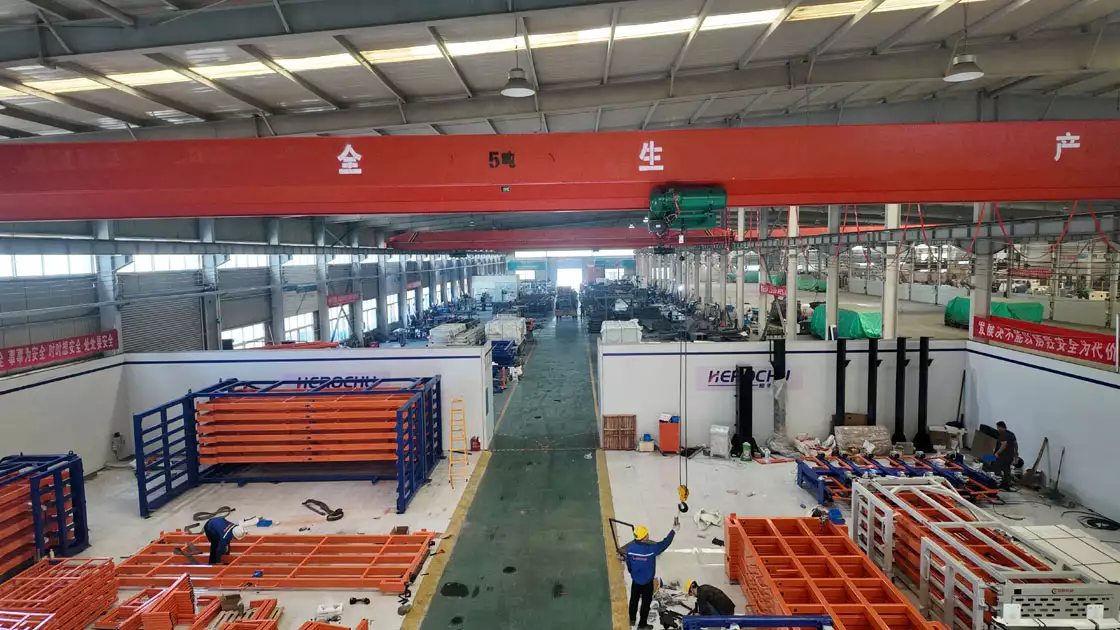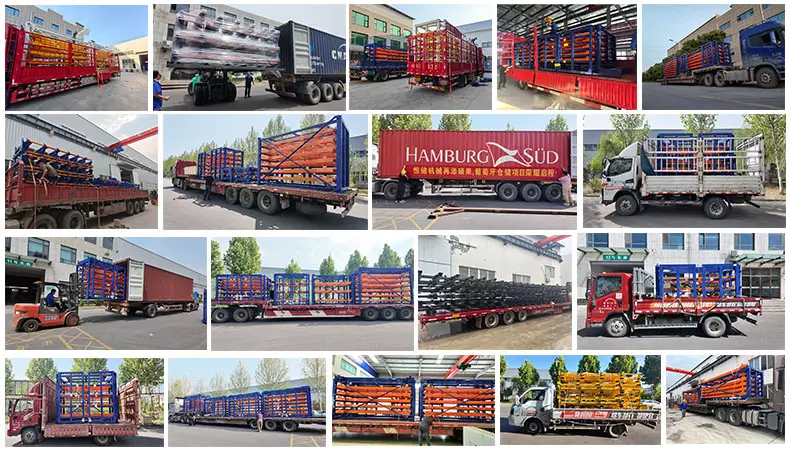
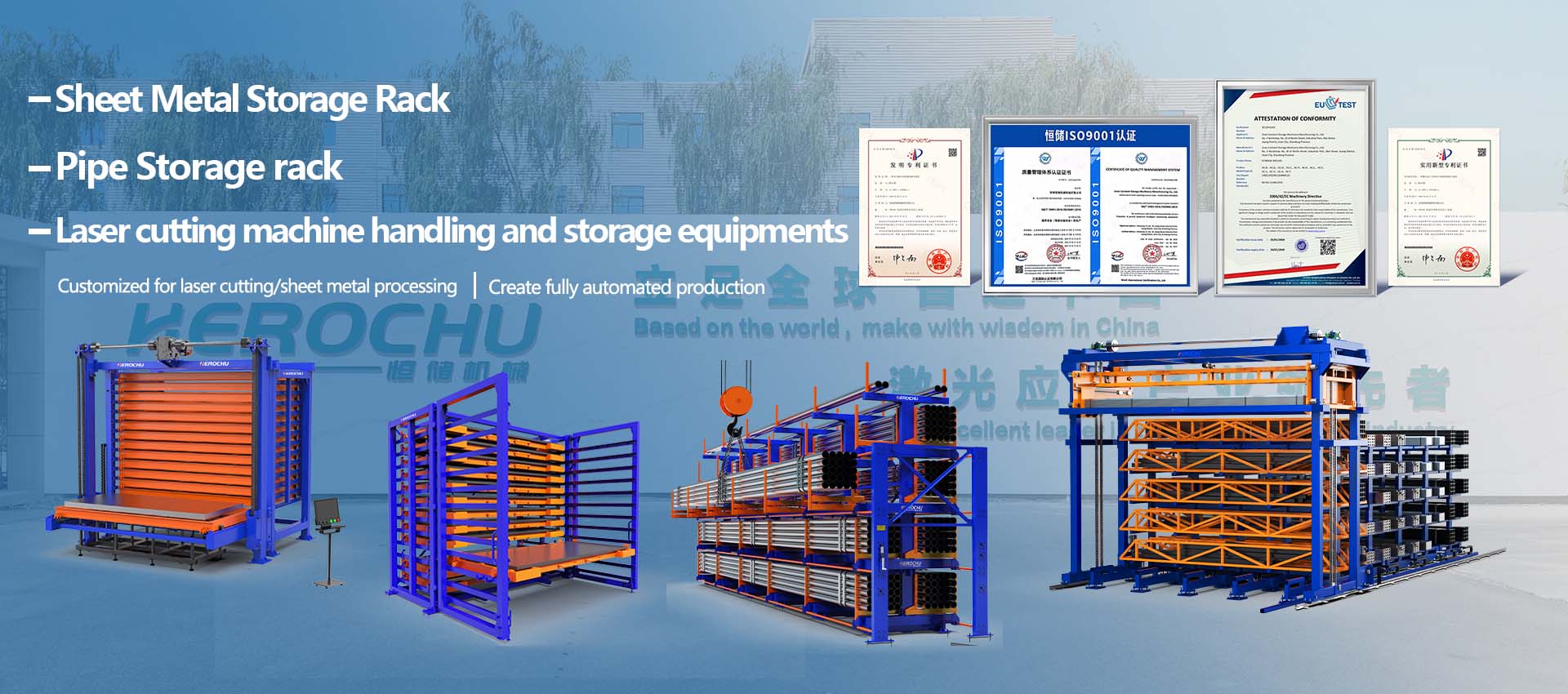
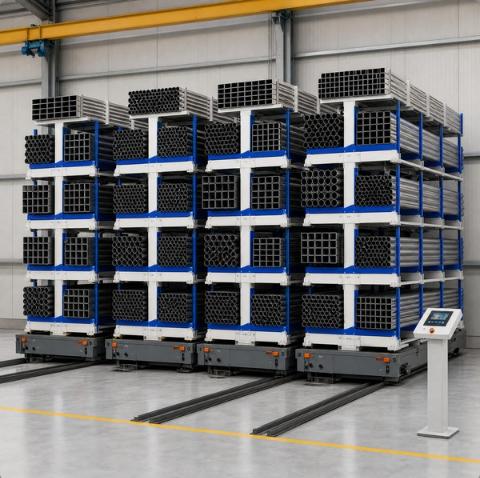
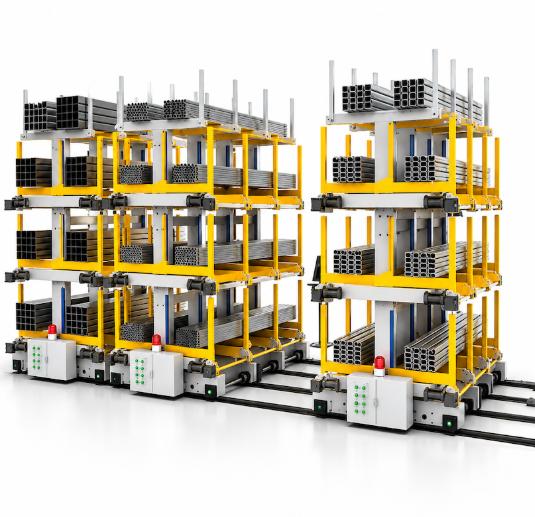
A rail-mounted cantilever racking system from Herochu carries loaded towers on floor rails, so they slide into a compact block and one aisle serves the group. The rails set the geometry, the slab sets the limits, and the commissioning checks decide whether the block still lines up three years later.
How Do You Lay Out a System in an Existing Bay?
Layout starts with what cannot move: columns, crane runway, door openings and drainage. Rail runs parallel to the long axis of the bay, because long stock wants the longest travel line and the fewest turns.
Three dimensions fix the arrangement. The clear opening is what the handling equipment needs — typically 3.5 m to 4.5 m for a counterbalance forklift carrying a 12 m bundle, less in a crane-served bay where the truck never enters.
Block travel is the parked tower bases plus the aisle they must open. Seven 12 m towers need roughly 18 m to 22 m of rail, and the run must stop clear of any column base by at least the anchor zone.
Herochu checks crane coverage before fixing the run: if the hook cannot reach the far end of a 12 m bundle at the top level, that level is decoration.
Embedded, Surface-Mounted or Trench Rail?
| Option | Installation | Floor disruption | Best for |
|---|---|---|---|
| Embedded flush | Cast or cut into slab, grouted to level | High, concrete work | New build or full refurbishment |
| Surface-mounted | Rail on grouted steel base, anchored | Low, weekend work | Operating plants that cannot stop |
| Shallow trench | Drained channel with cover plates | Medium | Wash-down areas and heavy traffic |
Surface mounting is the usual choice for an operating warehouse because it avoids cutting a live slab. It raises the rail 40 mm to 80 mm above finished floor — fine where the aisle is crane-served, awkward where forklifts cross the line, and a ramped crossing plate solves the second case.
Embedded rail gives the cleanest floor and the best wheel life, but it commits the building to the layout; moving the line later means cutting concrete again. Trench rail suits plants that wash floors, and it needs drainage plus a cover plate rated for wheel loads.
What Gets Checked at Commissioning?
Handover is a sequence, and a skipped step shows up months later as a knock, a drift or a cracked grout line.
- Rail level and straightness across the full run, checked at every anchor point rather than at the ends.
- Anchor torque on every plate, recorded, with the wrench calibrated that week.
- Chain tension and alignment on each drive, set cold and rechecked after the first loaded cycle.
- Carriage clearance through full travel with the tower loaded to rated capacity.
- PLC input and output test covering every photocell, gate switch and end stop.
- Interlock test with a person in the aisle, a truck in the zone and a simulated fault.
- Load test on each level at rated load, with deflection measured at the arm tip.
- Operator training on the pendant, the fault screen and the aisle rule.
What Does Daily Operation Look Like?
The shift starts with a walk-down: rail clear, no debris in the channel, no pallet across the line, photocells clean. On a system moving 5 t towers, five minutes of inspection protects a lot of steel.
During the shift the operator works from the pendant or the panel. Select the pocket, confirm the aisle is clear, open, load or pick, close. Traveling speed stays at the setting the supervisor chose; the 1 to 5 m/min range exists to match traffic density, not to be raced.
Two habits cause most damage. Opening a second aisle while the first is occupied bends arms and voids warranty. Loading above the rated level load — usually because two bundles look like one — overloads the carriage and the rail anchors. Control logic and a load figure painted on the column handle both.
Maintenance That Actually Prevents Downtime
| Interval | Task |
|---|---|
| Weekly | Rail sweep, photocell clean, visual check of chains and anchors |
| Monthly | Chain tension, wheel inspection, anchor torque sample |
| Quarterly | Drive alignment, brake and soft-stop test, fault log review |
| Annually | Full anchor torque check, structural inspection, control calibration |
Chain lubrication follows the environment rather than the calendar. A clean indoor bay is fine on a quarterly cycle; a shed with mill scale dust needs monthly attention, because a dry chain in a dusty bay wears faster than a wet one in a clean bay.
Log every fault as well. A repeating overtravel code is usually a slipping encoder or a stretched chain, and the second occurrence is the cheap one to repair.
What Throughput Should You Expect?
A rail-mounted block is not a high-bay ASRS and should not be sold as one. Herochu quotes realistic figures for a crane-served bay: eight to twelve bundle movements per hour with a skilled operator, including travel, lift and slinging.
That number holds because the aisle is short. Static racking forces the crane to cover the full bay width on every pick; a compressed block keeps the hook within a few metres of the load. Where throughput has to climb further, the answer is usually a second rail run rather than a faster drive, because two independent blocks beat one block working at double speed.
Frequently Asked Questions
Can rails be added to an existing cantilever rack? Only if the frames were designed for carriage mounting. A static rack base is not a carriage, and retrofitting one changes the load path.
How much floor does the rail itself take? A surface-mounted run occupies a strip about 200 mm wide per tower line, plus the base plate footprint.
Does the PLC need a network connection? No. The panel runs standalone. Remote diagnostics are optional and usually added where maintenance is contracted out.
What happens if a tower is overloaded? The drive stalls or the overload trips before structural yield, but the margin is finite. Rated load is a hard limit, not a target.
Summary
A rail-mounted cantilever racking system is a civil, mechanical and control project in one package. The layout is decided by the crane, the rail option by the floor, and the service life by commissioning. Herochu surveys the bay, sets the rail, commissions the drive and trains the shift, so the block that opens on day one still closes cleanly after ten thousand cycles.