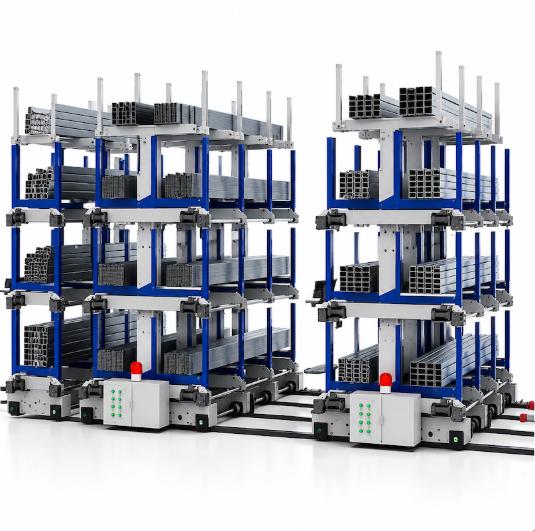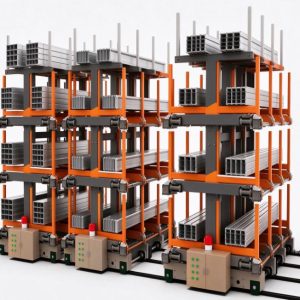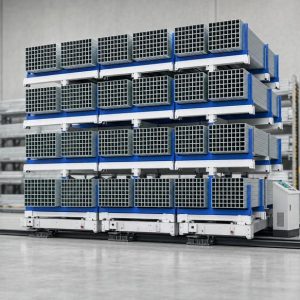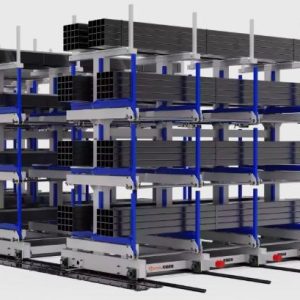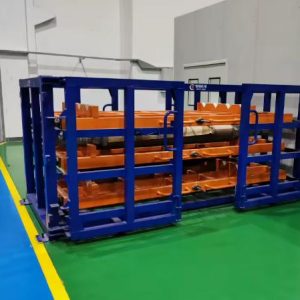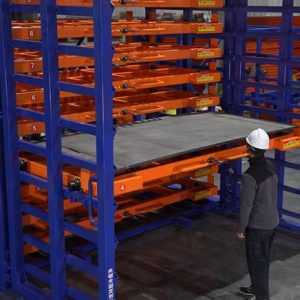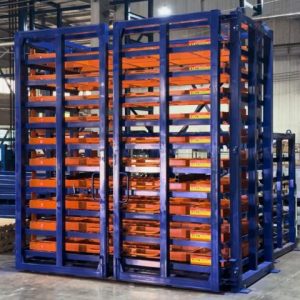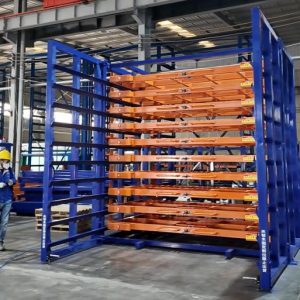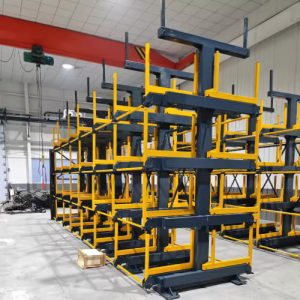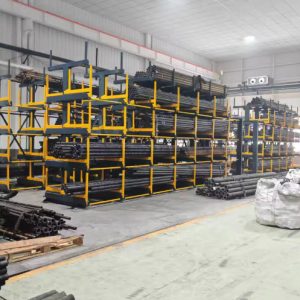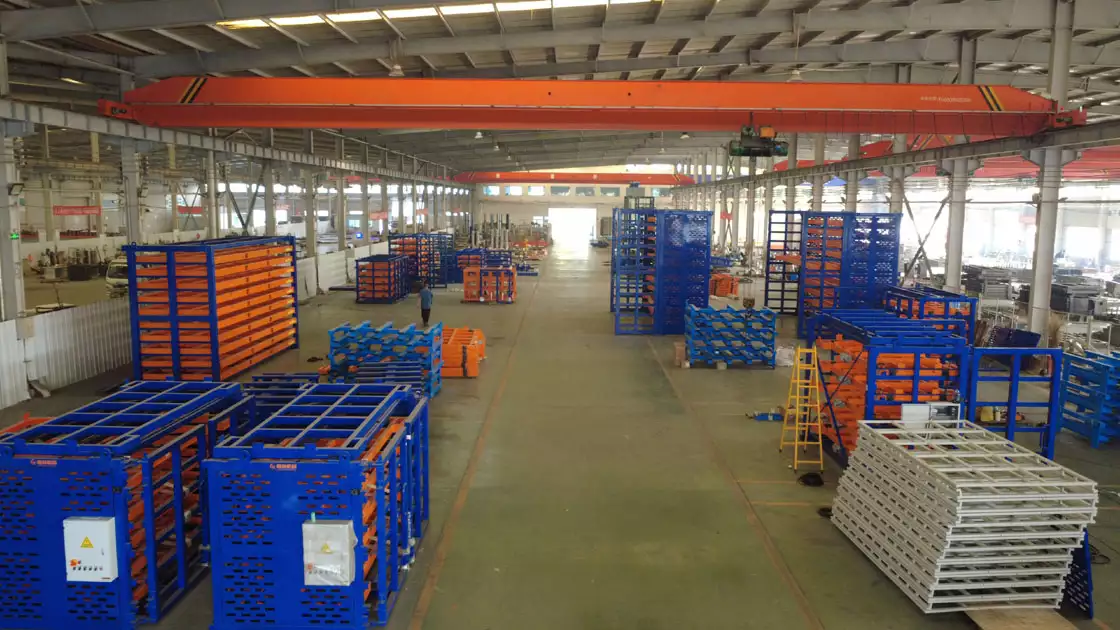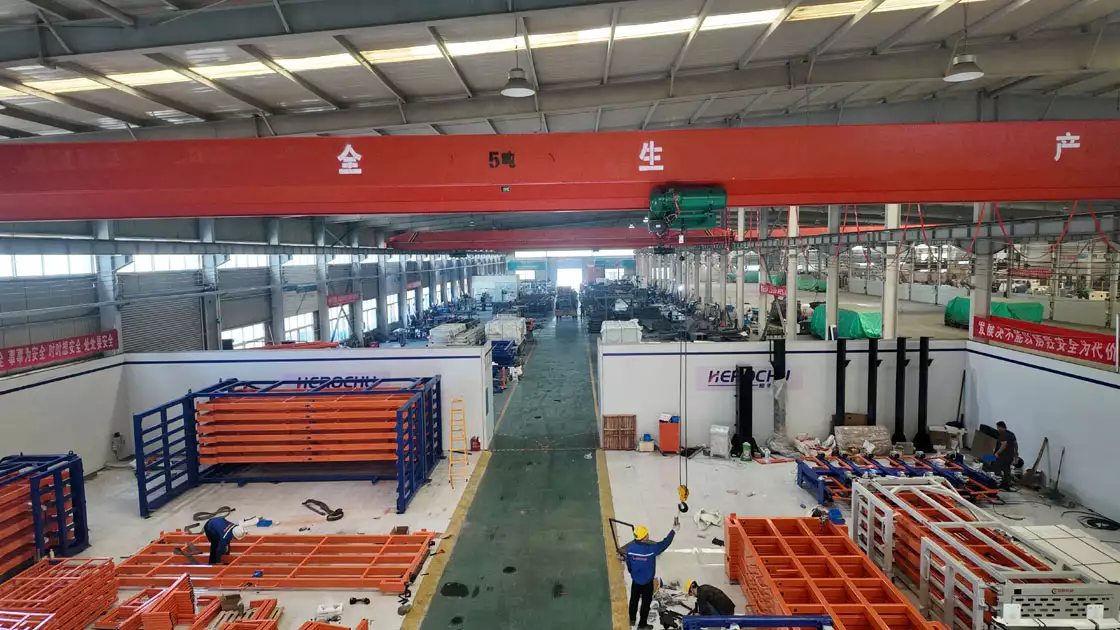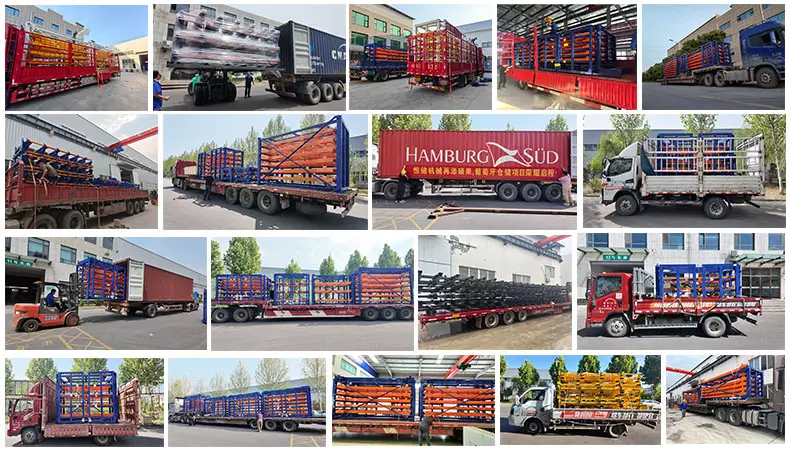
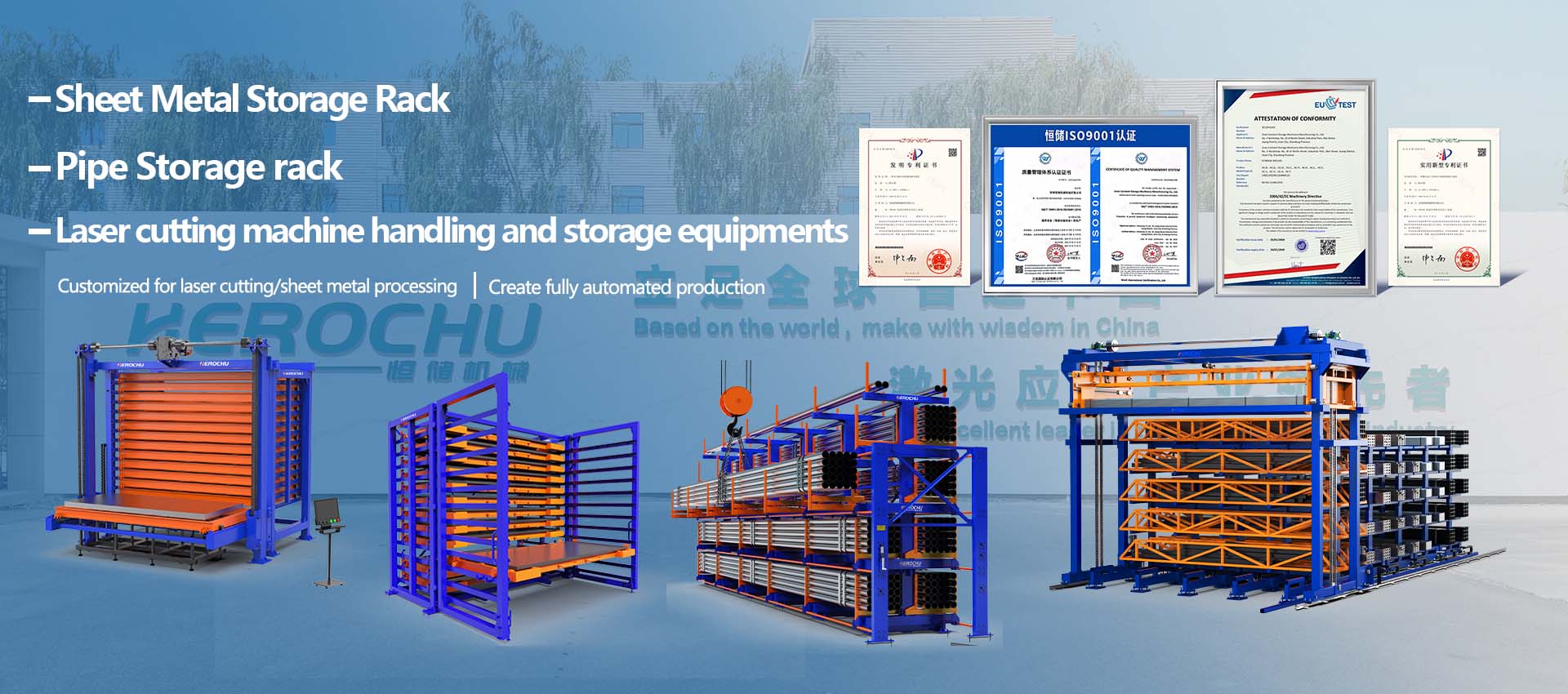
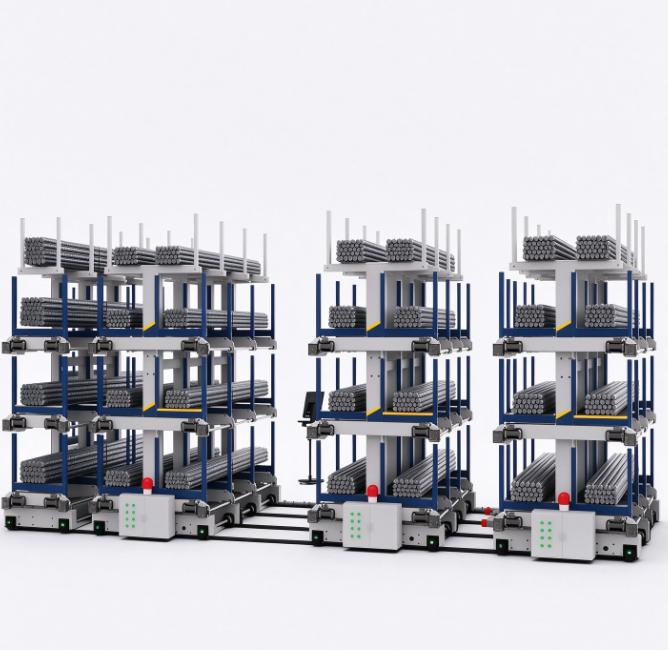
A heavy-duty mobile cantilever pipe rack stores bar, tube and profiles on cantilever arms fixed to towers running on floor rails. The towers park as one block and share a single picking aisle, so a bay that held four static racks can hold six without extra floor.
How Much Floor Space Does a Mobile Cantilever Pipe Rack Recover?
Static cantilever storage charges rent for every aisle. Each double-sided row needs its own forklift channel, and that channel sits empty most of the day.
Take a bay 24 m wide holding 6 m material. Static rows of 3.6 m aisle and 2.4 m deep double-sided blocks run on a 6 m pitch, so four blocks fit across the width. On rails, six blocks take 18 m and leave 6 m for staging.
Six blocks instead of four means 50 percent more storage positions, won from compression rather than height — a useful argument where crane rails, sprinklers and lighting already own the ceiling. The gain scales with the row count: ten static rows need ten aisles, ten mobile rows need one.
What Does the Motorized Drive Change in Daily Operation?
Without a drive, a rail system is a slide. Herochu fits each tower group with a motorized carriage on a chain drive, with traveling speed adjustable from 1 to 5 m/min through variable-frequency control. Acceleration and braking are ramped, so a loaded tower does not lurch.
One operator opens one aisle. A pendant or the PLC screen selects the group, the towers part, and the crane or forklift works. Interlocks stop travel while a person or truck is in the aisle, and a second aisle cannot open while the first is in use. At 5 t per level, that rule is not a convenience.

Which Herochu Model Matches Your Bar Length?
| Model | Material length | Layers | Load per level | Towers |
|---|---|---|---|---|
| HC-G6053EM-5 | 6,000 mm | 5 | 3,000 kg | 5 |
| HC-G9055EM-7 | 9,000 mm | 5 | 5,000 kg | 7 |
| HC-G12065EM-7 | 12,000 mm | 6 | 5,000 kg | 7 |
Tower count and layer number are customized to the inventory. Columns reach 12 m and arms run from 3,000 mm to 6,000 mm. A 6 m bar fits a 12 m frame if future stock needs the length; the reverse is not true, which is why going one size up at planning stage costs less than rebuilding later.
How Is Load Carried From Arm to Slab?
Levels are rated 3 t on the 6 m model and 5 t on the 9 m and 12 m models, per side per level, confirmed against the actual bundle during project engineering. The load runs arm to column, column to base frame, base frame to rail, rail to slab.
That path makes floor condition the real project variable. Five tonnes across six levels and seven towers is a heavy point load, and Herochu checks slab thickness, joint layout and reinforcement before fixing anchor spacing. A thin slab gets a grouted steel base beam rather than a longer anchor. A rail crossing a construction joint cracks its grout within a season unless the joint is bridged.
Where Mobile Racking Beats a Tall ASRS
Automated storage earns its cost in narrow aisles and high throughput. Rail-mounted cantilever earns it in buildings that are long, wide and low.
Under a truss at 6 m to 8 m, a 12 m mast is not an option, yet 300 m² of aisle is still wasted floor. Compressing racks sideways uses space that already exists, needs no civil work beyond the rail foundation, and keeps the bay visible from the door. There is no stacker crane to service and no software layer between operator and load. For a fabricator holding 200 to 2,000 tonnes of bar and tube, that combination of density and simplicity usually decides the layout.
What Material Can the Arms Hold?
Bars, tubes, pipes, angles, channels, flat bar and wire coil sit naturally on cantilever arms. Long sections rest across several arms at one level, which keeps them straight and avoids the bend that comes from floor stacking.
Optional plate supports turn a level into a tray for plate bundles and mesh. Irregular stock — bent sections, offcuts, mixed bundles — is where cantilever storage is often the only practical answer. Arm spacing follows the shortest piece in the inventory, not the longest.
Frequently Asked Questions
How fast do the towers move? Traveling speed is 1 to 5 m/min, set at the PLC. Parting an aisle moves the group by the aisle width only, so a full opening takes about 45 seconds at top speed.
Can the system work with an overhead crane instead of a forklift? Yes. Many installations load from above and use the aisle only for the hook path and slinging.
Is a pit required for the rails? Not always. Rails can be embedded flush, surface-mounted on a grouted base or set into a shallow trench, depending on floor condition and traffic.
How many towers can one drive handle? Tower count follows the material mix. Herochu configures groups of five to seven as standard and extends the run for longer bays.
Choosing the Configuration
Three numbers decide the layout: the longest bar, the heaviest bundle per level and the free width of the bay. Those fix model, arm length and tower count; rail length, drive size and control layout follow. Herochu builds each layout from a plant drawing and a material list, then checks loads against the slab before fabrication starts.