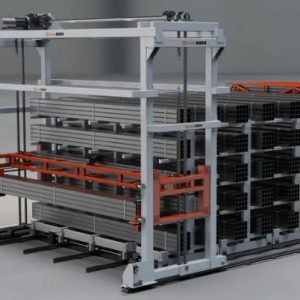
Electric Plate Magazine System with Drawer Design for Heavy Load Plate Handling
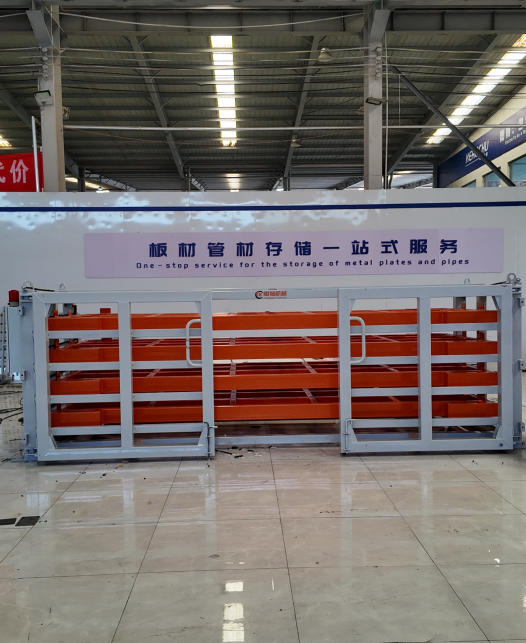
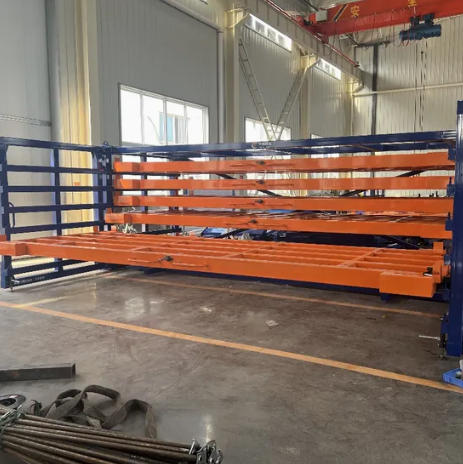
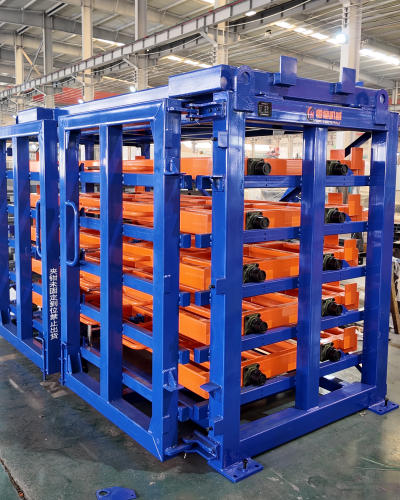
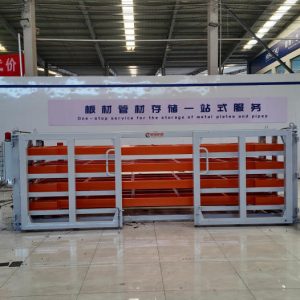
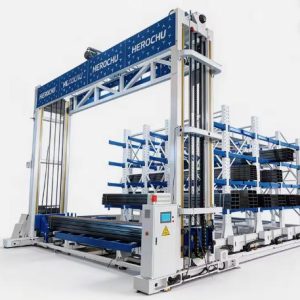
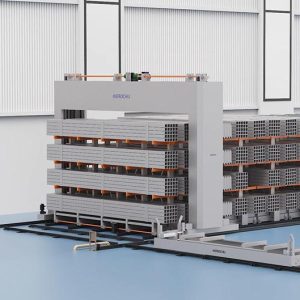
An electric plate magazine system stores plate on powered drawers that leave the rack on their own drive, so a crane only lifts the sheet instead of dragging it out of a stack. Herochu builds these drawers for 3,000 kg to 20,000 kg per tier, with remote control, dual-beam crossbar support and electric-assist discharge.
What a drawer design changes in plate handling
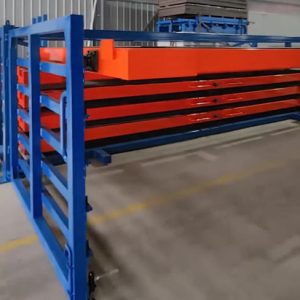
Cantilever arms hold plate vertically, and the crane threads a sling down a narrow gap before the sheet swings free. A floor stack buries the sheet under everything landed after it, so the hook pulls upward through the pile. With a drawer, the pallet travels out of the frame and the pick point moves into open air outside the rack.
That detail drives the rest. Vertical hook clearance is no longer limited by the tier above, slings do not foul the level below, and the operator can see the sheet edge before the lift starts.
The load path from sheet to slab
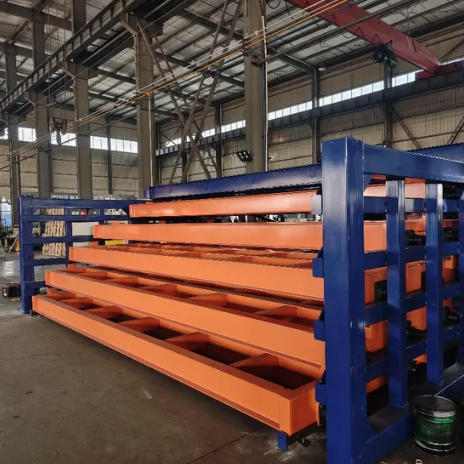
A 20 tonne tier is not a frame with a motor bolted on. The load has one route down: sheet to pallet, pallet to dual-beam crossbar, crossbar to side frame, side frame to base, base to anchor and slab.
The paired beams do the quiet work. Two members share the bending, so a stack deflects less at mid-span and a narrow bundle of thick plate cannot concentrate its weight on one line. On a 12,000 x 2,500 mm platform carrying 20,000 kg, that difference shows up as millimetres of sag under load, which becomes millimetres of misalignment at the drawer guides over years of use. The frame is welded Q235B throughout.
How a heavy pick runs, step by step
The operator identifies the tier from the stock list and selects it on the remote.
The drawer extends at up to 5.27 m/min until the pallet clears the frame.
The crane places a magnet, clamp or sling on the exposed sheet.
The sheet lifts vertically, with no lateral drag on the stack below.
The drawer retracts while the crane travels to the cutting table.
One habit separates a fast cell from a slow one: extending the drawer as soon as the crane starts moving toward the rack. By the time the hook arrives, the pallet is waiting, and the drive has done the horizontal move in parallel.
Where a heavy rating comes from
The largest platform takes 12,000 x 2,500 mm plate at 20,000 kg per tier across five tiers. That is 100 tonnes in one bay footprint, the density a pressure vessel shop or shipyard needs when plate arrives in 12 m lengths and cannot be cut down before storage.
Most plants need less, and matching the rating to the load schedule keeps frame, drive and foundation proportionate.
What to check before specifying a heavy-duty drawer
Slab capacity and flatness. Point loads at each foot, and a flat path along the drawer travel.
Drawer extension against aisle width. Full travel plus working space for the operator.
Crane capacity and hook height. Rated for the sheet plus the attachment, at the height the drawer presents it.
Tier clear space. 120 mm is standard, and the attachment decides whether that is enough.
Control position and sight line. The remote should let the operator watch the drawer without standing in its path.
Drawer system against the alternatives
| Criterion | Floor stacking | Cantilever rack | Herochu electric drawer | | Floor area per tonne | High, plus access gaps | Moderate | Low, tiers stack vertically | | Access to buried sheet | Restack required | Crane threads between arms | Drawer presents the pallet | | Surface protection | Steel dragged over steel | Edge contact on arms | Sheet stays on its pallet | | Crane time per pick | Long, repeated lifts | Moderate | Lift only, drawer moves in parallel | | Operator count | Two for heavy lifts | Two on long plate | One plus crane |
Technical parameters
| Model | Sheet size | Tiers | Load per tier | Travel speed | | HC-B3015E-63 | 3,000 x 1,500 mm | 6 | 3,000 kg | 2.97 m/min | | HC-B4015E-63 | 4,000 x 1,500 mm | 6 | 3,000 kg | 2.28 m/min | | HC-B4020E-63 | 4,000 x 2,000 mm | 6 | 3,000 kg | 5.27 m/min | | HC-B6015E-65 | 6,000 x 1,500 mm | 5 | 5,000 kg | Model dependent | | HC-B12025E-520 | 12,000 x 2,500 mm | 5 | 20,000 kg | Model dependent |
Safety on a 20 tonne drawer
Never stand in the drawer path while it moves. Confirm the sheet sits inside the pallet edge before extension. Keep the aisle clear to full travel, since a blocking pallet at 20 tonnes does not stop politely. Retract the drawer before leaving the cell, and inspect guides, rollers and drive mounting on the same schedule as the crane.
FAQ
What is the difference between an electric and a manual roll out plate drawer? The electric drawer carries more weight and extends under power, with travel on a remote. Herochu rates these tiers from 3,000 kg to 20,000 kg. A manual crank rack typically stops around 5,000 kg per level and needs an operator at the handle for every extension.
How long does one pick take? Drawer travel is up to 5.27 m/min, so a six metre drawer reaches full extension in a little over a minute while the crane is still approaching. The lift itself is unchanged.
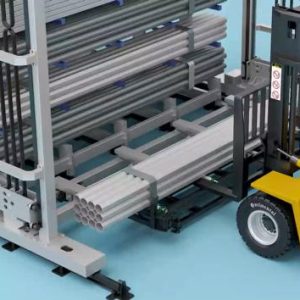
Can the system work with a forklift instead of a crane? Yes, for sheets within the truck’s capacity and fork length. The drawer removes the horizontal pull, so the forklift only lifts and reverses.
The drawer is the interface
A drawer that brings the pallet into open air, on a frame sized for the tonnage, removes the two costs that hurt most in plate handling: crane time spent positioning and sheet damage from dragging. Herochu builds that interface around a load schedule, which makes a 20 tonne rating a specification rather than a marketing figure.
FAQ
Here are some frequently asked questions about our sheet metal racks and pipe storage solutions. We hope you find them helpful!
Q1: Can I request a custom size or color? Absolutely. We offer complimentary design services and deliver efficient, tailored solutions to meet your specific requirements.
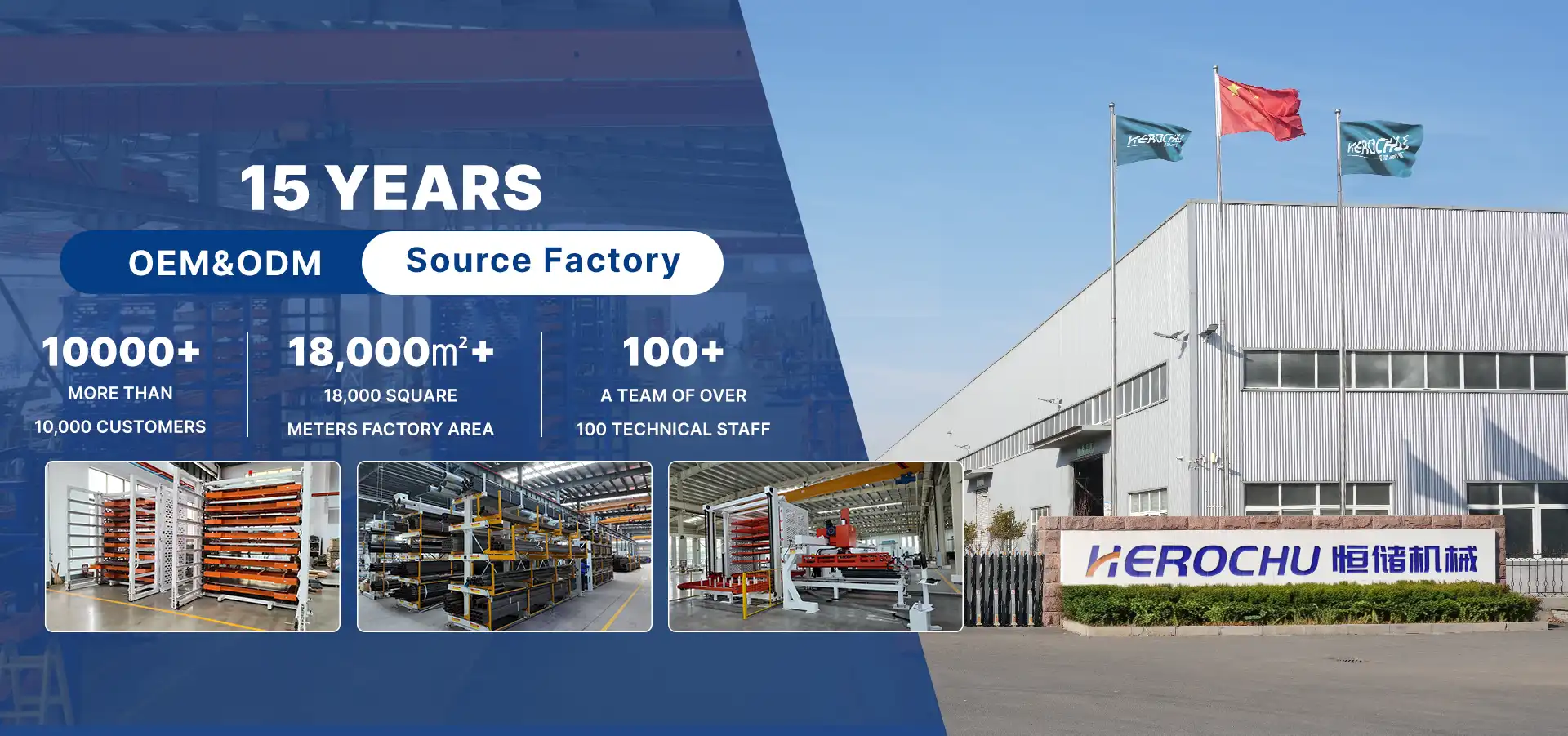
Q2: Are you a manufacturer or a distributor? We are a direct manufacturer with over 15 years of industry experience and expertise.
Q3: Is there a minimum order quantity? No. We welcome orders of any size, starting from a single unit.
Q4: How can I get detailed product information? Click the “Get a Quote” button to receive product images, detailed specifications, and videos. Our team is always ready to assist.
Q5: How do I provide my storage rack requirements? Simply share the type, dimensions, and quantity of materials you plan to store, along with any other specific needs. We will develop a professional storage solution for you. Alternatively, leave your contact details for a personalized consultation.
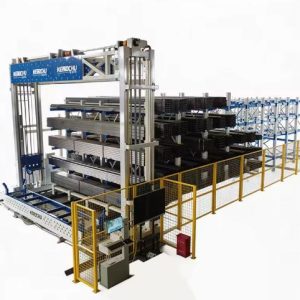
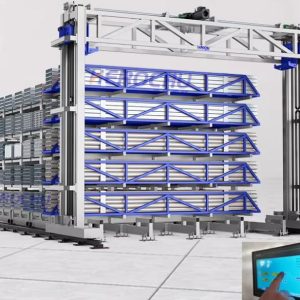
Q6: Do you offer automated loading systems or robotic arms? Yes. We provide loading robotic arms and integrated loading/unloading systems tailored to your laser cutting machine’s table size and material handling method (e.g., board rack, exchange platform, or material warehouse). Contact us with your details for a customized proposal.
Q7: Do you provide on-site installation and debugging? Yes. Our technicians can travel to your facility for installation and debugging, ensuring successful operation. We have served clients globally, including in the USA, South Korea, Russia, Qatar, Mexico, South Africa, Egypt, and Lebanon.
Q8: How do you ensure product quality? Our quality assurance includes:
A team of over 40 technical engineers for professional debugging and support.
A dedicated quality control department compliant with ISO9001 standards.
CE certification for all exports.
Rigorous load testing before shipment to ensure structural safety and reliability.
Q9: Where is your factory located? Our modern 10,000-square-meter manufacturing facility is located in Jiyang Industrial Park, Jinan, Shandong, China.
Q10: How can I evaluate your company’s capabilities? We offer virtual video factory tours and warmly welcome on-site visits.
Q11: What does your company specialize in? Jinan Constant Storage Machinery Manufacturing Co., Ltd. is a high-tech enterprise specializing in the R&D, production, sales, installation, and service of intelligent storage solutions. Our product range includes sheet material warehouses, drawer-style shelves, cantilever racks, servo manipulators, gantry loaders, and fully automated handling systems. Supported by a skilled technical team and advanced equipment, we are committed to delivering high-performance storage products and solutions to customers worldwide.
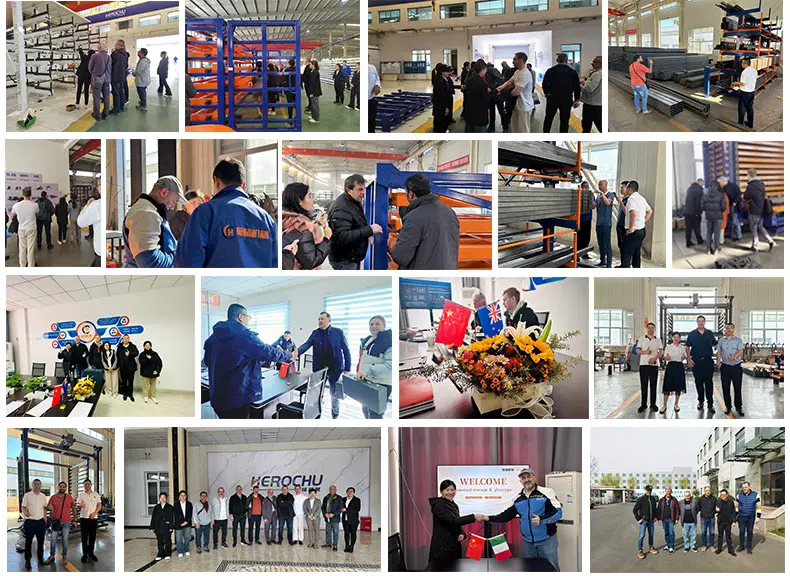
Customer visit
Herochu has always been adhering to the market-centric approach to meet customer requirements to the maximum extent, and the business philosophy of “creating brands with heart and gaining reputation with sincerity”. It provides customers with high-quality products and services with rigorous military quality, professionalism, and excellence, and has won unanimous praise in the Chinese aerospace, Chinese weapons, Chinese railways, automobile manufacturing, engineering machinery, non-ferrous metal titanium alloy and other industries.