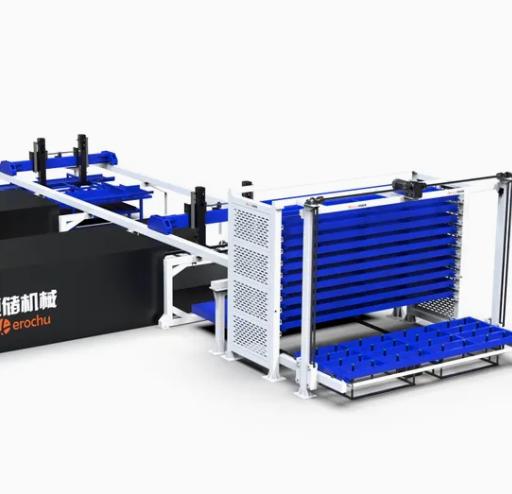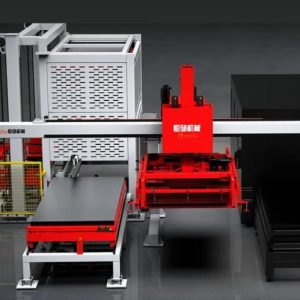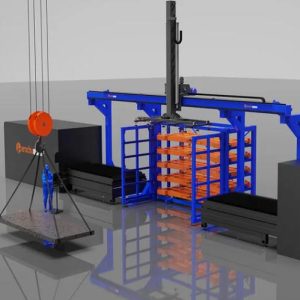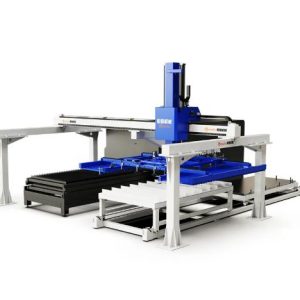
The structural architecture of a gantry loading manipulator determines its performance ceiling more than any other design decision. Motor sizing, vacuum capacity, and control sophistication matter—but if the truss flexes under load, every downstream specification degrades. Positioning accuracy suffers. Cycle times lengthen because the system must compensate for deflection. Maintenance intervals shorten as bearings and guides wear unevenly.
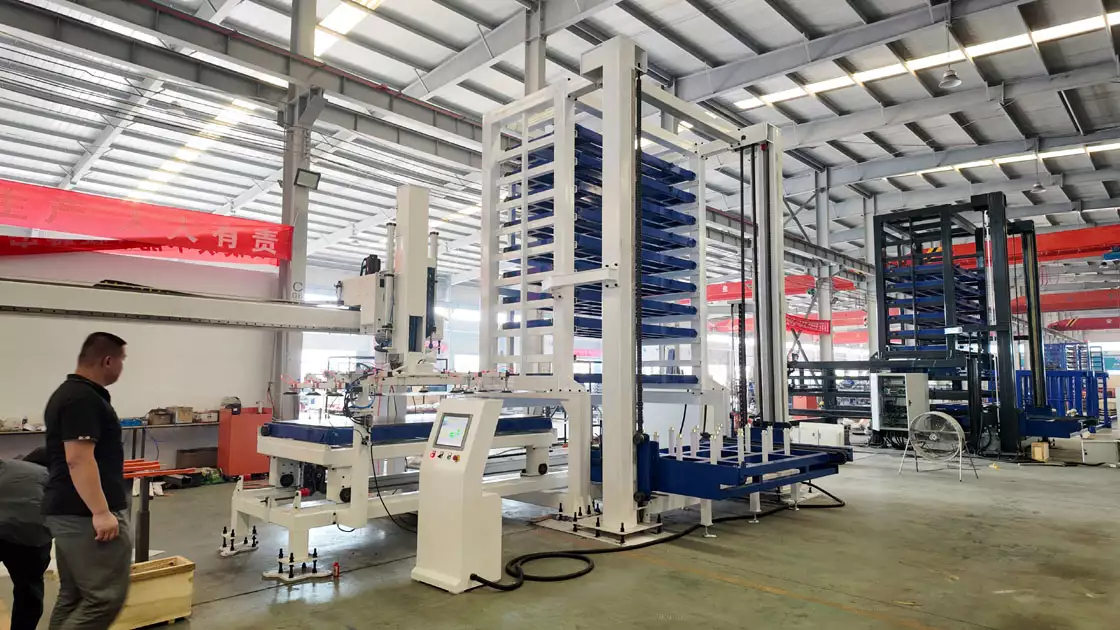
Herochu builds its loading manipulators on a double-sided gantry truss. The bilateral configuration is not cosmetic. It is a structural response to the physics of moving heavy sheet metal at production speeds.
The Problem with Single-Beam Designs
A single-beam gantry carries the manipulator head and payload on one structural member. Under load, that beam experiences torsional and bending forces. The deflection may be measured in millimeters—but in laser cutting, millimeters matter. A sheet placed 3 mm off-target produces scrap or requires edge-finding routines that add cycle time.
Single-beam designs compensate through over-engineering: thicker beams, heavier materials, more robust drive systems. That solves the deflection problem but creates a new one. The gantry becomes heavy, requiring larger motors and stronger rails. Acceleration and deceleration slow down. The system becomes a trade-off between rigidity and speed.
How the Double-Sided Truss Solves It
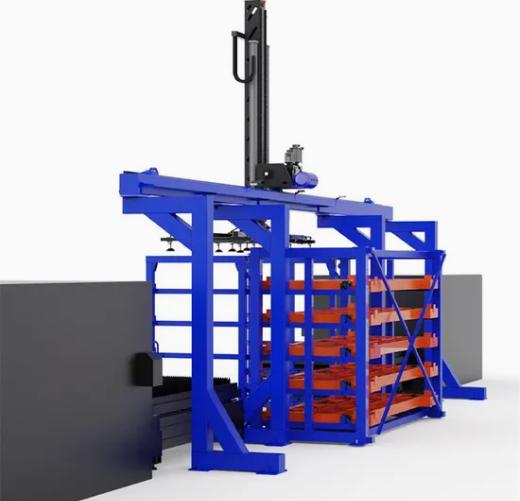
A double-sided gantry truss distributes the load across two parallel structural members. The manipulator head travels between them, supported at both ends. Torsional forces that would twist a single beam are resolved into balanced tension and compression within the truss geometry. The result is a structure that maintains rigidity without excessive mass.
For the Herochu double-sided gantry truss loading manipulator, this translates into concrete performance advantages. Traverse speed reaches 10–30 m/min while maintaining ±2 mm repeatability. Lifting speed of 5–10 m/min is achievable without the vertical oscillation that plagues lighter single-beam systems. The manipulator can accelerate aggressively at the start of a move and decelerate precisely at the target position, because the truss does not store and release energy like a flexing beam.
Sheet Handling at Speed
Speed in a loading manipulator is not about impressing observers. It is about matching the cutting cycle. A modern fiber laser can complete a nesting program in two to four minutes. If loading and unloading take three minutes, the laser sits idle for a significant portion of every cycle. The double-sided truss design allows Herochu’s manipulator to complete the full exchange—unload finished parts, retrieve raw sheet, position on cutting bed—in a fraction of that time.
The vacuum array is sized to match the truss dynamics. When the gantry moves at speed, the vacuum system must maintain grip without allowing the sheet to shift or vibrate. Herochu uses independently controlled suction cups with digital pressure monitoring. If any cup loses vacuum during transit—due to a surface irregularity or a pre-cut hole—the system detects the drop and responds before the sheet moves.
Sheet Separation Under the Truss
The rigidity of the double-sided truss also contributes to reliable sheet separation. Separation mechanisms—whether air blast, mechanical fanning, or magnetic—require precise force application at the sheet edge. If the gantry structure flexes during the separation attempt, the force vector changes and separation fails. The Herochu truss maintains consistent geometry across the separation zone, allowing the system to break adhesion between stacked sheets reliably.
Integration with Double-Layer Exchange Carts
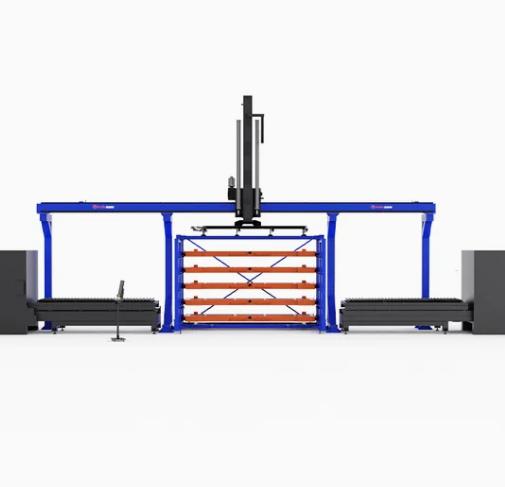
The double-sided gantry truss loading manipulator is typically deployed with a double-layer electric exchange material car. This configuration creates a parallel workflow: the manipulator unloads finished parts onto the lower layer while a fresh sheet sits staged on the upper layer. When the cutting bed is clear, the exchange car rotates or slides, presenting the raw sheet for loading. The manipulator never waits for the cart to cycle; the cart never waits for the manipulator to finish unloading.
This architectural pairing—bilateral truss plus double-layer exchange—is what makes continuous production possible. The laser fires while material handling occurs alongside it, not in sequence with it.
Structural Materials and Long-Term Reliability
Herochu constructs the double-sided truss from heavy-gauge steel with galvanized surface treatment for corrosion resistance. The guide rails are hardened and ground for wear resistance under continuous operation. Rack-and-pinion drives transmit motion without the belt stretch or chain elongation that degrade positioning over time.
The design philosophy prioritizes serviceability. Grease points are accessible without dismantling the truss. Wear components—guide blocks, pinion gears, vacuum cups—are standard industrial parts rather than proprietary assemblies. Maintenance can be performed by the fabricator’s own technicians, not a contracted service team.
Technical Specifications
| Parameter | Value |
|---|---|
| Sheet Dimensions | 3015 / 4015 / 4020 / 4025 mm (custom available) |
| Maximum Load | 100–500 kg |
| Skip Load | 3T |
| Traverse Speed | 10–30 m/min |
| Lifting Speed | 5–10 m/min |
| Repeatability | ±2 mm |
| Air Supply | 0.6–0.7 MPa |
| Air Consumption | 1.5 m³/min |
The Structural Argument
Fabricators evaluating gantry loading systems should look past the control panel and the vacuum cup count. The truss architecture is the foundation. A single-beam design may cost less upfront, but it imposes performance limits that become expensive over years of operation.
The Herochu double-sided gantry truss loading manipulator is engineered for the long duty cycles and high throughput that modern fiber laser cutting demands. The bilateral structure is the reason it can move fast without sacrificing accuracy, and the reason it can handle heavy sheets without developing the flex-related wear patterns that shorten equipment life.