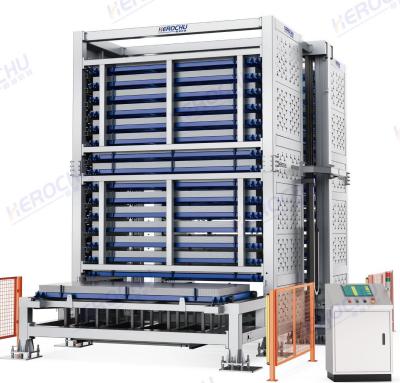
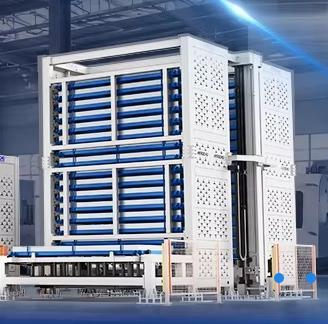
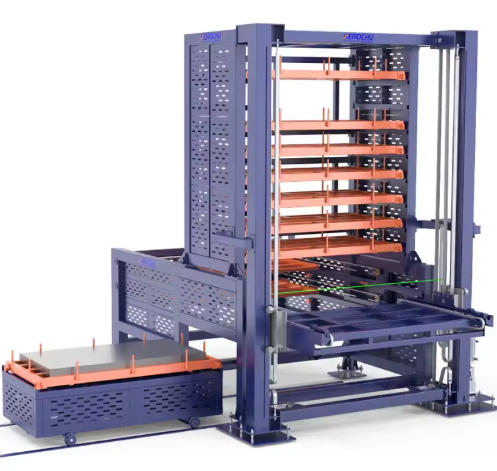
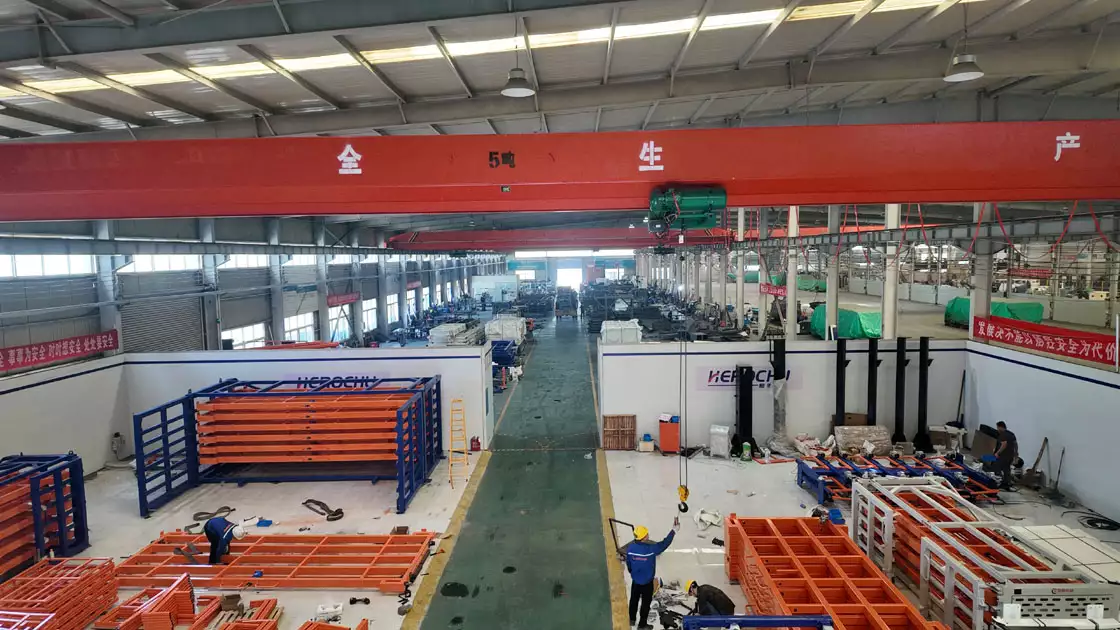
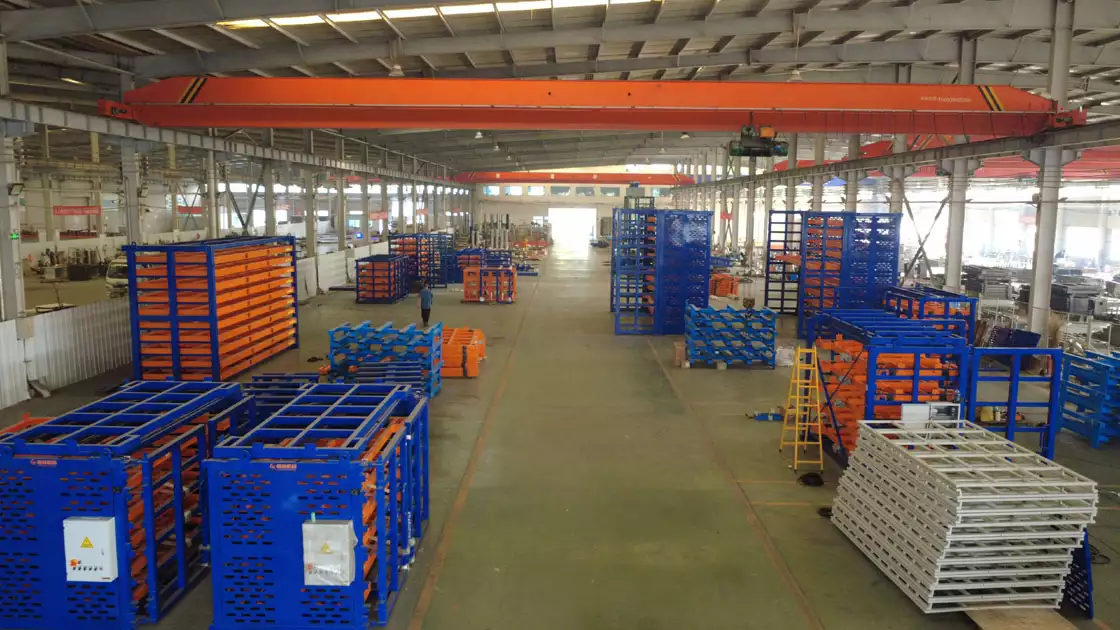
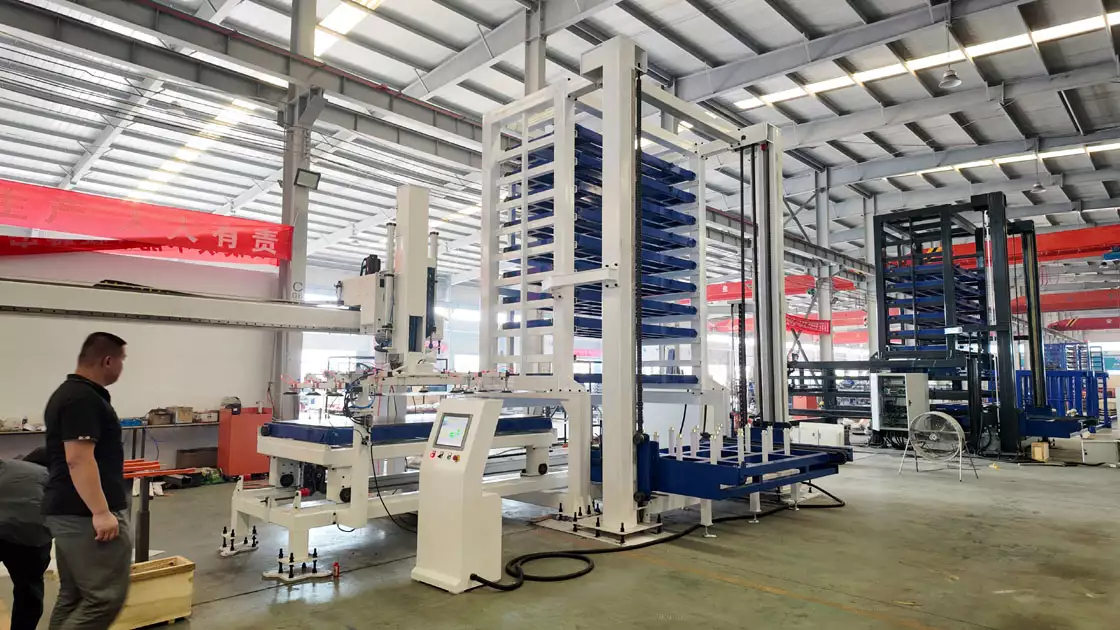
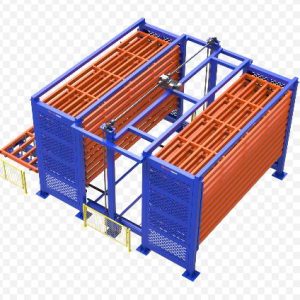
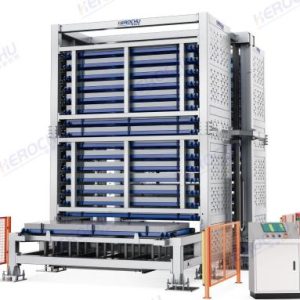
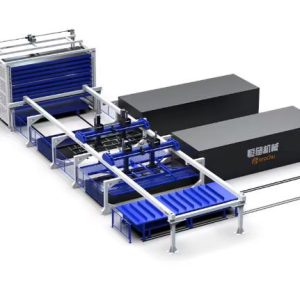
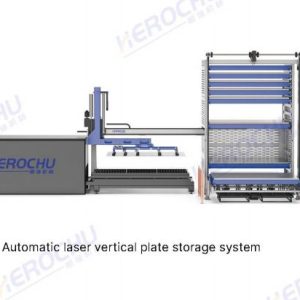
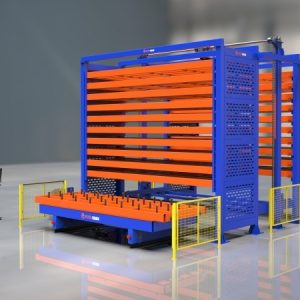
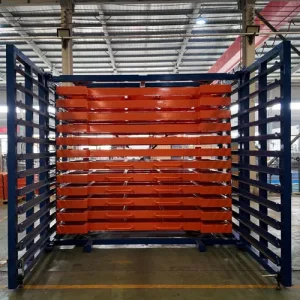
When a metal fabrication plant runs out of horizontal floor space but still needs to absorb growing raw plate inventory, the conversation shifts upward. A high-density twin-tower sheet storage warehouse does exactly what the name implies — it stacks storage vertically across two parallel towers flanking a central extraction aisle, doubling usable capacity without demanding a larger building footprint. For sheet metal operations handling carbon steel, stainless, aluminum, and copper plates day in and day out, this architecture solves the density problem at its source rather than patching around it.
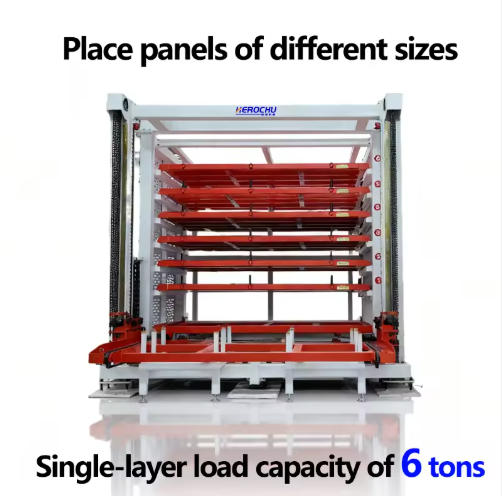
Herochu engineered its twin-tower warehouse line around a single premise: the floor area underneath a plate stack is the most expensive square meter on any production site. By building vertically — standard configurations climb from 5 meters up to 15 meters — the same concrete pad that once held a handful of palletized stacks suddenly supports six, eight, ten, or fifteen layers of organized, retrievable inventory. The HC-S3015-2-63 model handles 3000×1500 mm sheets across six layers; scale up to the HC-S6020-2-155 and the system accommodates 6000×2000 mm plates across fifteen layers, each tier rated for 5000 kg. That is the math of density, and it is the reason the twin-tower concept has displaced traditional flat racking in dense fabrication environments.
Why Two Towers Instead of One
A single verticalstorage tower solves the height problem but leaves the extraction aisle idle half the time — one tower, one shuttle, one cycle. The twin-tower configuration places a second storage structure on the opposite side of the central elevator aisle, so the same chain-driven lift and shuttle mechanism serves both sides. One retrieval stroke pulls a drawer from the left tower; the return stroke can extract from the right. Idle travel time collapses, and the throughput of the central mechanism roughly doubles without adding a second elevator.
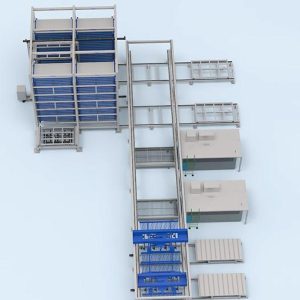
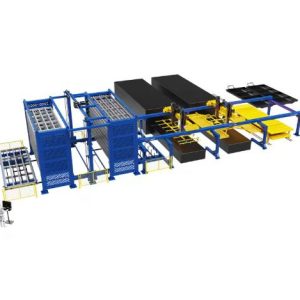
This is not a marginal gain. In a warehouse feeding two fiber laser cutting beds, a single-tower system becomes the bottleneck the moment both lasers call for fresh material simultaneously. The twin-tower layout keeps both queues fed from one central extraction point, which is why Herochu ships the double-tower architecture as the default for multi-machine cells rather than treating it as a premium upgrade.
Layer Engineering and Load Path
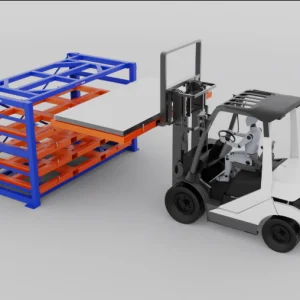
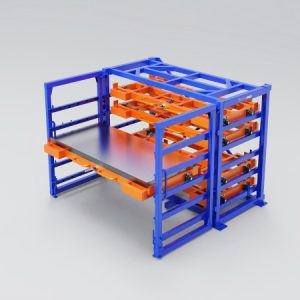
Each storage level is a removable drawer-type cassette that slides on guided rails into its designated slot. The cassette, not the plate, carries the load into the tower — the steel plate sits on the cassette, the cassette rides on the rails, and the rails transfer weight into the vertical structural frame. This separation matters because it means the plate surface never contacts the rack structure directly. Scratches, edge dings, and the surface damage that manualforklift stacking inflicts on stainless and aluminum sheets do not happen here.
Load capacity per level runs from 3000 kg on the HC-S3015-2-63 and HC-S4015-2-83 up to 5000 kg on the HC-S4020-2-105 and HC-S6020-2-155. The jump from 3-ton to 5-ton tiers is not a label change; it reflects heavier-gauge structural steel in the frame, reinforced rail mounting, and a stronger elevator chain assembly rated for the higher working load. Herochu specifies the load rating per level, not as a total — a fifteen-layer system at 5000 kg per tier means the vertical frame and foundation design account for 75,000 kg of stored material plus dynamic loads during extraction.
Clear Space and Plate Compatibility
The clear space between storage levels — 240 mm in the standard configuration, customizable for thicker plate stacks — determines what each tower can hold. Carbon steel plate, stainless sheet, aluminum sheet, copper, and brass all store in the same tower, separated by layer assignment rather than by physical relocation to different racks. The warehouse manager assigns a grade and thickness to a layer, and the system retrieves from that layer on demand. No more walking the floor with a tape measure looking for the right pallet.
Standard plate formats cover 3015, 4015, 4020, 6015, 6020, and 6025 — meaning sheets from 3 m × 1.5 m up to 6 m × 2.5 m. A fabricator cutting large structural plates from 6-meter stock needs a different tower than one running 3-meter sheets for enclosure panels, and the model lineup reflects that. Custom sheet dimensions are accommodated through structural customization rather than workarounds.
Density in Economic Terms
The pitch for a high-density twin-tower sheet storage warehouse is not that vertical storage is novel — it is that the alternative is more expensive. Expanding a warehouse horizontally means buying or leasing adjacent land, pouring a new slab, erecting steel, and running utilities to a new structure. Expanding vertically means adding layers to an existing frame within an existing building. The twin-tower design pushes that vertical expansion further by using both sides of the extraction aisle, which is space a single-tower system leaves structurally empty.
For plants where real estate is constrained — urban fabrication shops, facilities inside industrial parks with fixed lot lines, or operations that cannot afford to halt production for a building expansion project — the twin-tower warehouse converts an air-space problem into a solved inventory problem. Herochu’s fifteen-layer configuration at 6-meter plate format stores more plate in a 15-meter vertical column than a flat rack farm covering several hundred square meters of floor.
Construction and Certification
The structural frame is welded steel, powder-coated for corrosion resistance, with galvanized critical members in environments where humidity or process chemistry would attack bare steel. The chain and linear guide rail system that drives the central elevator is rated for continuous industrial duty — not a light-duty goods lift repurposed for plate storage. ESD protection is integrated for facilities storing materials destined for electronic-component manufacturing, where static discharge on a metal surface is a real defect risk.
CE and ISO 9001certifications apply across the model range. The systems ship with documentation supporting machinerysafety compliance, which matters for plants subject to audit and for export operations where receiving facilities verify equipment certification before installation.
Integration, Not Isolation
A high-density warehouse that operates as a standalone island still leaves the operator typing inventory data into a spreadsheet. Herochu’s twin-tower systems connect to ERP and MES platforms, reporting real-time stock levels, material dimensions, weights, and retrieval counts to the factory’s inventory management layer. When a laser cutting cell calls for a specific grade and thickness, the warehouse knows what is available, where it sits, and how long the retrieval cycle will take — without a human walking to the tower to check.
That connectivity is what separates a storage warehouse from an inventory warehouse. Storage holds material. Inventory management knows what it holds, how much, and where — and feeds that data downstream to the production scheduling system. The twin-tower architecture, with its PLC touchscreen control and real-time digital inventory display, delivers the second.
FAQ
Here are some frequently asked questions about our sheet metal racks and pipe storage solutions. We hope you find them helpful!
Q1: Can I request a custom size or color? Absolutely. We offer complimentary design services and deliver efficient, tailored solutions to meet your specific requirements.
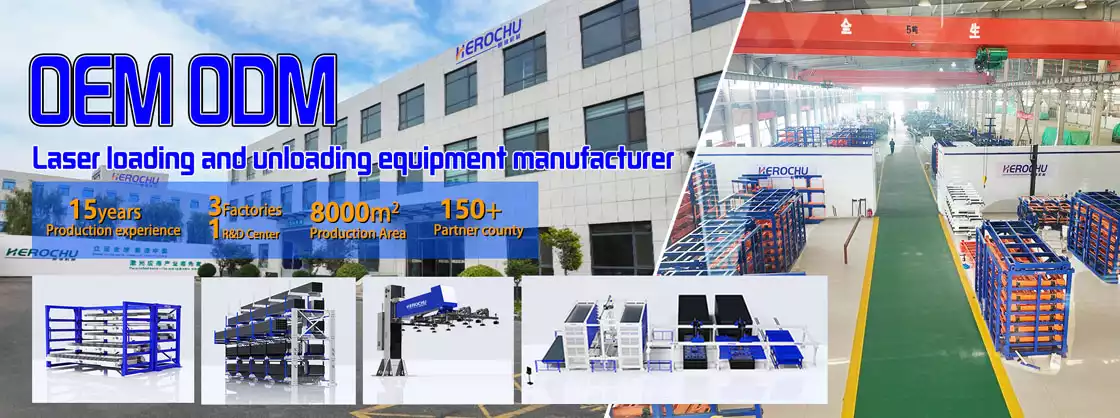
Q2: Are you a manufacturer or a distributor? We are a direct manufacturer with over 15 years of industry experience and expertise.
Q3: Is there a minimum order quantity? No. We welcome orders of any size, starting from a single unit.
Q4: How can I get detailed product information? Click the “Get a Quote” button to receive product images, detailed specifications, and videos. Our team is always ready to assist.
Q5: How do I provide my storage rack requirements? Simply share the type, dimensions, and quantity of materials you plan to store, along with any other specific needs. We will develop a professional storage solution for you. Alternatively, leave your contact details for a personalized consultation.
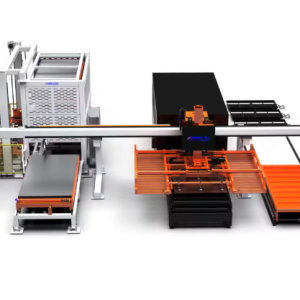
Q6: Do you offer automated loading systems or robotic arms? Yes. We provide loading robotic arms and integrated loading/unloading systems tailored to your laser cutting machine’s table size and material handling method (e.g., board rack, exchange platform, or material warehouse). Contact us with your details for a customized proposal.
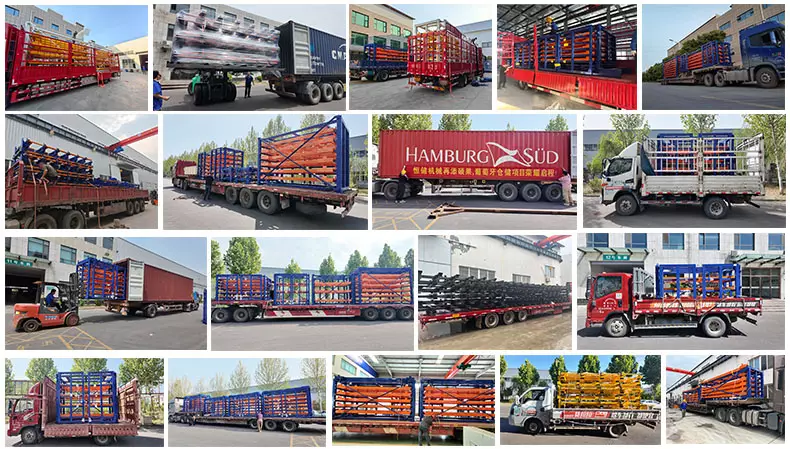
Q7: Do you provide on-site installation and debugging? Yes. Our technicians can travel to your facility for installation and debugging, ensuring successful operation. We have served clients globally, including in the USA, South Korea, Russia, Qatar, Mexico, South Africa, Egypt, and Lebanon.
Q8: How do you ensure product quality? Our quality assurance includes:
A team of over 40 technical engineers for professional debugging and support.
A dedicated quality control department compliant with ISO9001 standards.
CE certification for all exports.
Rigorous load testing before shipment to ensure structural safety and reliability.
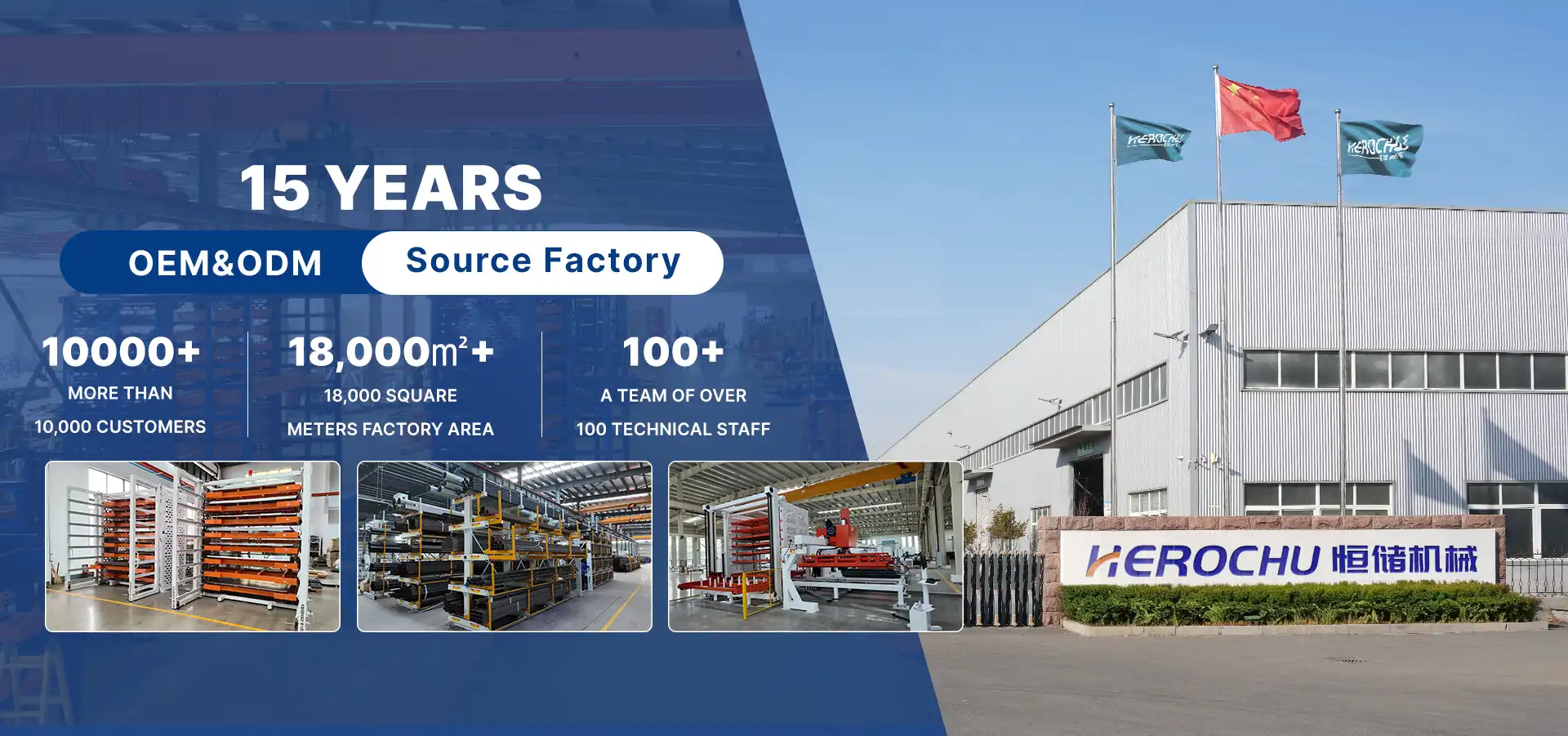
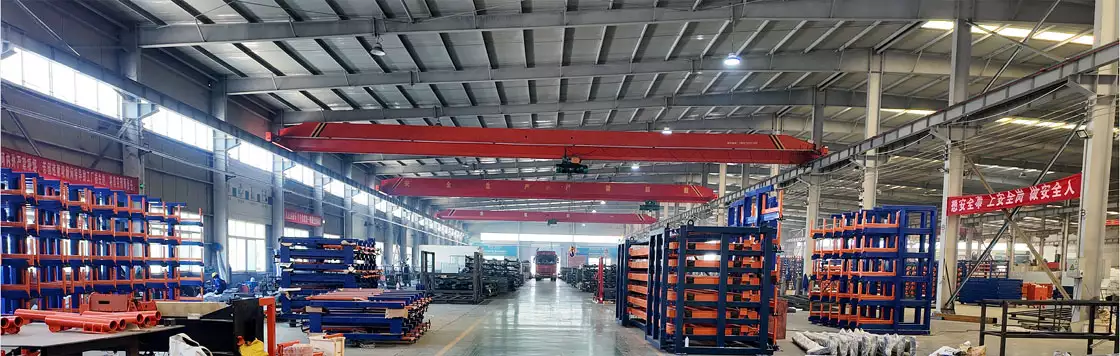
Q9: Where is your factory located? Our modern 10,000-square-meter manufacturing facility is located in Jiyang Industrial Park, Jinan, Shandong, China.
Q10: How can I evaluate your company’s capabilities? We offer virtual video factory tours and warmly welcome on-site visits.
Q11: What does your company specialize in? Jinan Constant Storage Machinery Manufacturing Co., Ltd. is a high-tech enterprise specializing in the R&D, production, sales, installation, and service of intelligent storage solutions. Our product range includes sheet material warehouses, drawer-style shelves, cantilever racks, servo manipulators, gantry loaders, and fully automated handling systems. Supported by a skilled technical team and advanced equipment, we are committed to delivering high-performance storage products and solutions to customers worldwide.
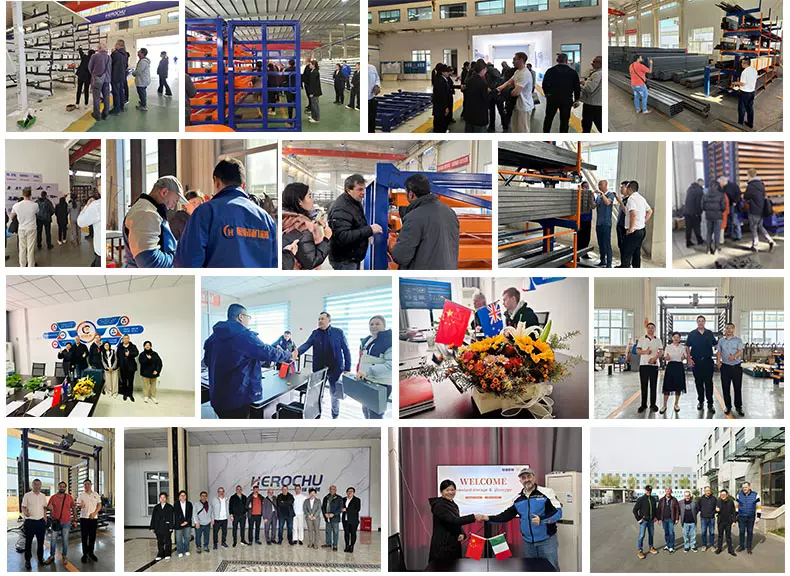
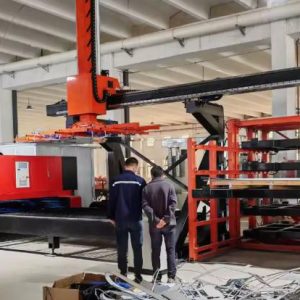
Customer visit
Herochu has always been adhering to the market-centric approach to meet customer requirements to the maximum extent, and the business philosophy of “creating brands with heart and gaining reputation with sincerity”. It provides customers with high-quality products and services with rigorous military quality, professionalism, and excellence, and has won unanimous praise in the Chinese aerospace, Chinese weapons, Chinese railways, automobile manufacturing, engineering machinery, non-ferrous metal titanium alloy and other industries.