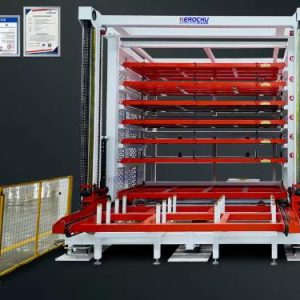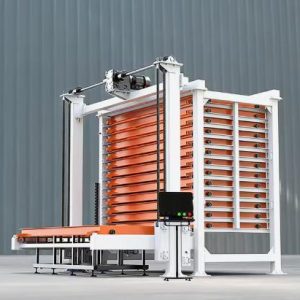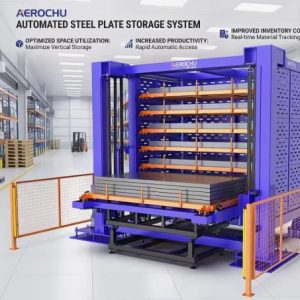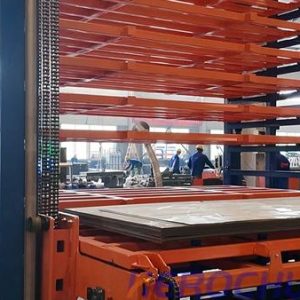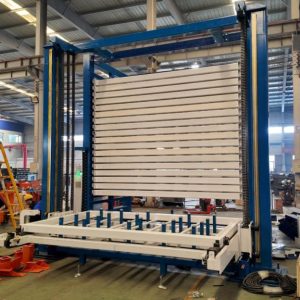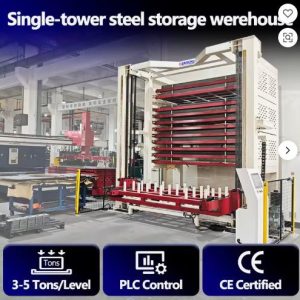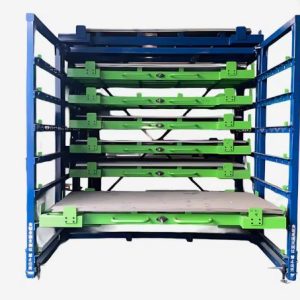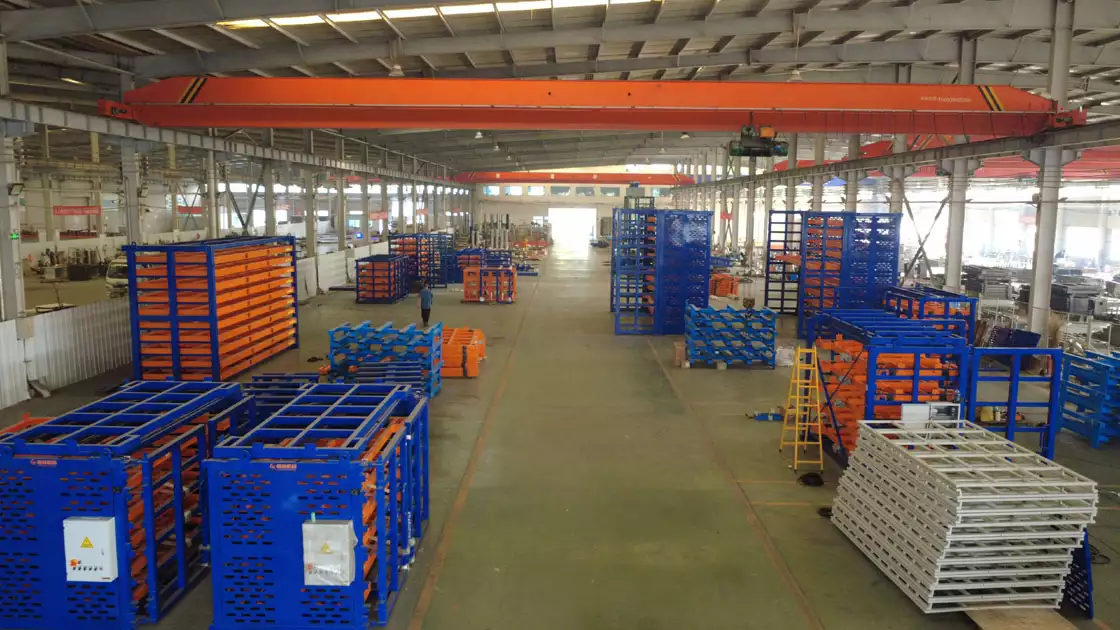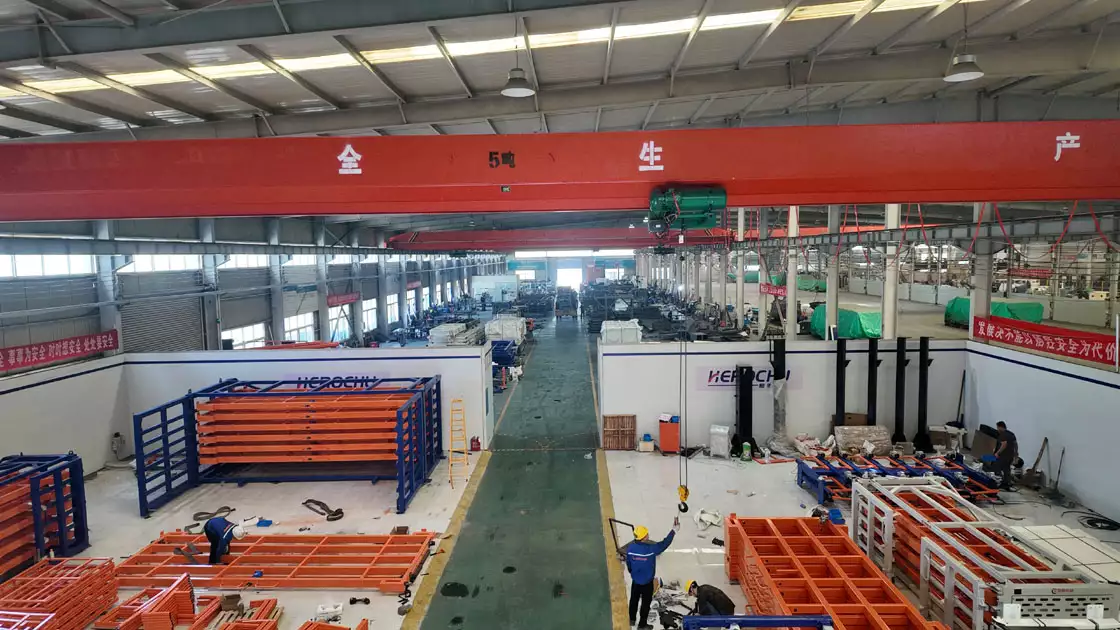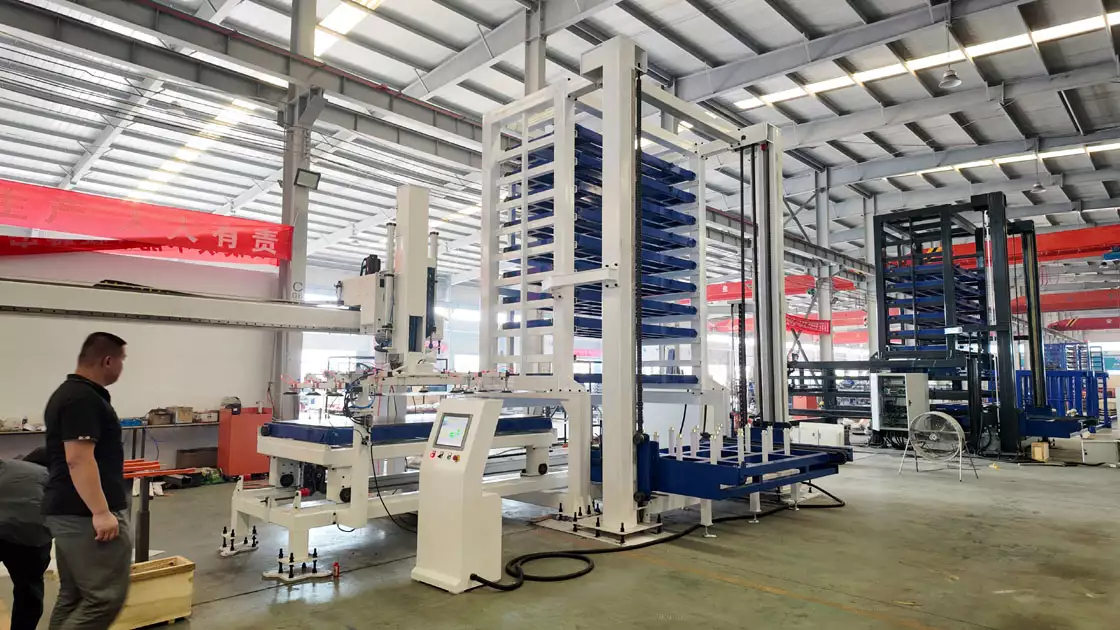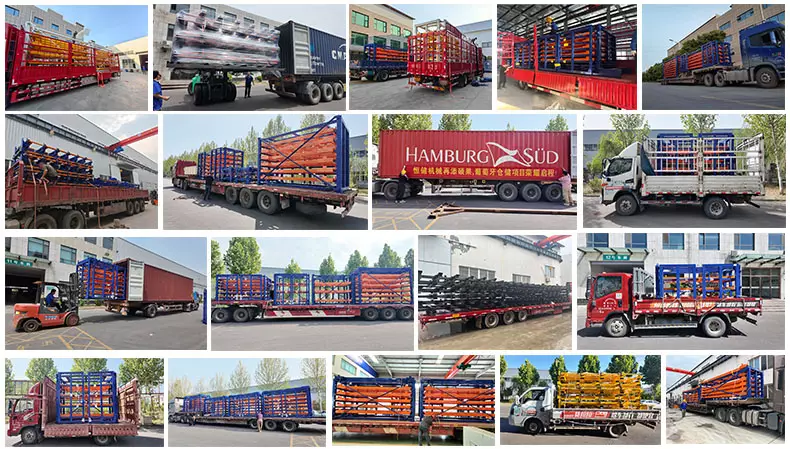
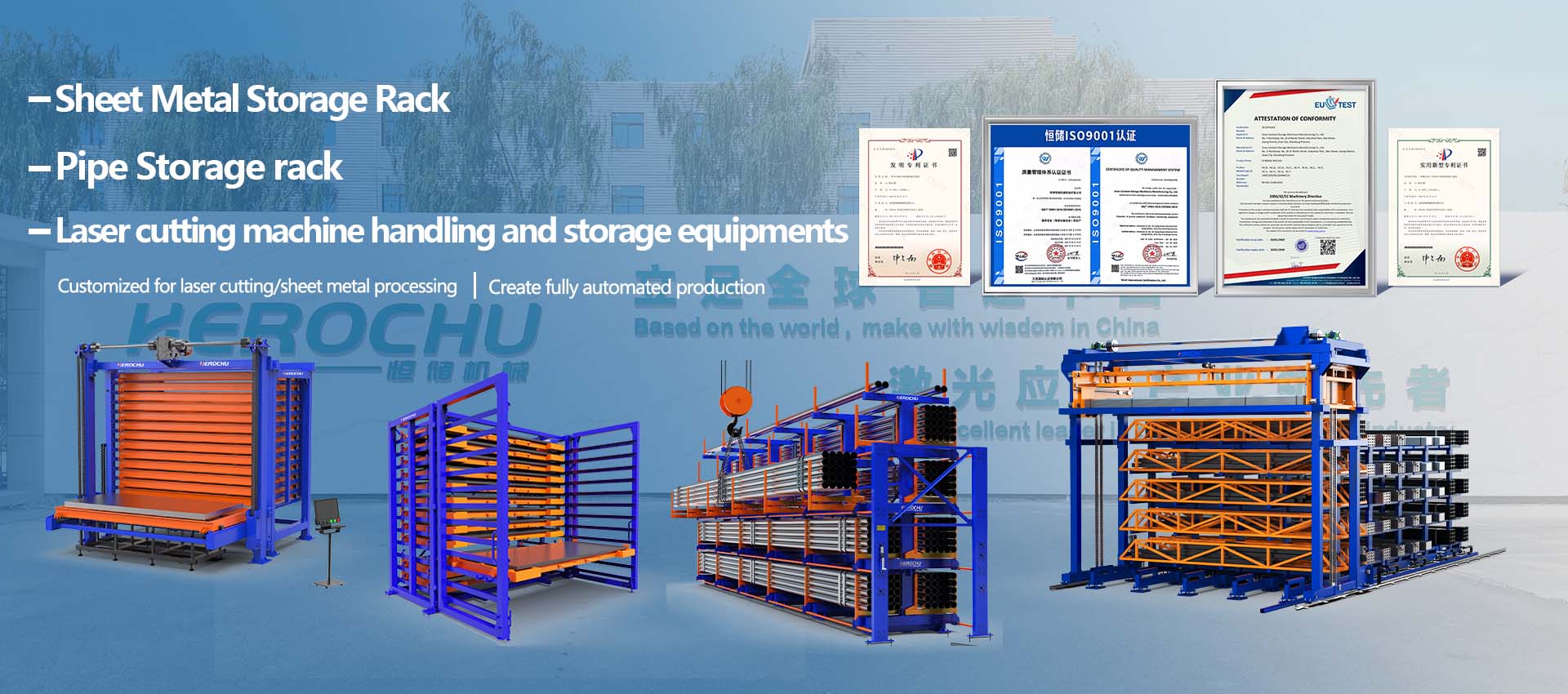
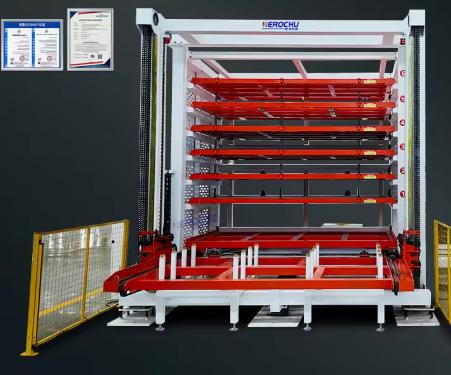
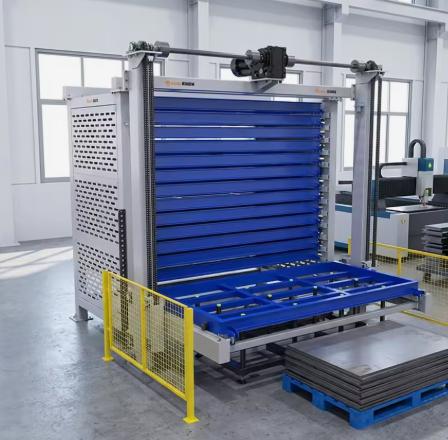
In facilities where floor space commands a premium, stacking inventory upward rather than outward has become more than a preference—it is an operational imperative. A Smart Vertical Panel ASRS Storage Tower from Herochu translates this principle into tangible storage capacity gains, compressing the footprint of sheet material storage by a factor of ten while multiplying accessible inventory slots by the same proportion. The underlying concept is mechanical simplicity applied at scale: a series of independently retrievable drawer bays arranged in a vertical column, each accessed by a chain-driven lifting carriage that rides on precision linear guide rails.
The Space Arithmetic That Drives Adoption
A conventional horizontal sheet storage layout—whether comprising A-frame racks, cantilever bays, or flat pallet stacks—consumes square footage in proportion to the number of material types maintained in inventory. Eight grades of aluminum, four thicknesses of cold-rolled steel, and three substrate variants of veneered board might occupy several hundred square meters of accessible floor. The same selection housed in a Herochu ASRS Tower occupies roughly the plan area of a single flatbed truck, because the system stacks ten drawer positions in the elevation that one pallet position occupies on the ground.
This arithmetic becomes compelling when workshop expansion is not feasible. Facility managers who have priced concrete, steel framing, and permitting for additional square footage recognize that a vertical storage tower achieves the same net capacity increase at a fraction of the construction timeline and capital outlay. The tower ships as modular subassemblies, installs with plug-in connection methodology, and can be commissioned within days of arrival on site.
How the Retrieval Mechanism Operates
Each drawer bay in the Herochu tower travels on a pair of hardened linear guide rails that constrain lateral movement to within submillimeter tolerances—a requirement driven by the need for repeatable positioning at the load/unload station. The carriage is driven by a roller chain system tensioned against a counterweight assembly of 1.5 or 2.5 metric tons, depending on the configuration. This counterweight reduces the effective load on the 5.5 kW main drive motor to roughly the net difference between the selected drawer weight and the counterbalance mass, extending motor service life and reducing peak current draw during lift cycles.
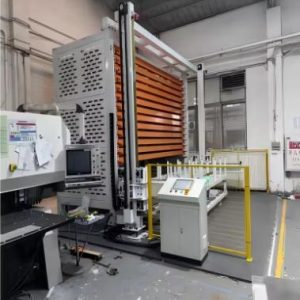
The control logic, resident on a Siemens-compatible PLC, tracks the physical position of each drawer with absolute encoder feedback. When an operator selects a material code at the HMI terminal, the controller calculates the shortest vertical travel path to the requested drawer, accelerates the carriage at a controlled ramp rate, cruises at 9 meters per minute vertical speed, and decelerates to a soft stop at the target elevation. The selected drawer then extends into the load/unload bay at 12 meters per minute, presenting the stored sheets to the fork tines or vacuum lift assist awaiting them.
Load Capacity and Configuration Range
Herochu offers the tower in six standard plan sizes—3015, 4015, 4020, 6015, 6020, and 6025 millimeters—corresponding to the length and width dimensions of the drawer trays. The 3015 configuration, accommodating sheets up to 3000 by 1500 millimeters, suits most panel processing shops. The 6025 variant extends to 6000 by 2500 millimeters for full-size timber panels and oversized steel plate stock.
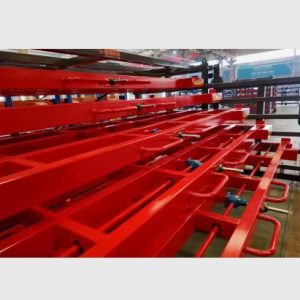
Layer count can be specified from 8 to 13 levels. Each drawer is rated for 3 or 5 metric tons, translating to a tower gross capacity approaching 65 tons at the maximum configuration. The structural frame uses welded carbon steel sections with surface treatment that combines anti-rust primer and finishing varnish, followed by oven curing. Herochu warrants the frame against deformation and weld defects for 24 months, a coverage term that reflects confidence in the build quality.
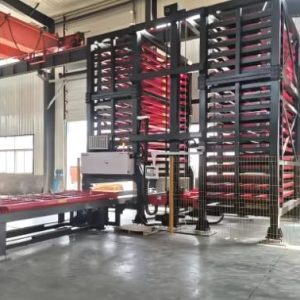
Below the drawer trays, pallet sleepers provide positive registration points that guide forklift tines into correct placement, eliminating the trial-and-error repositioning that can mar sheet edges during manual alignment. For shops using overhead crane handling, the drawer basket design leaves three open sides for strap or clamp access.
Material Protection in Storage
Storing sheets flat inside enclosed drawer bays offers an inherent advantage over open cantilever or A-frame storage: protection from ambient workshop contaminants. Grinding dust, welding spatter, overspray from nearby paint operations, and forklift exhaust residue settle on exposed stock and can transfer to finished surfaces during downstream processing. Each Herochu drawer forms a self-contained enclosure that shields its load from airborne debris while in the stored position. The drawer face plates close flush against the tower frame, creating a barrier that also excludes casual access—only the authorized operator interface can summon a given drawer.
For aluminum sheet storage, this protection is particularly relevant. Oxidized surfaces or embedded ferrous particles from grinding operations can cause galvanic corrosion at the sheet surface, compromising finish quality before the material ever reaches a CNC router or press brake. Keeping aluminum inventory sealed within the tower bays eliminates this contamination pathway.
Integration with Warehouse Management
The PLC controller communicates with external systems via standard industrial protocol interfaces, allowing the tower to function as an addressed node within a broader WMS or ERP architecture. Inventory records can be updated in real time as drawers cycle: when a retrieval sequence completes, the controller can transmit a material consumption event to the host system, adjusting stock-on-hand quantities without manual data entry. Conversely, inbound material can be assigned to specific drawer positions through the WMS interface, and the tower will present the correct empty drawer at the loading station when the receipt is processed.
This digital integration closes a common gap in sheet inventory management—the disconnect between physical stock movement and system record updates. Without automated position tracking, shops typically rely on periodic physical counts or operator discipline to maintain data accuracy, both of which introduce latency and potential for error. The tower’s encoder-based position verification provides deterministic knowledge of what material occupies which bay at any moment.
Applications Across Material Types
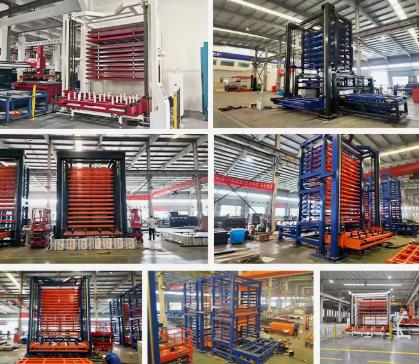
The tower’s design is material-agnostic in the sense that the drawer trays can accept any flat stock within the dimensional and weight limits. Aluminum plate processors use the system to segregate alloys and tempers—5052-H32 separated from 6061-T6, each thickness isolated on its own drawer level. Steel service centers organize hot-rolled, cold-rolled, and galvanized sheet by gauge and grade, retrieving specific coils or blanks on demand for slitting or blanking operations.
Wood product manufacturers employ the tower for MDF, plywood, particleboard, and veneered panels, where flat storage is essential to preventing the warping and edge damage that vertical leaning can introduce over time. The enclosed drawer environment also moderates humidity exposure compared to open warehouse storage, reducing dimensional change in hygroscopic wood-based materials.
Throughput Considerations
Cycle time from retrieval command issuance to drawer presentation at the load/unload station depends primarily on the vertical distance between the current carriage position and the target drawer. With a 9 meter per minute lift rate, a full-height traverse across all thirteen levels completes in approximately 55 seconds. Drawer extension and retraction at 12 meters per minute adds roughly 15 seconds per operation. Combined, a worst-case retrieval from the furthest opposing position consumes just over one minute—a figure that compares favorably to the time required for an operator to locate a specific sheet bundle in a sprawling horizontal storage field.
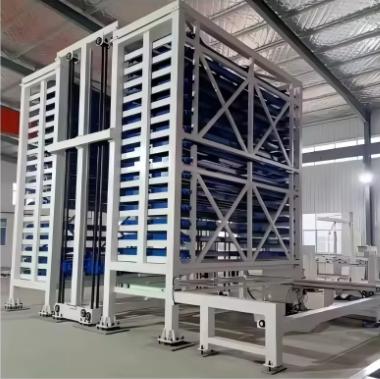
For high-throughput environments, Herochu can configure dual access stations—one at floor level for forklift loading and one at an elevated mezzanine for direct feed into an adjacent processing line. The control system sequences retrieval requests to minimize carriage travel, batching multiple picks into an optimized route rather than processing each request independently. This sequencing logic becomes increasingly valuable as the number of daily retrievals rises.
Installation and Commissioning
The tower assembly uses a plug-in connection system that eliminates field welding and minimizes on-site fabrication. Pre-drilled frame sections bolt together with high-tensile fasteners at designated connection nodes, and alignment is verified against laser reference planes during erection. The linear guide rails ship pre-mounted to frame sections and require only final alignment verification after assembly, not full re-leveling.
Electrical commissioning involves connecting the drive motor, encoder feedback, limit switches, and HMI panel to the control cabinet, followed by a calibration routine that teaches the PLC the physical position of each drawer level. This calibration is semi-automated: the technician initiates the routine from the HMI, and the carriage indexes through each level while the encoder registers absolute positions. The full commissioning sequence from unloaded truck to operational status typically spans two to three working days.
Long-Term Operating Economics
The economic case for a Herochu ASRS Tower rests on three quantifiable vectors: space cost avoidance, labor efficiency gain, and material damage reduction. Space savings translate to either deferred facility expansion or the repurposing of recovered floor area for revenue-generating production equipment. Labor efficiency arises from eliminating search time—operators retrieve by part number, not by memory of where a bundle was last placed. Material damage reduction flows from the combination of flat storage support and enclosed bay protection, which together reduce the scrap and rework attributable to handling and environmental exposure.
Across a ten-year service life with typical utilization, the cumulative cost of ownership—including initial capital, installation, electricity consumption, and scheduled maintenance—tends to be recovered within 24 to 36 months compared to the combined carrying costs of equivalent horizontal storage capacity. The 24-month warranty period provides a buffer against unplanned maintenance expense during the early operational phase when process integration is still stabilizing.
Selecting the Right Configuration
Choosing the appropriate tower specification begins with an inventory of the sheet sizes, weights, and material types that the system must accommodate. Herochu’s application engineering team requests dimensional and weight data for each stock item, along with anticipated retrieval frequency and preferred integration method—forklift, overhead crane, or conveyor handoff. From these inputs, the configuration is developed: drawer dimensions, layer count, load rating, counterweight specification, and control interface protocol.
The modular nature of the system permits reconfiguration if inventory profiles change over time. Drawer spacing can be adjusted during scheduled maintenance windows, and additional levels can be added to towers that were originally specified with conservative height allowances. This adaptability protects the initial investment against shifts in product mix or material sourcing strategy.
For operations currently managing sheet inventory across scattered floor locations, the transition to a centralized vertical tower often reveals additional benefits beyond those calculated in the initial justification: improved 5S scores, cleaner audit trails for quality system compliance, and reduced fork truck traffic through production aisles. These peripheral gains, while harder to quantify in a capital expenditure request, contribute meaningfully to the overall return on the investment.