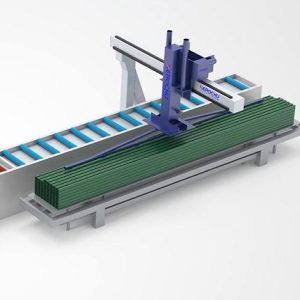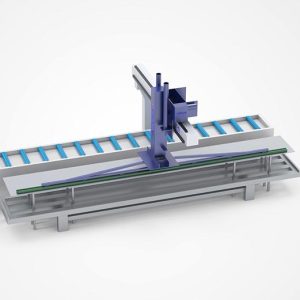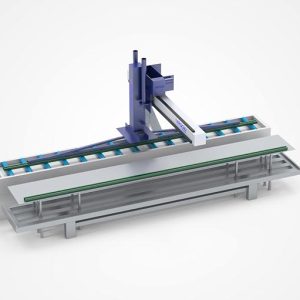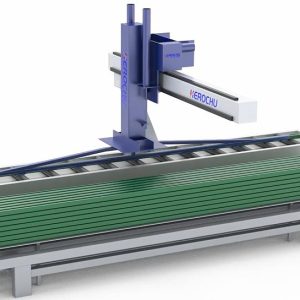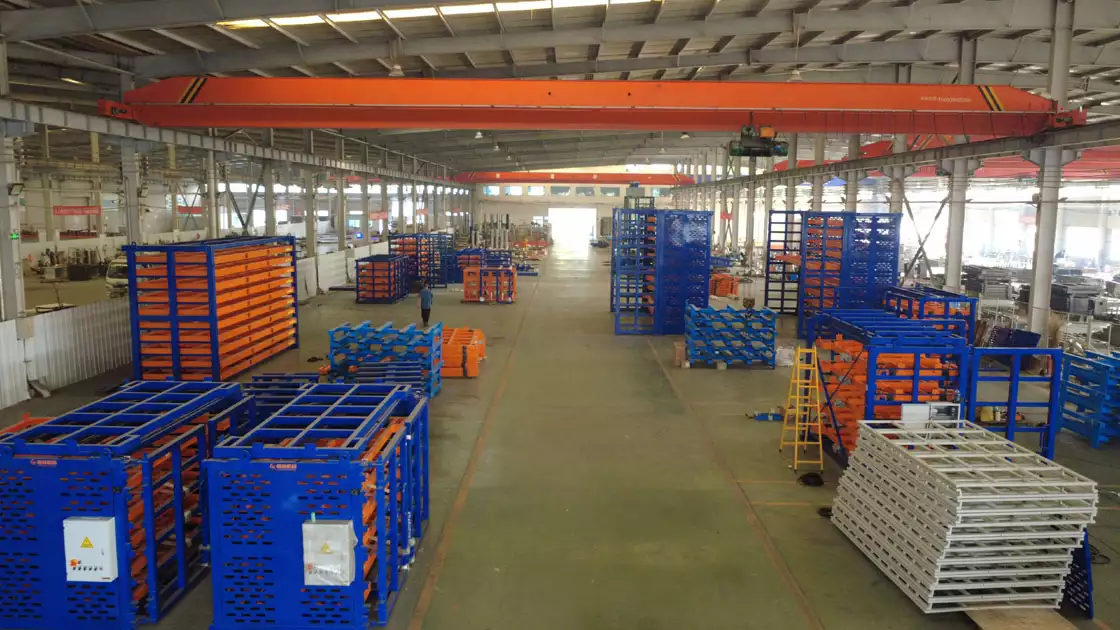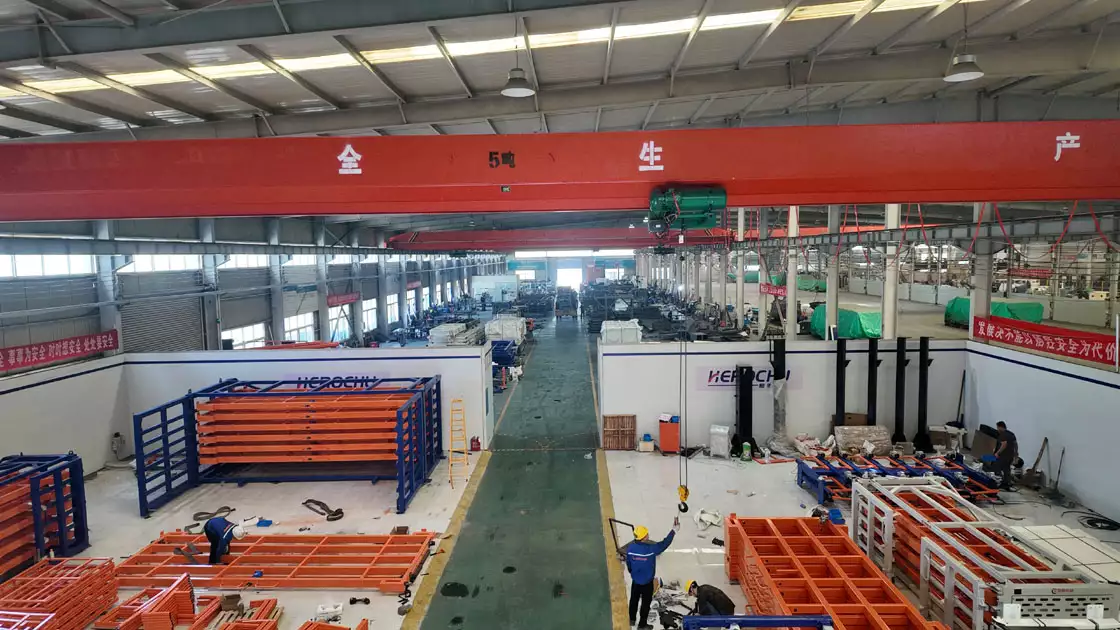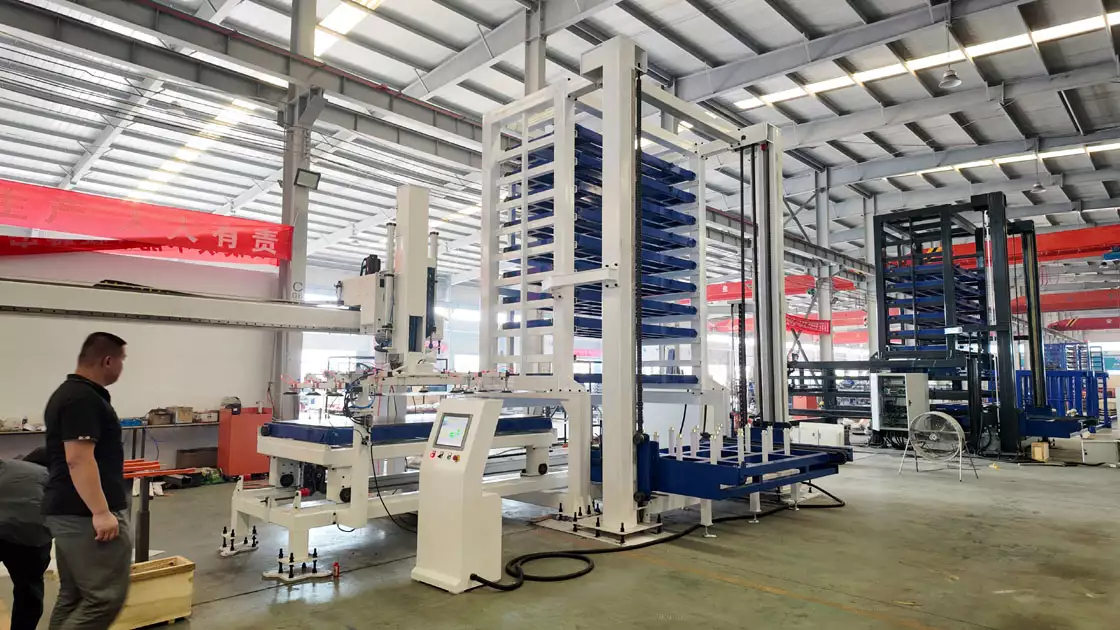
Overview of the Automatic Tube Stacking & Palletizing Line
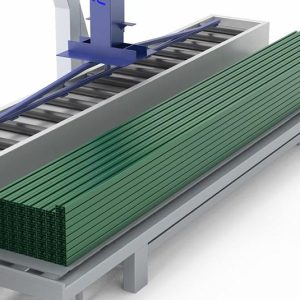
A tube mill produces continuous lengths of pipe — but the value of that output depends on how efficiently it transitions from the production floor into packaged, weighed, and inventory-ready pallets. The Herochu automatic tube stacking & palletizing line is a multi-station production cell that performs every post-mill operation between pipe discharge and warehouse storage. Unlike a standalone palletizer that only stacks, this line feeds, layers, stacks, bundles, weighs, and positions pipes for crane pickup in one uninterrupted sequence.
Pipe manufacturers specifying this line typically operate mills producing round steel tube from 10 mm to 168 mm outside diameter at lengths up to 6 meters. The line’s throughput synchronizes to the mill’s actual production speed rather than imposing a fixed cycle constraint, so it remains viable across product changeovers that alter mill output from rapid small-diameter runs to slower heavy-wall production.
Each station in the line communicates through a single PLC architecture. The infeed conveyor knows when the stacking arm is mid-cycle and holds the next pipe. The stacking arm knows when the pallet reaches its programmed layer count and triggers the transverse roller table. The bundling station knows when a full pallet arrives and initiates the strapping sequence. This choreography eliminates the handshake delays that occur when separate machines with independent controllers must signal each other through discrete I/O wiring.
The Eight-Stage Production Flow
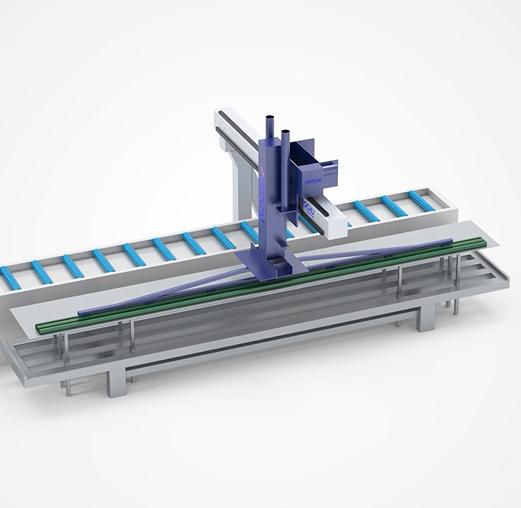
The Herochu automatic tube stacking & palletizing line follows an eight-stage sequence, each stage performing a distinct function before handing material to the next.
Stage 1 — Feeding: Pipes arrive from the tube mill discharge conveyor and enter the line’s alignment table. End stops square the pipe ends so all tubes in a layer share a common reference plane — a prerequisite for stable stacking, since even a 5 mm end offset compounds across layers into significant tilt. Roller conveyors with adjustable side guides carry aligned pipes toward the layering station.
Stage 2 — Layering: Pipes accumulate on a staging table until the programmed layer count is reached. Photoelectric sensors verify the count, and side clamps compress the layer to the target width before transfer. This compression step is critical for hexagonal bag formation: if pipes are loosely spaced when the layer transfers, the subsequent layer cannot nest properly into the valleys between pipes.
Stage 3 — Pushing: A pneumatic or hydraulic pusher transfers the complete layer from the staging table to the stacking zone in one linear stroke. The pusher face uses a full-length contact bar that distributes force across all pipes in the layer, preventing the end damage that would occur if force concentrated on one or two pipes. Stroke length adjusts through limit switch positioning or encoder feedback, accommodating different pallet widths.
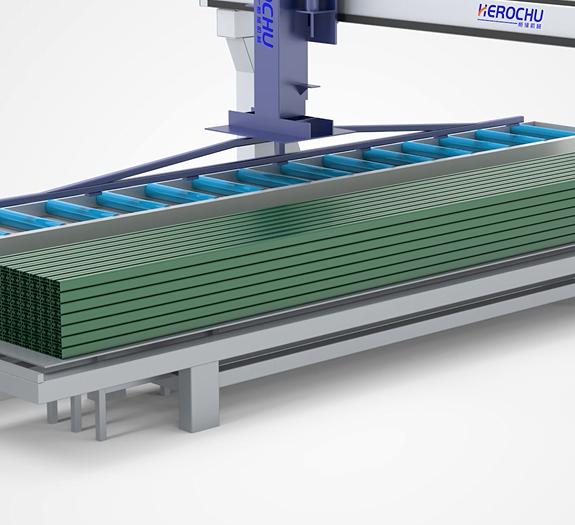
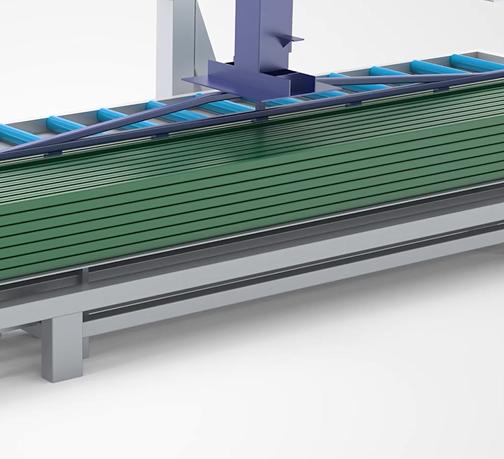
Stage 4 — Automatic Lifting and Stacking: The gantry arm lifts the layer using grippers or magnetic end-effectors — steel pipe applications typically use electromagnets for rapid pick-and-release cycles, while non-ferrous pipe uses mechanical grippers. The arm traverses to the pallet position and descends to placement height. For hexagonal bags, the arm offsets each layer by half a pipe diameter so that pipes in the new layer settle into the grooves between pipes in the layer below.
Stage 5 — Transverse Movement of Roller Table: When a pallet reaches its programmed layer count, the roller table transfer car shifts laterally. This moves the completed pallet out of the stacking zone and positions an empty pallet under the stacking arm, enabling continuous production without stopping the infeed for pallet changeover. The transfer car uses V-guide rollers on a precision-ground rail to maintain alignment during transverse travel, ensuring that the empty pallet arrives at the exact coordinate expected by the stacking arm’s motion program.
Stage 6 — Automatic Bundling and Packing: The completed stack moves into the bundling station. Strapping heads positioned at programmed intervals around the pallet feed steel strap or plastic banding through the pallet channels, tension to the set force, and seal the joint. For hexagonal bags of steel pipe, the most common configuration uses three to five steel straps per pallet, with strap placement avoiding the pipe ends to prevent strap slippage during crane handling. The bundling cycle runs independently of the stacking cycle, so a slow strap feed or tensioning operation does not delay the stacking arm.
Stage 7 — Water-Controlled Weighing: After bundling, the pallet travels to a weigh station integrated into the roller table. Load cells under the weigh platform capture gross weight; the control system subtracts the known tare weight of the pallet and strapping material to calculate net pipe weight. A label printer generates a tag with pipe specification, piece count, net weight, production date, and batch number. Operators affix the tag to the bundle for inventory tracking and shipping documentation.
Stage 8 — Lifting: The final roller table section positions the weighed and labeled pallet at the crane pickup point. The overhead crane operator lifts the pallet directly from the roller table and places it in the finished goods storage area or directly onto a truck for shipment. The line’s linear layout keeps the pickup point at the far end from the infeed, maintaining clear separation between raw material flow and finished goods handling.
Hexagonal Bag Forming: The Technical Detail
Hexagonal bag stacking — also called honeycomb or nested stacking — is the most space-efficient arrangement for round pipes on a rectangular pallet. Pipes in alternating layers nest into the valleys between pipes in adjacent layers, producing a hexagonal cross-section when viewed from the end. This geometry packs more pipes into the same pallet footprint than straight column stacking and resists lateral shifting during transport because each pipe is mechanically captured by its neighbors above and below.
Forming a hexagonal bag requires the stacking arm to calculate layer offsets with geometric precision. For pipes of diameter D, the horizontal offset between layers equals D/2, and the vertical rise per layer equals D × sin(60°), approximately 0.866D. The Herochu control system computes these offsets automatically from the pipe diameter entered in the recipe. The arm’s servo drives position each layer within ±1 mm of the calculated coordinate, maintaining the precise nesting that gives hexagonal bags their structural stability.
Pipe count per layer follows a simple pattern: if the bottom layer holds N pipes, the next layer holds N-1 pipes, the layer after returns to N, and the pattern alternates to the top of the stack. For a 6-layer hexagonal bag starting with 8 pipes in the bottom layer, the counts run 8-7-8-7-8-7 for a total of 45 pipes. The control software calculates these counts automatically and adjusts the infeed layering station to accumulate the correct number for each layer position.
Bundling Quality and Shipment Integrity
Steel pipe bundles travel by truck, rail, and ship — often across international supply chains where handling at intermediate warehouses subjects bundles to forklift impacts, vibration, and weather exposure. Bundling quality directly affects whether pipes arrive at the customer’s facility in saleable condition or with surface damage and shifted layers that require rework.
The Herochu bundling station applies strapping at consistent tension controlled by the strapping head’s tensioning motor. Tension setpoints vary by strap material and pipe surface: steel-on-steel requires higher tension to prevent strap-loosening from the low coefficient of friction, while plastic strap on painted or galvanized pipe uses lower tension to avoid cutting into the surface coating. Edge protectors — folded steel or plastic angles placed at the corners where strap meets pipe — distribute tension across multiple pipes rather than concentrating force on the outer two pipes, reducing the visible strap marks that customers sometimes flag as quality defects.
Water-controlled weighing adds a layer of shipment verification. Each pallet’s net weight cross-checks against the theoretical weight calculated from pipe specification, wall thickness, piece count, and length. A deviation exceeding the configured tolerance — typically ±2% for bundled steel pipe — triggers an alert for operator review, catching counting errors or mixed specifications before the pallet leaves the production floor.
Noise Reduction and Facility Environment
Tube mills are inherently loud environments, with cutting saws, end-facing machines, and conveyor rollers generating sustained noise levels that contribute to long-term hearing damage among production workers. Manual pipe stacking adds impact noise — pipes clanging together during handling and dropping onto pallets — that produces sharp transient peaks above the continuous background level.
The Herochu automatic tube stacking & palletizing line reduces stacking noise through controlled placement rather than gravity drops. The stacking arm’s servo-driven descent brings each layer to within approximately 10 mm of the previous layer surface before release, eliminating the free-fall impact that generates the loudest transient noise in manual stacking. Conveyor rollers use polymer sleeves rather than bare steel-to-steel contact, reducing the continuous rolling noise along the transport path. Together, these measures bring stacking-related noise below 80 dB(A) at the operator station — a level that meets occupational exposure limits without requiring hearing protection for the palletizer operator specifically, though mill-wide hearing protection programs typically remain in place for other equipment.