The Case for an Integrated Pipe Handling & Palletizing System
A standalone palletizer only solves part of the problem. Between the tube mill discharge and the pallet sits a sequence of handling steps — conveying, orienting, layer forming, counting — each capable of becoming a chokepoint if addressed with separate, uncoordinated equipment. A pipe handling & palletizing system treats these steps as one continuous motion chain, reducing the number of transfer points where pipes can jam, misalign, or drop.
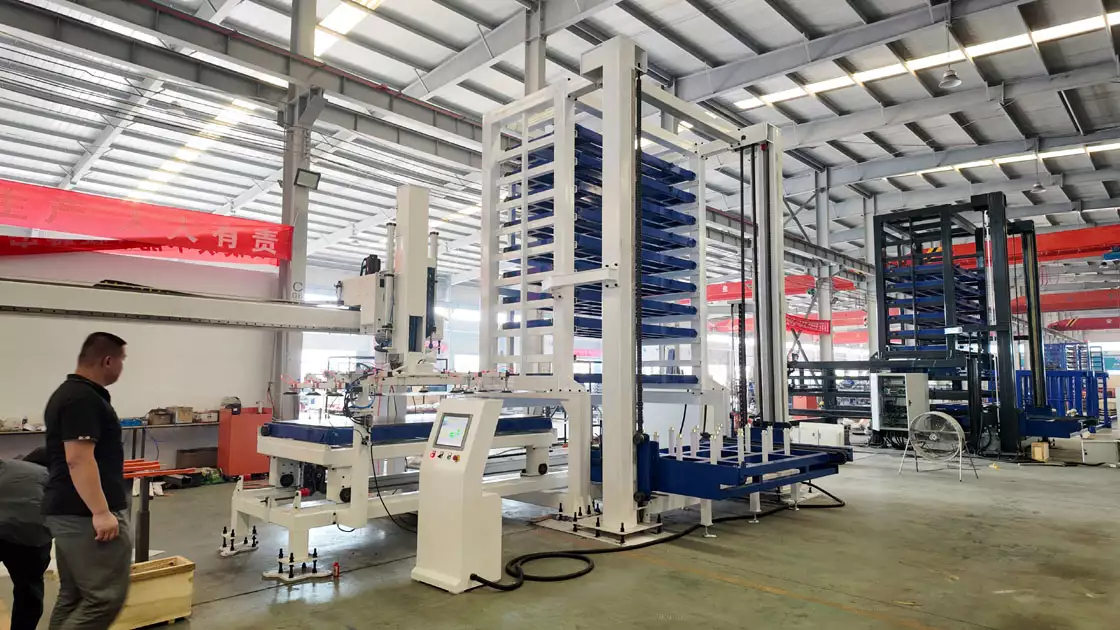
Herochu designs its pipe handling & palletizing system as a unified automation cell. Unlike fragmented setups where a third-party conveyor feeds into an independently controlled palletizer, the Herochu approach uses a common PLC backbone that synchronizes every motor, sensor, and actuator across the entire handling sequence. One HMI panel provides the operator with visibility into every stage: infeed conveyor status, layer count progress, stacking arm position, and bundling station cycle state.
This integrated control architecture becomes particularly valuable during product changeovers. When the operator selects a new pipe specification from the recipe menu, the system simultaneously adjusts conveyor speed, side guide width, gripper clamping force, stacking pattern parameters, and layer count — eliminating the need to recalibrate individual machines at each transfer point.
System Architecture: From Mill Discharge to Pallet
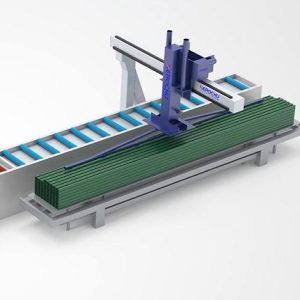
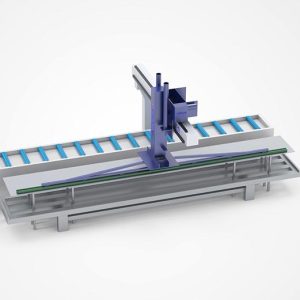
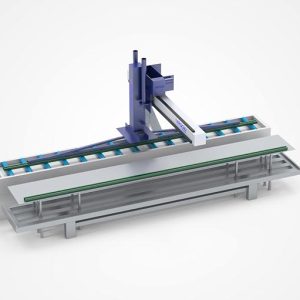
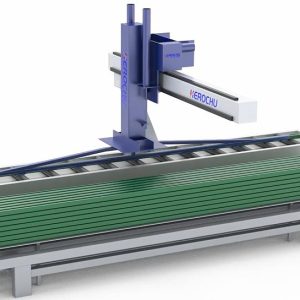
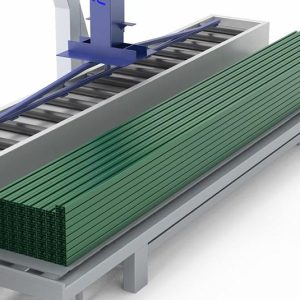
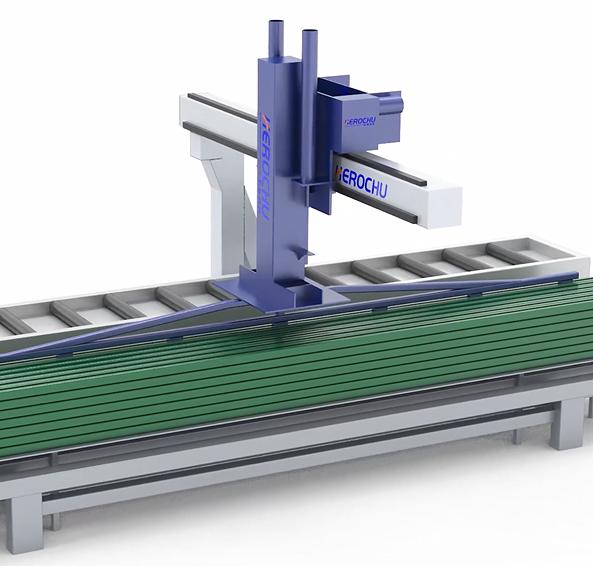
The Herochu pipe handling & palletizing system follows a linear layout that can be configured to match available floor space. Pipe enters the system at the infeed section, where an alignment table squares the pipe ends and orients each tube parallel to the conveyor direction. Roller tables with individually adjustable roller spacing carry pipes forward; side rails prevent lateral drift while allowing different diameters to pass through without manual adjustment.
A layering station sits between the infeed conveyor and the palletizing zone. Here, pipes accumulate into complete layers — typically 5 to 15 pipes per layer depending on diameter — before the full layer transfers to the stacking zone in one motion. This accumulation-and-transfer method is faster than placing pipes one at a time onto the pallet, because the stacking arm makes one travel cycle per layer rather than one per pipe. For a 6-layer hexagonal bag of 61 pipes, the arm executes six placement cycles instead of sixty-one.
After stacking, the system moves completed pallets laterally on a roller table transfer car. This transverse movement shifts full pallets to the bundling station while positioning an empty pallet under the stacking zone, allowing stacking to resume without interruption. The bundling station applies steel straps or plastic bands around the completed stack at programmed tension and spacing. A water-controlled weighing station next records the gross weight of each pallet, printing a label that documents pipe count, specification, production date, and weight for inventory tracking.
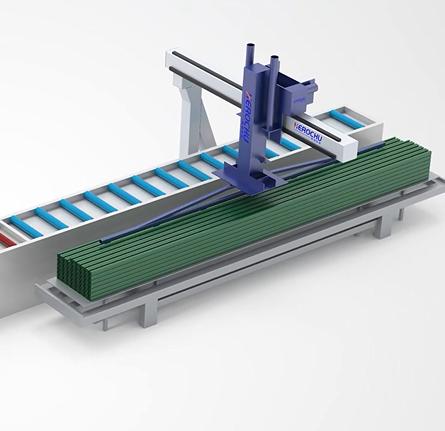
An overhead crane pickup point at the end of the line completes the material flow. The crane operator lifts the strapped and weighed pallet directly from the roller table, eliminating the need for a forklift to enter the palletizing area and reducing the risk of collision with the machine frame.
Chain Drive and Motor Sensing Technology
At the mechanical core of the handling system sits a chain drive arrangement that moves pipes through each transfer stage. Heavy-duty roller chain runs on hardened steel sprockets, with chain tensioners maintaining proper engagement as ambient temperature fluctuates between cold mill startup and continuous running conditions. Chain drives offer several advantages over belt conveyors for pipe handling: they resist the abrasive wear caused by pipe ends sliding across the transport surface, they maintain positive engagement without slip under load, and they tolerate the occasional coolant or cutting oil drip that would degrade rubber belt surfaces.
Motor sensing governs the counting and positioning logic. Each drive motor connects to an encoder that reports shaft position to the PLC. By correlating encoder counts with chain pitch and conveyor geometry, the system determines the exact position of each pipe on the conveyor — not just presence or absence, but location along the travel path with millimeter-level resolution. This position data feeds into the palletizing sequence: the arm only initiates a pick cycle when the target pipe reaches the pickup coordinate, and the conveyor only advances the next pipe when the previous one has cleared the transfer zone.
The motor sensing system also performs self-diagnostics. If an encoder reports motor rotation but a photoelectric sensor at the next transfer point does not detect a pipe within the expected time window, the system flags a possible jam or missing pipe. Operators receive an alert on the HMI with the specific fault location, reducing troubleshooting time compared to generic alarm messages that require walking the entire line to find the problem.
Stacking Quality and Product Protection
Manual pipe handling inevitably produces surface damage — pipes banging against each other during stacking, dragging across rough pallet surfaces, and scraping against adjacent layers during transport. The Herochu pipe handling & palletizing system addresses each of these damage modes through controlled motion and material selection.
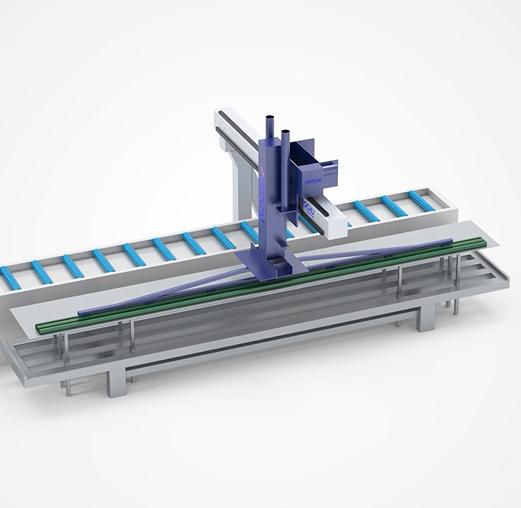
The stacking arm’s vertical travel uses a servo drive that decelerates smoothly as the pipe layer approaches the stack surface. Rather than dropping pipes from a fixed height, the arm descends to a point just above the previous layer and releases with minimal free-fall distance. This controlled placement reduces impact marks and prevents the layer-shifting that occurs when pipes bounce after a high-drop release.
Pallet contact surfaces use polyurethane or nylon wear strips rather than exposing pipes directly to wood or steel pallet surfaces. The wear strips provide a low-friction sliding surface during layer formation and a cushion during placement, then remain under the bottom layer to protect pipes from pallet nail heads and splinters during transport and storage.
Throughput and Operational Continuity
The system’s production speed adjusts to the tube mill’s actual output rather than running at a fixed cycle rate. If the mill produces at 40 meters per minute, the handling system’s conveyor and stacking arm synchronize to that pace. If the mill changes speed for a different product, the system follows without manual reprogramming. This synchronization prevents both overflow — where pipes accumulate faster than the palletizer can stack — and underflow — where the palletizer cycles empty and wastes motion energy.
For continuous-operation facilities, the machine supports 24-hour production without scheduled cooldown periods. Chain drives use sealed bearing housings with lithium-complex grease rated for the operating temperature range of a steel mill environment. Electrical cabinets include filtered intake fans and positive-pressure seals to keep metallic dust out of contactor and relay internals — a common failure mode in unprotected cabinets on tube production floors.
The transverse roller table transfer car enables pallet changeover without pausing production. While the stacking arm fills one pallet, an operator positions an empty pallet on the standby side of the transfer car. When the active pallet reaches its programmed layer count, the car shifts laterally in under 15 seconds, the full pallet moves toward bundling, and stacking resumes on the fresh pallet. This continuous-cycle design maintains throughput during the transition that would otherwise require stopping the infeed conveyor.
Labor Impact and Workplace Safety
Automating pipe handling and palletizing removes the most physically demanding job on the tube mill floor. Stacking 6-meter steel pipes by hand requires two to four workers per shift, each lifting and positioning pipes that weigh anywhere from a few kilograms for small-diameter thin-wall tubes to over 40 kilograms for heavy-wall sections. Over an 8-hour shift handling thousands of pipes, the cumulative load far exceeds occupational health guidelines for manual material handling.
The Herochu pipe handling & palletizing system reduces direct labor at the stacking station to one operator who monitors the HMI, manages pallet supply, and responds to occasional alerts. The system does not eliminate jobs — it shifts human effort from repetitive lifting to supervisory and quality-control roles that leverage judgment rather than physical endurance. Facilities that adopt automated handling typically reassign former stacking workers to inspection, packaging quality verification, or machine maintenance positions.
Safety improvements extend beyond ergonomics. The machine’s guarded perimeter keeps personnel outside the motion envelope of the stacking arm and chain drives. Since the system handles pipe movement through sensors and programmed logic rather than hand signals and verbal coordination, the risk of communication errors — where a worker enters a zone before the machine completes a cycle — drops to near zero. Light curtains and interlocked guarding provide the hardware safety layer; the integrated control system provides the operational discipline that prevents the human errors responsible for most industrial handling injuries.