What a Pipe Palletizing Machine Delivers on the Factory Floor
Steel pipe manufacturers and tube mill operators face a recurring bottleneck at the end of the production line: how to stack finished pipes quickly, neatly, and without damage. Manual stacking introduces inconsistencies in layer alignment, creates safety hazards from heavy lifting, and limits throughput to the pace of human workers. A pipe palletizing machine replaces this manual step with automated stacking that places each pipe into a predetermined pattern on pallets or designated collection zones.
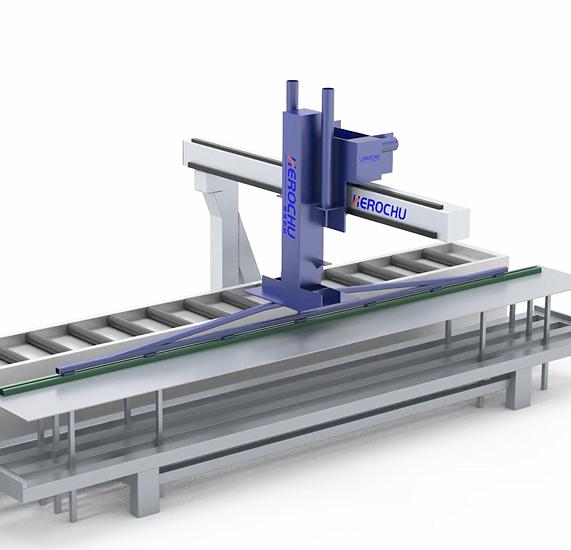
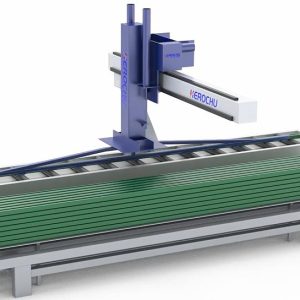
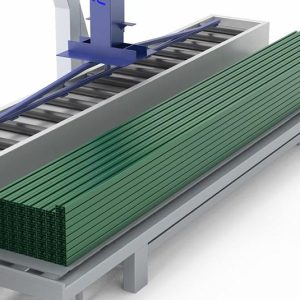
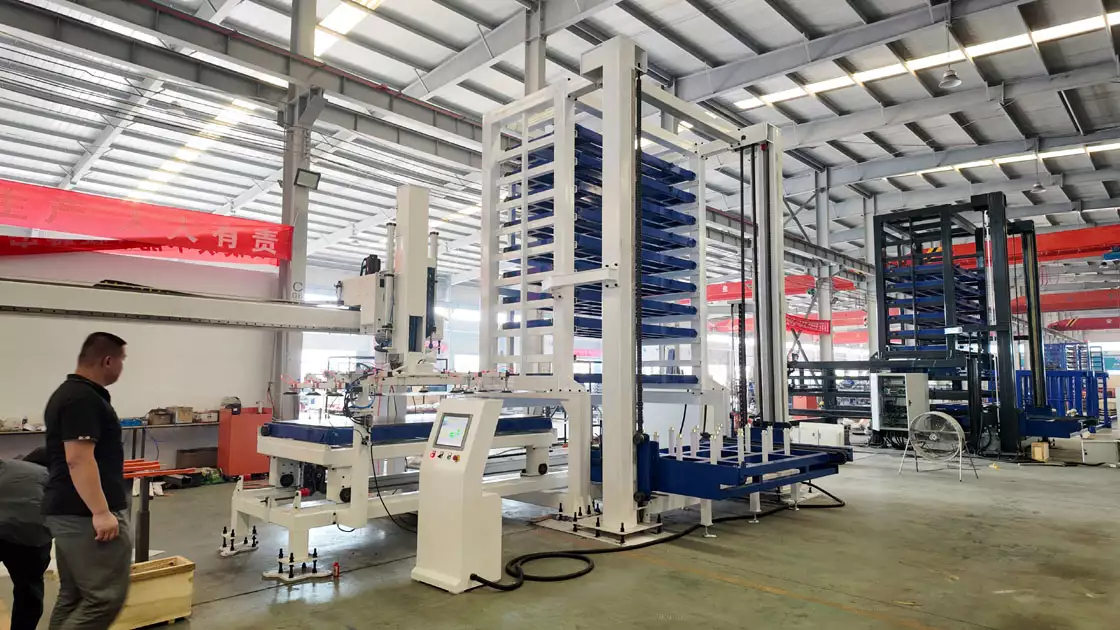
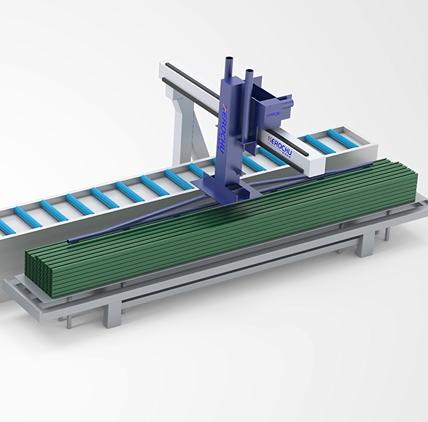
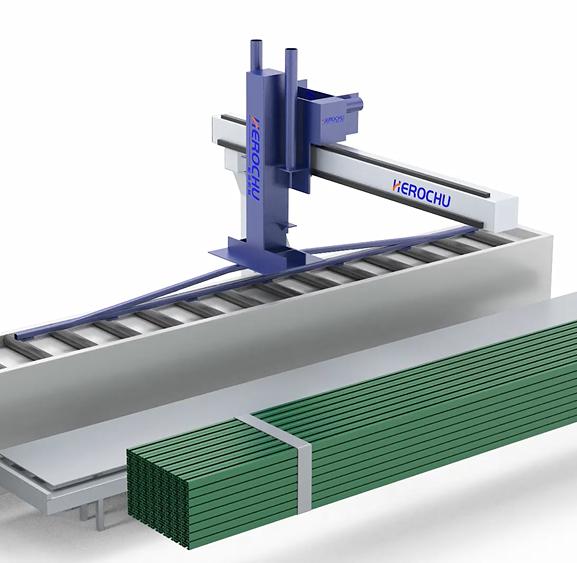
Herochu has developed an automatic pipe palletizing machine built around a column-type gantry frame. The machine receives pipes directly from the production conveyor, positions them through a robotic arm assembly, and stacks them layer by layer according to preset parameters entered through the human-machine interface. This approach eliminates the risk of pipe collapse during transit, reduces surface scratches from manual handling, and raises the overall aesthetic quality rate of finished products.
The machine handles round pipe outside diameters from 10 mm to 168 mm, with a standard pipe length capacity of 6 meters. Speed adjusts to match the actual output of the customer’s production line, so the palletizer neither creates a bottleneck nor sits idle waiting for material. A chain-driven transfer mechanism moves pipes through each stage, while motor sensing systems count and position each unit before the stacking sequence initiates.
Gantry-Type Structure and Mechanical Design
The column-type gantry frame serves as the structural backbone of the Herochu pipe palletizing machine. Two vertical columns support a horizontal bridge beam that carries the robotic arm assembly. This configuration provides the vertical clearance needed for multi-layer stacking and the lateral reach required to cover the full width of a pallet. The frame uses welded steel construction, with gusset plates at column-to-beam joints to resist the twisting forces that accumulate when stacks grow to several hundred kilograms.
The robotic arm travels along the bridge beam on linear guide rails driven by a rack-and-pinion system. Gripper assemblies at the arm end-effector clamp pipes without deforming the tube wall — a consideration that becomes important when handling thin-wall PVC and plastic pipes alongside heavier steel sections. Pneumatic or servo-driven grippers adjust clamping force based on pipe material and diameter, with settings stored in the control system for quick changeover between product batches.
Conveyor sections upstream of the palletizing zone use roller tables with adjustable spacing to accommodate different pipe diameters. Side guides keep pipes aligned as they move from the production line into the machine’s receiving zone. The transition from conveyor to palletizing arm uses a lift-and-place motion rather than pushing or rolling, which prevents the end-to-end impacts that create dents and burrs on pipe ends.
Control System and Palletizing Logic
The Herochu automatic pipe palletizing machine runs on a PLC-based control architecture with an operator-facing touchscreen interface. Operators select the pipe specification, pallet size, stacking pattern, and layer count from pre-configured recipes stored in the controller. The system calculates arm motion trajectories, gripper positioning, and layer offsets without requiring manual programming for each production run.
Stacking patterns include straight layers, staggered layers for interlocking stability, and hexagonal bag formation — a configuration widely used in the steel pipe industry where pipes nest into a honeycomb cross-section for compact bundling. For hexagonal bags, the machine automatically calculates the pipe count per layer and adjusts the placement coordinates so that each successive layer nests into the valleys of the layer below. The control logic tracks the cumulative layer height and adjusts the arm’s vertical travel to maintain consistent drop height, preventing pipes from being dropped from excessive height onto the stack.
Layer counting uses photoelectric sensors that detect each pipe as it passes through the receiving zone. The sensor array cross-checks against the programmed count per layer and triggers an alarm if a discrepancy appears — for instance, if a pipe fails to arrive due to an upstream jam or if a double-feed occurs. This closed-loop verification ensures that every pallet leaves the stacking zone with the correct quantity and pattern.
Safety Systems and Operator Protection
Multiple safety layers protect both personnel and the machine itself. Light-curtain sensors create an invisible detection field around the palletizing zone; if any object or person breaks the beam during automatic operation, the machine executes an immediate controlled stop and requires manual reset before resuming. Emergency stop buttons positioned at each operator station and at key points along the conveyor line provide additional stop authority.
Physical guarding encloses all moving components — chain drives, gear racks, and the robotic arm’s travel zone. Guards use steel mesh panels with interlock switches wired into the safety circuit, so opening any guard door during operation triggers the same controlled stop sequence as the light curtain. Warning labels and floor markings delineate the machine’s operational footprint, establishing clear zones where personnel may stand during automatic cycles.
The machine also incorporates overload protection on all motor drives. If a mechanical jam or excessive resistance occurs — from a misaligned pipe, foreign object, or component failure — the drive controller detects the current spike and stops motion before mechanical damage propagates. This protection extends equipment service life and reduces unplanned downtime on the production floor.
Customization and Integration
Every Herochu automatic pipe palletizing machine is built to order. Customers specify pipe diameter range, length, material type, desired stacking pattern, pallet dimensions, and throughput requirements. Herochu engineering reviews each specification against the standard machine platform and modifies frame dimensions, gripper type, conveyor length, and control parameters accordingly.
Integration with existing tube mill lines requires an interface study: conveyor height at the discharge point, available floor space, electrical supply specifications, and any upstream or downstream automation that must communicate with the palletizer. Herochu provides interface drawings and PLC communication protocols before fabrication begins, so the machine arrives ready for mechanical mounting and electrical connection with minimal on-site modification.
For operations that run continuous shifts, the machine supports 24-hour uninterrupted production. Chain drive components use sealed bearings that do not require daily greasing, and the control cabinet includes filtered ventilation to maintain stable internal temperature in hot mill environments. Maintenance access points position wear components — drive chains, guide rail blocks, and gripper pads — within reach of floor-level inspection, reducing the time required for preventive maintenance checks.
The pipe palletizing machine represents the convergence of mechanical engineering, control logic, and production workflow design. When a tube mill integrates automated palletizing at the end of its line, the benefits extend beyond labor savings: stacking consistency improves downstream warehouse density, automated counting reduces shipment discrepancies, and the machine’s repeatable motion eliminates the ergonomic injuries associated with manual pipe handling. Herochu builds each unit to match these operational requirements from the first specification review through commissioning and handover.