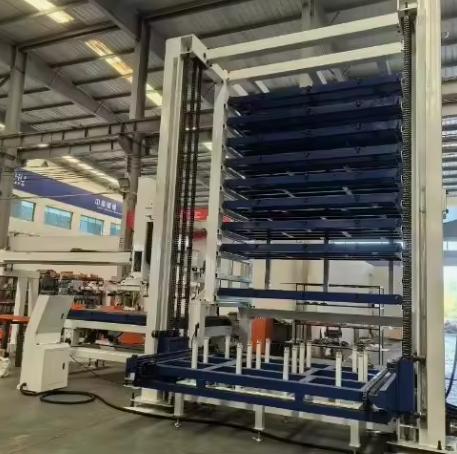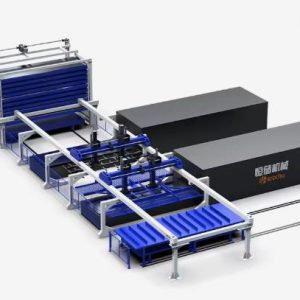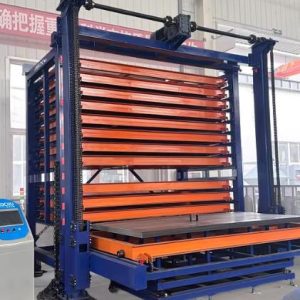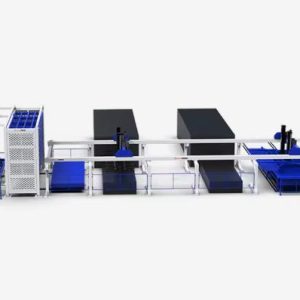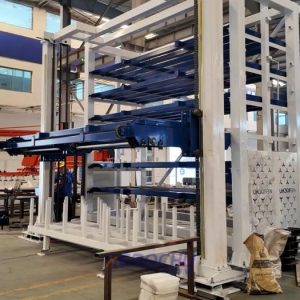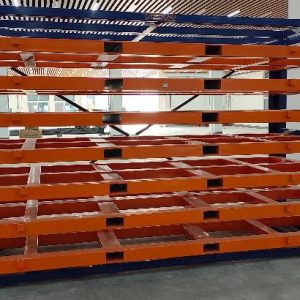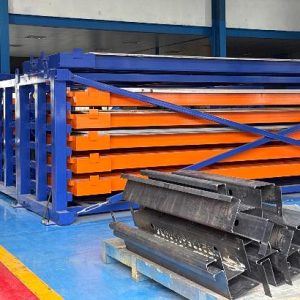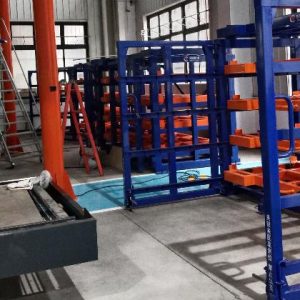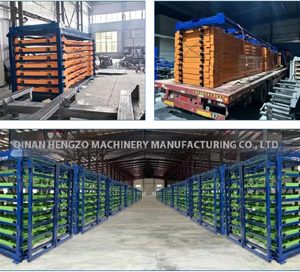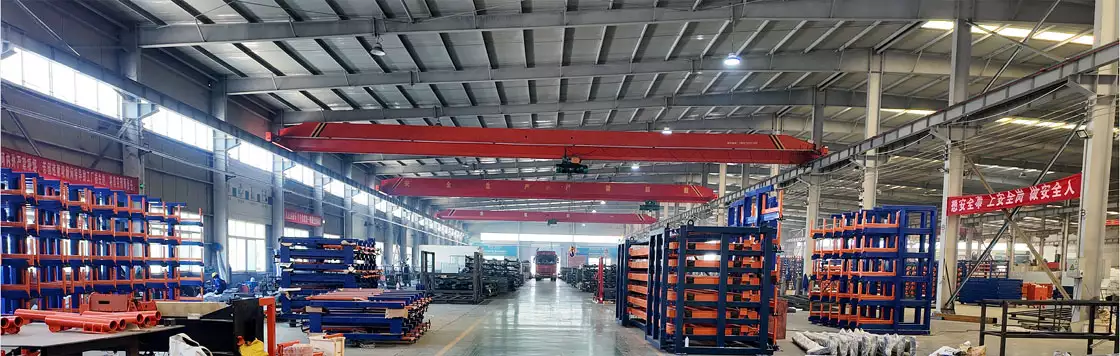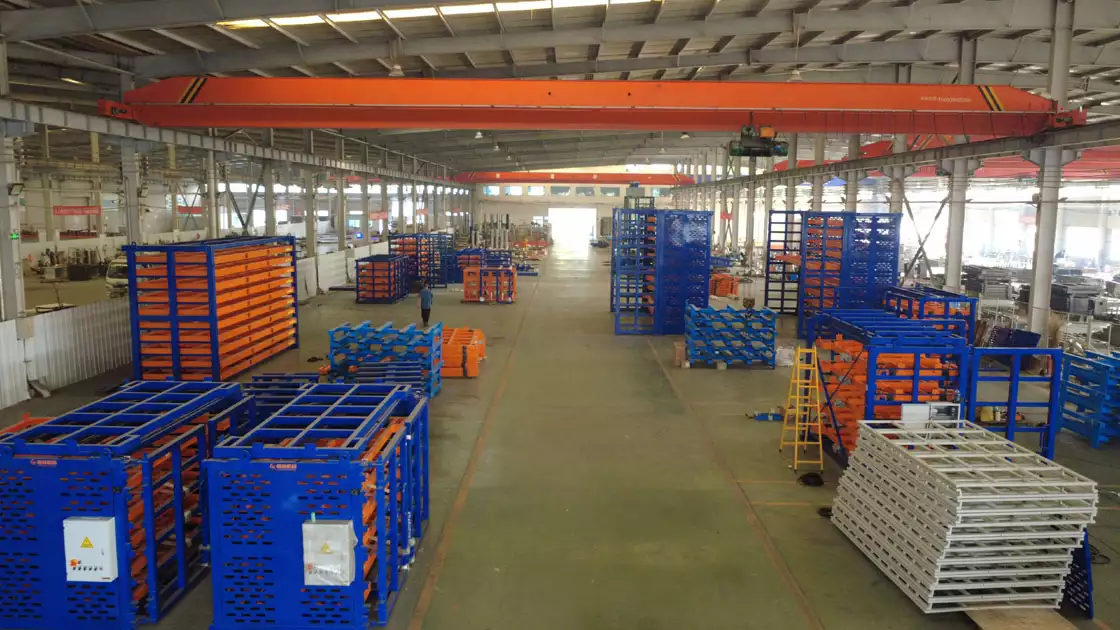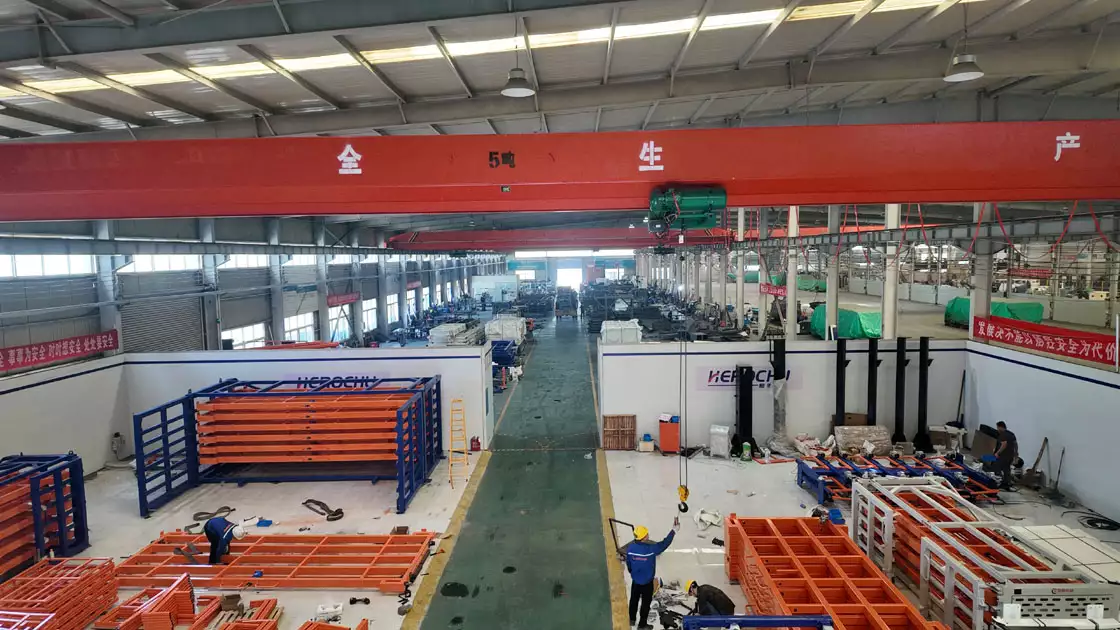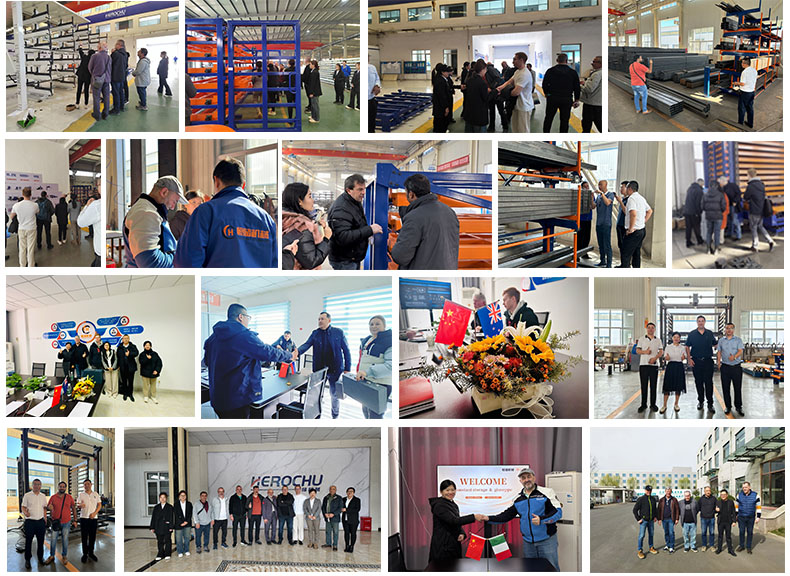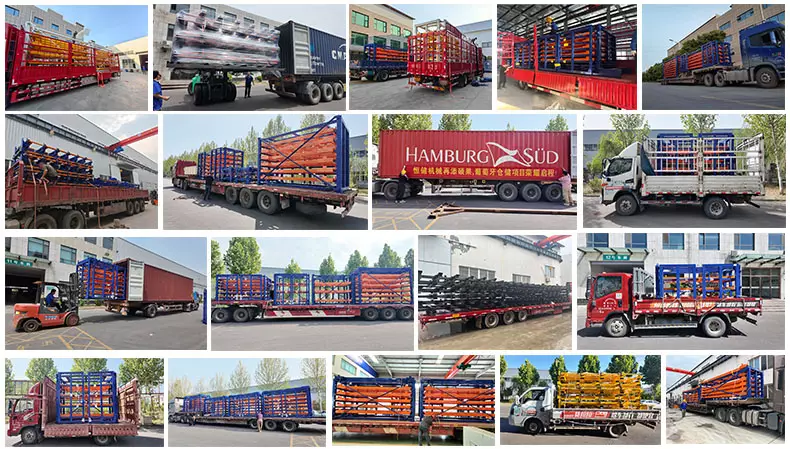
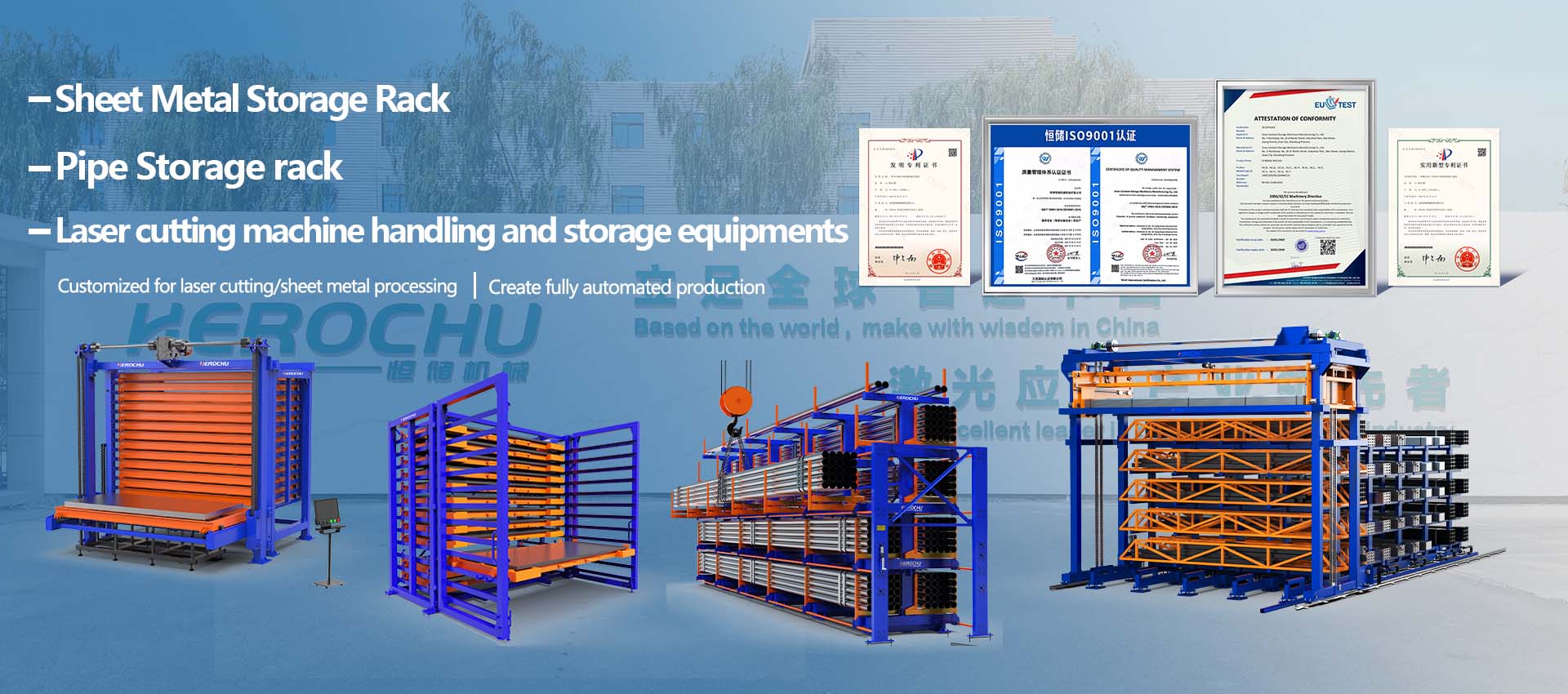
In metal fabrication facilities where floor space commands a premium and throughput determines profitability, the conventional approach of stacking sheet metal horizontally across large warehouse bays has become an operational liability. Floor-level storage not only devours square footage that could house additional production equipment but also introduces handling delays that starve high-speed cutting systems of material. Herochu addresses this fundamental inefficiency with a purpose-built High-Density Automated Sheet Metal Storage & Retrieval System engineered to collapse the distance between raw inventory and the cutting head.
Structural Engineering and Load Architecture
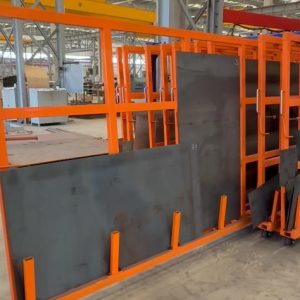
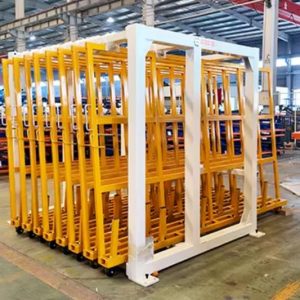
The Herochu system employs a multi-level vertical racking configuration, typically spanning 8 to 13 tiers, with each level engineered to support loads between 3,000 and 5,000 kilograms depending on the model variant. The HC-S3015-63 handles sheets up to 3,000 mm by 1,500 mm across six levels at three metric tons per tier. Stepping up in capacity, the HC-S4020-85 and HC-S6020-105 accommodate plates measuring 4,000 mm by 2,000 mm and 6,000 mm by 2,000 mm respectively, with the larger unit reaching ten storage levels at five tons per cassette.
The racking frame is fabricated from Q235B structural steel, selected for its strength-to-weight ratio and weldability under heavy cyclic loading. Every column and cross member is sized using finite element analysis with factors of safety exceeding 1.5 under worst-case eccentric load conditions. Inter-level clear spacing is set at 350 mm as standard and can be customized upward to accommodate bowed or warped plate stock that might catch during automated retrieval.
Gantry Manipulator and Motion Control
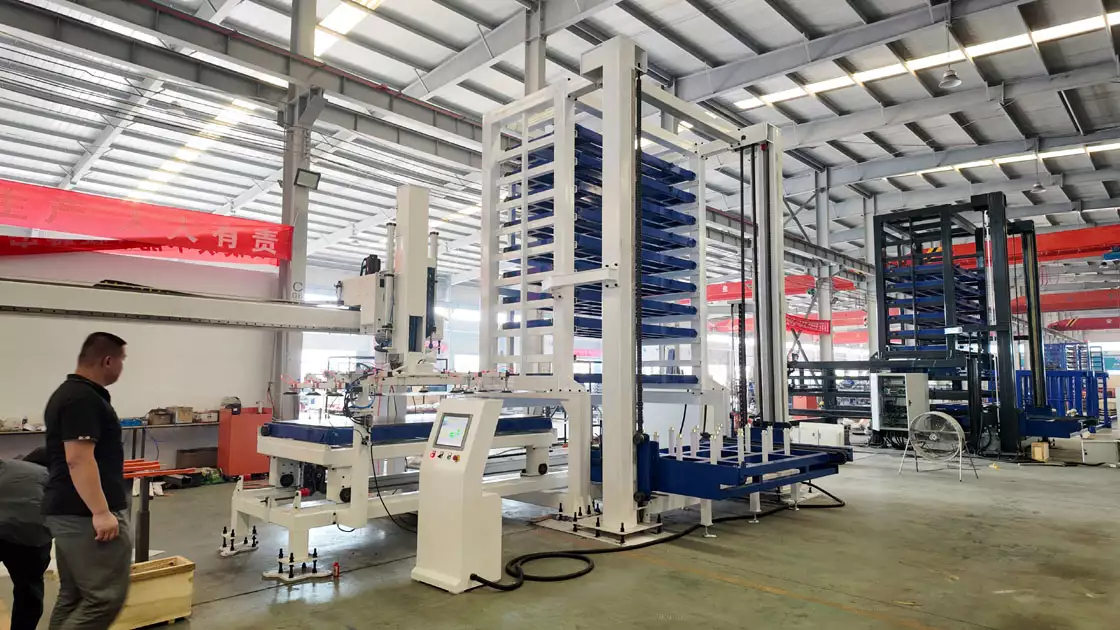
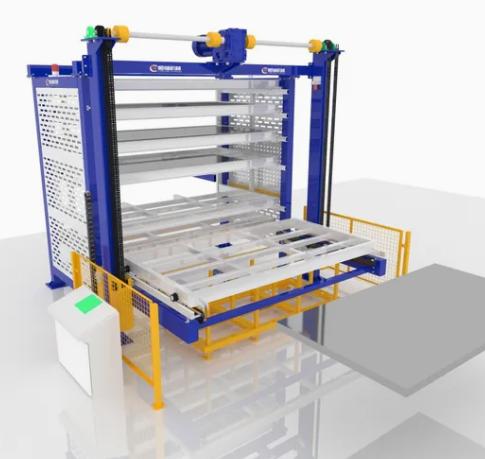
Material transfer between storage positions and the discharge station is executed by a bilateral gantry truss assembly carrying a composite truss manipulator. The gantry rides on precision-ground linear rails with rack-and-pinion drive along the longitudinal axis, delivering positioning repeatability of plus or minus 2 mm across the full travel envelope. A separate lifting carriage operates on the vertical axis through a synchronized dual-motor hoist arrangement that prevents racking or tilting under asymmetric loads.
Horizontal travel speeds for the loading arm range from 10 to 30 meters per minute, while the lifting axis operates between 5 and 10 meters per minute. These figures are not arbitrary maximums set under no-load conditions; Herochu validates all speed ratings at 80 percent of rated payload to confirm that real-world cycle times match specification sheets. A complete sheet changeover—from retrieval command to material placement at the laser bed—completes in under 90 seconds, a figure that keeps pace with modern fiber laser cutting speeds that would otherwise outrun manual material handling by a factor of four or five.
End-effector technology on the Herochu system centers on a zoned vacuum gripper matrix with individually gated suction cups. This architecture allows the controller to activate only the zones in contact with the sheet surface, preventing vacuum loss from exposed cups when handling narrower or irregularly shaped stock. A dual-needle separation mechanism coupled with a magnetic thickness sensor provides positive confirmation of single-sheet pickup, eliminating the double-feed condition that can damage cutting heads and scrap material.
Control Architecture and ERP Integration
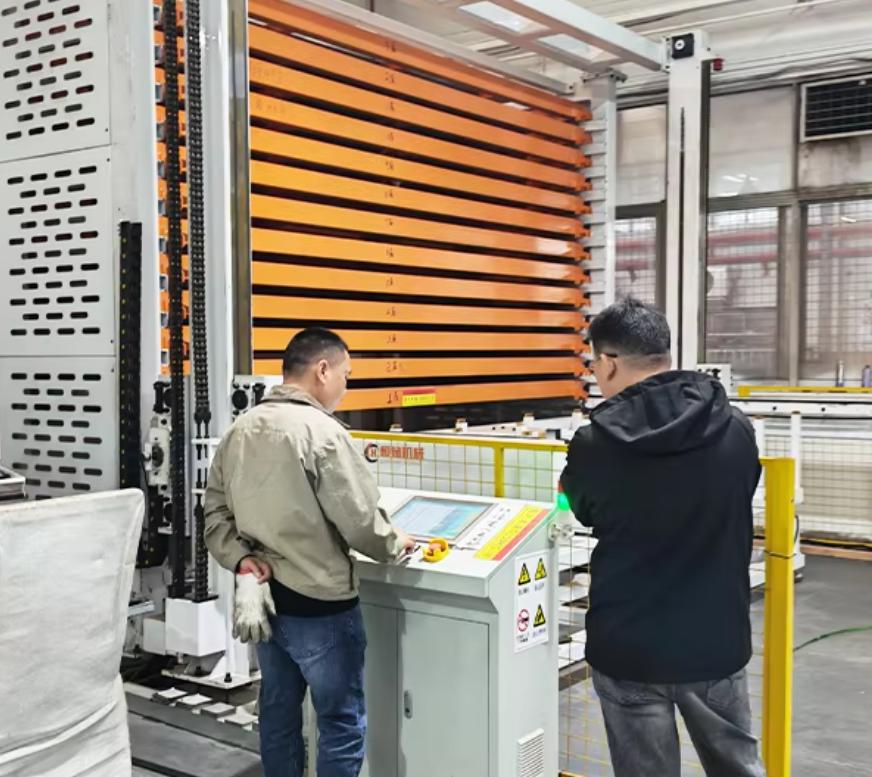
At the operator interface level, Herochu deploys a PLC-driven touchscreen HMI that consolidates all warehouse functions into a single control panel. An operator selects the material grade, thickness, and dimensions from the on-screen inventory map and confirms the delivery command; the system handles the rest without further manual intervention. Real-time inventory tracking displays live counts of remaining sheets per cassette, aggregate weight data from integrated load cells, and dimensional verification pulled from the laser cutting CAM database.
The PLC network communicates with factory ERP systems through standard industrial protocols, enabling on-demand cycle counts, automatic reorder triggers when inventory dips below user-defined thresholds, and production scheduling that accounts for material availability without manual data entry. The result is a closed-loop information chain from purchase order to finished part, eliminating the manual clipboard inventories that introduce lag and error into production planning.
Throughput and Floor Space Economics
A single Herochu high-density system reclaims substantial floor area by stacking vertically rather than spreading horizontally. A facility that currently devotes 400 to 600 square meters to ground-level sheet storage can typically consolidate into an 80 to 120 square meter footprint served by the automated depot. The liberated space supports additional production machinery or raw material staging without expanding the building envelope.
Beyond square footage savings, the throughput impact is measurable. By decoupling material staging from operator availability, the system enables multi-machine synchronization where one gantry-fed depot supplies two or more laser or punch cells with zero inter-machine waiting. During unmanned night shifts, the depot pre-stages material cassettes based on the next day’s production schedule, allowing cutting to begin the moment the first operator arrives rather than after a 30-minute material changeover period. Factories deploying Herochu automated storage routinely report daily cutting throughput increases of 40 to 60 percent compared to their previous manual storage and retrieval workflows.
Safety and Operator Risk Reduction
Heavy sheet handling is among the highest-risk activities on a fabrication floor. Manual rigging of 3,000 to 5,000 kilogram steel plates using overhead cranes and slings exposes operators to crush hazards, pinch points, and repetitive strain. The Herochu system removes personnel from the material transfer path entirely. Once sheets are loaded into cassettes at the receiving dock using standard forklift or overhead crane equipment—an operation that Herochu’s design accommodates with open front access and generous clearance—all subsequent movement is automated and gated behind physical guarding and light curtains.
Integrated weight monitoring at each cassette position provides continuous overload detection. If a pallet exceeds its rated capacity, the system locks out retrieval for that position and flags it on the HMI. This proactive load verification prevents the structural and safety risks associated with overloading that go undetected in manual warehouse environments.
Deployment Scenarios
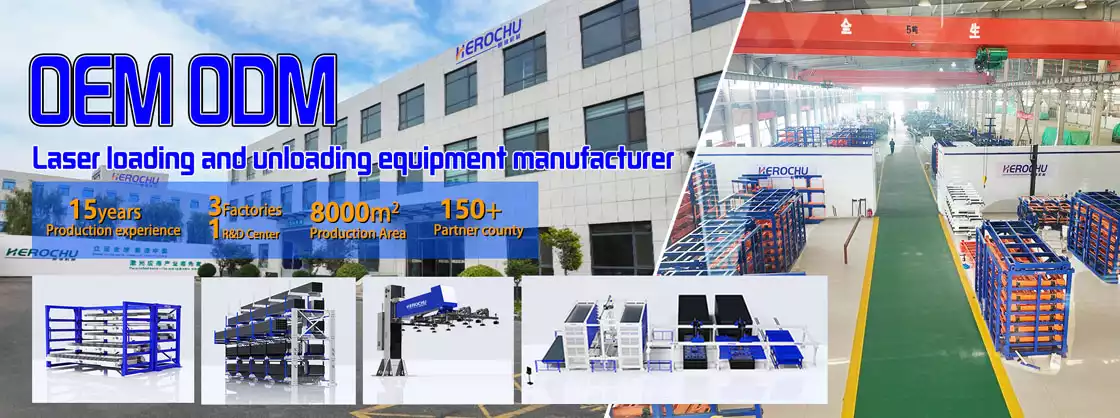
The system is configurable as a single-aisle installation serving one cutting cell or as a multi-aisle configuration with a shared gantry serving three or more machines. In multi-machine layouts, the PLC sequences retrieval and delivery commands by priority, giving production-critical jobs precedence while buffering lower-priority material movements. The racking frame can be extended vertically to a building height of 15 meters, and additional cassettes can be inserted into unused positions as production volumes grow. Herochu supplies turnkey installation including foundation anchoring, alignment, commissioning, and operator training to bring the system online with minimal production interruption.
For fabrication shops transitioning from manual to automated storage, the learning curve concentrates on the touchscreen interface rather than mechanical operation. Inventory data migration from existing spreadsheets or ERP tables into the Herochu control system is handled during commissioning, and the HMI is localized to the operator’s language preference. Routine maintenance on gantry drive components and vacuum system filters is accessible from catwalk platforms integrated into the racking structure, requiring no special access equipment.