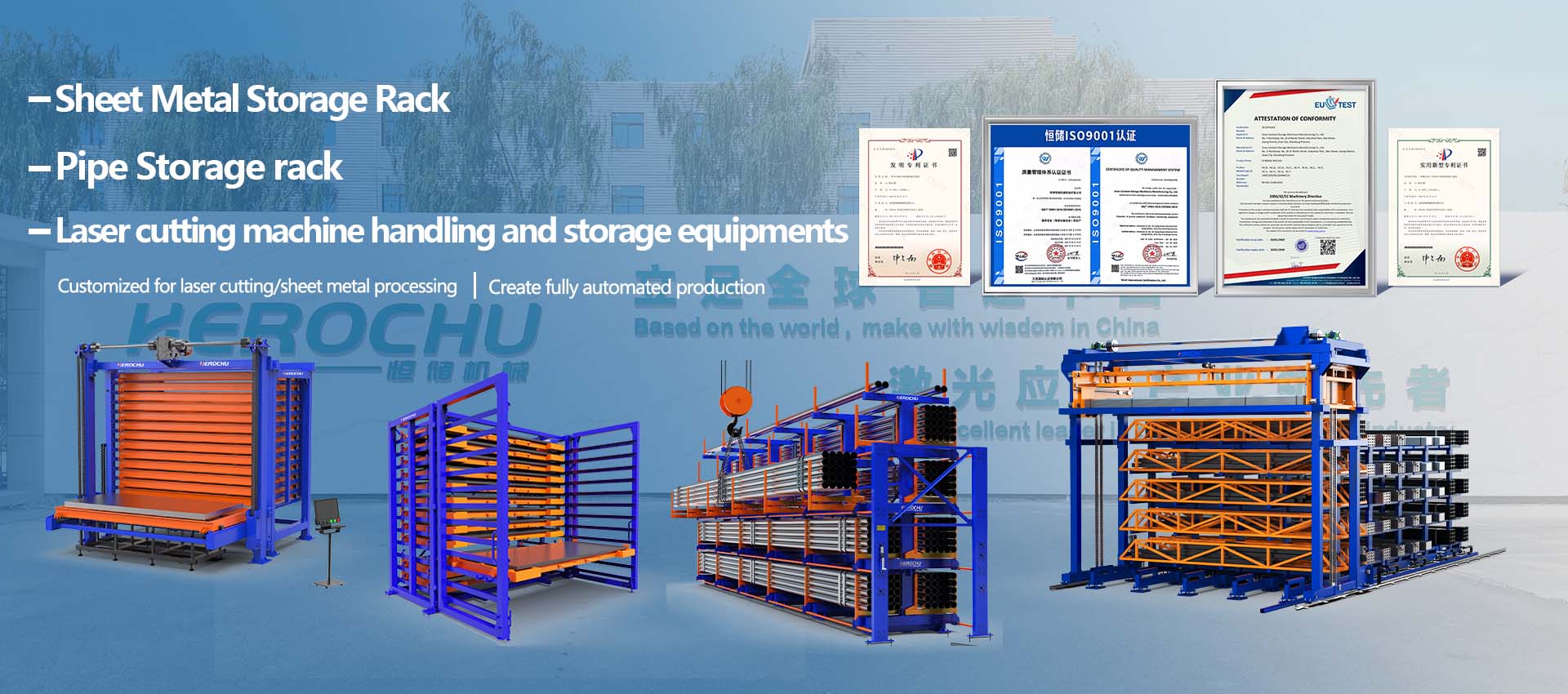
Fabrication facilities that process high volumes of sheet metal inevitably confront a spatial paradox. The material that feeds their production lines occupies significant square footage, yet the machines that consume it demand proximity to that stored material for efficient operation. Moving stock from a remote warehouse to the production floor introduces handling steps that consume labor hours and extend lead times. The answer, increasingly adopted by shops running laser and punch press fabrication lines, is vertical sheet stacking and nesting tower systems that compress storage into the third dimension without sacrificing retrieval speed.
Herochu entered the vertical tower segment with the same engineering discipline that characterizes its drawer and cantilever product lines. The result is a family of stacking and nesting towers that store sheet metal in vertically arranged compartments, each independently accessible through motorized retrieval mechanisms, and each rated for loads that match the demands of industrial sheet processing.
The Vertical Tower Concept
The physics of vertical sheet storage creates distinct engineering requirements compared to horizontal drawer or cantilever systems. In a horizontal drawer configuration, the load path from stored material to the facility floor travels primarily through the drawer carriage, the frame rails, and the vertical support columns. Gravity works in the designer’s favor: the load presses downward through the structure along a direct compression path.
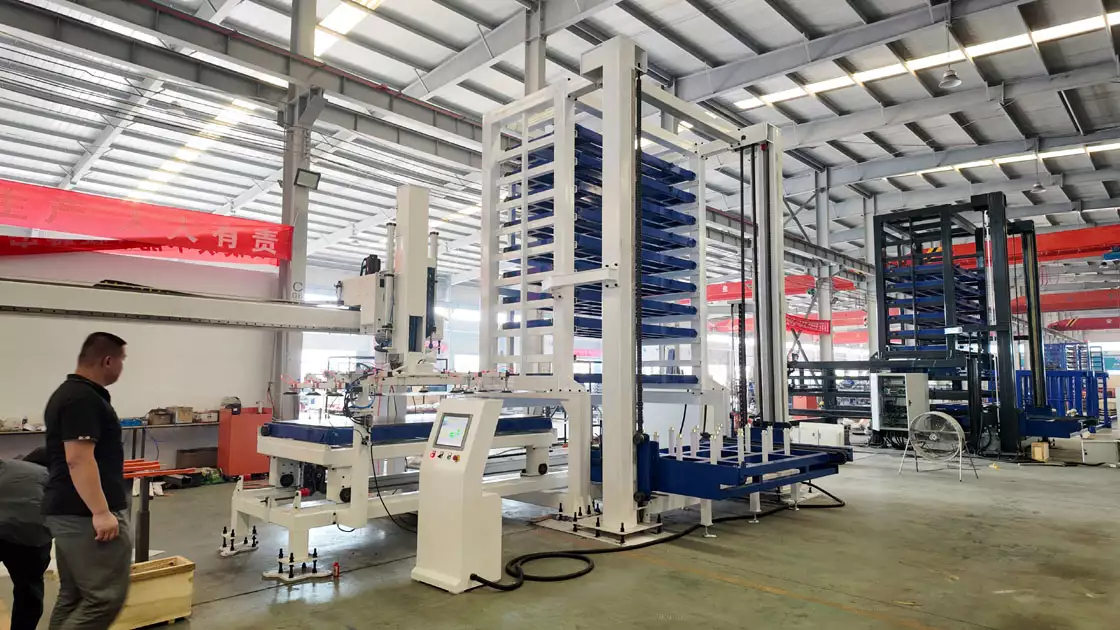
A vertical tower stacks material compartments one above another, and each compartment must be independently retrievable. This introduces an additional mechanical requirement: the ability to extract a specific compartment from the vertical stack and present it at a consistent operator access height. Herochu achieves this through an integrated elevator mechanism that traverses the full height of the tower, engaging the selected compartment and delivering it to the access position.
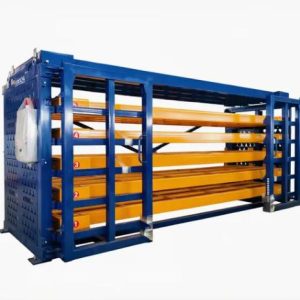
The external dimensions of Herochu vertical towers reflect the plate sizes they accommodate. For a facility processing 4000-by-1500-millimeter sheets, the tower envelope measures approximately 4505 millimeters in length, 2280 millimeters in height, and 2000 millimeters in width. The 2280-millimeter height accommodates a five-drawer-plus-top-deck configuration within a footprint that would hold only a single layer of the same sheets if stored flat on the floor. The vertical compression ratio — floor area consumed versus material stored — makes the economic case for tower systems self-evident in space-constrained facilities.
Structural Framework and Load Distribution
The structural demands on a vertical tower exceed those on a comparable horizontal rack. The frame must handle not only the static weight of stored material but also the dynamic loads introduced by compartment retrieval and the eccentric loading that occurs when heavier compartments occupy upper positions while lighter or empty compartments sit below.
Herochu constructs its tower frames from Q235B structural steel with member cross-sections selected through finite element analysis rather than rule-of-thumb sizing. The analysis considers multiple load cases: all compartments loaded to rated capacity, compartments loaded in worst-case unbalanced patterns, and dynamic loads during compartment traversal at maximum rated speed. The frame design that emerges from this analysis uses triangulated bracing in the vertical plane to resist racking forces and stiffened column sections at the corners to handle combined compression and bending.
The base frame warrants particular attention. A tower loaded to its full 30-ton-plus capacity concentrates that weight into four corner columns and their base plate connections. The base plates distribute the column loads across the concrete floor slab at pressures that must remain within the slab’s bearing capacity. For installations on existing floor slabs not originally designed for concentrated industrial loads, Herochu can specify extended base plates or supplemental steel spreader beams that reduce ground-bearing pressure to acceptable levels.
Floor anchoring follows engineering calculation rather than assumption. Chemical anchor bolts in drilled holes provide pull-out resistance for the overturning moment generated during compartment retrieval at upper levels. The anchor specification considers concrete strength, embedment depth, edge distance, and bolt spacing per the relevant structural design codes. Herochu provides anchor specifications as part of its installation documentation, and qualified installers verify concrete conditions before drilling.
The Elevator Retrieval Mechanism
The elevator mechanism that retrieves individual compartments from the vertical stack represents the most mechanically sophisticated element of the tower system. It must engage a selected compartment — potentially weighing 6 tons — lift it clear of the stack, traverse it horizontally to the access position, and hold it stationary during loading and unloading, all while maintaining the positional precision required for safe engagement and disengagement.
Herochu employs a vertical lift carriage running on guided rails along the tower’s interior. The carriage carries an engagement mechanism — typically a set of hooks, pins, or grippers — that mechanically couples to the selected storage compartment. Once engaged, the carriage lifts the compartment slightly to clear stack alignment features, then moves it to the access opening. The entire sequence is motor-driven and controlled through a programmable logic controller that sequences the engagement, lift, traverse, and lock operations.
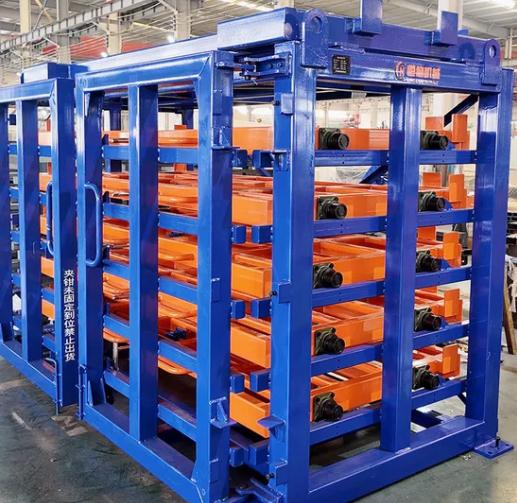
Safety interlocks prevent the elevator from operating unless the compartment is fully engaged in both the vertical and horizontal planes. Position sensors at multiple points along the travel path provide the controller with carriage location data, enabling automatic slowdown and stop functions. If a sensor indicates carriage position outside expected parameters, the system halts and requires operator intervention before resuming.
The lock-out function at the access position secures the compartment against any movement during loading. Given that a single compartment can hold 6,000 kilograms of plate material, any uncontrolled motion during the loading sequence presents a severe safety hazard. The Herochu mechanical lock-out provides positive physical restraint independent of the motor brake, ensuring that the compartment remains stationary regardless of any drive system fault.
Nesting Tower Applications in Production Lines
The term “nesting tower” describes a specific application of vertical storage technology in laser and punch press fabrication lines. In this configuration, the tower holds sheet metal organized by the nesting programs used to optimize material utilization on the cutting table. Each compartment contains sheets of a specific size and material grade that correspond to a set of optimized nesting layouts prepared by the shop’s CAD/CAM software.
The operational sequence illustrates the efficiency gain. A production scheduler releases a batch of jobs requiring 3000-by-1500-millimeter mild steel sheet at 3-millimeter gauge. The nesting tower compartment holding that material specification is retrieved to the access position. The laser operator, using an overhead vacuum lifter or magnetic hoist, transfers sheets from the compartment to the laser table one at a time until the batch quantity is met. Completed nests are unloaded from the table, and remnants too small for further nesting are removed to scrap. The compartment returns to its storage position in the tower, and the next job’s material compartment is queued for retrieval.
This nesting-tower workflow eliminates several inefficiencies inherent in floor-stack operations. Material for upcoming jobs is staged not on the floor but in designated tower compartments, keeping walkways clear and material protected. Job changeover requires only the elevator cycle time rather than a forklift trip to a remote storage area. The operator never leaves the work cell to search for material, maintaining focus on machine operation and part quality.
Integration with Automated Material Handling
Herochu vertical towers support integration with automated material handling systems when a facility’s throughput demands it. The tower’s programmable controller can interface with a factory’s manufacturing execution system or SCADA platform, receiving commands for compartment retrieval based on the production schedule and transmitting status data back to the central control system.
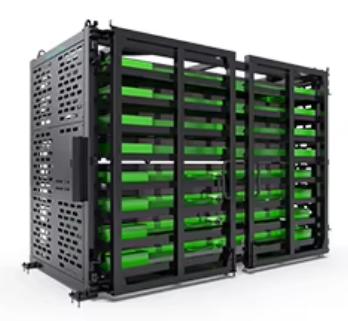
In higher levels of automation, a gantry-style sheet loader positioned between the tower and the laser or punch press table can execute the material transfer without operator intervention. The tower delivers the correct compartment to the access position, the gantry picks a sheet using vacuum or magnetic grippers, traverses to the machine table, and positions the sheet on the cutting bed. The machine starts its program, and while cutting proceeds, the gantry can return to the tower for the next sheet or handle finished part unloading.
This level of automation requires careful coordination between the tower controller, the gantry controller, and the machine tool controller. Handshake signals confirm that the compartment is locked in the access position before the gantry begins its pick cycle, and that the gantry has cleared the pick zone before the compartment is allowed to retract. Herochu provides the interface documentation and signal mapping necessary for system integrators to build these automated workflows.
Material Protection and Inventory Control
Vertical tower storage provides environmental protection that open floor stacking cannot match. While the tower is not a sealed enclosure in the sense of a climate-controlled vault, the compartment structure shields stored sheets from workshop contaminants. Cutting fluid mist, grinding dust, and welding spatter that would settle on exposed floor-stacked material are largely excluded from compartment interiors.
For materials sensitive to atmospheric exposure — such as cold-rolled steel prone to surface rust or aluminum susceptible to water stain — the tower environment, while not humidity-controlled, represents a meaningful improvement over exposed storage. Shops that add simple humidity monitoring to their tower compartments can track storage conditions and identify when environmental controls might be warranted.
Inventory accuracy benefits from the fixed-location logic inherent in tower storage. Each compartment has a defined position in the tower stack, and the controller maintains a database mapping compartment positions to material specifications. When inventory is received, it is assigned to a specific compartment and the database is updated. When material is consumed, the quantity remaining in that compartment is decremented. Cycle counting — physically verifying compartment contents against database records — becomes a straightforward task of retrieving each compartment in sequence and confirming contents, a process that can be completed during a single shift.
Configuration Flexibility
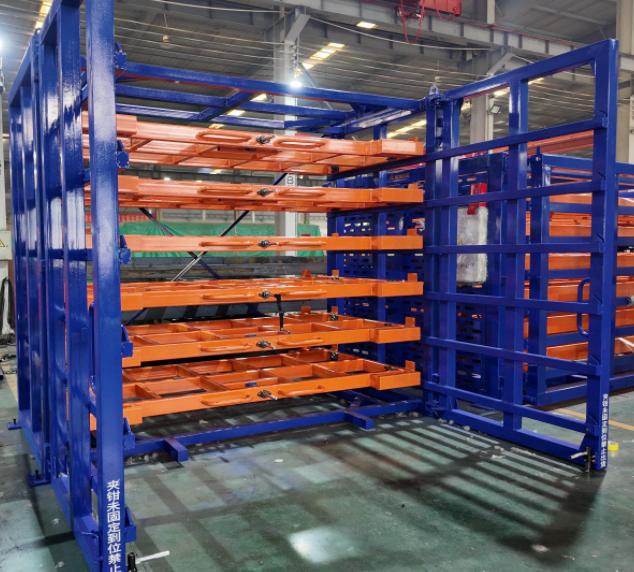
The Herochu tower product line spans multiple standard configurations, each matched to a range of sheet sizes and load requirements. The HC-B3015-63 accommodates 3000-by-1500-millimeter sheets at 3 tons per compartment. The HC-B4015-63 extends length capacity to 4000 millimeters. For larger-format processing, the HC-B4020-65 handles 4000-by-2000-millimeter material at 5 tons per compartment, while the HC-B6020-66 reaches 6000-by-2000-millimeter capacity at 6 tons per compartment.
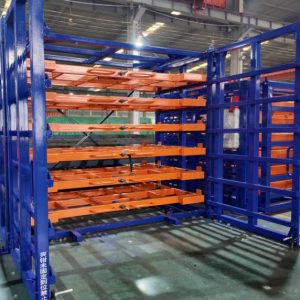
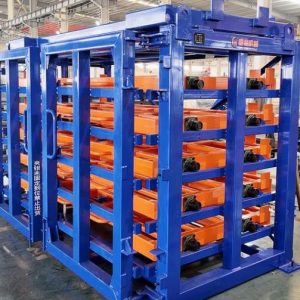
Each configuration includes five storage compartments plus a top deck, though compartment count can be adjusted upward or downward based on facility requirements. Shops that process a diverse material mix with small quantities per specification might opt for more compartments with reduced height to increase the number of distinct storage locations. Shops that run high volumes of a few material specifications might prefer fewer compartments with higher capacity each.
Custom engineering extends to compartment partitioning, specialized surface treatments for corrosive environments, integration with specific lifting equipment brands and models, and control system customization to match facility communication protocols. Herochu approaches custom requirements as engineering challenges rather than exceptions, applying the same analytical discipline to modified designs as to standard catalog configurations.
The vertical tower represents a significant investment in material handling infrastructure, and its justification rests on measurable operational improvements. Floor space recovery, retrieval time reduction, material damage prevention, and inventory accuracy gains each contribute to the return on investment calculation. For fabrication lines where laser or punch press throughput is constrained by material availability rather than machine speed, the tower pays for itself through recovered production capacity. Herochu vertical stacking and nesting towers deliver that capacity by systematically removing the material handling bottleneck that limits so many otherwise well-equipped fabrication operations.