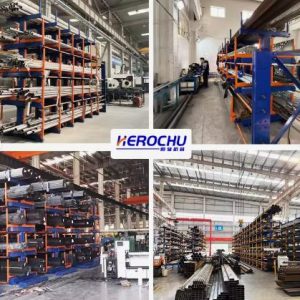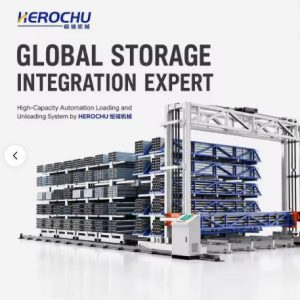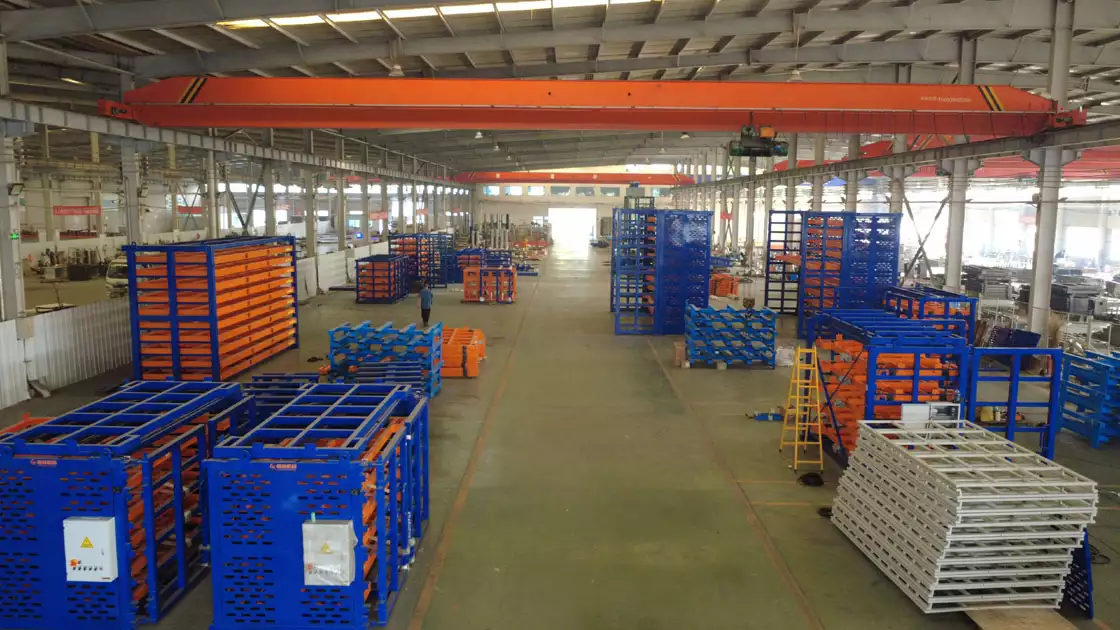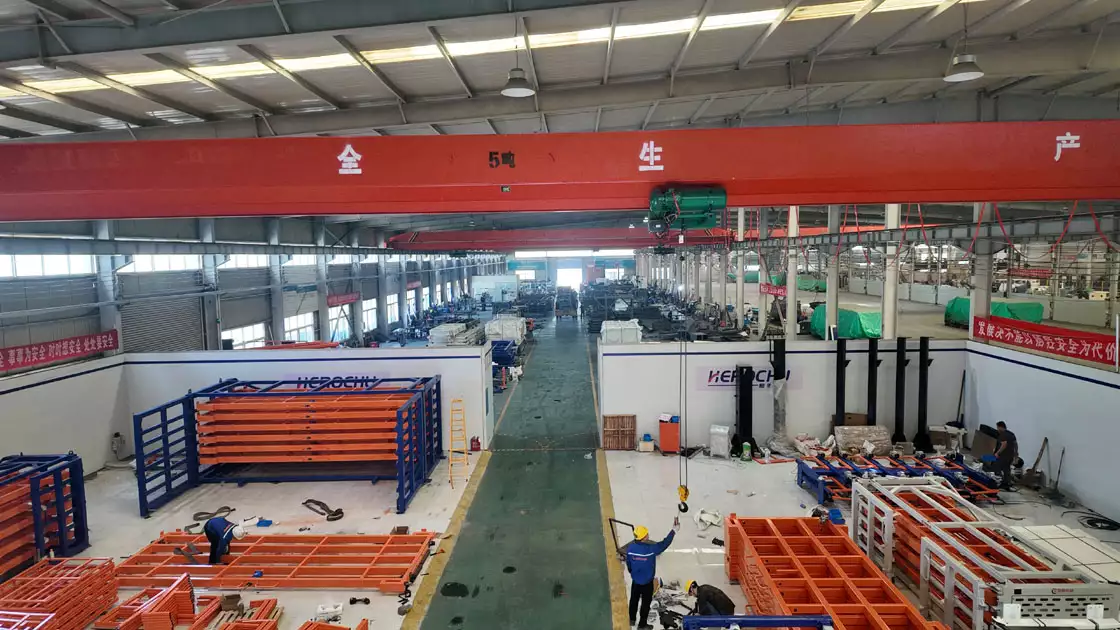
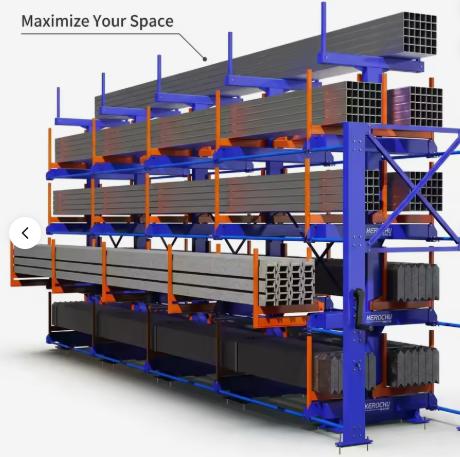
Most fabricators carry two stock lengths, not one. Six-meter pipes feed the cutting line during the day, while 12-meter material waits for long-run orders, and purlins and profiles sit somewhere between. Building separate racks for each length doubles the floor space and splits the inventory into two management systems. The Herochu electric telescopic cantilever pipe rack stores 2 to 12 meter stock in one unit, with every layer extending on its own motor. This article covers the mixed-length layout, the per-layer telescopic action, the floor space saved, and the steel frame behind it.
One rack for 6m and 12m stock
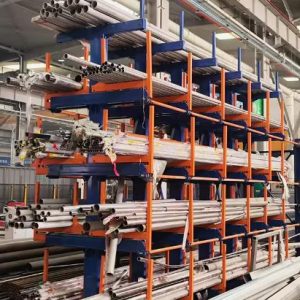
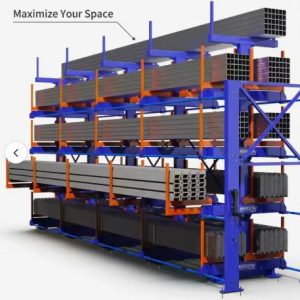
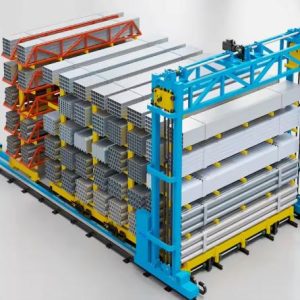
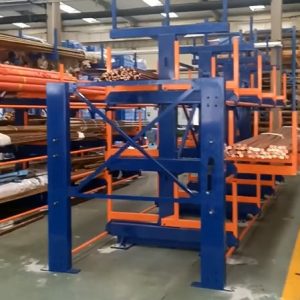
The rack accepts material from 2m to 12m, with the cantilever length set between 400mm and 1500mm to match the stock list. A 6-meter bay and a 12-meter bay can share one row: the deeper bay carries the long profiles, the shorter bay carries the daily 6-meter sizes, and both run under the same control system. Extension length is chosen per bay — long arms for 12m stock, shorter arms where aisle clearance matters. Because the rack is built to order, the bay structure is defined from the material list before fabrication starts, so there is no wasted arm length and no bay too short for the stock it holds.
Each layer extends on its own
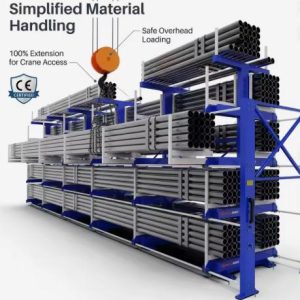
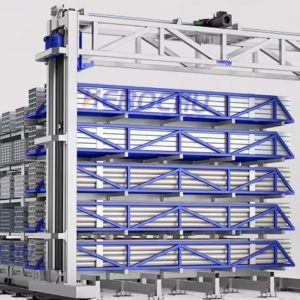
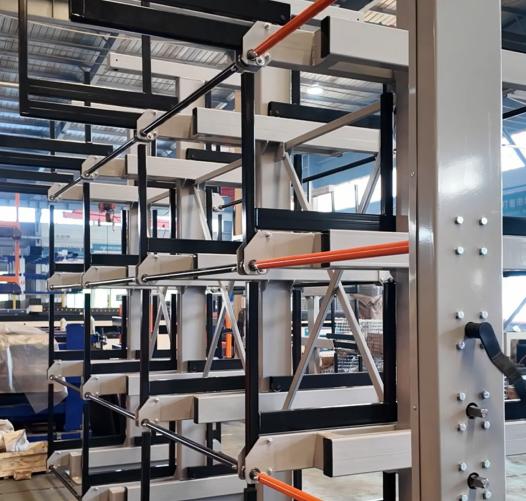
The defining feature is independent telescopic motion per layer. Every layer has its own motor, so one layer extends while the others stay locked in place. The operator presses a button, the selected layer glides out at 0.1–0.2 m/s, and the crane or fork truck picks the bundle from the extended arms. The rest of the rack does not move, which means the other five layers stay stable and the material on them is never disturbed. For mixed-length inventories this is the practical difference between a useful machine and a wall of steel: an operator retrieves exactly the bundle needed, without shifting the whole row to reach it.
Vertical layering saves more than 70% of floor space
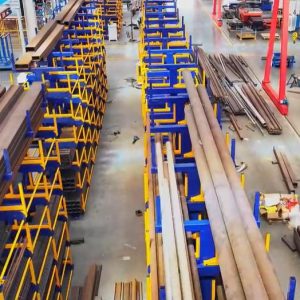
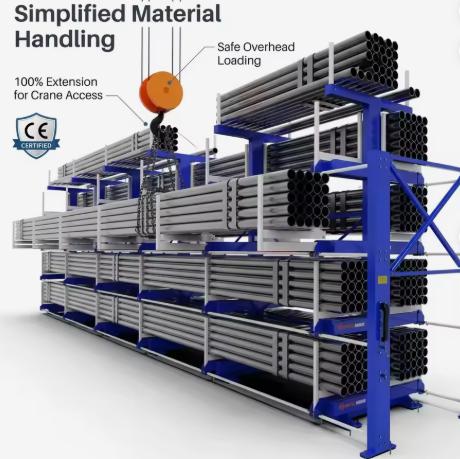
The rack stacks material vertically, layer over layer, and this is where the space calculation changes. A floor-stacked yard holding 6m and 12m stock occupies aisles and staging areas at roughly four to six times the footprint of the same tonnage stored on a vertical rack. The electric telescopic system pushes the comparison further, because the rack aisle stays narrow — the extension brings the material to the aisle instead of the fork truck driving into the rack. Warehouses that have converted report floor savings above 70% on the same inventory, which in most plants converts directly into production floor, staging area, or buffer stock for the next shift.
Modular and combinable
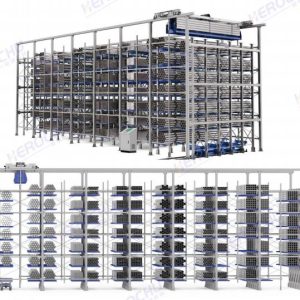
The rack is built in single-sided and double-sided versions, and multiple racks can be combined into one row with shared uprights. A double-sided unit with staggered layers is a common layout: 6m material on one face, 12m material on the other, one crane aisle serving both. Direct loading by crane and forklift is supported at every level — the frame is heavy steel, and the layer drive takes the load without hand positioning. Because the units combine, the storage system grows with the stock list. Add a bay, add a layer, or add a second face without replacing the existing rack.
Thickened Q235 cold-rolled steel frame
The frame is built from national standard Q235 thickened cold-rolled steel. The telescopic arms use an interlocking fixed-arm structure, where each extension segment nests inside the previous one; the interlock spreads the bending load across the full engagement length and gives the arm its anti-fatigue and anti-impact behavior under repeated heavy pulls. The design holds up to the cycle that wears out lighter racks: thousands of extensions, each one carrying a full bundle. Multiple safety protection devices are fitted as standard — limit switches at full extension, anti-drop catches on the moving arms, and overload protection on the drive. Herochu runs every rack through a no-load and rated-load test before shipping, and the drive units carry the operating voltage and phase marked on the control panel.
| Parameter | Value |
|---|---|
| Cantilever length | 400 mm–1500 mm (customizable) |
| Main material | National standard Q235 thickened cold-rolled steel |
| Overall height | 2000 mm–6000 mm (customizable) |
| Single arm load | 500 kg–5000 kg (customizable) |
| Drive type | Electric motor drive |
| Number of layers | 3–8 (customizable) |
| Material length | 2m–12m (customizable) |
| Standard color | Blue / yellow / orange (customizable) |
Where mixed-length racks pay for themselves
The strongest case is a processing line with two feeding lengths — a plate or profile cutting line fed by 6m stock, with 12m stock staged for large orders. The rack puts both within one crane reach, and the per-layer extension cuts changeover time because the crane never waits while an operator digs a bundle out of a stack. The same logic applies to purlin and profile storage in steel service centers, where order picking by length is the daily routine.
FAQ
Do the layer motors need special power? The standard supply is 380 V, 50 Hz, three-phase, which is common across industrial plants. Single-phase and other voltages are available on request.
Can a 12m bay and a 6m bay share one rack row? Yes. Bays are specified individually within the row, with cantilever length and layer count set per bay.
How is maintenance handled? The moving parts are the drive, the guide rollers, and the limit switches. Access to each layer’s drive is direct, and spare parts are shipped from the Herochu service stock.
Plan the row around your stock list
Bay lengths, arm capacities, layer counts, and side layout are set from the material list — the 6m and 12m sizes, bundle weights, and daily retrieval volumes. Send the list to Herochu, and the rack row is engineered to match, with per-layer electric extension and Q235 cold-rolled steel construction as standard. Contact Herochu for a layout drawing and a floor space comparison for your 6m and 12m pipes, purlins, and profiles.