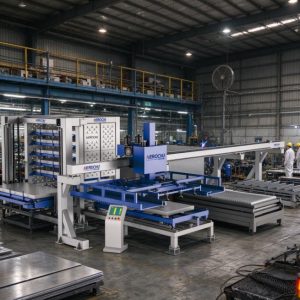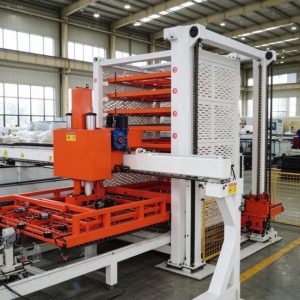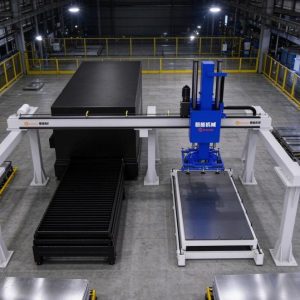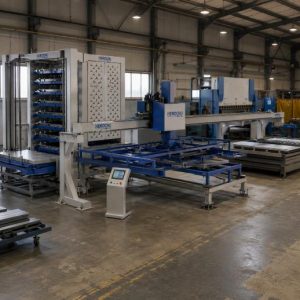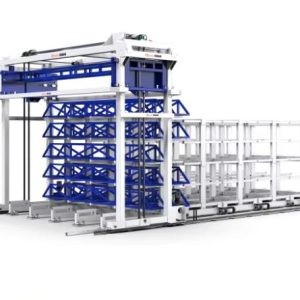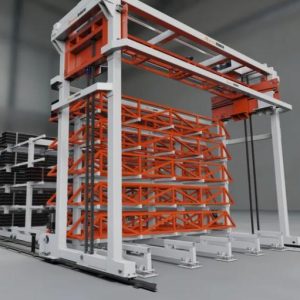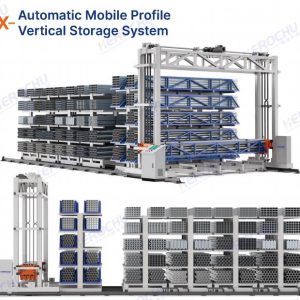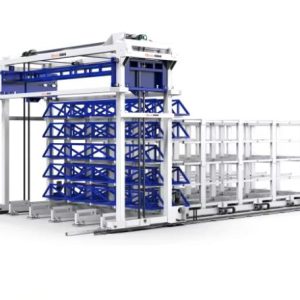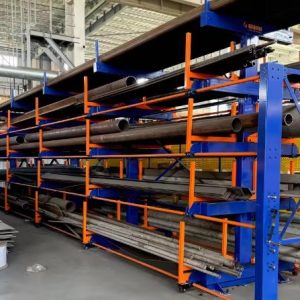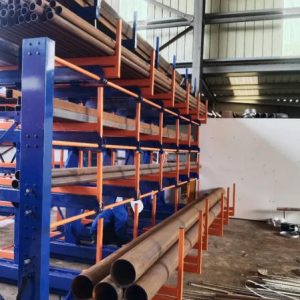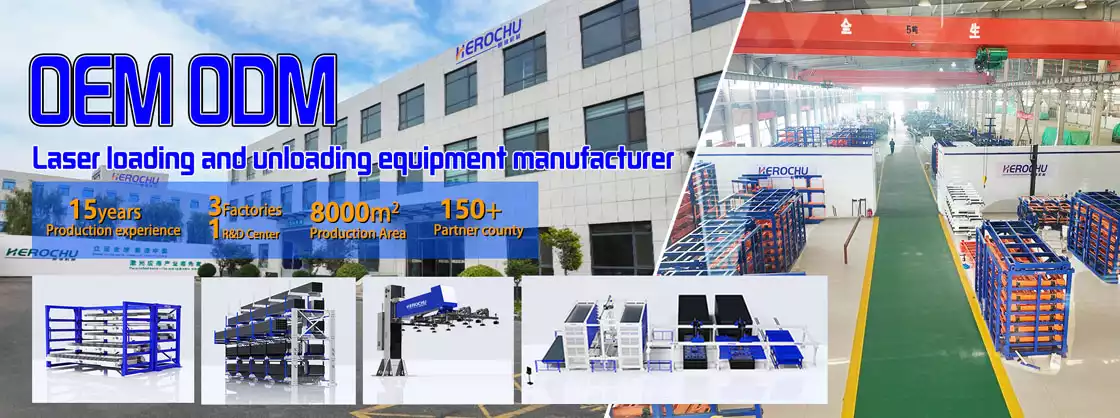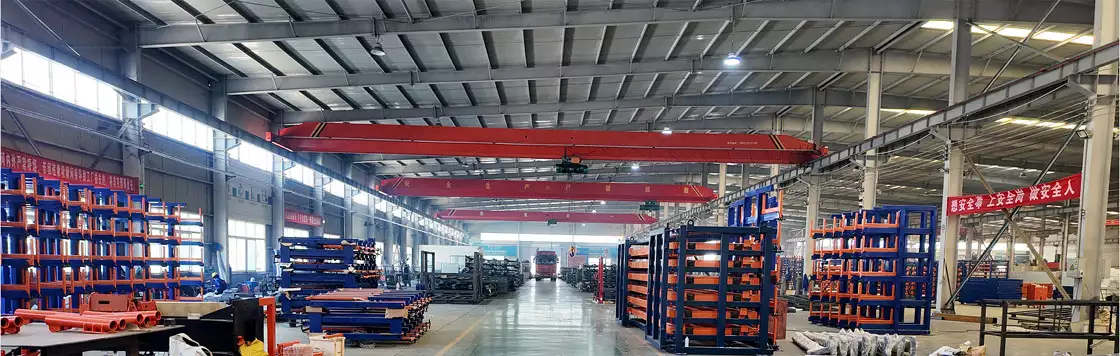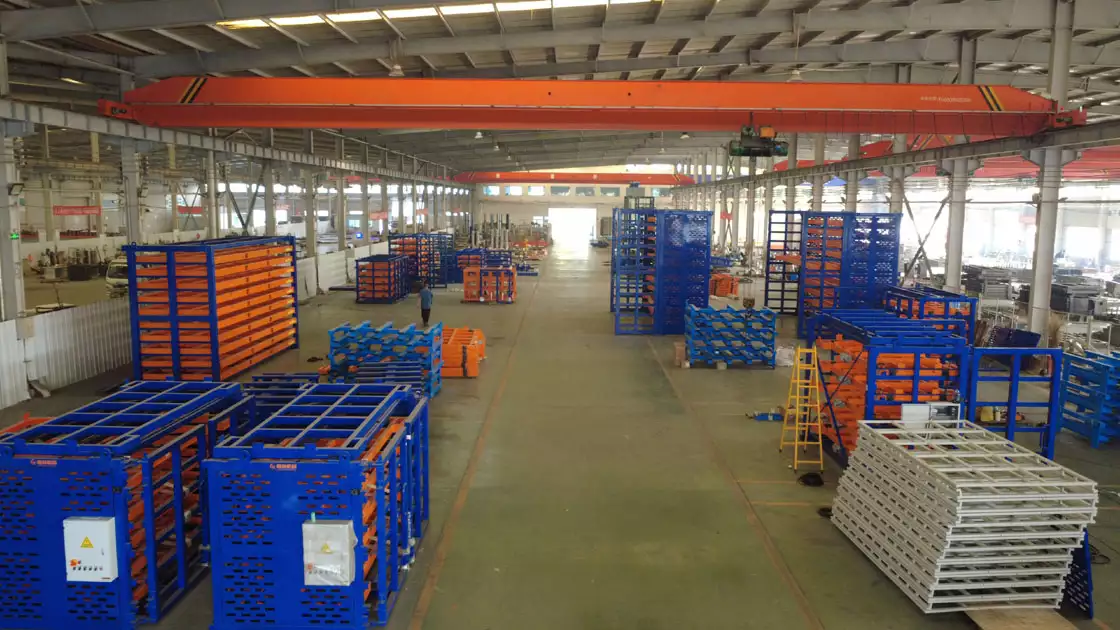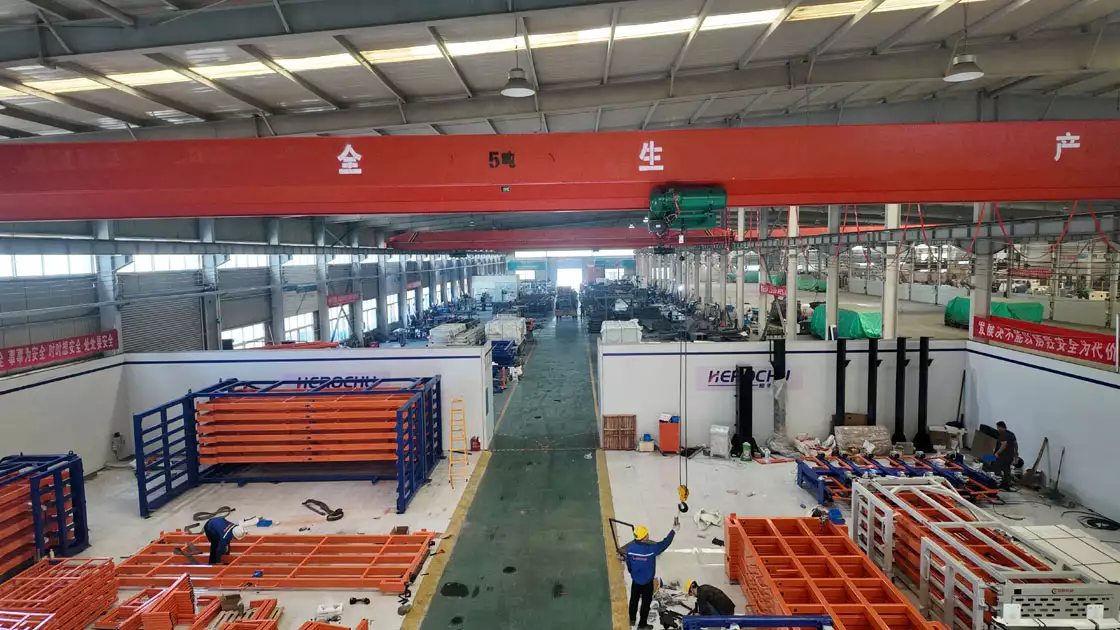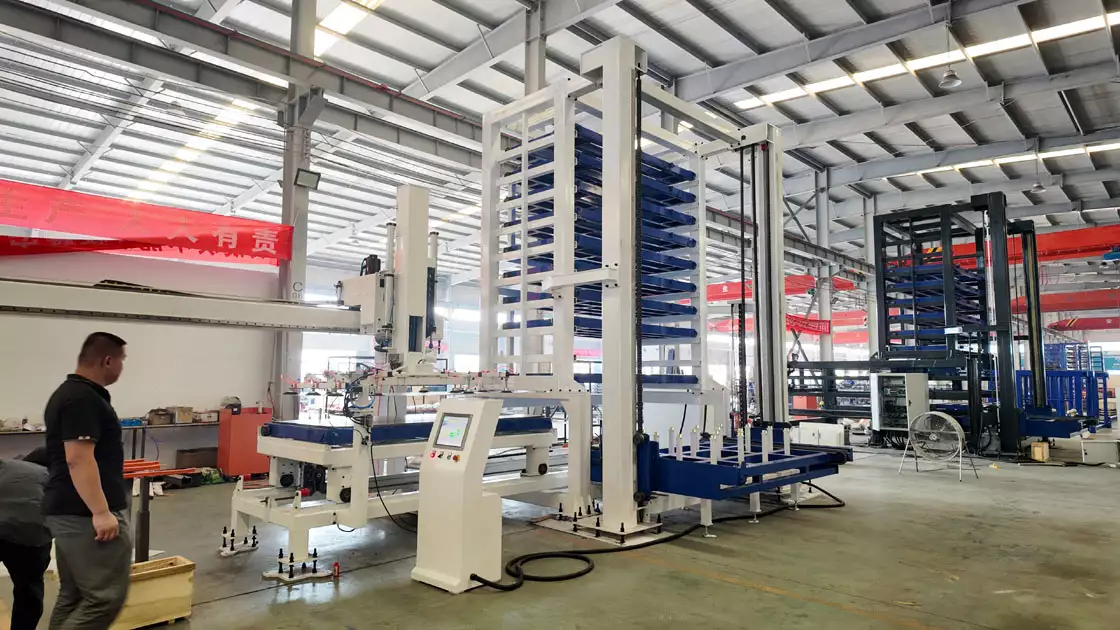
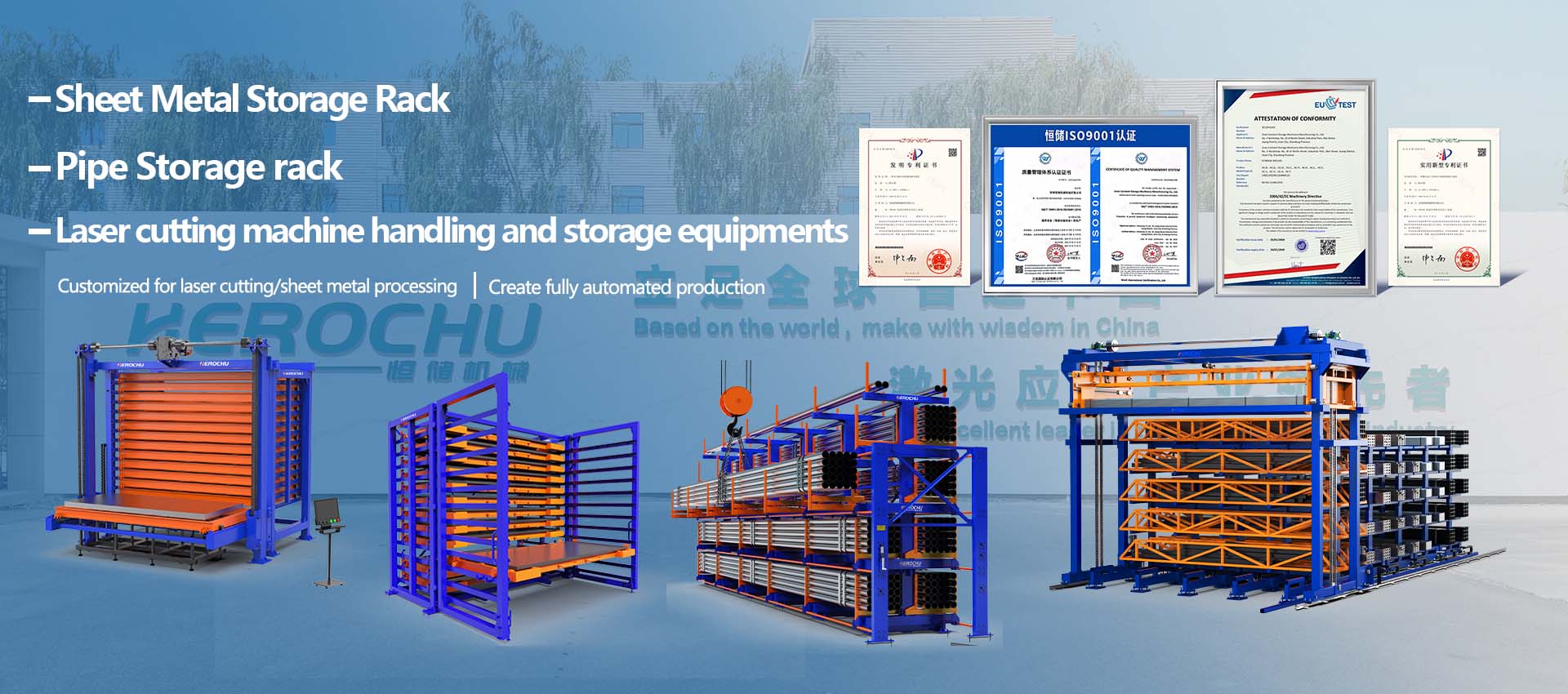
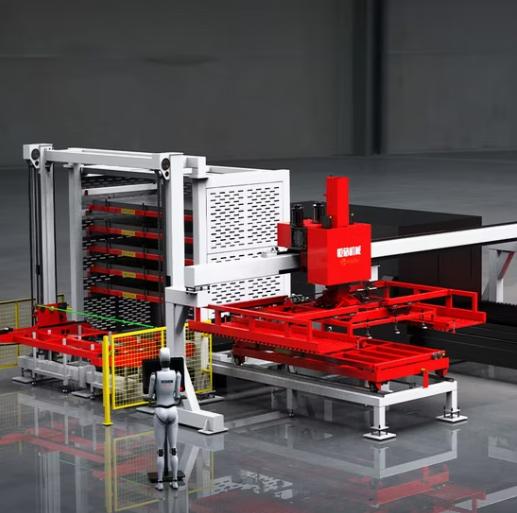
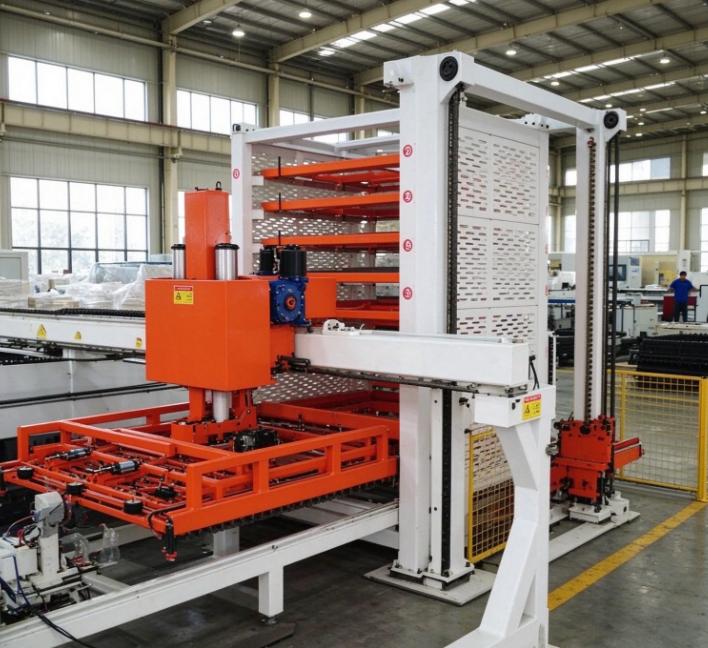
An integrated loading and unloading system pairs a vertical metal sheet storage tower with a handling head that loads blanks by vacuum suction and removes cut sheets with grippers. Herochu builds loader and tower as one machine, with ±2 mm repeatability, 10–30 m/min traverse, and coverage of 2500 × 1300 mm to 6000 × 1500 mm formats.
Two good machines standing next to each other are not an automated line. If the tower has one control and the laser has another, an operator still walks between them with a pallet truck, and the automation stops at the machine guard. The value sits in the interface.
Two jobs, one handling head
A laser cell needs sheet in and sheet out. Herochu solves both with a single gantry head:
- Loading uses computer-controlled vacuum suction, zoned to the sheet size, so a 2500 × 1300 mm blank and a 6000 × 1500 mm blank both lift flat without bowing or dropping at the corners.
- Unloading uses grippers that take the cut sheet and skeleton off the table when the program ends, the step most shops still do by hand with gloves and a shoulder at risk.
Because both actions run from the same structure, the cell needs no second safety zone and no second set of positioning references. That is why ±2 mm repeatability covers the whole cycle, not just the pick.
Sheet separation decides uptime
Anyone who has lifted a stack of 1 mm cold-rolled with suction knows the failure mode: two sheets come up as one, the laser cuts double thickness, and cut quality collapses. Separation logic in the Herochu head prevents the double-pick and the sticking that follows oiled or freshly sheared stock. The cost of getting this wrong is not a jam. It is a scrapped nest, a damaged lens, and an hour of production.
The same head places each blank against the table datum. A sheet that lands 5 mm off square cuts a part 5 mm out of position, and no nesting software recovers from that.
What a full cycle looks like
| Step | Action | Controlled by |
|---|---|---|
| 1 | Job released with nesting program | ERP / planning |
| 2 | Tower retrieves the matching pallet | WMS + crane |
| 3 | Pallet presented at transfer station | Tower control |
| 4 | Vacuum head lifts one sheet, checks separation | Loader PLC |
| 5 | Sheet placed on table against datum | Loader PLC, ±2 mm |
| 6 | Laser cuts | Laser control, handshake |
| 7 | Gripper removes cut sheet and skeleton | Loader PLC |
| 8 | Remainder returned to its bay, linked to the job | WMS |
Steps 2 to 8 run without an operator. The handshake is what makes unattended cutting possible: the loader waits for a table-clear signal, the laser waits for a sheet-loaded signal, and neither machine acts on an assumption.
Where the idle time goes
On a manual cell the laser sits idle while someone finds a pallet, opens the stack, lifts a sheet with a vacuum lifter, aligns it, and later clears the table. Those minutes repeat with every sheet, all shift. An integrated loader turns that dead time into cutting time, because the next blank is staged while the current sheet is cut. On a high-volume 3015 cell running thin gauge, the difference is measured in hours per week.
Machine range
| Model | Sheet size (mm) | Max. load |
|---|---|---|
| HC-RT2513-300 | 2500 × 1300 | 300 kg |
| HC-RT3015-500 | 3000 × 1500 | 500 kg |
| HC-RT4015-500 | 4000 × 1500 | 500 kg |
| HC-RT4020-500 | 4000 × 2000 | 500 kg |
| HC-RT6015-500 | 6000 × 1500 | 500 kg |
All models: arm traverse 10–30 m/min, lifting 5–10 m/min, fork adjustment 5–20 m/min, repeatability ±2 mm, air supply 0.6–0.7 MPa.
Matching the tower to the loader
Herochu towers run 8–13 levels with 3 t or 5 t rated layers and pallet loads from 300 kg to 3000 kg, in formats from 3015 to 6025, sized so a full shift of material sits inside the rack without a replenishment run. Special forks and a closed dust-proof structure protect the material while it waits.
Tower, loader, and laser share one air line at 1.5 m³/min and 0.6–0.7 MPa. Beyond air, the layout turns on ceiling height, floor flatness along the crane rail, clearance at the transfer station, and travel distance to the table. Herochu checks all four against the customer’s drawing before the machine is built, because moving a tower after installation is a construction project.
Questions buyers ask
Can the loader serve two laser cutters?
Layouts are usually configured for one machine per cell. Multi-machine arrangements are reviewed case by case against required cycle time and travel distance.
What happens if the laser stops mid-job?
The loader holds position and the WMS keeps the remainder linked to the job, so restarting needs no manual inventory correction.
Why buy the tower and the loader from one supplier?
When three vendors share a cell, alignment tolerances, signal timing, and blame for a dropped sheet end up in meeting minutes. Herochu supplies tower and loader as one system with one control philosophy, so the handshake is designed rather than improvised. Send the laser model and sheet list to confirm the cycle sequence for your line.