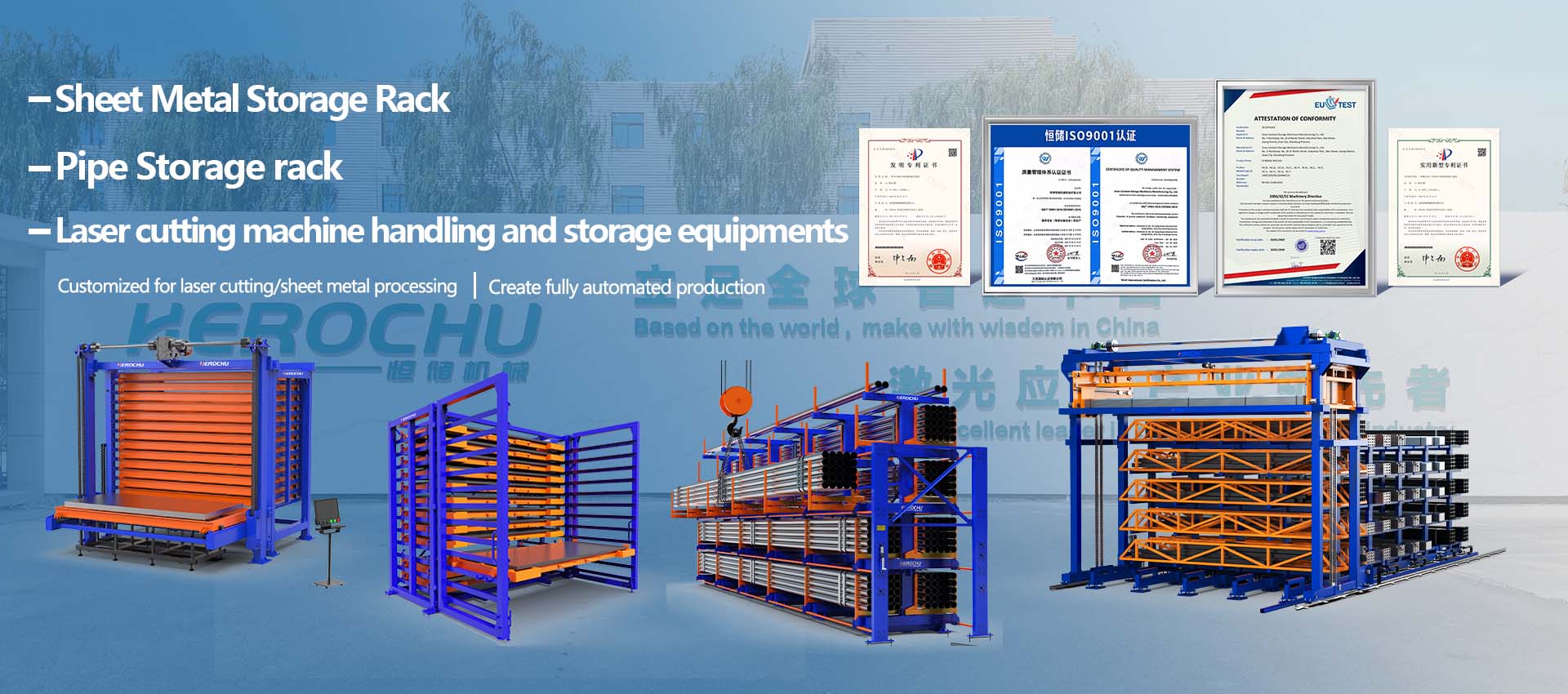
Factory automation has moved beyond a competitive advantage—it has become a baseline requirement for fabricators facing rising labor costs, tightening delivery windows, and relentless pressure on machine utilization. Among the technologies enabling this shift, the gantry loading manipulator for factory automation stands out as a direct, mechanical solution to a persistent bottleneck: getting raw sheet metal onto the cutting bed and finished parts off it, without human intervention.
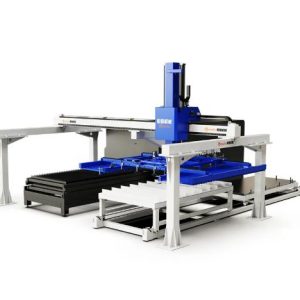
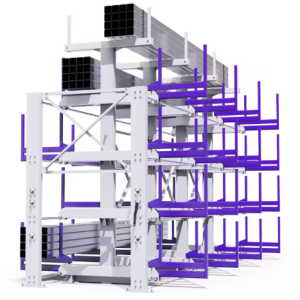
Herochu designs and manufactures gantry loading manipulators specifically for this task. The system is not an articulated robot arm retrofitted to a cutting table. It is an overhead truss structure engineered from the ground up to span storage racks and laser shuttle tables, moving sheet metal with the speed and repeatability that automated production demands.
What the System Actually Does
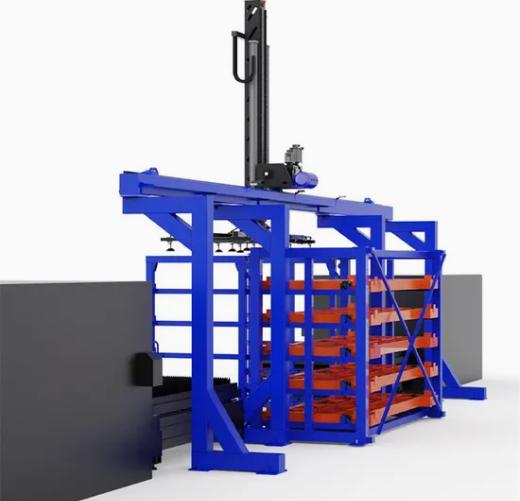
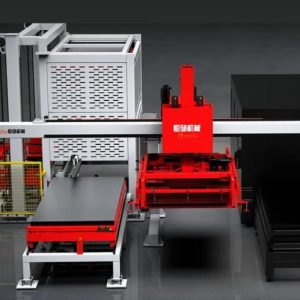
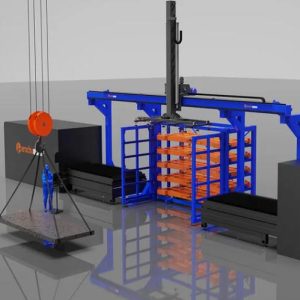
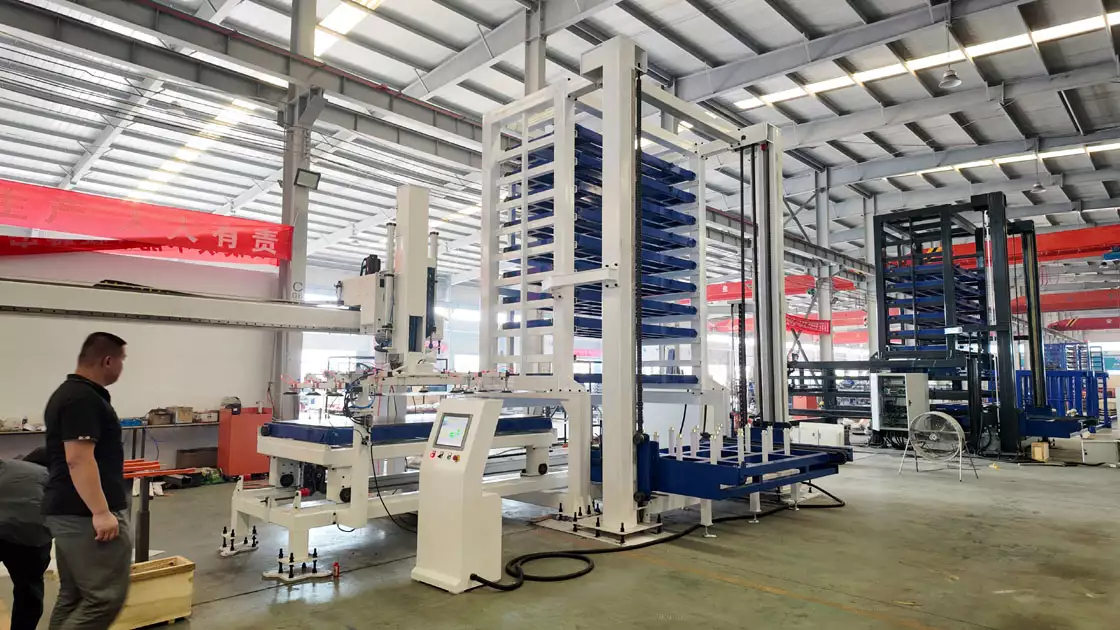
The core function is straightforward. The gantry bridge traverses the production floor on elevated rails. Suspended from that bridge is a composite manipulator head equipped with vacuum suction arrays and mechanical grippers. When a cutting cycle completes, the manipulator lifts the finished part or skeleton, deposits it onto a sorting station or finished-material cart, then retrieves a fresh raw sheet from storage and places it onto the laser bed. The laser never waits for material.
This continuous material flow is the fundamental value proposition. In a conventional setup, the laser stops while an operator or overhead crane positions the next sheet. That idle time accumulates across every shift. A Herochu gantry loading manipulator for factory automation eliminates it by decoupling material handling from the cutting cycle entirely.
Structural Design and Motion Architecture
Herochu builds these systems on a bilateral gantry truss. The dual-beam configuration distributes load symmetrically, which matters when the manipulator is carrying a 500 kg steel plate at speed. Single-beam designs tend to flex under heavy loads, introducing positioning errors that show up as misaligned cuts near sheet edges. The Herochu truss maintains rigidity across the full travel length.
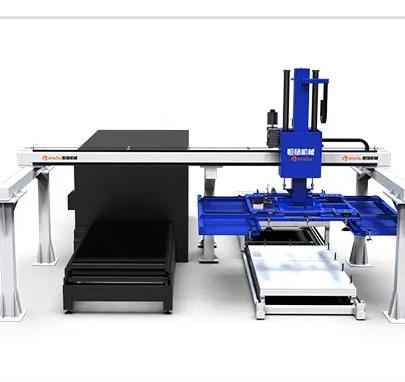
Motion is driven by variable-frequency motors running on high-precision linear guide rails. Traverse speed ranges from 10 to 30 m/min depending on model and load. Lifting speed and fork adjustment speed are separately controlled, allowing the manipulator to accelerate horizontally without destabilizing the sheet vertically. Repeated positioning accuracy holds at ±2 mm, which is sufficient for edge-finding routines to be eliminated entirely. The sheet lands where the nesting software expects it.
Sheet Separation and Material Protection
Anyone who has handled stacked sheet metal knows the problem: vacuum lifters often pick up two sheets instead of one, either because of residual oil films, protective plastic, or simple surface tension. Feeding a double sheet into a laser cutter risks head collisions and wasted material.
Herochu addresses this with an integrated sheet separation mechanism. The vacuum array engages, then the system introduces a controlled air blast or mechanical fanning action at the sheet edge, breaking the adhesion between layers. Digital pressure switches monitor vacuum levels in real time. If a seal is compromised—whether from a pre-cut hole, a warped edge, or double-pick—the system halts before the lift completes. This is not a background safety feature. It is a core reliability function that determines whether unattended operation is actually viable.
Technical Parameters
| Parameter | Specification |
|---|---|
| Sheet Dimensions | 2500×1300 to 6000×1500 mm |
| Maximum Load | 100–500 kg |
| Skip Load | 3T |
| Traverse Speed | 10–30 m/min |
| Lifting Speed | 5–10 m/min |
| Repeatability | ±2 mm |
| Air Supply | 0.6–0.7 MPa |
| Air Consumption | 1.5 m³/min |
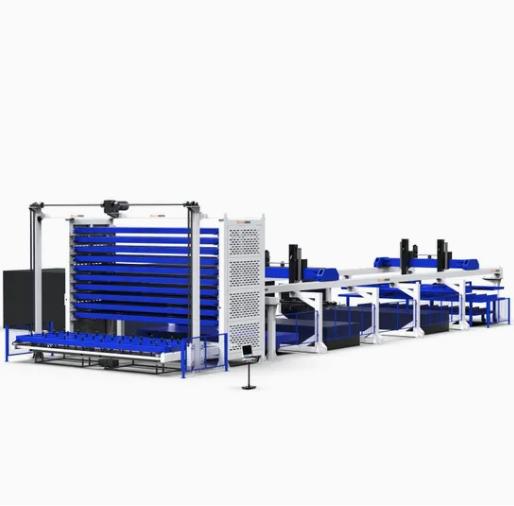
These specifications cover the bulk of sheet metal formats used in fiber laser cutting operations. Custom dimensions are available for non-standard warehouse configurations.
Integration with Laser Cutting Cells
The manipulator is controlled by a PLC system with a touchscreen HMI. Communication with the laser cutter occurs through standard fieldbus protocols, allowing the manipulator to read machine status and time its movements to the cutting cycle. When the laser signals cycle complete, the manipulator moves. When the laser signals ready for load, the manipulator positions the next sheet.
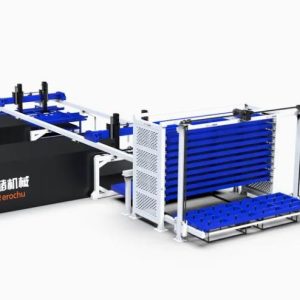
For fabricators running multiple laser machines, Herochu offers a one-to-two configuration. A single gantry manipulator can service two cutting systems, queuing loading demands and feeding both machines without either going idle. This architecture maximizes the return on the gantry investment by spreading its cost across a larger production volume.
The Operational Case
The case for a gantry loading manipulator for factory automation rests on three measurable outcomes. First, laser uptime increases because material handling no longer gates the cutting cycle. Second, labor costs decline because one operator can supervise multiple automated cells rather than manually loading a single machine. Third, workplace safety improves because workers are no longer lifting heavy plates onto cutting beds.
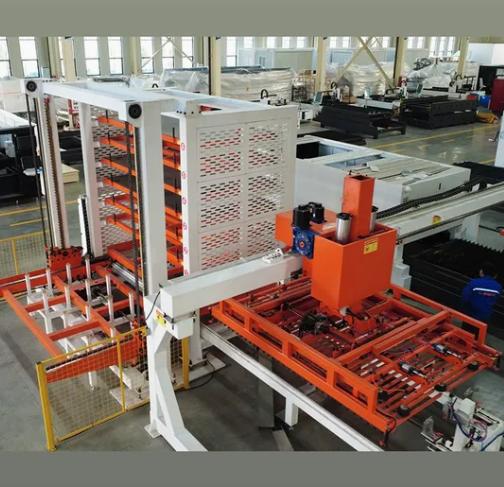
Herochu has engineered this system to operate continuously, including overnight shifts and weekends, with minimal maintenance intervention. The mechanical architecture is intentionally simple: linear guides, rack-and-pinion drives, accessible lubrication points. When maintenance is required, it does not demand specialized service contracts or proprietary parts.
For fabricators evaluating automation, the question is not whether gantry loading is technically feasible. It is whether the specific system matches the production profile. Herochu publishes full specifications and offers configuration support to ensure the manipulator fits the warehouse, the laser, and the material mix it will handle.