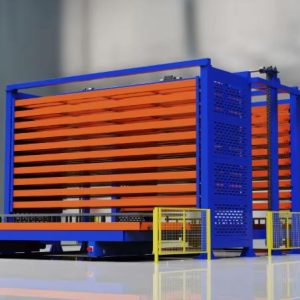
The spatial economics of sheet metal storage present a persistent challenge for fabrication facilities. Traditional racking systems consume vast floor areas while providing limited storage density, forcing operators to choose between maintaining extensive material inventories and preserving production floor space. Herochu’s Twin-Tower Vertical Storage Rack for Sheet Materials resolves this dilemma through an innovative architectural approach that leverages vertical space while minimizing horizontal footprint.
The Twin-Tower Architecture: A Fundamental Rethinking of Material Storage
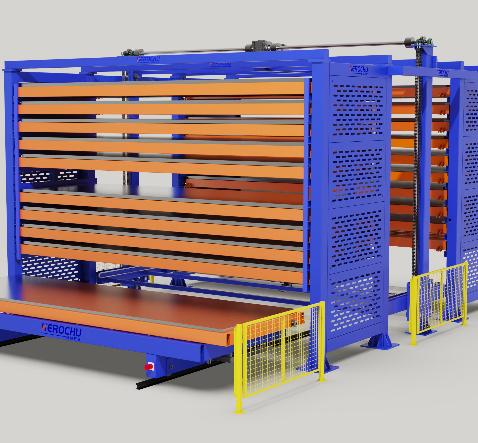
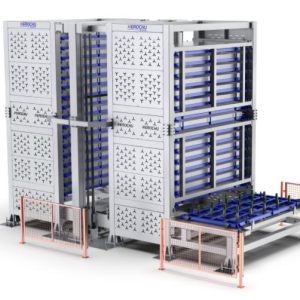
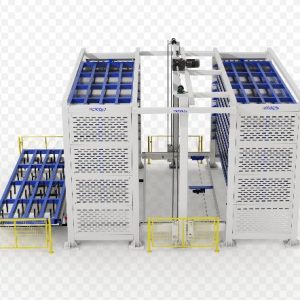
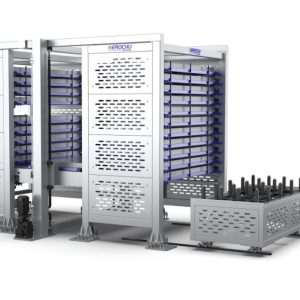
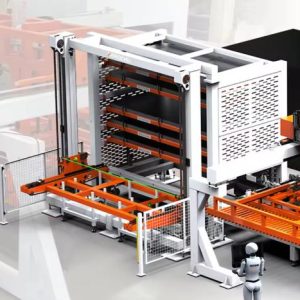
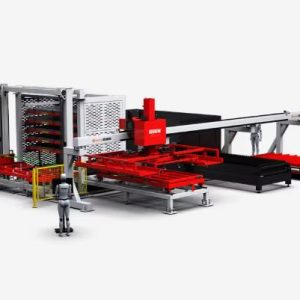
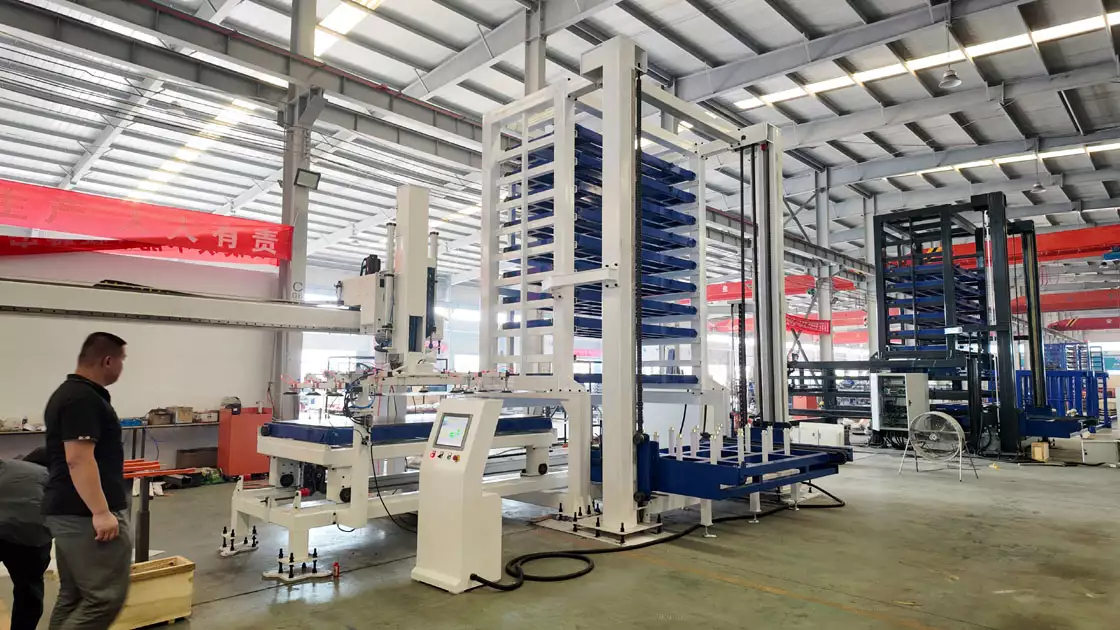
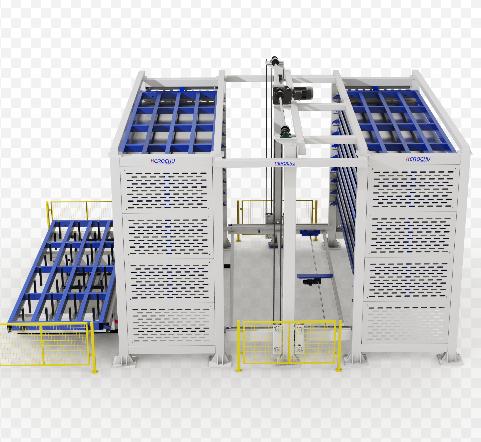
At its core, the Twin-Tower Vertical Storage Rack for Sheet Materials comprises two independent storage columns served by a single centralized lifting mechanism. This configuration fundamentally differs from conventional approaches that would stack two independent towers side-by-side—an arrangement that requires redundant aisles, duplicate lifting mechanisms, and significantly larger floor space allocations.
By integrating the lift between the two towers, Herochu eliminates the wasted aisle space that plagues conventional racking configurations. The elevator mechanism services both towers with impartial efficiency, retrieving sheets from either column and delivering them to the outlet position without wasted travel. This centralized architecture reduces mechanical complexity, lowers maintenance requirements, and improves overall system reliability.
The twin-tower configuration is particularly advantageous for facilities dealing with materials that exceed standard dimensions. Long sheets, wide plates, and oversized panels that would be awkward or impossible to store in conventional racking systems find efficient accommodation within the twin-tower vertical arrangement.
Engineered for Extreme Loads
Herochu constructs the Twin-Tower Vertical Storage Rack for Sheet Materials with the same rigorous engineering standards that define the entire product line. Finite element analysis using Simsolid and Ansys validates every structural component, ensuring that the system achieves its rated load capacities with substantial safety margins.
The main load-bearing elements employ cold-rolled steel pipe construction, delivering the high strength-to-weight ratio essential for vertical storage applications. The integral bilateral frame design, combined with triangular oblique span beams, distributes loads evenly across the structure, preventing stress concentrations that could lead to premature fatigue or failure.
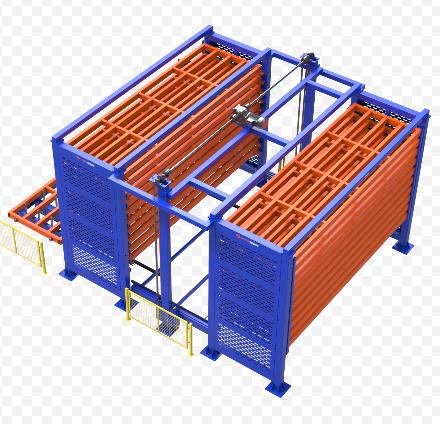
Each storage level accommodates up to 5 tonnes of material, with the system supporting 8 to 13 levels depending on configuration. The chain-driven transmission and linear guide rail movement system deliver smooth, precise positioning even when handling maximum payloads.
Operational Speed and Throughput
The Twin-Tower Vertical Storage Rack for Sheet Materials achieves vertical lifting speeds of 9 meters per minute, with inlet and outlet speeds reaching 12 meters per minute. This rapid movement capability ensures that material retrieval does not become a production bottleneck, even in high-throughput environments.
The system’s automated access mechanism incorporates high-precision robotic arms and AGV transfer systems, eliminating manual handling entirely. Single material retrieval completes in 10 seconds or less, enabling continuous material flow to laser cutting machines and other downstream equipment.
Intelligent Material Tracking and Management
Each board stored in the Twin-Tower Vertical Storage Rack for Sheet Materials receives an RFID tag upon entry, establishing a digital identity that persists throughout the material’s lifecycle. The system tracks every movement—storage, retrieval, and consumption—creating a complete audit trail accessible through the management interface.
IoT sensors provide continuous monitoring of storage positions, verifying pallet location, measuring steel plate weight, detecting overweight conditions, and confirming empty slot status. This real-time awareness enables the system to maintain accurate inventory records without manual intervention and to generate automatic alerts for replenishment or clearance requirements.
Integration with Manufacturing Execution Systems
The Twin-Tower Vertical Storage Rack for Sheet Materials operates under programmable logic controller (PLC) control, providing seamless integration with manufacturing execution systems and enterprise resource planning platforms. The PLC system manages all movement operations, coordinates with upstream material handling equipment, and communicates status information to higher-level systems.
Default language support includes Chinese and English, with region-specific customization available for international installations. The user interface presents real-time stock levels, production schedules, and maintenance alerts through an intuitive graphical display.
Customization for Specific Operational Requirements
Herochu offers extensive customization options for the Twin-Tower Vertical Storage Rack for Sheet Materials:
- Storage levels: Configurable from 8 to 13 layers to match facility height and inventory requirements
- Load capacity: Per-shelf capacity from 1 to 6 tonnes, accommodating diverse material types and weights
- Color: Available in custom colors to meet facility standards or safety requirements
Space Utilization and ROI
The vertical storage design of the Twin-Tower Vertical Storage Rack for Sheet Materials enables material storage capacity increases of up to 200% within the same factory floor area. This dramatic space efficiency translates directly to reduced facility costs, improved operational flexibility, and enhanced production capacity.
The one-item-one-code management system eliminates the inventory inaccuracies that plague manual tracking methods, while the 60% increase in inventory turnover rate reduces working capital requirements and ensures fresher material inputs. For manufacturing operations seeking to optimize their material handling infrastructure, the Herochu Twin-Tower Vertical Storage Rack for Sheet Materials delivers measurable returns across every dimension of performance.