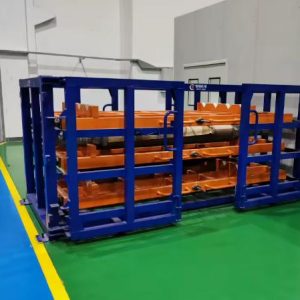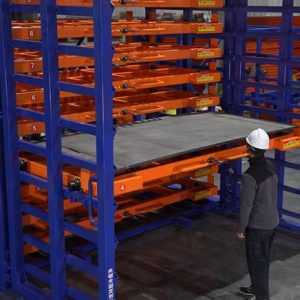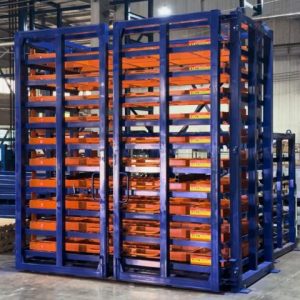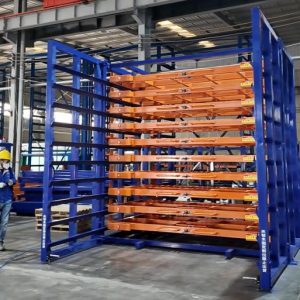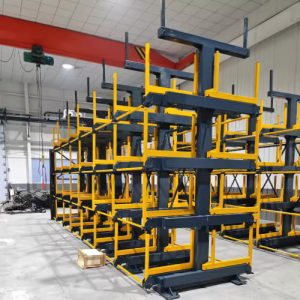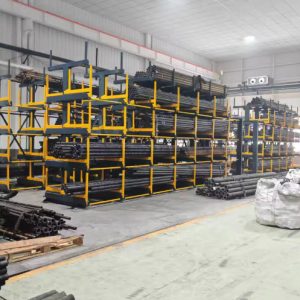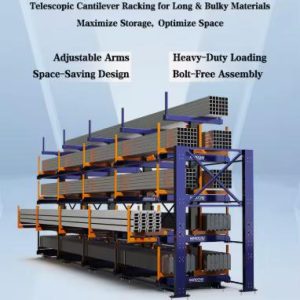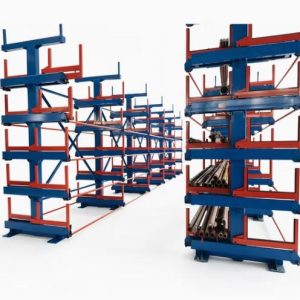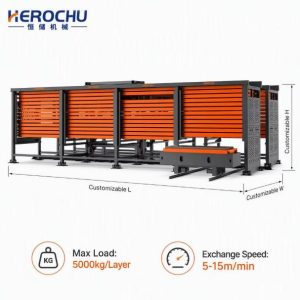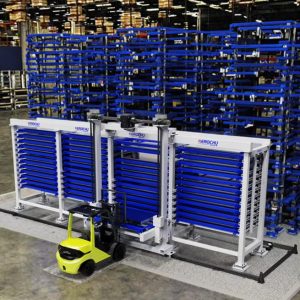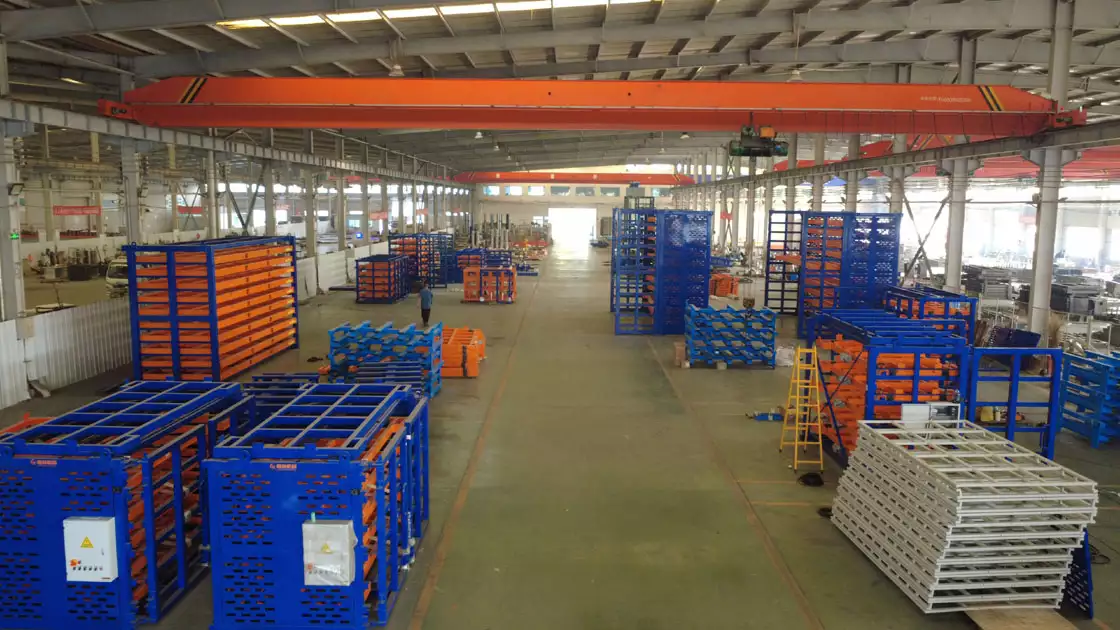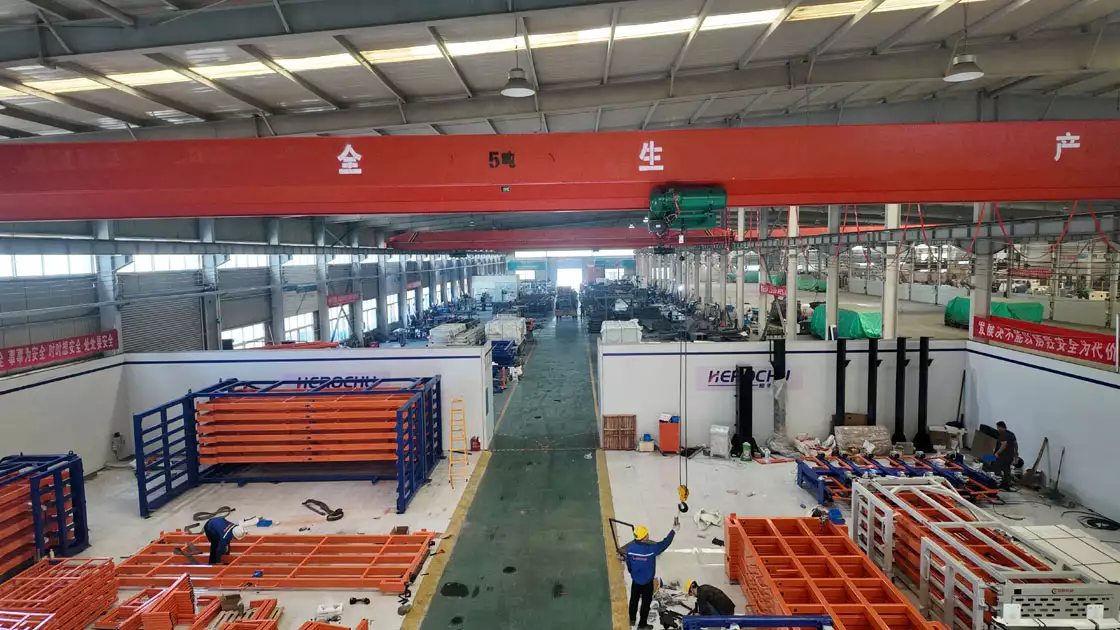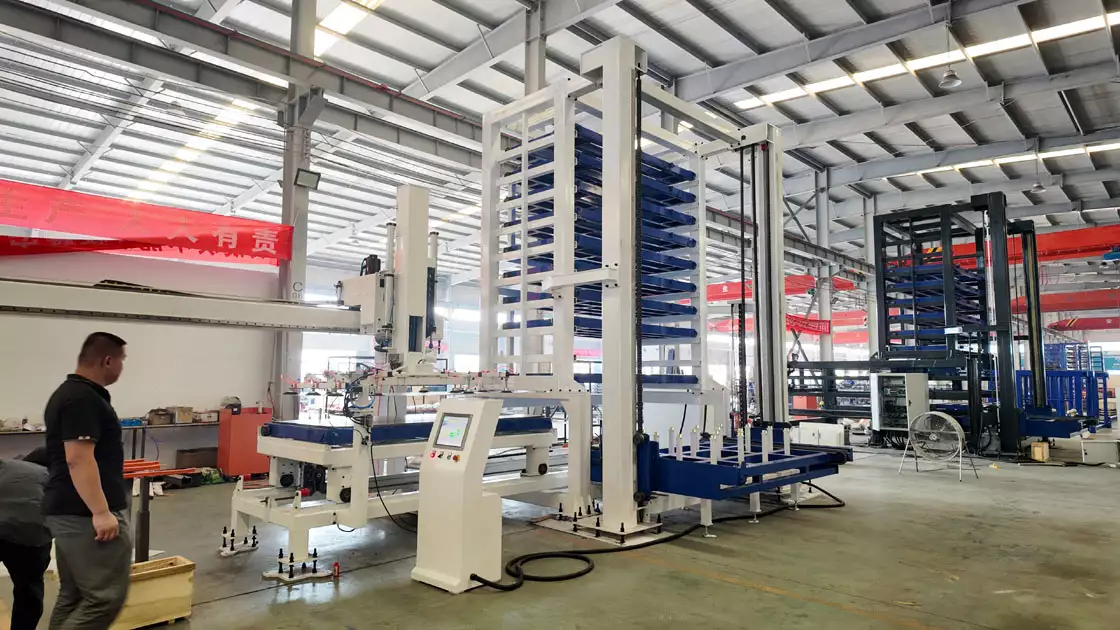
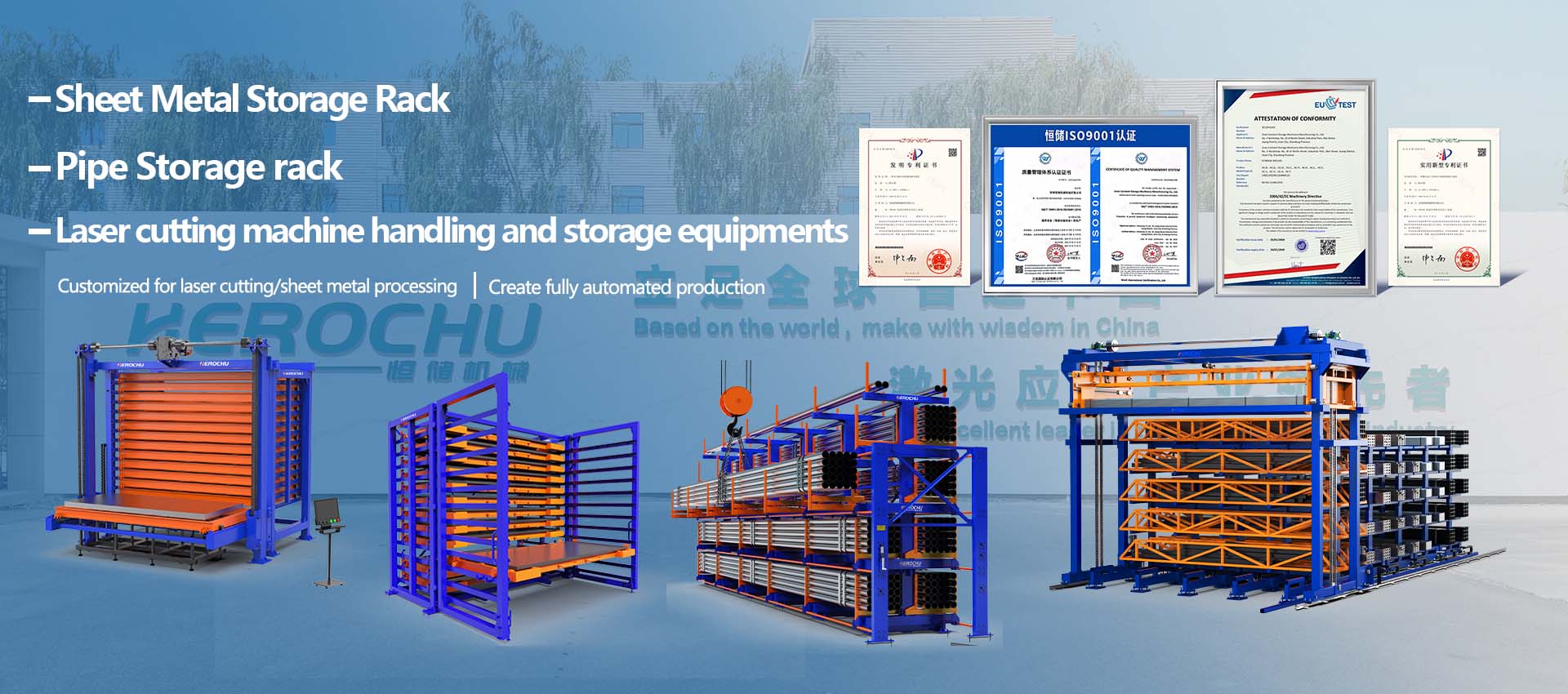
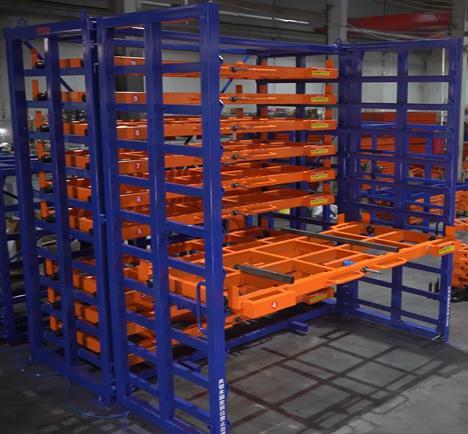
A manual crank-out drawer stainless steel plate storage rack system holds 304 and 316 sheet in separate sliding drawers so no plate touches another. Each drawer opens its full depth at crank speed, carries 3 to 5 tons, and is loaded by crane or vacuum lifter. Herochu builds the system with hot-dip galvanized frames and replaceable drawer liners.
Why Does Stainless Sheet Need a Different Rack?
Carbon steel tolerates handling marks. Stainless does not. A 2B or No. 4 finish that picks up a scratch during storage becomes a rework item, and on a visible architectural panel that means polishing a full sheet or scrapping it. The usual culprit is not the crane but the stack: plates slid across each other, grit trapped between two surfaces, and the pressure of 20 sheets resting on the bottom one.
A stainless steel plate storage rack system solves the problem by removing contact. Each sheet sits on its own drawer deck, separated by the level above, and leaves the rack without sliding against anything. The same applies to aluminium, acrylic and plywood, where surface damage ruins the panel. Herochu builds these drawers with a flat deck and an optional non-marking liner.
How Does the Drawer Protect the Plate Surface?
Three points matter. First, the deck is continuous, so a sheet is supported across its area instead of resting on two narrow arms that leave pressure lines. Second, the drawer comes to the aisle, which means no sheet is ever dragged over another. Third, the drawer face and side rails sit below the deck plane, so an operator loading with a suction cup has clear access to the full sheet edge.
For 0.5 to 2 mm stainless, the liner choice is more important than the frame. A 3 mm polymer or felt-faced deck stops the micro-movement that dulls a brushed finish. For 3 mm and above, the plate weight keeps it stable and a plain galvanized deck is enough. Tell Herochu which finishes you store and the liner spec is matched to them rather than defaulted.
How Do You Keep Alloys From Contaminating Each Other?
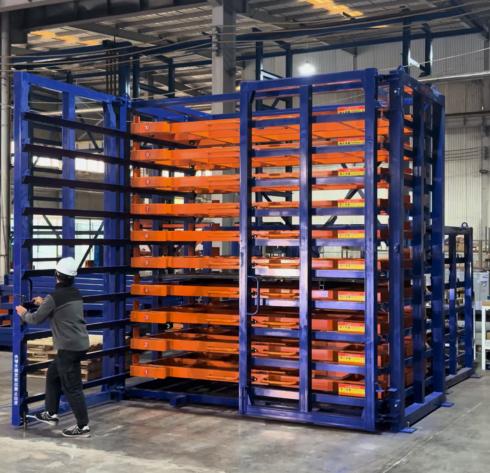
This is the question that decides the layout. Carbon steel dust on stainless becomes a corrosion site, and 304 swarf on a 316 job defeats the purpose of buying 316. The answer is physical separation by drawer, not by bay. One drawer holds 304, the next holds 316, a third holds aluminium, and the label slot on each drawer front carries the alloy, gauge and heat number.
Because the tiers are independent, a mixed rack works. A six-tier unit can run 304 on levels one to three, 316 on four and five, and aluminium on the top deck without cross-contact, since nothing passes from one drawer to another. That is why classification by drawer beats classification by zone in shops with a wide material mix.
What Does the Crank Mechanism Change for the Operator?
On a fixed rack, the operator reaches into the stack at shoulder height and pulls. On a crank-out drawer, the operator turns a handle and the drawer travels out at a steady rate. The crank gives a mechanical advantage of roughly four to one on the rail pull, which is why a fully loaded drawer on the larger builds can be moved by one person without a forklift and without a second pair of hands.
The crank also fixes a height problem. Above the third tier a drawer face sits higher than a comfortable pull, and force at that angle goes through the operator’s back. A crank at chest height works at any tier because the handle is on the drawer front and travels with it. Above six tiers, or where a level exceeds 5 tons, an electric drive with remote control is the practical choice; Herochu supplies both.
How Is the Drawer Loaded and Unloaded?
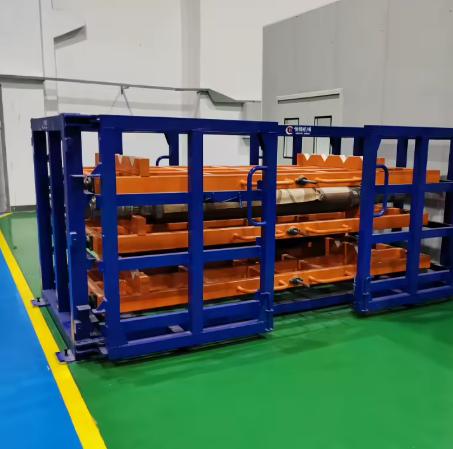
Full extension exposes the entire sheet, which is what makes crane, forklift and vacuum suction cup handling viable. A 100 percent extension means the trailing edge clears the rack frame, so a vacuum lifter can take the sheet from above without the frame obstructing the cup frame. The spring-loaded locking pin holds the drawer at the open position while the load is set down, and re-engages at the closed position so the drawer cannot creep during a shift.
In a shop working to a No. 4 finish the sequence is: extend, set the suction cups, lift clear, retract, release onto the next operation. Nothing is dragged across a deck.
Typical Configurations
| Model | Sheet size (mm) | Levels | Load per level | Best for |
| HC-B2513-63 | 2,500 x 1,300 | 6 (custom) | 3,000 kg | Job shops, mixed alloy stock |
| HC-B3015-63 | 3,000 x 1,500 | 6 (custom) | 3,000 kg | Standard 4 x 8 ft sheets |
| HC-B4015-63 | 4,000 x 1,500 | 6 (custom) | 3,000 kg | Long stainless runs |
| HC-B4020-65 | 4,000 x 2,000 | 6 (custom) | 5,000 kg | Heavy gauge and plate |
| HC-B6020-65 | 6,000 x 2,000 | 6 (custom) | 5,000 kg | 5 x 10 ft and larger |
Frequently Asked Questions
Will the galvanized frame mark stainless steel?
Only where the two touch. The frame does not contact the plate; the deck does, and that deck can take a polymer or felt liner. Specify the liner if you store finished No. 4 or mirror sheet.
Can one rack hold stainless and carbon steel?
Yes, on separate drawers. Keep carbon steel on the lower levels so grinding dust and scale fall away from the stainless above, and label each drawer front by alloy.
Is the crank removable?
The handle is a fixed part of the drawer front on the hand-crank version. It folds on request so it does not protrude into a narrow aisle.
What about thin sheet that bends?
Below 1 mm, support spacing matters more than load rating. Herochu sets the deck stiffener pitch to the gauge you store, and for very thin sheet a closer pitch prevents sagging in the middle of the drawer.
Specifying a Stainless Storage System
Bring four things to the quotation: the full sheet size range, the alloy list, the gauge range and the overhead handling equipment. From those, Herochu fixes drawer depth, tier count, deck liner and rail rating, then confirms the anchor layout. A rack sized to your real mix stores more in less space than one sized to the largest sheet you occasionally buy.