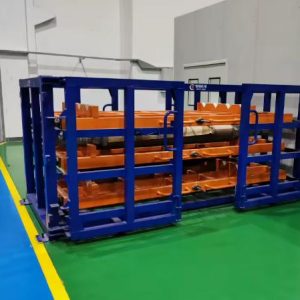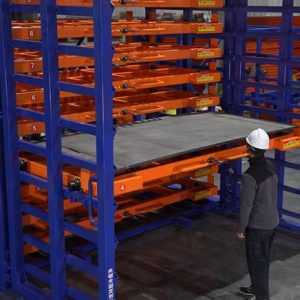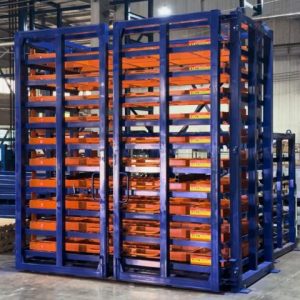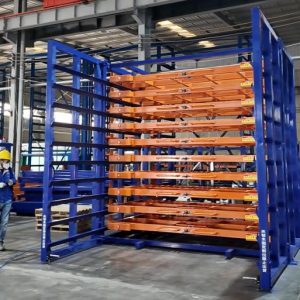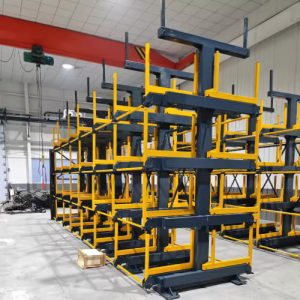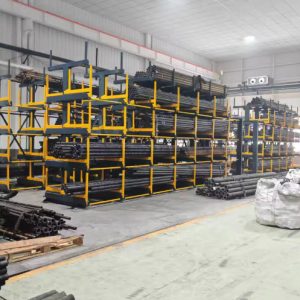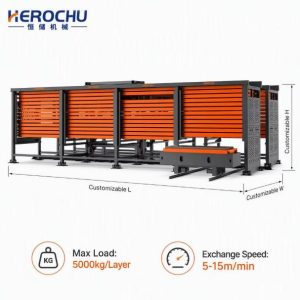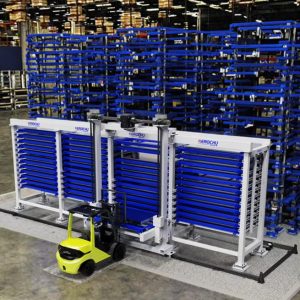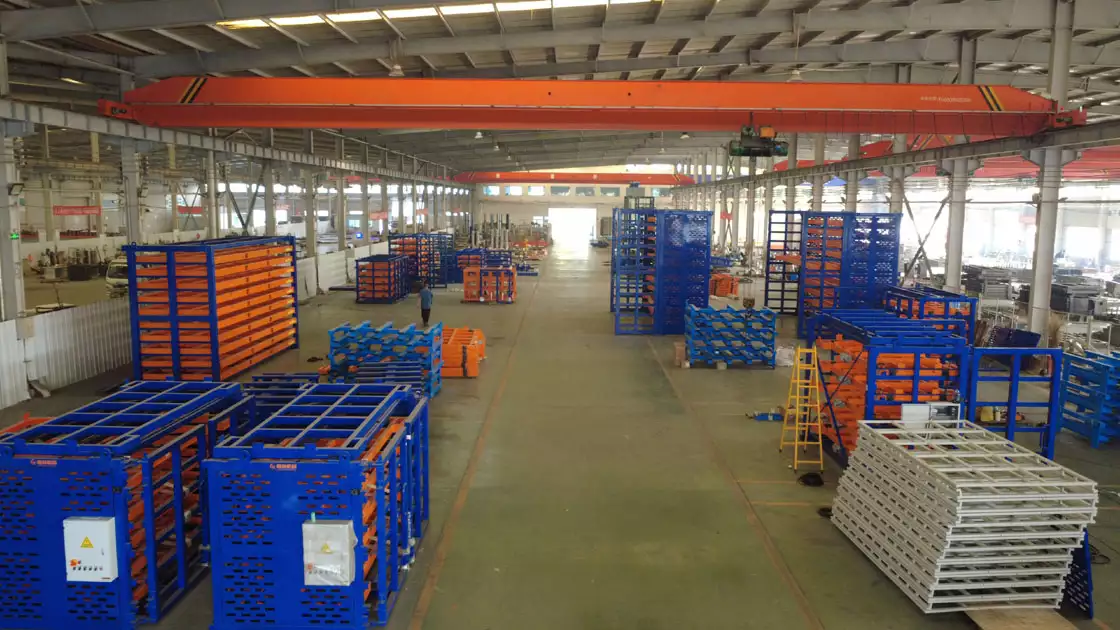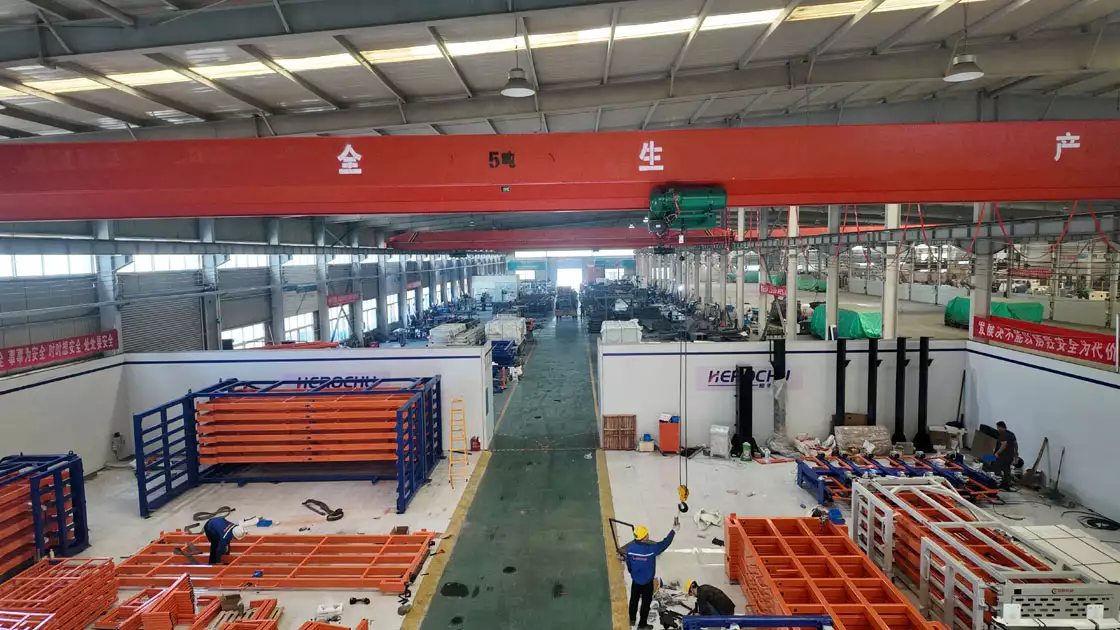
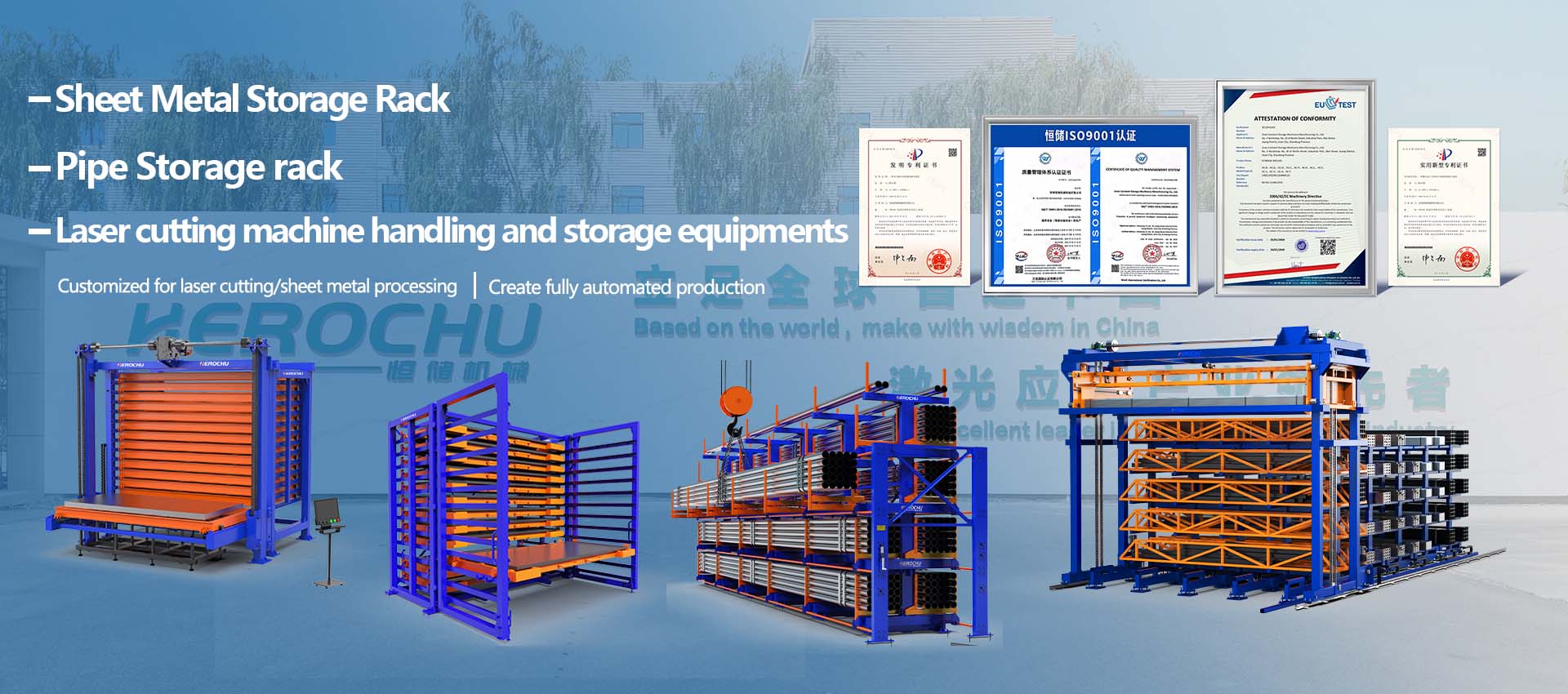
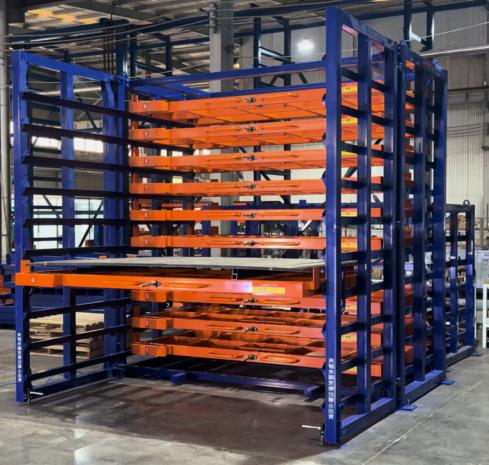
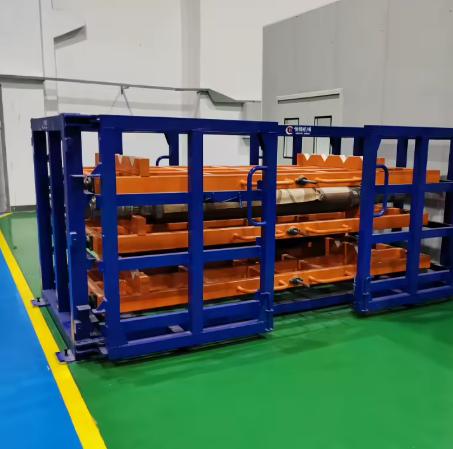
A heavy duty hand-crank roll out sheet metal storage rack keeps steel plates in independent sliding drawers rather than on fixed arms. Each drawer carries 3 to 5 tons, extends its full depth into the aisle, and is opened by one worker using a crank handle and ball-bearing rails. Herochu builds these racks for plates up to 6 m by 2 m.
What Separates a Heavy Duty Roll Out Rack from a Standard Sheet Rack?
Cantilever arms and slotted vertical racks both assume the same handling pattern: a crane lifts the top plate off a leaning stack while two people guide the edges. On 12 mm plate that is slow, and the sheet second from the bottom stays buried until everything above it moves. A heavy duty roll out sheet metal storage rack reverses the logic: every tier is a drawer on its own rail pair, so the plate comes to the aisle instead of the operator reaching into a stack.
The structure carries that change. Herochu builds the drawer frame from cold-rolled steel profiles on a dual-beam base, with the main mast in Q235B structural steel. Load travels from the deck into the rail carriage, then into the mast and floor anchors, so the plate below never acts as a spacer or a shock absorber.
How Much Weight Does Each Drawer Actually Carry?
The HC-B series is rated at 3,000 kg per level on the 2,500 mm, 3,000 mm and 4,000 by 1,500 mm models, and 5,000 kg per level on the 4,000 by 2,000 mm and 6,000 by 2,000 mm models. Single-tier engineered builds reach 10,000 kg. Those figures assume a uniformly distributed load across the drawer deck, which is how plate normally sits.
A 6,000 by 2,000 mm drawer holding 20 mm plate carries roughly 1.9 tons per sheet at 7,850 kg per cubic metre, so a 5-ton drawer takes two sheets with margin. At 5 mm the same drawer holds about 470 kg per sheet, and the limit becomes stack height rather than weight. Clear space is 120 mm as standard and adjustable from 50 to 200 mm, so the drawer count follows your thickness mix.
Can One Person Move a Fully Loaded Drawer?
Yes, within the mechanical limits of the configuration. The rails are industrial ball-bearing slides sized for the rated load, and rolling friction is a small fraction of the force a crane needs to break a plate free from a stack. On the largest builds an operator can start a fully loaded drawer and control it to the stop without power assistance.
The crank matters most on the upper tiers, where a standing operator cannot reach a drawer face at chest height. Winding the drawer out at a controlled speed is safer than a free pull when the plate overhangs. Above six tiers, or where a level exceeds 5 tons and the crank sits beyond comfortable reach, an electric drive with a handheld remote is the better fit.
What Keeps a Drawer From Rolling Out Under Load?
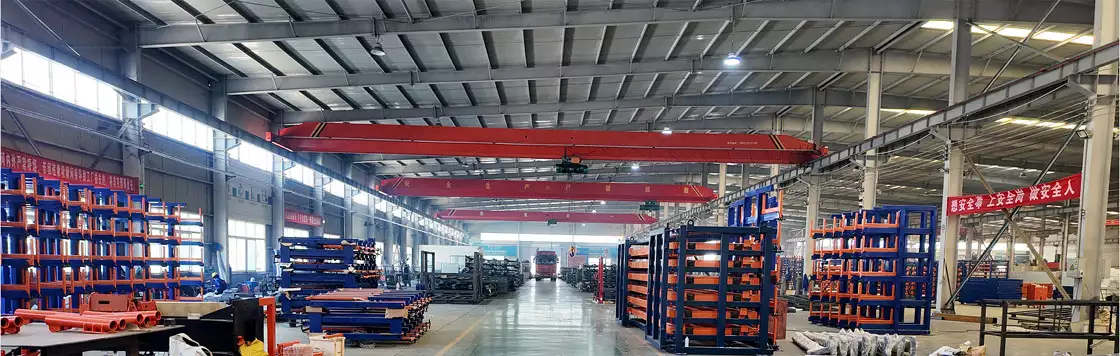
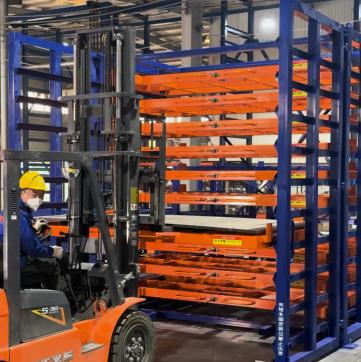
A spring-loaded locking pin engages when the drawer reaches the fully open or fully closed position. Being mechanical rather than hydraulic, it holds if power is lost mid-lift. Operators load at full extension with a crane, forklift or vacuum suction cup, and the pin stops the drawer creeping back while a plate is set down. Herochu assembles and tests each unit in a 20,000 square metre factory to CE and ISO 9001 requirements.
What Plate Sizes and Thicknesses Fit?
Standard models cover 2,500 by 1,300 mm up to 6,000 by 2,000 mm, which includes 4 by 8 ft and 5 by 10 ft nominal sheets. Longer formats such as 9,000 by 2,500 mm are quoted as custom builds because the rail span and mast spacing change. Drawer depth is set by the longest plate in the mix, so it pays to list your full size range before ordering rather than sizing to the most common sheet.
The rack handles steel, stainless, aluminium, copper, embossed and stone plate. Mixed loads work as long as each drawer stays within its rating and the heavy plate sits on the lower tiers.
HC-B Series Specifications
| Model | Sheet size (mm) | Levels | Load per level | Clear space |
| HC-B2513-63 | 2,500 x 1,300 | 6 (custom) | 3,000 kg | 120 mm (custom 50-200) |
| HC-B3015-63 | 3,000 x 1,500 | 6 (custom) | 3,000 kg | 120 mm (custom 50-200) |
| HC-B4015-63 | 4,000 x 1,500 | 6 (custom) | 3,000 kg | 120 mm (custom 50-200) |
| HC-B4020-65 | 4,000 x 2,000 | 6 (custom) | 5,000 kg | 120 mm (custom 50-200) |
| HC-B6020-65 | 6,000 x 2,000 | 6 (custom) | 5,000 kg | 120 mm (custom 50-200) |
How Does It Compare with Cantilever Racking on Floor Area?
Cantilever systems store plate on arms that project into the aisle, and each arm position needs clear space in front of it for the crane hook. Drawer racks put the travel inside the rack footprint and need only enough aisle for the drawer to extend plus the operator. In the same floor area, a drawer configuration holds up to 60 percent more sheet metal than a comparable cantilever layout, mostly by using the vertical space above 2.5 m that arms cannot reach safely.
On a 6 m plate the gap widens: a cantilever bay serving the same tonnage needs two arm positions at 1.2 m pitch plus a 4 m handling aisle, where a six-tier drawer stack works from one crane position.
Frequently Asked Questions
Can a forklift load the top drawer?
Only with the drawer fully extended and the forks reaching the deck without side load. Most shops load the top tiers by crane or vacuum lifter and use the fork truck on the lower levels.
Does the rack need a reinforced floor?
It needs a level, load-rated slab and anchored base plates. Point loads concentrate at the mast feet, so Herochu confirms the anchor layout against your slab thickness during engineering review.
Will hot-dip galvanizing survive a weld shop?
The zinc coating resists rust and cutting-fluid corrosion far better than paint, and it tolerates abrasive grinding dust. Weld spatter still pits the surface, so keep the rack clear of active arc zones.
How long does a drawer take to open?
A six-tier unit with a 4 m drawer opens in a few seconds by crank. The gain is the missing clearing step, not the open time.