A fiber laser cutting machine is expensive to own and even more expensive to leave sitting idle. In a workshop that runs mixed profiles — tubes, angle iron, flat bar, H-beams — the cutting head is rarely the slowest part of the job. The bottleneck sits a few meters away, in the raw material stack. Operators wait for a bundle to be found, moved, or unstacked. Forklifts maneuver in aisles designed for foot traffic. By the time the right alloy reaches the cutting table, the machine has been quiet for fifteen or twenty minutes.
That gap between cutting cycles is where throughput disappears. Herochu roll-out cantilever racks are built to close it.
Why Laser Cells Stall on Material, Not Cutting
Laser cutting optimization software can nest parts within millimeters. The machine can pierce, cut, and unload at high speed. None of that matters if the operator cannot get the correct 6-meter tube to the loading table without disturbing three bundles above it. In a traditional floor stack or static rack, retrieving a specific heat number or wall thickness means secondary handling: lifting, shifting, and re-stacking material that the job does not need.
The cost shows up in machine hours. A laser cutter running at 60 to 70 percent utilization because of material delays is not a cutting problem; it is a storage and flow problem. The same dynamic applies to plasma cutters and automatic sawing cells. The machine is ready. The material is not.
What a Roll-Out Cantilever Rack Changes
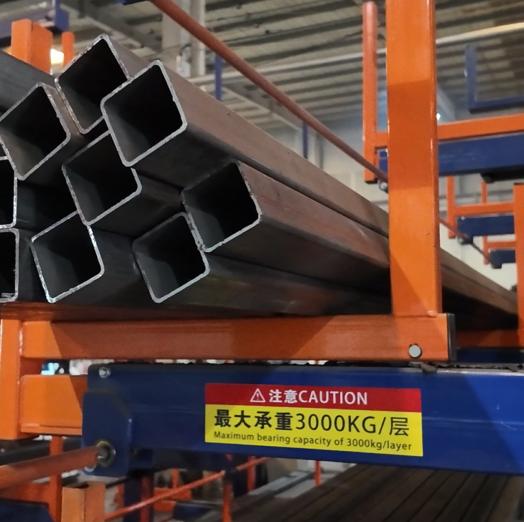
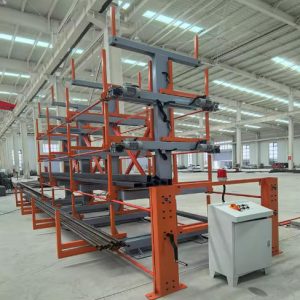
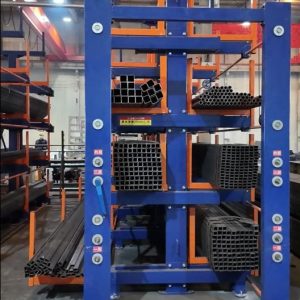
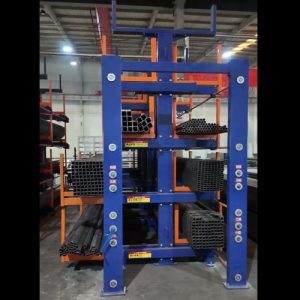
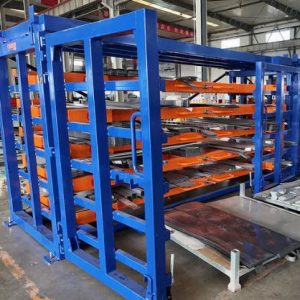
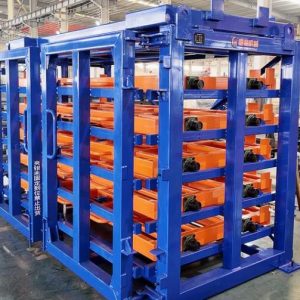
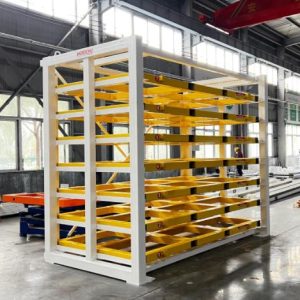
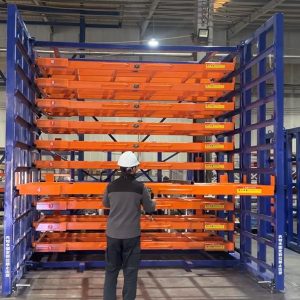
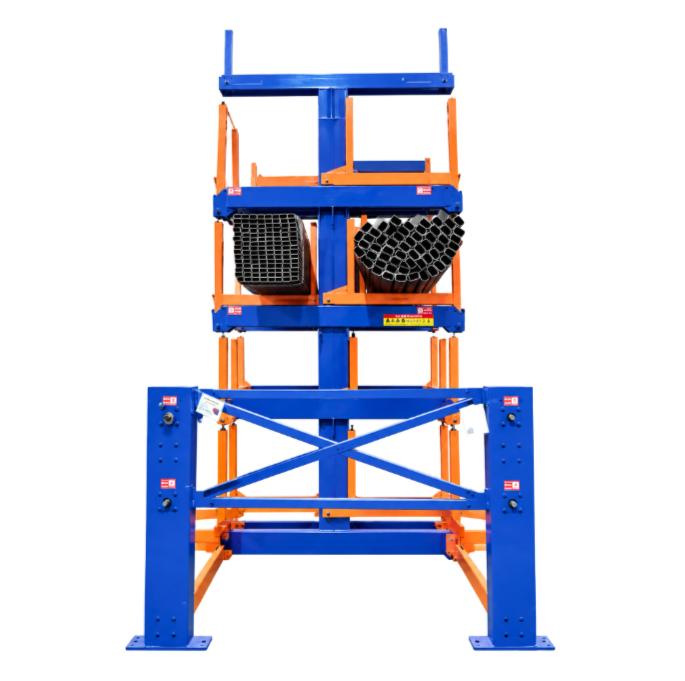
A roll-out cantilever rack works like a heavy-duty industrial drawer. Each storage level sits on a roller system and extends fully into the aisle with a manual crank or an electric drive. Once the tier is out, an overhead crane has unobstructed top-down access to the entire bundle. The crane lifts vertically, the tier rolls back in, and the cutting cell receives material without a forklift entering the storage zone.
The difference in aisle demand is measurable. A standard cantilever rack typically needs 3.5 to 5 meters of forklift aisle for safe operation. A roll-out cantilever rack needs about 1.4 meters, because the crane lifts vertically rather than horizontally. On a busy fabrication floor, that recovered aisle width becomes space for a material staging table, a parts bin, or simply a safer walking route.
The Three Risks Roll-Out Storage Removes
Machine downtime. When every tier is independently accessible, the operator does not wait for a top bundle to be removed. Herochu’s roll-out design gives 100 percent selectivity: any level can be extended without touching the levels above or below. Retrieval drops from a 15–25 minute unstacking exercise to under three minutes in a properly laid-out cell.
Surface scratches. Dragging a bundle across the arm of a static rack, or sliding a tube out from under another, leaves marks that become scrap on aerospace, sanitary, or architectural work. Roll-out arms present material in free space; the crane lifts it cleanly without side friction. Herochu offers UHMW or polymer arm liners for polished stainless and aluminum, so the storage surface does not become the damage source.
Forklift risk. A forklift working inside a storage aisle is exposed to narrow clearances, poor sightlines, and heavy loads at height. Moving the primary lift to an overhead crane removes the forklift from the point of retrieval. The operator controls the tier and the hoist from the aisle side, and the load never travels horizontally through a congested zone.
Placing the Rack Where It Matters
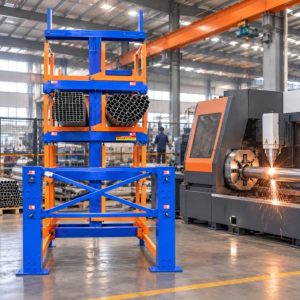
The efficiency gain is largest when the rack sits directly alongside the cutting cell. Material travel distance falls, the crane hook path stays short, and the laser operator can replenish stock without leaving the work zone. Herochu engineers configure the rack height, column grid, and arm projection around the crane hook path and the building’s available headroom, rather than forcing the layout around a fixed catalog size.
For a fabrication shop measuring performance in machine hours, the question is straightforward: how many more cuts can the laser make if the material is always at the edge of the aisle, ready for the crane? A roll-out cantilever rack from Herochu is not a storage upgrade for its own sake. It is a way to keep the most expensive asset in the building cutting.