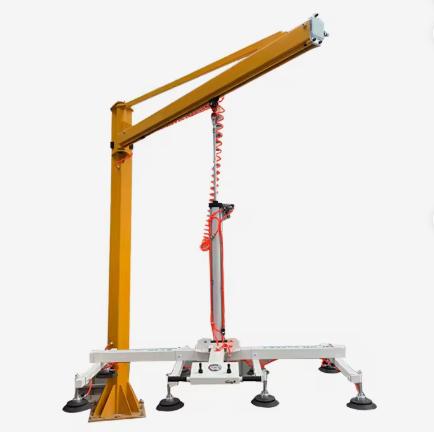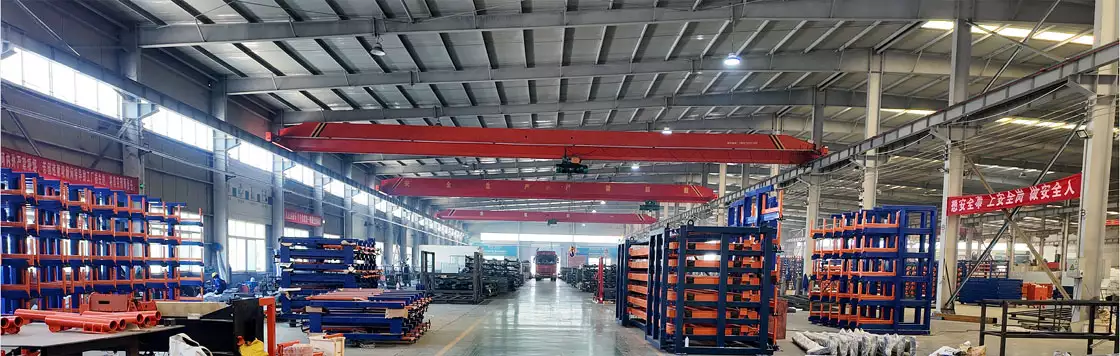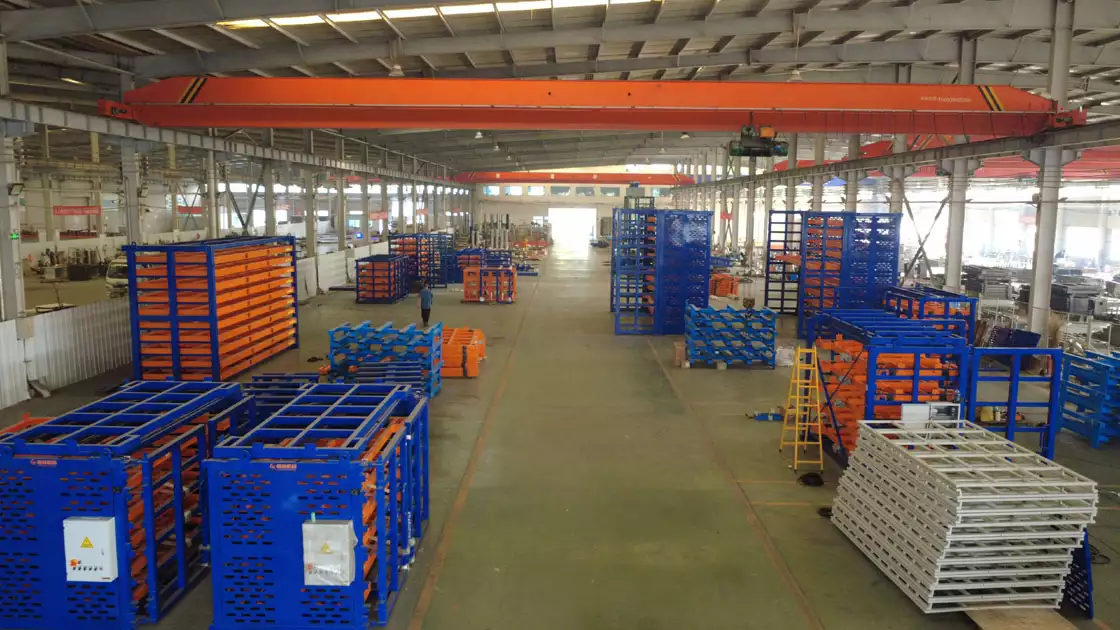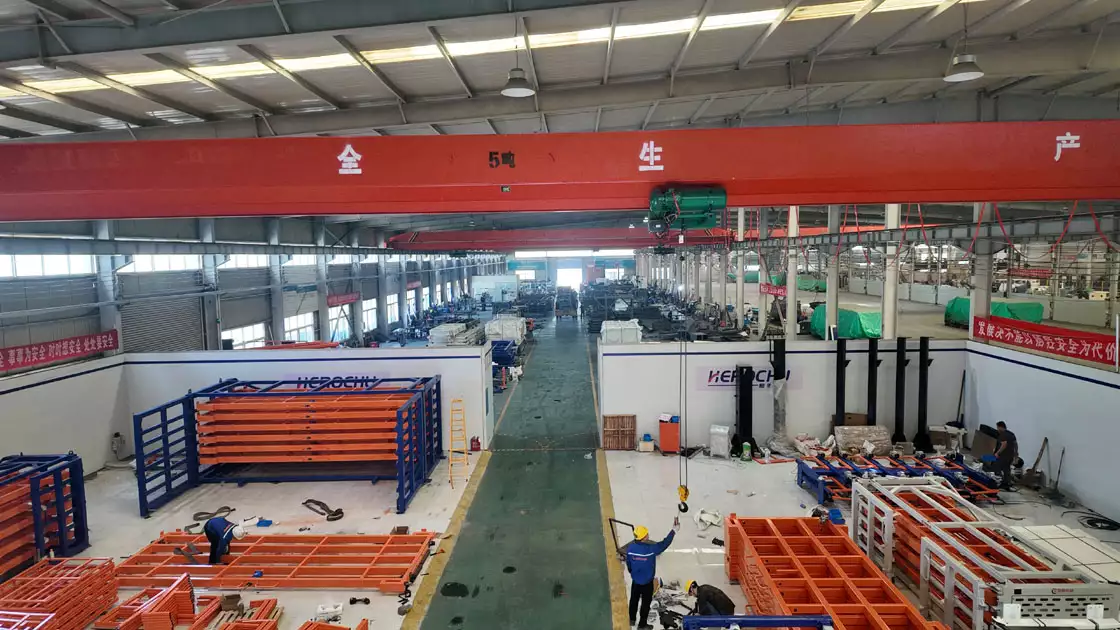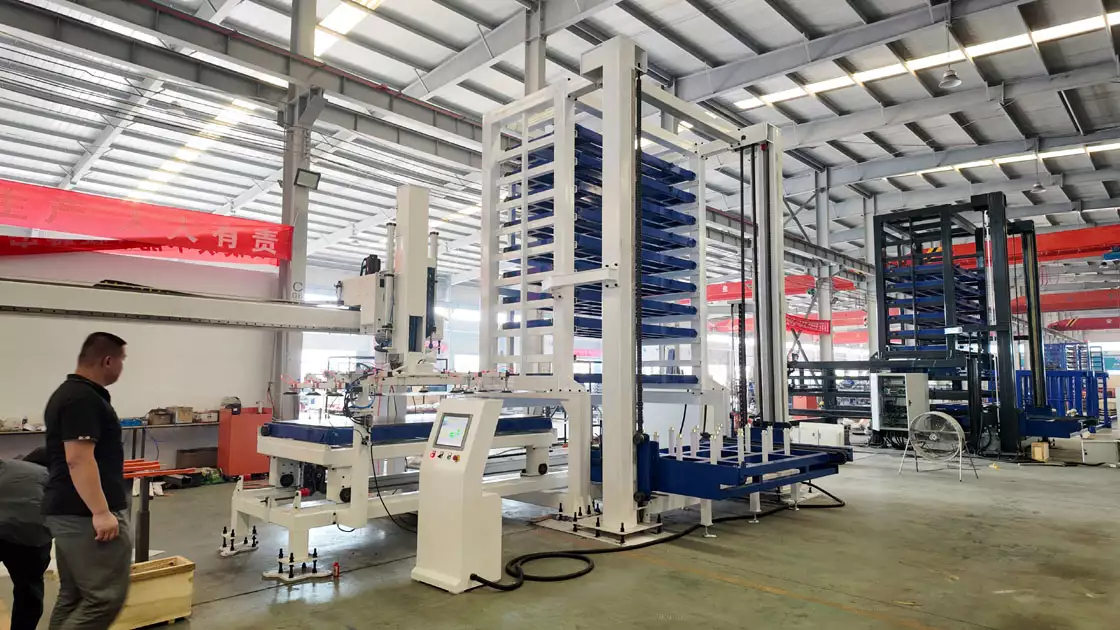
In most sheet metal shops, the work stops at the crane hook. A plate is lifted with slings, chains, or a magnetic lifter, swung over a machine, and lowered by eye. The operator guides the load by hand, the plate can slip or swing, and the surface gets scratched where slings bite into the edge. A crane vacuum lifter changes the rules of that job. The Herochu crane vacuum lifter for sheet metal material handling grips the plate with suction cups, lifts it clear, and holds it rigid while the crane – or the cantilever frame it is mounted on – moves the load to the next station.
The machine is built for plate movement across the whole shop: from storage racks to laser beds, from cut stations to forming presses, from a stack of raw sheets to a pallet of finished blanks. It handles the standard industrial formats up to 3000 x 1250 mm and 4000 x 1250 mm, with plate weights from 300 kg to 1000 kg depending on the model.
Why Sheet Metal Handling Needs a Vacuum Tool
Slings and chains grip only the edges and corners of a plate. That works for structural steel, but thin sheet and coated sheet are a different problem: the strap marks the surface, the load can tilt, and a sharp edge can cut the sling. Magnetic lifters fail on stainless steel, aluminum, and non-ferrous alloys. A vacuum lifter is indifferent to material type. It works on carbon steel, stainless, aluminum, and coated sheets alike, and it grips the flat face of the plate rather than its edges, so the surface stays clean.
Mounting the Lifter to Your Crane or Gantry Rail
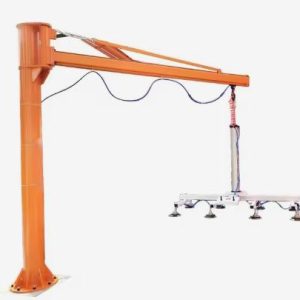
The Herochu unit mounts on an overhead crane, a jib, or a cantilever frame. The electric cantilever carries the rotary manipulator and the suction head; the crane provides the long-distance travel across the shop. Shops that already run an overhead crane install the lifter on the hook or on the trolley and keep the existing rail layout. Shops without a crane mount the lifter on a floor-standing cantilever and use its own travel axis for the short transfers between rack and machine. Either way, the installation keeps the shop layout as it is.
Rotation and Positioning Across Multiple Stations
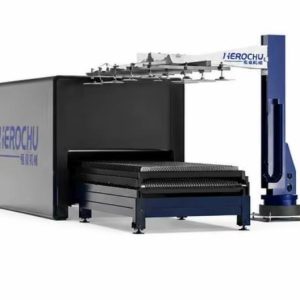
The rotary manipulator gives the system a ±150-degree rotation range. That freedom matters on the floor: a plate can be picked from a stack on one side of the bay, rotated over a rack, and placed on a table facing the other way. Cells with several stations – raw material rack, destacker, laser bed, finished parts pallet – are served from one position instead of requiring a crane move for every leg of the trip.
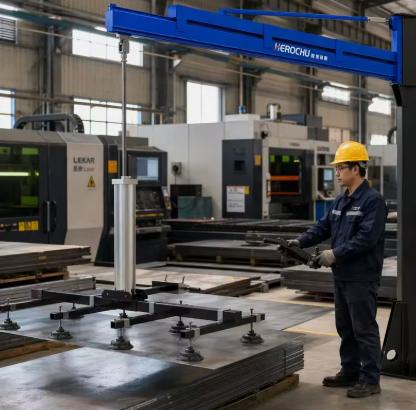
Repetitive positioning accuracy on a Herochu lifter is ±2 mm. For a crane operation, that level of control is the difference between dropping a plate and placing it. The operator sets the lifter down on a machine bed or into a fixture without hand-trimming, which cuts the time per plate and protects the equipment below the load.
Moving Plates Without Marking the Surface
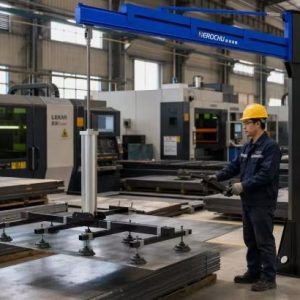
Surface finish is where a vacuum lifter earns its keep. The suction cups press on the face of the plate with soft seals; there are no chains dragging across the top sheet, no magnets lifting a stack of stuck-together plates, no forks sliding underneath. The high-torque servo drives keep every rotation, lift, and travel movement smooth and vibration-free, so the plate does not jolt or scuff as it moves. On painted, oiled, or brushed-finish sheets, the first plate out of the stack leaves in the same condition as the last.
Safety Under Load: Pneumatic Fail-Safe and Emergency Braking
A crane lifts a load over people and machines, so the vacuum circuit has to behave under fault conditions. The system includes active air pressure protection: if air pressure drops, the load locks in place instead of releasing. An emergency braking module holds the load if power is lost. Air cut-off protection and anti-collision devices round out the safety package. The result is a handling tool that holds a 300 kg plate – up to 1000 kg on the larger models – securely through the whole cycle, including a fault.
Operators keep control of the fine moves because the machine can stop at any position in its stroke. Placing a plate onto a stack of finished blanks, or aligning it with a fixture, is done at slow speed under a pendant rather than by swinging the load and guessing.
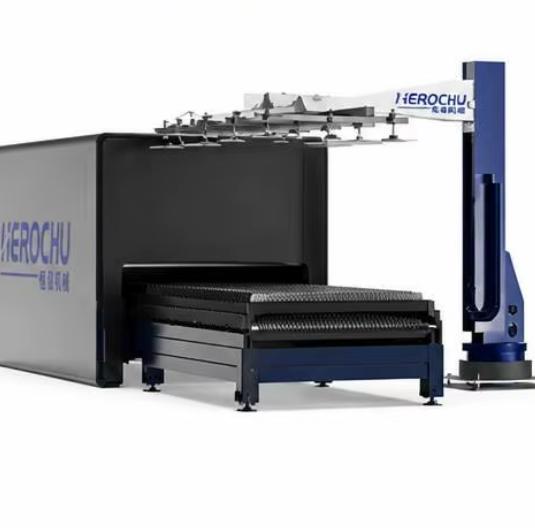
Model Range and Specifications
Five models cover the standard plate sizes in the industry. The HC-PR3015-300 handles 3000 x 1250 mm plates up to 8 mm thick and 300 kg; the HC-PR3015-1000 takes the same width with plates up to 20 mm and 1000 kg. The HC-PR4020 series serves 4000 x 1250 mm plates up to 12 mm and 500 kg. All models accept a minimum plate of 1250 x 1250 mm and run on pneumatic/electric power.
The pneumatic/electric power mode keeps the installation simple – no hydraulic pump units, no oil lines, just shop air and standard power. Maintenance stays with the vacuum circuit and the servo drives, both of which are familiar territory for any machine maintenance crew.
Herochu HC-PR Series Crane Vacuum Lifter – Specifications
| Model | Thickness of feeding plate | Maximum feeding width | Minimum feeding width | Maximum plate weight | Number of suction cups | Suction cup diameter | Power mode |
| HC-PR3015-300 | 8 mm | 3000×1250 mm | 1250×1250 mm | 300 kg | 8 | 200 mm | Pneumatic/Electric |
| HC-PR3015-500 | 12 mm | 3000×1250 mm | 1250×1250 mm | 500 kg | 8 | 200 mm | Pneumatic/Electric |
| HC-PR3015-1000 | 20 mm | 3000×1250 mm | 1250×1250 mm | 1000 kg | 10 | 250 mm | Pneumatic/Electric |
| HC-PR4020-300 | 8 mm | 4000×1250 mm | 1250×1250 mm | 300 kg | 8 | 200 mm | Pneumatic/Electric |
| HC-PR4020-500 | 12 mm | 4000×1250 mm | 1250×1250 mm | 500 kg | 8 | 200 mm | Pneumatic/Electric |
Power mode: Pneumatic/Electric. Minimum feeding width applies across all models.
Shops that move sheet metal by crane every day measure the gain in minutes per plate, and those minutes add up over a shift. The Herochu crane vacuum lifter for sheet metal material handling turns a two-man lifting job into a one-man positioning job, and it does it on the equipment already in the building.