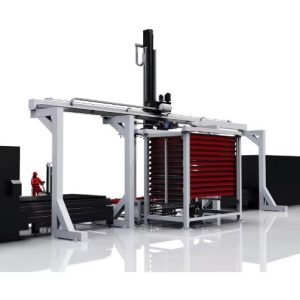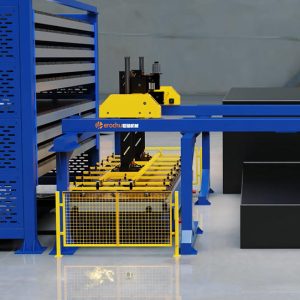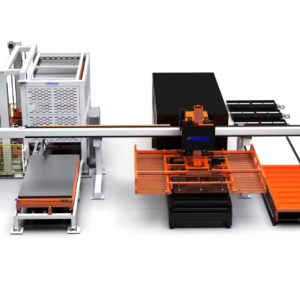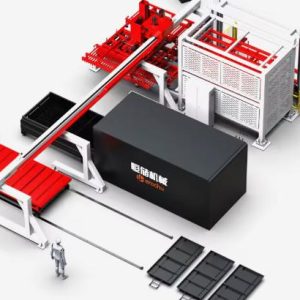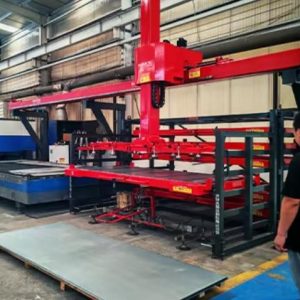
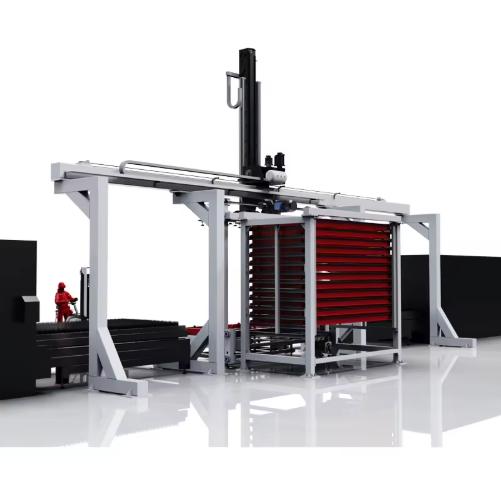
The gantry robotic arm for sheet metal laser cutting machines is the component that actually touches the material, and material handling errors are the most expensive errors in a cutting shop. A double-picked sheet feeds a misfeed into the machine. A scratched surface sends a stainless part to rework. A sheet set 2 mm off position produces a batch of unusable parts. Herochu designs its gantry arm to eliminate those three failure modes at the source rather than compensating for them downstream.
Integrated Vacuum Suction and Gripper System
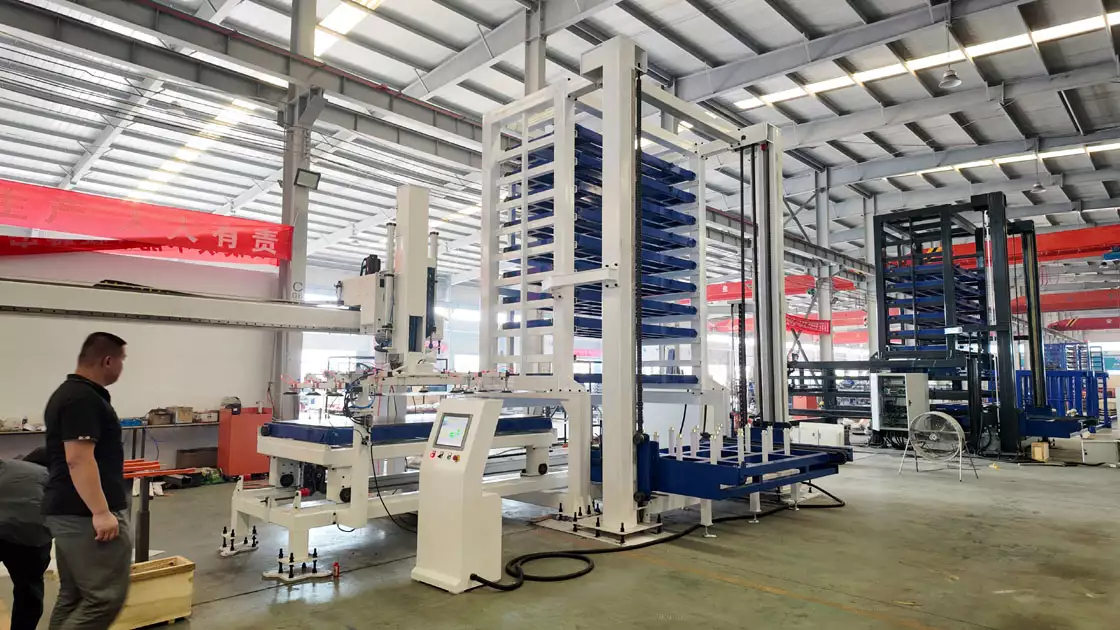
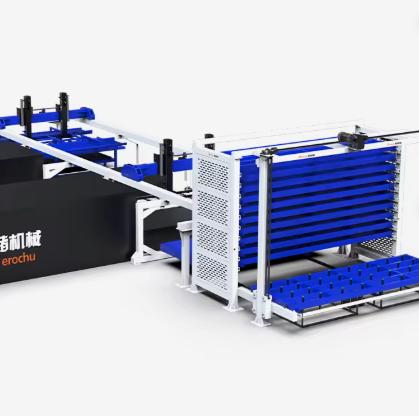
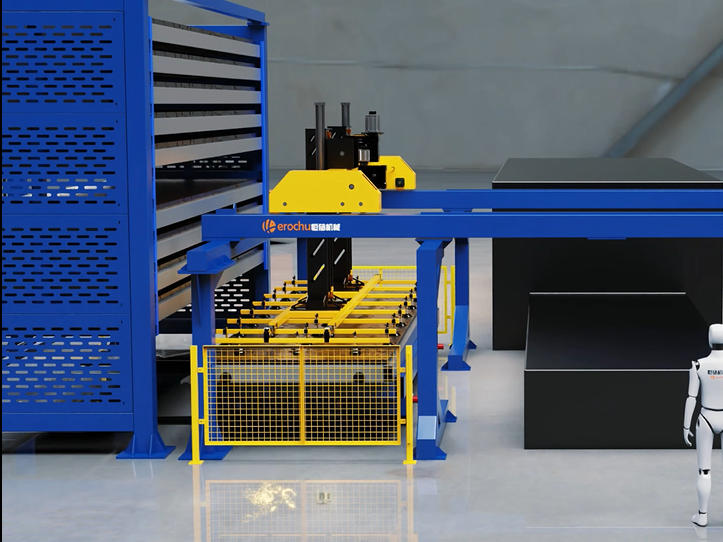
The arm carries two handling tools on one frame. Loading is done by computer-controlled suction: a matrix of vacuum cups lifts the top sheet cleanly off the stack and transfers it to the cutting bed. Unloading is done by mechanical grippers, which close on cut parts and skeleton frames and carry them away from the bed. The two-tool design exists for a practical reason. Vacuum is the gentlest way to lift a flat sheet, but finished parts are often small, warped, or covered with dross, and grippers hold those more reliably than suction does. Splitting the jobs between suction and grippers gives the arm the right tool for each task.
Sheet Separation That Prevents Double Pick
Sheets stick together for reasons that have nothing to do with the operator: residual oil film, slight magnetism in ferrous stock, burrs on cut edges, and suction acting through the gap between stacked sheets. If the arm lifts two sheets at once, the laser cuts through the first and strikes the second, which ruins the part, the nozzle, or both.
Herochu’s separation sequence handles this in stages. The vacuum matrix is split into adjustable zones, so suction is applied only over the sheet’s actual surface. Separation nozzles introduce a thin air film between the top sheet and the one beneath it before lifting. Double-sheet detection sensors then verify the pickup, and the system rejects and re-picks if a second sheet comes along. The result is that double feeds and sheet sticking become rare exceptions instead of recurring problems.
Size Compatibility Across Laser Cutter Models
The arm is built to match the machine, not the other way around. Standard formats cover 3015, 4015, 4020, and 4025 mm machines, with a 6015 option for long-bed cutters. Sheet dimensions run from 2500 × 1300 mm up to 6000 × 1500 mm, and the minimum feedable size is 1250 × 1250 mm. Because the suction matrix has adjustable zones and the fork positions are programmable, a single arm handles mixed sheet sizes across the day without a tooling change. For unusual formats, Herochu customizes the span, the number of suction cups, and the gripper layout at the quotation stage.
Positioning and Repeatability
The arm’s motion axes are sized for speed without sacrificing placement accuracy. Traverse speed runs 10 to 30 m/min, lifting speed 5 to 10 m/min, and fork adjustment speed 5 to 20 m/min. Repeatability is ±2 mm, which is tight enough for most laser cutting beds and consistent enough that the operator does not need to re-align sheets after the first job. Faster positioning would buy little; what matters for cutting quality is that every sheet lands in the same place, cycle after cycle.
Cycle Sequence in Practice
One loading cycle runs like this. The exchange car indexes a fresh stack to the pickup point. The suction matrix descends, applies vacuum only in the zones covering the sheet, and the separation nozzles blow a thin air film beneath the top sheet before the lift begins. Double-sheet sensors confirm a single pickup. The arm traverses to the cutting bed at up to 30 m/min, lowers the sheet, and releases vacuum once the sheet rests on the bed support pins. The grippers then wait at the unload position while the laser runs. When cutting completes, the grippers lift the parts and skeleton in one pass, move them to the unloading deck, and the car cycles the next sheet. The CNC logs the entire sequence, so Herochu customers can review cycle times and pickup statistics without installing a separate monitoring system.
Protecting the Surface
The suction cups are arranged in multi-point configurations, and the grippers use coated contact surfaces, so stainless steel, aluminum, and carbon steel leave the cell unmarked. This matters most for decorative and pre-finished stock, where a scratch is not a quality issue but a rejected part. The vacuum circuit also holds the sheet rigidly during transfer, which prevents the flexing that causes edge damage on thin gauges.
Technical Parameters
| Model | Sheet dimensions (mm) | Max load (kg) |
| HC-RT2513-300 | 2500 × 1300 | 300 |
| HC-RT3015-500 | 3000 × 1500 | 500 |
| HC-RT4015-500 | 4000 × 1500 | 500 |
| HC-RT4020-500 | 4000 × 2000 | 500 |
| HC-RT6015-500 | 6000 × 1500 | 500 |
All HC-RT models share the same motion ratings: robot arm traverse speed 10–30 m/min, lifting speed 5–10 m/min, fork adjustment speed 5–20 m/min, repeatability ±2 mm, and air supply 0.6–0.7 MPa. The standard suction head carries 15 cups.
Retrofitting to an Existing Machine
A Herochu gantry robotic arm is normally installed around the customer’s existing laser cutter. The arm’s CNC controller connects to the laser’s control system, the floor layout is planned around the machine’s bed height and stack position, and commissioning includes a run-in period with the customer’s own sheet stock. Because the arm does not modify the laser itself, the machine keeps its original warranty and service agreements.
Working With the Laser Controller
The arm does not run on its own timer; it works from the laser cutter’s cycle. The CNC exchanges ready and complete signals with the machine controller, so a sheet is placed only when the bed is clear and the beam is off. On fiber lasers with automatic nozzle changing and adaptive focus, the arm simply waits for the controller’s go signal and responds. This tight handshake is why a Herochu gantry robotic arm for sheet metal laser cutting machines can be added to an existing machine without changing the way the laser is programmed — the cutting programs stay exactly as they were, and the arm fits around them.
FAQ
How many suction cups does the standard head use?
Fifteen in the standard Herochu configuration, arranged in adjustable zones so smaller sheets activate only the cups above their surface.
Will the arm damage polished stainless steel?
No. Multi-point suction cups and coated gripper surfaces keep the sheet unmarked, including on stainless, aluminum, and pre-finished stock.
Can it handle mixed sheet sizes in one batch?
Yes. Zone control and programmable fork positions allow the arm to switch sheet sizes within a shift without tooling changes.