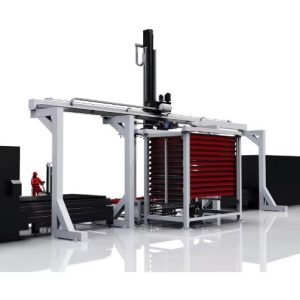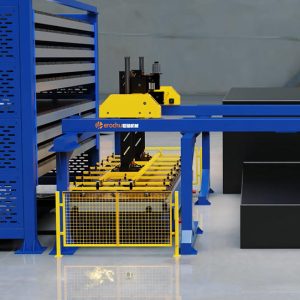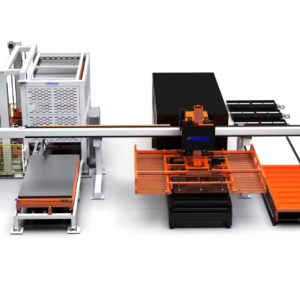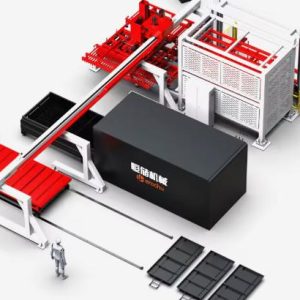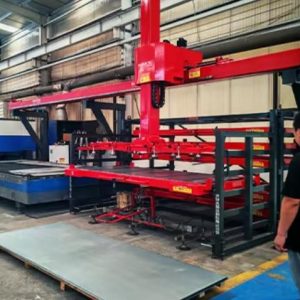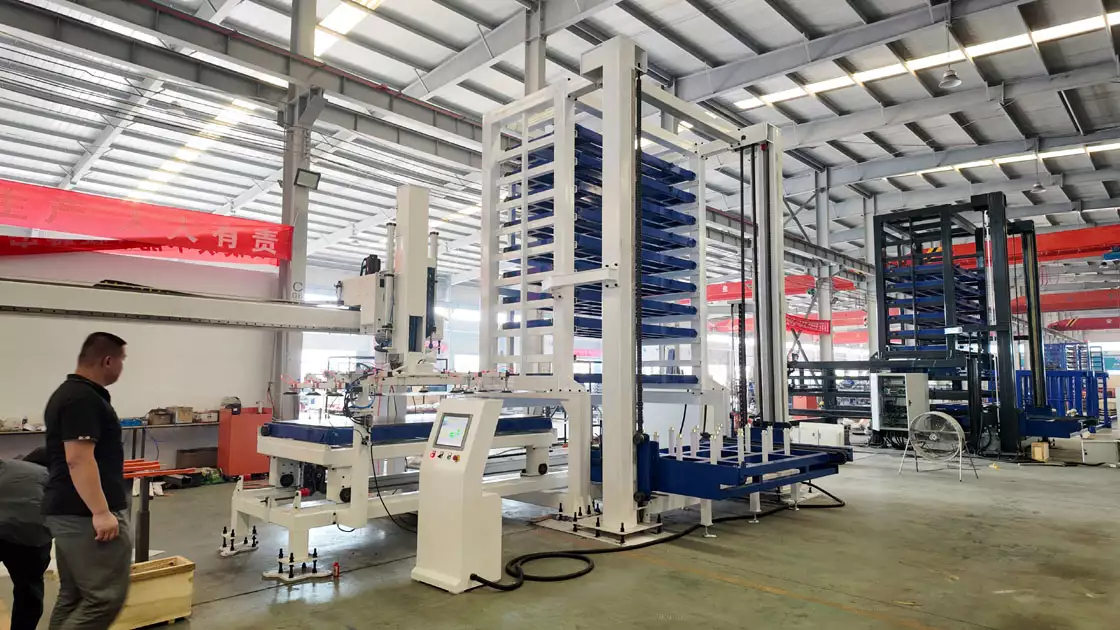
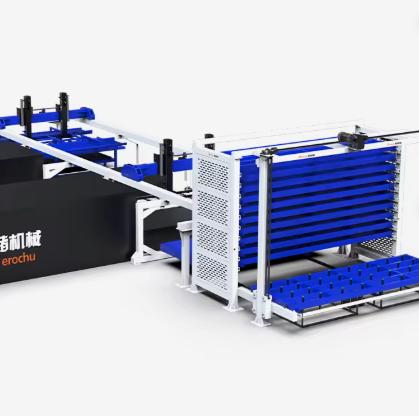
A fiber laser cutting machine earns its keep only while the beam is cutting. The minutes spent loading raw sheets, removing finished parts, and stripping skeleton frames are dead time, and on a high-power machine that dead time costs far more than the operator’s hourly wage. Herochu’s automated gantry robot for material handling exists to remove it. The system pairs a composite truss manipulator for loading and unloading with a double-layer electric exchange material car, a CNC control system, and a vacuum control system to form a single automated sheet metal production unit around the laser cutting machine.
On a conventional line, the loading sequence is a chain of manual decisions: lift the sheet, align it to the bed, confirm the position, unload the cut parts, dispose of the skeleton. Each step invites positioning errors, scratched surfaces, and interruptions between cutting cycles. An automated gantry robot for material handling replaces that chain with a fixed, repeatable sequence executed on command. The operator stages a stack of raw sheets once, and the cell then manages feeding, cutting, and removal without further handling.
How the Cell Is Put Together
The unit contains four cooperating subsystems, each with a defined job. Every Herochu unit is configured around the customer’s machine, but the four subsystems stay the same:
Composite truss manipulator — the gantry structure that carries both the vacuum suction head for loading and the mechanical grippers for unloading.
Double-layer electric exchange car — the staging device that moves raw sheets in and finished parts out of the cutting zone.
CNC control system — the brain that sequences the whole operation and exchanges status with the laser cutter’s controller.
Vacuum control system — the network of suction zones, valves, and sensors that handles sheet pickup and separation.
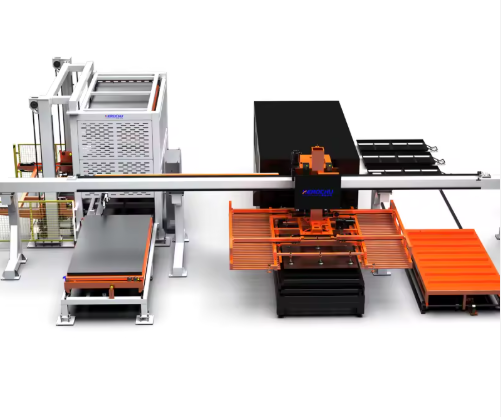
The manipulator performs the two tasks that used to demand two people: lifting a raw sheet off the stack and taking finished parts off the cutting bed. Loading uses computer-controlled suction, while unloading uses grippers. The two mechanisms share one gantry frame but work at different points in the cycle, so the cell keeps moving while the laser keeps cutting.
The Double-Layer Electric Exchange Car
The exchange car is what makes continuous production practical. Its two decks let the operator stage the next batch of sheets while the current batch is being cut. When a cutting job finishes, the manipulator places finished parts and skeletons onto one deck, the car indexes, and the second deck presents the next raw sheet at the pickup position. Material flows in and out of the cell on the same piece of equipment, which keeps the footprint small and the floor layout simple.
Because the car is electric and CNC-controlled, its position is repeatable to the same tolerance as the rest of the system. There is no guessing about where the stack is; the manipulator always knows where to reach. Skip loads up to 3 tonnes can be staged, so large batches of heavy plate do not force extra forklift trips during a shift. For most installations, Herochu sizes the car for the customer’s largest sheet, so one car covers the full product range.
CNC and Vacuum Control
All motion in the cell is coordinated by the CNC control system, which runs the sequence from stack pickup to final unloading and exchanges status with the laser cutter between cycles. The vacuum control system operates the suction matrix with adjustable zones, so a small sheet never activates suction cups that would sit outside its edges. Double-sheet detection sensors check every pickup; if a second sheet comes along, the system rejects it before it reaches the bed rather than feeding a misfeed into the laser.
The two control systems also handle the edge cases that stop manual lines: a sheet that sits crooked on the stack, a warped plate, a remnant too small to feed. Each is detected and handled inside the programmed sequence. That is why a Herochu cell holds its cycle time across an entire shift instead of drifting slower as operators tire.
System Specifications
| Specification | Value |
| Cutting formats | 3015 / 4015 / 4020 / 4025 mm |
| Maximum load | 100 kg – 500 kg |
| Skip load | 3 T |
| Air consumption | 1.5 m³/min |
| Air source | 0.6 – 0.7 MPa |
From One Cell to a Full Warehouse
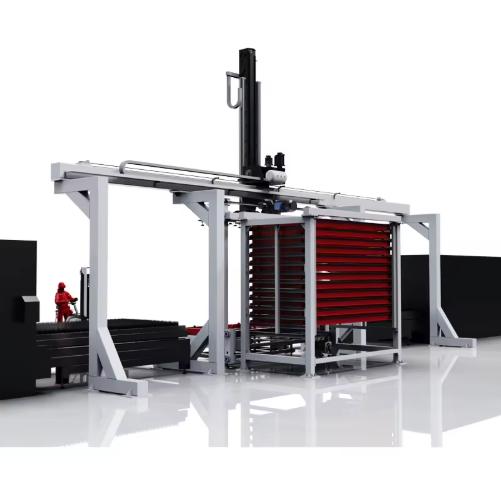
The same control architecture scales. Herochu builds the automated gantry robot for material handling in three steps: a compact single-gantry feeding unit for shops that need automation on a smaller footprint; a bilateral loading and unloading system fed by a multi-layer storage tower with 8 to 13 layers and 3 to 5 tonnes per layer; and a gantry palletizer workstation that sorts and stacks finished parts at the end of the line. The hardware differs between stages, but the control logic does not, which means a shop can start with one cell and expand later without retraining operators or replacing the control system.
Production Economics
Shops adopt this system for four measurable reasons. First, throughput: the laser’s cutting duty cycle rises because loading and unloading no longer pause the beam. Second, consistency: every sheet is positioned to the same tolerance, so scrap from misaligned parts drops. Third, labor: one operator supervises the cell instead of two people handling sheets. Fourth, safety: nobody stands near a moving sheet or inside the cutting zone while the machine is cycling. Over a production year these four factors usually repay the investment well before the machine’s next major service.
FAQ
Can the system feed laser cutters of different sizes?
Yes. The gantry spans 3015 to 4025 mm formats, and Herochu builds custom spans for machines up to 6000 mm.
What utilities does the cell need?
Compressed air at 0.6–0.7 MPa with roughly 1.5 m³/min of flow, plus a standard three-phase supply for the electric car and the control cabinet.
Does it integrate with an existing laser cutter?
Yes. The CNC system links to the laser’s controller for cycle handshakes, and retrofit installations are a standard part of Herochu’s offering.